
What the Republican Presidential Candidates Should Be Saying


Thanks largely to Donald Trump the Republican presidential candidates are not taking the best approach to winning the White House in November. Instead of arguing with each other about who is the toughest on immigration or who is the most anti-establishment, they should be focusing on one issue where Republicans could have a big advantage: how to speed up our slow economic growth.

Capture9The Stanford economist, John Cochrane, makes very clear the value of doing this on his blog, The Grumpy Economist.  Says Mr. Cochrane:

  • From 1950 to 2000 the U.S. Economy grew at an average rate of 3.5% per year. Since 2000, it has grown at only half that rate, 1.7%.
  • The average American is more than three times better off than his or her counterpart in 1950. Real GDP per person has risen from $16,000 in 1952 to over $50,000 today, both measured in 2009 dollars.
  • If the U.S. economy had grown at 2% rather than 3.5% since 1950, income per person by 2000 would have been $23,000 not $50,000.
  • Even these large numbers understate reality. GDP per capita growth does not capture the increase in life span – nearly ten years – or other improvements in the quality of life such as health and environmental gains which we have experienced.

Says Mr. Cochrane, “Next to this increase in the standard of living, nothing the candidates are talking about – monetary policy, Fed, fiscal stimulus, minimum wage hikes, pay equity, and so on, even comes close to what growth can bring ordinary Americans.” The important question then is how to speed up economic growth.  Even though there are strong headwinds slowing down our modern economy, Mr. Cochrane has many excellent ideas on measures which can be taken to accomplish this.  This will be the subject of my next post.

Follow me on Twitter: https://twitter.com/jack_heidel
Follow me on Facebook: https://www.facebook.com/jack.heidel.3


The Appeal of Donald Trump


Donald Trump is having a huge impact on the 2016 U.S. presidential race and lots of people are trying to understand why. In a previous post I wrote that the Republican Party needs to figure out where all of the Trump supporters are coming from and then try to keep these people under a perhaps larger Republican tent.
Capture1
A very good explanation of the Trump phenomenon comes from the AEI social scientist, Charles Murray, writing in yesterday’s Wall Street Journal. Says Mr. Murray:

  • The long time American Creed of egalitarianism, liberty and individualism is losing its authority and its substance. One of the most widely acknowledged aspects of American exceptionalism is the lack of class consciousness.
  • This lack of class consciousness has now been replaced by the emergence of a new upper class, a new lower class and the plight of the working class caught in between.
  • The new upper class is characterized by its condescension toward ordinary Americans. Mainstream America is fully aware of this condescension and contempt and is irritated by it. It may mean that American egalitarianism is coming to an end.
  • In the 1960s, white working class men in their 30s and 40s were almost all working and almost all married. But, as shown in the chart, these high labor participation and marriage rates have dropped dramatically in the past 50 years.
  • The success of the civil rights and feminist movements, both classic invocations of the American Creed, have led to a large scale ideological defection from the pillars of liberty and individualism. The problem is that affirmative action demands that people be treated as groups. Equality of outcome trumps equality before the law.
  • By the 1980s Democratic elites largely subscribed to an ideology in conflict with liberty and individualism. This produced the Reagan Democrats.
  • During the past half-century, American corporations exported millions of high-paying jobs while the federal government allowed the immigration, legal and illegal, of tens of millions of competitors for the remaining working class jobs.

As Mr. Murray says, “if you are dismayed by Trumpism don’t kid yourself that it will go away if Donald Trump fails to win the Republican nomination. Trumpism is an expression of the legitimate anger that many Americans feel about the course the country has taken.”

Follow me on Twitter: https://twitter.com/jack_heidel
Follow me on Facebook: https://www.facebook.com/jack.heidel.3

The Quality of American Health Care


One of the most common themes on this website is the high cost of American healthcare. What I am saying is that our annual deficits are way too high and that our accumulated debt is increasing too fast.  Furthermore, the only way to get the cost of healthcare entitlements, Medicare and Medicaid, under control, is to get the overall cost of private healthcare under control as well.  And, of course, I support specific policies to do just this.
CaptureIt so happens that I have just had a major interaction with the American healthcare system in Omaha NE where I live.  I go jogging first thing in the morning, five days a week, all year around.  I have done this all my life and have never had a problem – until last Monday morning when I slipped on some ice, fell down and fractured my wrist.  What I did then was:

  • Call off my 8:00 A.M. Calculus class
  • My wife, Sharon, took me to a Minor Medical facility at 8:00 A.M. just as it opened.
  • The facility x-rayed my wrist and determined that I had broken several bones.
  • They then located an orthopedic surgeon who could see me the same day at 2:50 P.M.
  • The surgeon scheduled me for surgery the very next morning.
  • The surgery was successful and I am now recovering.
  • In other words, 30 hours after my accident occurred, I had had an intense inter-action with American medicine and came through with flying colors.
  • To say the least, I am very impressed with the quality of the facilities and healthcare professionals with whom I interacted.

It may cost an arm and a leg for this superb medical treatment but then I have excellent health insurance which I have seldom had to make use of.
Conclusion: Although we must make significant changes in healthcare delivery in the U.S., to make the system more cost efficient, we should try hard to do this without affecting the high degree of quality inherent in the system.

Follow me on Twitter: https://twitter.com/jack_heidel
Follow me on Facebook: https://www.facebook.com/jack.heidel.3

The Big Picture on America’s Fiscal Crisis II. How Urgent?


My last post, “The Big Picture on America’s Fiscal Crisis” explains, according to the political scientist James Piereson, why three very difficult contemporary problems:

  • Very high public debt (74% of GDP, highest since WWII)
  • Unfavorable demographics (a rapidly increasing number of retirees)
  • Slowing economic growth (for fundamental reasons)

will inexorably lead to a breakdown of the Democratic-welfare regime which has lasted from 1932 until the present. The reasoning is very simple and direct.  We already have huge debt.  Rapidly increasing entitlement spending on our rapidly increasing number of retirees will keep driving our debt higher and higher.  We won’t be able to grow our way out from under this debt because we have run out of industrial revolutions to spur new growth.
Capture1A new study co-written by Doug Elmendorf, CBO Director from 2009-2015,  makes the case that our fiscal crisis, although real, is less urgent than often believed for the following reasons:

  • Lower than expected health-care inflation
  • The persistence of low interest rates

The above chart shows, for example, that the public debt may not reach 100% of GDP until 2032 instead of the earlier CBO prediction of 2030. I believe that this Elmendorf projection should be viewed as false comfort.
Both health-care inflation and low interest rates are a direct result of very low overall inflation in the U.S. and this will not last forever.  Low interest rates mean that interest payments on the debt are also very low.  This is a very poor reason to increase current borrowing.  When interest rates do go up, whether it is sooner or later, interest payments on the debt will increase by hundreds of billions of dollars a year over a likely relatively short time period.
This is the severe crisis, or Fourth Revolution, which Mr. Piereson is predicting.  We don’t know when it will occur because we don’t know when inflation will rear its ugly head.
Wouldn’t it be much better to put our debt on a downward path, as a percentage of GDP, and avoid the otherwise very unpleasant consequences?

Follow me on Twitter: https://twitter.com/jack_heidel
Follow me on Facebook: https://www.facebook.com/jack.heidel.3

The Big Picture on America’s Fiscal Crisis


The political scientist, James Piereson, categorizes U.S. history, after the founding years, into three primary periods:

  • A Democratic-expansionist regime from 1800 to 1860 which dissolved in the midst of the slavery and secession crisis.
  • A Republican-capitalist regime 1860 to 1930, which was ended by the Great Depression.
  • A Democratic-welfare regime from 1932 until the present, although with faltering support after 1980.

Mr. Piereson makes a persuasive argument that America’s current third regime is in the process of collapsing for three major reasons:
Capture0

  • Debt. Our public (on which we pay interest) debt today is $13 trillion or 74% of GDP, the highest since right after the end of WWII, and is continuing to climb.
  • Demographics. There are over 46 million Americans aged 65 and older today and this number is growing much faster than the overall population. The same for the number of people on Medicare (48 million) and Social Security (58 million). There will soon be only two workers for each retiree. How are we going to pay for the rapidly increasing costs of old age in the U.S.?
  • Slowing Economic Growth. We know that economic growth has averaged only 2.1% a year since the end of the Great Recession in 2009. The economist Robert Gordon makes a strong argument, here and here, that the rate of economic growth is declining for fundamental reasons which will be very hard to counteract.

There are lots of proposals to reform entitlement programs or to rewrite the tax code to stimulate more economic growth. As Mr. Piereson says, such proposals make sense on paper but they are unlikely to be adopted.  “The clearest obstacle to any preemptive solution is the polarization of the two major political parties.”  Democrats have moved leftward and Republicans have moved rightward.  “Polarization is characteristic of regimes as they begin to tear themselves apart in conflicts which defy resolution within the existing structure of politics.”
Any number of events or developments could throw the system into a terminal crisis which would make it difficult for the U.S. to pay off the many commitments it has made.  Such an upheaval would amount to the “fourth revolution” in our nation’s history.  A serious prospect indeed!

Follow me on Twitter: https://twitter.com/jack_heidel
Follow me on Facebook: https://www.facebook.com/jack.heidel.3

Why the GOP Should Reconcile with Donald Trump II. How to Do It.


As I have stated over and over again on this blog, It Does Not Add Up, my greatest concern for our country is the lack of fiscal responsibility amongst our national leaders.  The public debt (on which we pay interest) is $13 trillion, which is 74% of GDP.  This is way too high for peacetime and, furthermore, it is very likely to just keep getting worse until serious steps are taken to shrink it (as a percentage of GDP).
CaptureIt is my opinion that the Republicans are more serious than the Democrats about fixing this problem.  Therefore I want the Republicans to nominate a presidential candidate who has a good chance of being elected in November.  I don’t know if Donald Trump is that candidate but he is attracting a whole new group of people to the Republican cause.  They are working class whites who have fallen away from the Democratic Party.
Republicans can reach these voters, as Trump is doing, with suitable policies such as:

  • Immigration. Rather than “Comprehensive Immigration Reform” which would put most of our current illegal immigrants on a path to citizenship, we should adopt the principle, “All the immigrants we need but only the immigrants we need.”  A tightly constrained Guest Worker program, enforced with border control and eVerify, would accomplish this.
  • Free Trade. Trade agreements are still possible but need to include provisions like Trade Adjustment Assistance or other programs to help retrain laid-off workers for the millions of well paying, high skill jobs in the U.S. which are hard to fill.
  • Tax Policy. Rather than skewing tax cuts mainly for the wealthy, as most of the Republican candidates propose, they should be applied equally to all income levels, and fully paid for by shrinking deductions which mostly benefit the wealthy. This would put more money in the pockets of all middle income workers and create more and better jobs at the same time by speeding up economic growth.

Conclusion. Donald Trump has lots of negatives as a presidential candidate but Republicans can, and hopefully will, learn a lot from his very successful campaign so far.

Follow me on Twitter: https://twitter.com/jack_heidel
Follow me on Facebook: https://www.facebook.com/jack.heidel.3
Why the GOP Should Reconcile with Donald Trump


I am a non-ideological fiscal conservative. I don’t judge government as being either too large or too small.  I just want to pay for however much government we do have without going into debt.  Such an approach normally leads to political compromise whereby Congress tries to operate efficiently and hold costs down, only raising taxes as a last resort when it is impossible to squeeze any more low priority programs out of the system.
Such common sense used to be a fundamental operating principle, adhered to by both political parties.  Unfortunately in recent years we have moved away from this model.  In fact our public debt (on which we pay interest) has rapidly accumulated to $13 trillion, 74% of GDP, and will continue to grow much higher unless we strongly change our ways.
In some ways our current presidential campaign is following a conventional path.  Both of the major Democratic candidates, Hillary Clinton and Bernie Sanders, want to expand federal programs and raise taxes to pay for the new spending.  The Republican Tea Party candidate, Ted Cruz, is a constitutional and social conservative and wants to cut back on government programs.  The leading Republican establishment candidate, Marco Rubio, supports modest new programs, such as expanding the Earned Income Tax Credit, and also modest tax reform to stimulate the economy.
Capture0The wild card in the presidential race is Donald Trump.  He is a secular populist with unconventional and even contradictory policy views.  He not only leads the Republican field in most polls, he is steadily pulling ahead.  He is doing all this by attracting huge support from working class white voters who have fallen away from the Democratic Party.  In other words, he is potentially expanding the Republican base and therefore should be taken very seriously.
Question. Can a fiscal conservative (who just wants to balance the budget!) but who also wants to address the very serious social problems in American society, support a Donald Trump candidacy for president?  I am struggling with this question.  Stay tuned!

Follow me on Twitter: https://twitter.com/jack_heidel
Follow me on Facebook: https://www.facebook.com/jack.heidel.3
 

Economic Growth is Slowing Down: What Shall We Do about It?


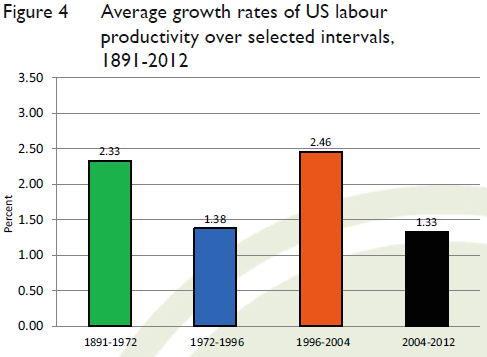
My last post, “Why Economic Growth is Slowing Down,” reports on the work of the economist Robert Gordon in his book “The Rise and Fall of American Growth.”  Mr. Gordon makes a persuasive argument that the U.S. experienced an unusually strong economic growth spurt from 1870 – 1970 and that we simply cannot expect future GDP growth to replicate such a sustained streak in the future.
Capture0Furthermore, in addition to much slower productivity growth at the present time, we are also facing strong headwinds to growth such as rising inequality, poor educational outcomes, demographic challenges, a huge debt burden and social deterioration at the bottom of the income distribution.
All of this together represents a severe double whammy holding back future economic progress in the U.S.  So what type of public policy response is called for?  Here are what I consider to be Mr. Gordon’s best ideas for simultaneously boosting productivity and combating the headwinds:

  • Toward greater equality of outcomes. Increase the minimum wage (state by state in my opinion), expand the Earned Income Tax Credit to able bodied adults without dependents, reform sentencing to keep more non-violent law breakers out of prison (which makes them unemployable, and therefore poor marriage prospects, upon release).
  • Towards greater equality of opportunity. Provide greater access to preschool education for all children growing up in low-income families. Allow college debt to be repaid as a percentage of taxable income after graduation. Reduce regressive regulatory measures such as occupational licensing.
  • Reducing Demographic Headwinds. Focus immigration reform on raising the average skill level of the working age population. This would include both blue-collar skills and college degrees.

I consider these types of reform to be relatively uncontroversial and therefore more easily doable through the political process. Other policy changes capable of speeding up growth such as broad-based tax reform (lowering tax rates paid for by shrinking deductions), major regulatory reform such as making the Affordable Care Act more flexible and the Dodd/Frank Act less restrictive, and approving the Trans Pacific Partnership to expand trade are all political hot potatoes and therefore will much harder to accomplish.

Follow me on Twitter: https://twitter.com/jack_heidel
Follow me on Facebook: https://www.facebook.com/jack.heidel.3
Why Economic Growth is Slowing Down


The two main themes on this website, “It Does Not Add Up,” are that the U.S. national debt is too high and that our economy is growing too slowly.  How can we shrink the debt (as a percentage of GDP) and how can we make the economy grow faster?  I make use of all sources of information which shed light on these two fundamental issues.
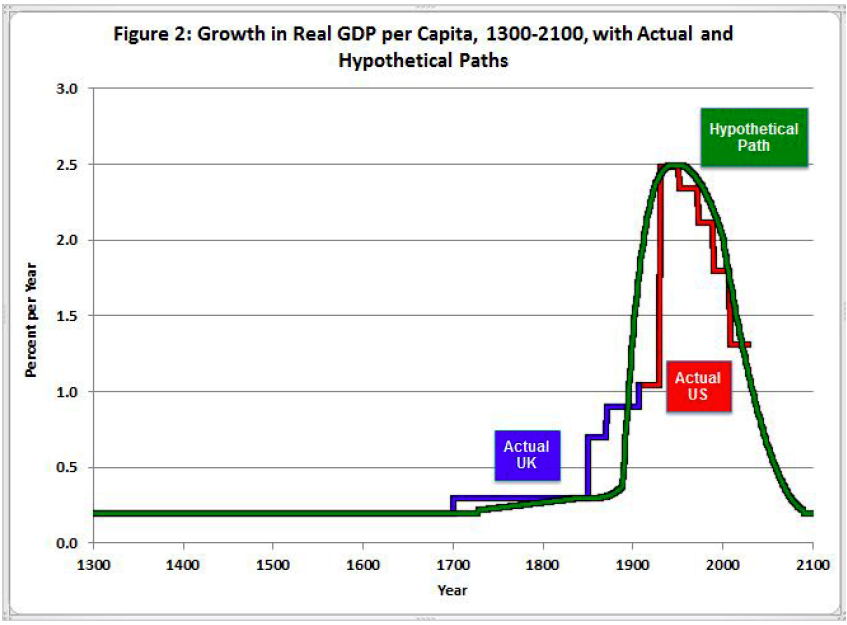
CaptureToday I briefly discuss the work of the Northwestern University Economist Robert Gordon, summarized in his new book, “The Rise and Fall of American Growth.”  His basic thesis, see the above chart, is that human civilization experienced essentially no economic growth up until about 1700, then slow growth occurred mainly in the UK and US up until about 1870 followed by explosive growth mainly in the US up until about 1970.  Since 1970 growth has slowed way down except for a brief spurt from 1994 – 2004.
According to Mr. Gordon, these growth periods were caused by Industrial Revolution #1 (steam, railroads), IR #2 (electricity, internal combustion, modern plumbing, communications, petroleum), and IR #3 (computers, internet, mobile phones), all of which led to productivity growth spurts which have by now largely run their course. Not only are we out of industrial revolutions but there are, in addition, stiff headwinds working against economic growth.  For example:

  • The First Headwind: Rising Inequality. Downward pressure on the wages of the bottom 90%. Increased inequality at the top. Educational outcomes strongly correlated with socio-economic status.
  • The Second Headwind: Education. Stagnation in high school graduation rates and poor performance on international tests measuring achievement. High debt levels for college graduates.
  • The Third Headwind: Demography. The labor participation rate has dropped form 66.0% in 2007 to 62.6% today, only half caused by baby boomer retirements.
  • The Fourth Headwind: Repaying debt. The public debt, on which interest is paid, is now 74% of GDP and is predicted by the CBO to steadily increase. This will inevitably lead to either higher taxes or slower growth in future transfer payments.
  • The Fifth Headwind: Social deterioration at the bottom of the income distribution. Increasing number of children are born out of wedlock for high school graduates and dropouts, much higher for blacks than for whites. For mothers aged 40, the percentage of children living with both biological parents declined from 94% in 1960 to 34% in 2010.
  • Other Headwinds. Globalization and Global warming.

Mr. Gordon makes a voluminous case for the slowing down of economic growth, the basic reasons why this is happening, and the social forces which are making it worse. Next: How should public policy respond to this huge challenge?

Follow me on Twitter: https://twitter.com/jack_heidel
Follow me on Facebook: https://www.facebook.com/jack.heidel.3


Health Care Spending is Driving Budget Deficits


In my last post, “Annual Deficits are Starting to go Back Up,” I refer to a new report from the Congressional Budget Office to show that it is the large annual increases in federal healthcare spending (Medicare, Medicaid, CHIP and Obamacare) which is the main driver of our annual deficit spending which is going to start increasing again unless we do something serious about it.
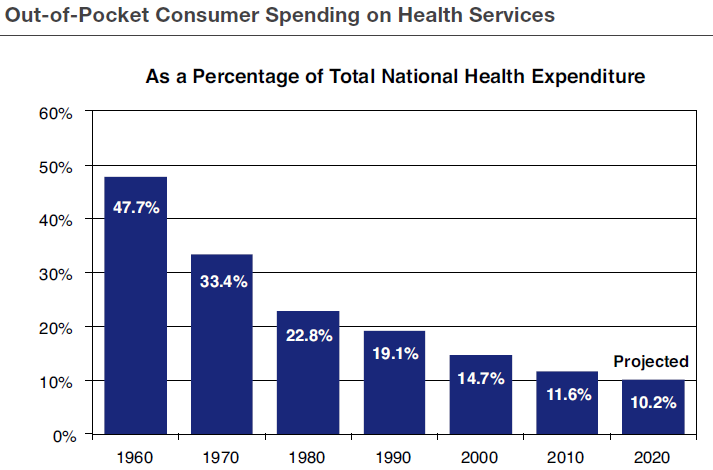
CaptureThe basic problem is, as shown by the above chart, that Americans, in general, don’t have enough skin in the healthcare game, i.e. we don’t pay enough of our health care expenses out of our own pockets, and therefore we don’t directly feel the pain of high and rapidly increasing health care costs.
A group of policy experts from the American Enterprise Institute have come up with a practical plan to address this problem.  Its elements are:

  • Retain employer provided coverage. This is how half of Americans get health insurance. The only change would be an upper limit on the tax preference for employer-paid premiums so that only the most expensive plans would exceed it.
  • Tax Credits. Individuals without employer coverage would get a tax credit with no strings attached to pick any state-approved plan that meets their needs.
  • Continuous coverage protection. As long as people stay insured, they cannot be denied enrollment based on health status.
  • Medicaid reform. The federal government would give states fixed, per-person payments based on historical spending patterns. Able bodied adult and their children could combine Medicaid and the (refundable) federal tax credit to enroll in a private insurance option.
  • Medicare reform. Medicare would provide a fixed level of assistance which seniors would use to purchase a health plan of their own choosing.
  • Expanded Health Savings Accounts. These are intended to be used with catastrophic insurance with a high deductible. HSAs could be established with a one-time $1000 tax credit and unused funds rolled over from one year to the next.

Such a system does not repeal, but rather improves the Affordable Care Act. It keeps the ACA exchanges and introduces cost controls in a flexible manner, i.e. without mandates.  It is the type of system the U.S. needs to get health care costs, and therefore overall deficit spending, under control.

Follow me on Twitter: https://twitter.com/jack_heidel
Follow me on Facebook: https://www.facebook.com/jack.heidel.3