What Lesson Does “The Big Short” Have for Us?


The newly released movie, “The Big Short” based on Michael Lewis’s book of the same name is a fascinating account of several investors who figured out that subprime mortgages would eventually turn bad and made billions of dollars by betting against them.
One of the main characters in The Big Short, the investor Michael Burry, could accurately predict when his credit default swaps would pay off.  Subprime mortgages started out with a low, fixed two-year “teaser” rate and then reset after two years to much higher floating interest rates.  Once the housing market peaked out in 2006 and started to turn down, it became virtually certain that many subprime mortgages would end up in default after the initial two year period because the holders of these mortgages would be unable to refinance in a falling market.
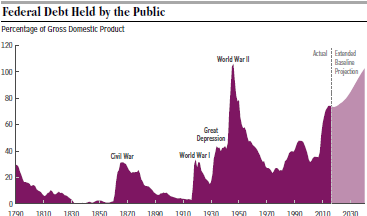
CaptureToday we have a very large debt bubble as illustrated in the above chart from the Congressional Budget Office.   Why is this so serious?

  • Right now our public debt (on which we pay interest) is “only” 74% of GDP but it is likely to keep getting worse in the coming years as clearly indicated by CBO. Congress has the ability to reduce deficit spending and shrink the debt but does it have the will to do so?
  • Right now our debt is almost “free” money because interest rates are so low. But this is already starting to change and we should assume that interest rates will eventually return to normal historical levels of about 5%. When this happens, interest payments on the debt will surge from about $250 billion per year at present to double or triple this amount. This will make our deficits and debt grow even faster.
  • The debt bubble is much more dangerous than the housing bubble from ten years ago because its bursting will affect the whole economy and not just one sector. It is unlikely that anyone will be able to pull a Michael Burry and predict the exact timing of the burst. But this doesn’t mean that no one will try. When China and Japan (our biggest foreign lenders) start shorting U.S. debt, it will serve to hasten the downfall of our whole financial system.

Conclusion. This is an intentionally scary scenario. Things don’t have to happen this way but it’s going to require an enormous effort to turn it around.  Are we capable of doing this?

Follow me on Twitter: https://twitter.com/jack_heidel
Follow me on Facebook: https://www.facebook.com/jack.heidel.3

Passing a Balanced Budget Amendment to the Constitution


My last three posts have discussed the long term damage that will be caused by excessive spending in the recently passed 2016 federal budget and what should be done about it.
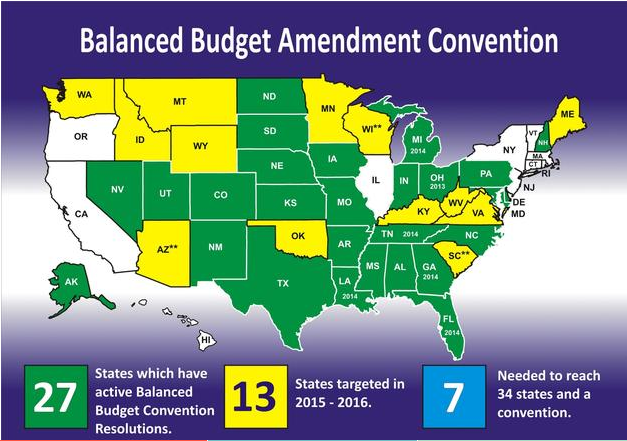
CaptureThere is at least one way to force Congress to act in a responsible manner, namely, by putting into effect a Balanced Budget Amendment to the Constitution.  Here is a brief history of recent efforts to do exactly this:

  • In the 1995-96 session of Congress, the House of Representatives passed (by a 2/3 vote) a BBA but it was defeated in the Senate by one vote.
  • Application by 34 states requires Congress to call a Constitutional Convention to propose an amendment. At the end of 2009, 16 states had so applied. Each year since one or more new states have also applied and now there are a total of 27. An additional 13 states are actively considering applications for a BBA at the present time.
  • As the number of applying states gets close to the required 34, it becomes more and more likely that Congress will act on its own in order to preempt a “Con-Con.” This would avoid the messiness and uncertainties of such a convention, none of which have yet occurred in our nation’s history.
  • Once 34 states have applied, however, Congress must call a convention. Any fear of a runaway convention, exceeding a limited mission, should be alleviated by the fact that any proposed amendment(s) have to be ratified by 38 states.
  • In my opinion a proposed amendment should have no restrictions on how a balanced budget will be obtained. There will be far more political pressure to cut spending than to raise taxes. Let Congress hash out the proportion of each.

Fiscal responsibility does not require the budget to be exactly balanced each year. In fact, temporary deficits can be useful as a stimulus in time of recession.  However, deficit spending has gotten so far out of control in recent years that Congress must be forced to modify its behavior.

Follow me on Twitter: https://twitter.com/jack_heidel
Follow me on Facebook: https://www.facebook.com/jack.heidel.3

We Need a Balanced Budget Amendment to the Constitution!


“The Congress, … , on the application of the legislatures of two thirds of the several states, shall call a convention for proposing amendments, which shall be valid to all intents and purposes, as part of this Constitution, when ratified by the legislatures of three fourths of the several states, or by conventions in three fourths thereof  …”
Article V, The U.S. Constitution

As I pointed out in my last post, under the current 2016 federal budget, just adopted by Congress and signed by the President, our public debt (on which we pay interest) is now projected by the Congressional Budget Office to increase from 74% of GDP today to 175% of GDP in 2040, just 25 years from now.
Of course, a new, and more severe, financial crisis is likely to occur long before we hit such a high level of debt but this serves to emphasize the extreme seriousness of our present situation and the need to address it without delay.
The best and simplest way to do this is for Congress to act on its own accord to pass balanced budgets.  In fact, the current Congress passed a multi-year budget plan last Spring which leads to a balanced budget in ten years, by 2025.  But the budget just passed last week for 2016 totally ignores this plan and actually increases the deficit for 2016 by $158 billion.
In other words, Congress on its own accord appears incapable of acting in a fiscally responsible manner.
Capture0As shown above, our founding fathers foresaw the possibility of congressional stalemate and provided for an alternative route to force Congress to act on critical issues.  As reported by the Balanced Budget Amendment Taskforce, 27 states have already called for a Constitutional Convention out of the 34 needed to force congressional action.
In my next post I will discuss in detail the ramifications of holding a constitutional convention, pro and con.
Merry Christmas!

Follow me on Twitter: https://twitter.com/jack_heidel
Follow me on Facebook: https://www.facebook.com/jack.heidel.3

The Just Approved 2016 Federal Budget II. A Long Term Disaster


I have been writing this blog, “It Does Not Add Up” for three years now.  It deals with fiscal and economic policy at the national level.  Of the many problems in this area, there is one which looms larger than all the others.  It is our out-of-control annual deficit spending which is in turn leading to a rapidly exploding national debt, now roughly $13 trillion or 74% of GDP.
Capture1My last post considers the details of the recently passed 2016 Federal Budget and how it will add $158 billion to the deficit in just 2016 alone.  The Committee for a Responsible Federal Budget estimates that the 10 year total in additional debt will be about $1.7 trillion.
As the above chart shows, such a huge additional debt in just ten years will lead to a total public debt in 2040 equal to 175% of GDP.  Such an enormous debt is obviously unsustainable and will almost surely lead to a new, and much worse, financial crisis long before the year 2040 arrives.
As the chart also shows, we need to be moving in exactly the opposite situation to keep our debt under any semblance of control.  Reducing deficit spending by $2 trillion over the next ten years would serve to “stabilize” the debt at 72% of GDP in 2025.
To actually end deficit spending, and therefore balance the budget, would require reducing the deficit by a total of $5 trillion over ten years.  This is exactly what the Republican Budget Resolution from Spring 2015 proposed to do.  Needless to say, this desirable goal has fallen by the wayside.
The Republicans are promising a fresh start and better process next year.  We can only hope that they are more successful in the new year.

Follow me on Twitter: https://twitter.com/jack_heidel
Follow me on Facebook: https://www.facebook.com/jack.heidel.3
Republican Congress Approves Irresponsible Budget


Congress has adjourned for Christmas having passed a final budget for the 2016 Fiscal Year extending through next September. It puts into place for this year the two year spending agreement reached between Congress and the President in October.  However Congress started out the year by passing a ten year budget plan resolution leading to a balanced budget by 2025.  The budget just passed leads instead to a deficit of $1.1 trillion in 2025.
CaptureHere are the details as described by the nonpartisan Committee for a Responsible Federal Budget:

  • Revenue: decreased under new budget by a $650 billion (over ten years) by making various temporary tax deductions permanent.
  • Discretionary Spending: increased by $50 billion for the current budget year (by breaking the sequester cap).
  • Medicare: instead of saving $430 billion over ten years, Medicare spending is increased by $95 billion over ten years.
  • 2025 Deficit: instead of shrinking to zero in ten years, it is now projected to be more than $1 trillion in 2025.
  • 2025 Debt: currently the (public, on which we pay interest) debt is 74% of GDP. The ten year balanced budget plan would reduce the debt to 56% of GDP. Instead, the debt is now on track to reach 80% of GDP by 2025.

Granted the Republican Congress hopes to develop a tax reform plan in 2016 which would lower tax rates for everyone, paid for by closing many of the loopholes and deductions just approved last week. One very good way to do this has recently been proposed by the Tax Foundation. The TF plan would boost economic growth and thereby increase tax revenue substantially over ten years.
The problem is that real tax reform is unlikely to happen without a Republican president in office.  If a Democratic president is elected in 2016, then the dire predictions made by the CRFB (above) are likely to remain valid for the foreseeable future. Our fiscal and economic future remains quite precarious at the present time!

Follow me on Twitter: https://twitter.com/jack_heidel
Follow me on Facebook: https://www.facebook.com/jack.heidel.3

Stopping Donald Trump II. Less Inequality or More Growth?


In my last post I presented the argument that voters are often more reasonable than the populist leaders who are trying to appeal to them.  They would rather hear something more optimistic than rage against a dangerous world.
Capture0But there is a difference of opinion on how to reach these voters:

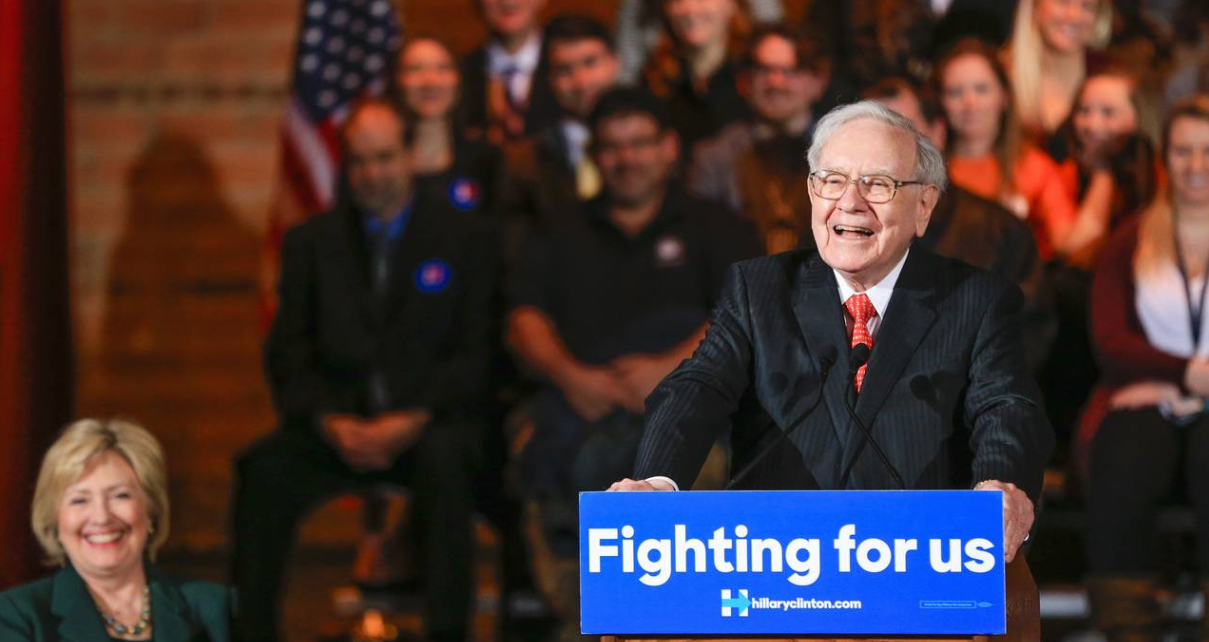
  • Leading Democratic presidential candidate Hillary Clinton endorses the Buffett Rule which calls for millionaires to pay a minimum tax of 30% on their income. Says Clinton, “I want to go even further because Warren is right. I want to be the president for the struggling, for the striving and the successful.”
  • All of the Republican presidential candidates, including Donald Trump, have tax reform plans which will grow the economy but none of which are revenue neutral. In other words, they will all add to annual deficits and therefore make our debt problem much worse than it already is.
  • The nonpartisan Tax Foundation has issued a new report, “Options for Broadening the U.S. Tax Base,” which proposes capping itemized deductions at $25,000 per individual combined with
    i)   cutting the corporate tax rate to 27%
    ii) cutting the top three ordinary income brackets by 5%, and
    iii) implementing a top capital gains tax rate of 20%.
    Such a plan would be revenue neutral and would lead to a long term GDP gain of 2.7%, a long term wage gain of 2.2% and a ten year dynamic revenue gain of $759 billion.

The Clinton plan would bring in up to $50 billion per year in new tax revenue but would do little to boost the economy. The Republican presidential tax plans are fiscally irresponsible. The Tax Foundation plan would boost the economy and reduce deficits rather than increase them.  Other specific reforms would boost the economy even more.
In other words there are clear cut ways to create more jobs and raise wages.  This is a message which should appeal to the angry and disaffected voters who are attracted to Donald Trump.

Follow me on Twitter: https://twitter.com/jack_heidel
Follow me on Facebook: https://www.facebook.com/jack.heidel.3
 

The Best Way to Stop Donald Trump


The main sources of background information for my posts are The New York Times and the Wall Street Journal. I read the Economist but most of the time it is either too esoteric or else too far  removed from the specifics of U.S. fiscal and economic policy which I am interested in.  But this week they have hit the nail on the head regarding Donald Trump and his fellow right-wing populists around the world.
Capture0
Says the Economist:

  • Populists differ but the bedrock for them all is economic and cultural insecurity. Stagnant wages hurt a cohort of older working-class white men whose jobs are threatened by globalization and technology. Jihadist terrorism pours petrol on this resentment and extends populism’s appeal.
  • Nobody should underestimate how hard it is to take the populists on. It is a huge mistake to dismiss their arguments by calling them fascist or extremist. Such disdain risks suggesting that political leaders are uninterested in the real grievances the populists play on.
  • The best way to overcome resentment is economic growth – not putting up walls. The best way to defeat Islamist terrorism is to enlist the help of Muslims – not to treat them as hostile.
  • Voters are often more reasonable than the populist leaders who are trying to appeal to them. Most of them would sooner hear something more optimistic than rage against a dangerous world.
  • Politicians also need to deal with the populists’ complaint that government often fails them. Reluctance to deploy more troops against the ISIS caliphate in Syria and Iraq does not appear to be a serious strategy to defeat it.

Conclusion: There is a clear path forward for candidates with a positive message of openness and tolerance and realistic plans to make the economy grow faster. Who is best situated to deliver such a message?  Stay tuned!

Follow me on Twitter: https://twitter.com/jack_heidel
Follow me on Facebook: https://www.facebook.com/jack.heidel.3
Lowering the Cost of American Healthcare III. Single Payer?


My last two posts, here and here, argue that the high costs of American healthcare, almost double what other developed countries pay per-capita, has two fundamental causes which must be addressed:

  • Very low out-of-pocket costs as a result of the tax exclusion for employer provided care.
  • The very expensive, and rapidly growing, government entitlement programs of Medicare and Medicaid.
    Capture4

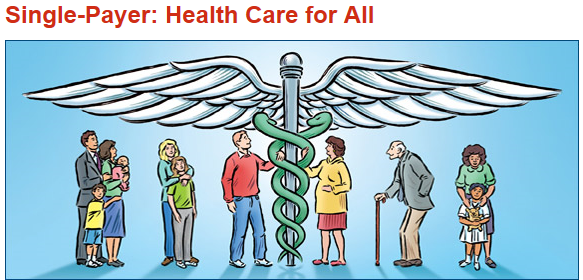
It is often suggested that the best way to get these high costs under control is for the U.S. to adopt a single-payer, government run, healthcare system, like many other developed nations have done. Writing in yesterday’s Wall Street Journal, the policy analyst, Nathan Nascimento, makes a persuasive, and well referenced, counter argument to this suggestion:

  • The State of Vermont recently backed away from implementing a single payer system because of the very high tax increase which would have been required, more than doubling Vermont’s annual budget.
  • The State of Colorado will vote a year from now on a petition-supported single payer proposal, ColoradoCare, which would be paid for by a $26 billion annual state tax increase and is therefore unlikely to pass.
  • In Canada, which has a single payer system, the average wait between a general practitioner’s referral and delivery of treatment was more than four months in 2013.
  • Our own Veterans Affairs hospital system, a single payer system on an annual budget, is failing thousands of veterans who often die while waiting for treatment.
  • Medicare, an open ended single payer entitlement system, now costing almost $600 billion per year, is one of the main causes of our burgeoning, out of control, national debt.

Conclusion: For the U.S. to move to a national single payer system would be very risky and very costly. It is far better to wait and see if Colorado or some other state is willing to take such a leap of faith and then see how it works out in that context.

Follow me on Twitter: https://twitter.com/jack_heidel
Follow me on Facebook: https://www.facebook.com/jack.heidel.3

Lowering the Cost of American Healthcare II. Entitlements


My last post emphsizes that any solution to our nation’s long term debt problem must include reining in the cost of American healthcare.  There are two major drivers to this problem as is made clear by a new report from the American Enterprise Institute, “Improving Health and Health Care: An Agenda for Reform.”
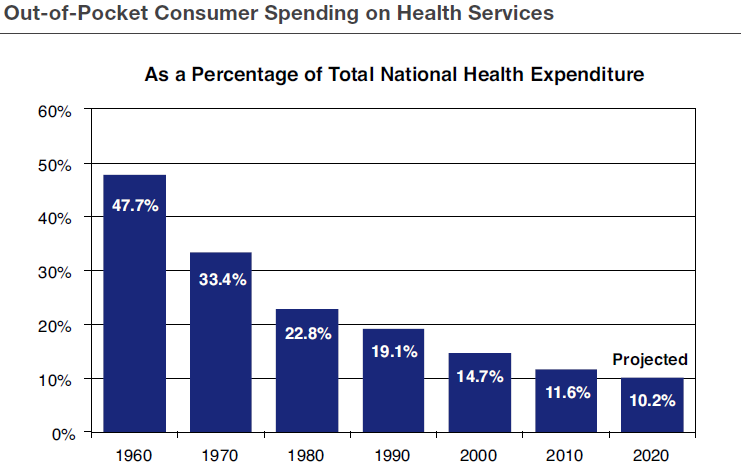
Capture1First of all, out-of-pocket consumer spending on healthcare has been steadily declining for many years. The less we pay directly for our own healthcare, the less incentive we have to control costs.
Capture2Secondly, the cost of healthcare entitlement spending, for Medicare and Medicaid , is growing rapidly as a percentage of GDP.  Such a rapid increase is unsustainable and must be curtailed. Here is what the AEI report recommends for doing this.

  • Medicaid. It serves two groups of people: 1) able bodied adults and their children and 2) the disabled and elderly. The federal government should make fixed, per-capita payments to the states based on historical spending patterns for these two groups. The able-bodied adults and children would get the same (refundable) federal tax credits as everyone else supplemented by Medicaid payments. The states would be totally responsible for the second group.
  • Medicare. The current system would be gradually migrated to a premium support system which would provide enough to pay for a choice of competing insurance options. The eligibility age would gradually rise to 67, consistent with Social Security.
    Capture3
  • Health Savings Accounts. HSAs are tax-preferred vehicles for saving for medical expenses until the (perhaps high) deductible amount is reached. Their use is growing rapidly. A one-time $1000 federal tax credit for establishing an HSA would increase their number even more. Their use should be expanded into Medicaid and Medicare as well.

Such reforms as these can significantly lower the cost of providing healthcare to the poor, the elderly and everyone else as well. If we don’t do something along these lines, we will eventually end up with a government run single payer system much to our detriment.


Follow me on Twitter: https://twitter.com/jack_heidel
Follow me on Facebook: https://www.facebook.com/jack.heidel.3


Lowering the Cost of American Healthcare


It is well understood that entitlement spending (Social Security, Medicare and Medicaid) is the biggest driver of our very serious long term debt problem.  Furthermore the high costs of Medicare and Medicaid can’t be separated from the high cost of American healthcare in general.  In other words, getting the cost of national health spending  under control is a fundamental fiscal and economic issue.
Capture1A major reason for this high cost is the tax exclusion of employer provided healthcare.  American out-of-pocket spending on healthcare is only 11% of the total as compared to 26% in Switzerland or 52% in Singapore, two examples of countries with efficient free-market systems.  Americans have little incentive to hold down the cost of their own care because it is mostly paid for by third party insurance companies.
The Affordable Care Act (aka Obamacare) expands access to healthcare but does nothing to control overall costs.  This means that any changes made to the ACA should be aimed at preserving access but making healthcare much more cost efficient.  This can be accomplished by

  • Keeping the Exchanges. The exchanges were set up to expand access for the uninsured and provide subsidies for those who couldn’t otherwise afford health insurance. This is the best feature of the ACA and should be retained.
  • Repealing the mandates for both individuals and employers. Mandates mean that benefits have to be strictly defined, uniform for all, and therefore more expensive. Employers are burdened by extra regulations which affect hiring and growth decisions.
  • Replacing the employer tax exclusion with a uniform tax credit for all. The credit would be about $2500 per person, the cost of high deductible catastrophic care. Employers could still provide insurance to employees but the tax deduction would be limited to the amount of the tax credit. The self-employed would get the same tax credit and it would also be refundable for those with low-incomes.

The American Enterprise Institute’s James Capretta describes how a transition could be made from the current ACA to such a new system.

Follow me on Twitter: https://twitter.com/jack_heidel
Follow me on Facebook: https://www.facebook.com/jack.heidel.3