Why I Support Jim Jenkins for the U.S. Senate from Nebraska


I have been writing this blog for almost two years because of my great concern about the direction our country is headed on fundamental fiscal and economic issues. Federal spending has been out of control for over thirty years and the situation is getting progressively worse.  Our national debt is over $17 trillion and growing at a rate of $500 billion per year.  And it will soon be growing much faster than this if we don’t make big changes.  Economic growth has been stuck at the anemic rate of 2.2% of GDP ever since the end of the Great Recession over five years ago.
Our national leaders are simply not doing the job they were elected for.  Democrats blame the Republicans and Republicans blame the Democrats but excuses are not good enough.  We need people in Washington who can figure out how to navigate within the system and actually find solutions to our very serious problems.

CaptureI believe that Jim Jenkins, a registered independent from Callaway, is the best qualified candidate to do what needs to be done.  Check out his website, Jenkins for Senate, and decide for yourself.  Here are a few of his views on important issues:

  • Fixing the Debt. Jim supports the recommendations of the Simpson-Bowles Commission which calls for dramatically cutting federal spending especially for entitlements and also raising taxes if necessary in order to drastically shrink our annual deficits.
  • Tax Reform. Jim supports lower tax rates achieved by eliminating many of the tax expenditures (credits, deductions and exclusions) embedded in the code. This is what is needed to boost economic growth.
  • Affordable Care Act. Jim believes that the ACA has many rough edges but that it is possible to fix them rather than repealing it and starting over.
  • Immigration Reform. Jim supports comprehensive immigration reform which includes securing our borders but at the same time expanding the number of guest worker visas to meet the needs of business and agriculture.
  • Veterans Administration. Jim supports setting up a plan to enable veterans to obtain medical care from health professionals within their own communities.

Compare these common sense views with the far more ideological positions of the other candidates in this race. I think that you will agree with me that Jim Jenkins is the person we want representing us in Washington!

Which Is More Important: Increasing Growth or Decreasing Inequality?


The progressive Global Strategy Group has recently released a new survey report “Focus on Growth to Frame Priorities” with a valuable message for all political candidates, left, right and center.
CaptureGSG surveyed 3000 registered voters earlier this year and discovered that they overwhelmingly rate economic growth as a higher priority than economic fairness, economic justice, expanding the middle class, increasing wages or decreasing income inequality.  In fact, economic growth trumped all of these alternative policy strategies by wide margins as shown below.
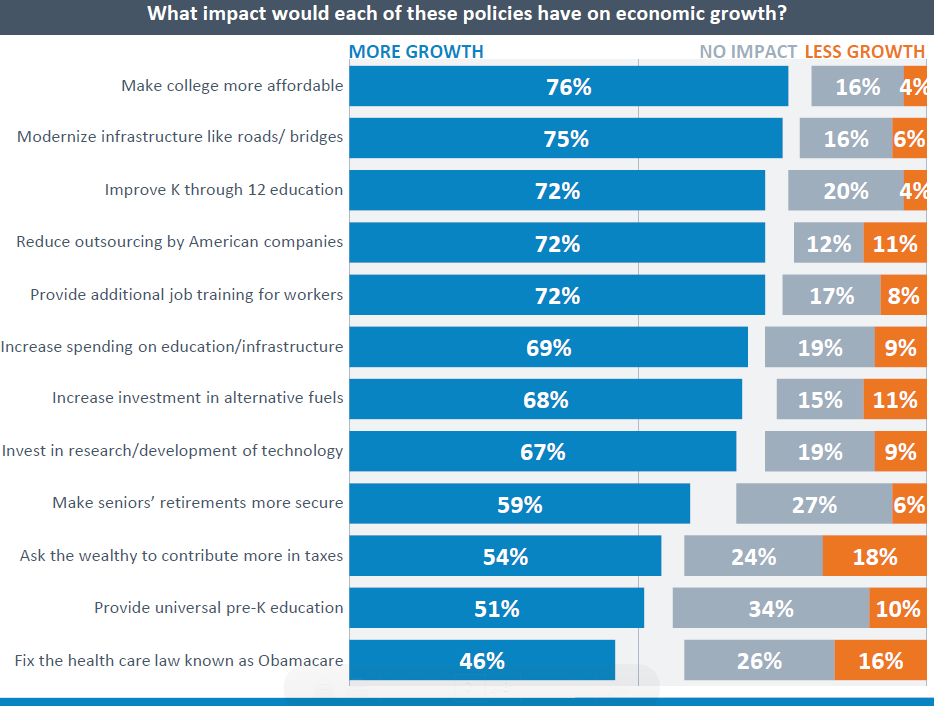
Capture1GSG then goes on to list various possible growth strategies in order of voter popularity such as making college more affordable, modernizing infrastructure, improving K-12 education and others (see below). This list of possible growth strategies is made up mostly of new spending programs.  The less costly might be doable by reforming existing spending programs.  But expensive new programs simply will not fly in today’s high deficit environment.
Capture2What is needed is a growth strategy which does not require new spending.  The obvious choice is tax reform.  For example, the fourth item in the above chart, reduce outsourcing by American companies, could be addressed by reforming corporate taxes.
But an even better growth strategy is individual tax reform whereby tax rates are lowered across the board, paid for by shrinking the many loopholes and deductions which primarily benefit the wealthy.
I described such a plan in detail in a previous post, but here is a brief summary: 64% of taxpayers do not itemize their deductions.  This means that any reduction in tax rates will put money in their pockets.  Since these are primarily the same middle- and lower-income workers with stagnant incomes, they will likely spend most of their increased pay, thus giving the economy a big boost.
In summary, the GSG report provides ammunition for political candidates of all ideological stripes.  Let’s have a contest to see which party can be the most pro-growth.  The winner will be the American people!

An Economy Doing Half Its Job


The Harvard Business School has just conducted its third alumni survey on U.S. competitiveness and finds “An Economy Doing Half Its Job.”  “Our report on the findings focuses on a troubling divergence in the American economy: large and midsize firms have rallied strongly from the Great Recession, and highly skilled individuals are prospering.  But middle- and working-class citizens are struggling, as are small businesses.  We argue that such a divergence is unsustainable.”
CaptureHighlights of the survey are:

  • Survey respondents were pessimistic on balance, although less so than in previous surveys. By a ratio of three to two, those who foresaw a decline in U.S. competitiveness in the next three years outnumbered those who predicted an improvement. Respondents were much more hopeful about the future competitive success of America’s firms than they were about the future pay of America’s workers.
  • Respondents saw weaknesses in those aspects of the U.S. business environment that drive the prospects of middle- and working-class citizens, for instance, the education system, the quality of workplace skills, and the effectiveness of the political system.
  • Alumni working in small businesses had more negative views of virtually every aspect of the U.S. business environment. This finding echoes growing evidence from other sources that small businesses are disadvantaged in America.

Capture1The authors of the report “see a need for business leaders to move toward strategic, collaborative efforts that make the average American productive enough to command higher wages even in competitive global labor markets.  Without such actions, the U.S. economy will continue to do only half its job, with many citizens struggling.” What’s interesting about this report is that it describes the problems of the American economy in a straightforward and practical way with no apparent ideological slant.  Of course, addressing these issues requires political action with all of its messy, partisan overtones. Nevertheless perhaps all parties can at least agree on what the basic problem is.

Three Cheers for Blue Cross Blue Shield Nebraska!


As I reported in my last post healthcare costs in the U.S. are expected to start climbing rapidly in next few years as the economy continues to recover and insurance coverage expands.
The Manhattan Institute’s Avik Roy has proposed a comprehensive new plan, ”Transforming Obamacare” to achieve, at the same time, both near-universal coverage and stringent cost control for healthcare.  Mr. Roy emphasizes the need to regulate hospital system consolidation which is especially responsible for driving up the cost of healthcare.
CaptureIn Omaha NE, where I live, there are three hospital systems: Catholic Health Initiatives, the Nebraska Medical Center and the Methodist Hospital System.  According to the insurance company, Blue Cross Blue Shield Nebraska (OWH 9/6/14), “CHI prices are 10 to 30 percent higher than for the Nebraska Medical Center and Methodist Hospital System.”  BCBS insists that CHI cut its prices.  As of September 1, CHI hospitals are out of network for BCBS and so patients who are insured by BCBS have to pay higher hospital rates.
“We are ready and willing to meet with them when they propose an agreement that gets serious about the cost issue,” said Lee Handke, a senior vice-president for Blue Cross Blue Shield.
Reports the OWH  “Blue Cross’ biggest customers are the region’s employers, whose 560,000 workers and family members supply 80% of Blue Cross’ revenue each year.  A big share of these people are CHI customers, too. … Blue Cross has told us (an insurance benefits broker) they understand that they might lose some business over this deal, but they feel that the point they have to make on the cost disparity is more important.”
For one hospital system to charge 30% more than two others for the same services is totally unacceptable.  It means that customers for the other two systems are paying higher insurance costs in order to subsidize the system with the higher prices.
In the Omaha market, Blue Cross has the clout and the will to force CHI to lower its prices.  But many other communities may not be as fortunate.

The High Cost of U.S. Health Care and What To Do About It


The United States spends 17.2% of GDP on healthcare costs, public and private, almost twice as much as any other developed country, and this percentage is gradually increasing.  In today’s New York Times there is a good discussion about these rising costs (see below).
Capture1My recent post, “Fixing Obamacare Rather Than Replacing It,” discusses a comprehensive new healthcare reform proposal by Avik Roy of the Manhattan Institute.  Mr. Roy’s plan both expands health insurance coverage beyond ACA levels as well as reining in the huge costs of healthcare. As Mr. Roy says “Among the industrialized member countries of the OECD, the average hospital stay cost $6,222 and lasted 7.7 days in 2009.  In the United States, the average hospital stay cost $18,142, despite lasting only 4.9 days.  In other words, the average daily cost of a hospital stay in the U.S. was 4.6 times the OECD average.”  Mr. Roy goes on to show that it is hospital system consolidation which is especially responsible for driving up the cost of health insurance.
CaptureThere is a clear example of this situation in Omaha NE where I live.  There are three hospital systems here: Catholic Health Initiatives, the Nebraska Health System and the Methodist Health System.  As stated by the CEO of Blue Cross and Blue Shield of Nebraska in the Omaha World Herald on August 28, 2014, “Our experience in addressing health care costs is precisely what led us to our current negotiations with Denver-based Catholic Health Initiatives.  CHI’s Alegent Creighton Health network of hospitals and physicians charges our members up to 30 percent more than other providers in Omaha for the same services. … These numbers reinforce a simple truth: We cannot allow one provider group to charge our members more for the same services they can receive elsewhere.”
We are fortunate in Omaha to have a choice of three different hospital systems and an insurance company with sufficient clout and integrity to fight price gouging by one of these systems.  But not every community is as fortunate as Omaha in this respect.  This is just one simple example of why cost control needs to be at the center of healthcare reform.

Why Medicare Needs to Be Reformed and How to Do It


My last post, “Fixing Obamacare Rather Than Repealing It,”presents a comprehensive new healthcare reform proposal by Avik Roy of the Manhattan Institute.  His plan has the ambitious goal of expanding health insurance coverage beyond ACA levels and at the same time achieving a huge deficit reduction compared with current CBO projections.
Capture1Mr. Roy points out, for example, that for all of Medicare’s huge cost, $635 billion in 2014 alone, it does not provide catastrophic coverage against long-term hospitalizations.  The supplemental insurance program, “Medigap,” accelerates Medicare’s wasteful spending by wiping out cost-sharing features such as co-pays and deductibles.  Medigap has proven hard to change because it generates huge royalty fees for the AARP, $458 million in 2011, for example.  For all of these reasons and others, Medicare needs big changes.
The core Medicare reform of Mr. Roy’s Universal Exchange Plan is to increase the eligibility age by four months per year forever, beginning in 2016.  This means that current seniors can stay in the existing Medicare program but that future retirees will remain in the universal state-based exchanges for an increasing period of time.  This is estimated to save $6.5 trillion over 30 years.
Additional features of the new Medicare program are:

  • Reduce Medicare subsidies for hospital’s uncollected bills saving $4 billion per year.
  • Exempt Medicare Part C and Part D from state and local taxes.
  • Combine Part A and Part B into a single insurance product saving $30 billion per year by reforming Medigap.
  • Introduce additional means-testing into Part D premiums.
  • Reduce waste, fraud and abuse systematically, saving approximately $50 billion per year.
  • Restore the ability of seniors to opt out of Medicare.
  • Restore the pre-ACA tax subsidy for employer-sponsored retiree coverage (to encourage more employers to sponsor retiree health benefits).
  • Address the physician shortage through additional medical education funding costing $6 billion per year.

Medicare spends 30% of its overall budget on end-of-life care (for the last six months of life).  The reforms suggested by Mr. Roy will allow it to operate much more efficiently and thereby put a greater focus on the end-of-life care which is its fundamental purpose.

Fixing Obamacare Rather Than Repealing It


The Manhattan Institute’s Avik Roy has just released a comprehensive and very impressive new study of the American healthcare system, “Transcending Obamacare: A Patient-Centered Plan for Near-Universal Coverage and Permanent Fiscal Solvency.”  By 2025 it will increase insurance coverage by 12.1 million above Affordable Care Act levels.  It will at the same time achieve a 30 year deficit reduction of $8 trillion compared to current CBO projections (see chart below).
CaptureMore specifically Mr. Roy’s new Universal Exchange Plan will

  • Expand coverage well above ACA levels without an individual mandate
  • Improve the quality of coverage and care for low-income Americans
  • Make all U.S. healthcare entitlement programs permanently solvent
  • Reduce the federal deficit without raising taxes
  • Reduce the cost of health insurance

The five core elements of Mr. Roy’s Plan are:

  • Exchange Reform. The ACA’s individual mandate is repealed. The Plan restores the primacy of state-based exchanges and insurance regulation. Insurers are encouraged to design policies of high quality tailored to individual need. By lowering the cost of insurance for younger and healthier individuals, the Plan will expand coverage without a mandate.
  • Employer-sponsored Insurance Reform. The employer mandate is repealed, thereby offering employers a wider range of options for subsidizing employees insurance.
  • Medicaid Reform. The Plan migrates the Medicaid acute-care population onto the reformed state-based exchanges with 100% federal funding. The Plan returns to the states full financial responsibility for the Medicaid long-term care population.
  • Medicare Reform. The Plan gradually raises the Medicare eligibility age by four months each year forever. The end result is to preserve Medicare for current retirees and to maintain future retirees on their exchange-based or employer sponsored health plans.
  • Other Reforms. The Plan tackles the growing problems of hospital system monopolies and malpractice litigation and also accelerates the pace of medical innovation by reforming the Food and Drug Administration.

These reform proposals are amazingly ambitious and far reaching in scope.  How can they possibly be achieved?  Stay tuned!

Another Voice for Abolishing the Corporate Income Tax: Sheila Bair


My last post “Real Tax Reform: Abolish the Corporate Income Tax,” gives six substantial reasons for abolishing the U.S. corporate income tax.  As shown in the table below, many American companies are keeping large percentages of their total cash balances overseas in order to avoid paying the very high U.S. corporate tax rate of 35% on these funds.
Capture1Sheila Bair, former chair of the Federal Deposit Insurance Corporation from 2006 – 2011, has recently endorsed the same idea in “Why Getting Rid of the Corporate Income Tax Makes Sense”.  Ms. Bair’s recent book, “Bull by the Horns,” is one of the best books written about the financial crisis.
Ms. Bair makes many of the same points as in my last post including the suggestion that in return for totally eliminating this tax, both dividends and capital gains should be taxed at the same (higher) rates as for ordinary earned income.  She points out that applying ordinary tax rates to realized investment income would make up only about $90 billion of the approximately $300 billion annual cost of eliminating the corporate tax.  She suggests that the remaining $210 billion could be raised by implementing Martin Feldstein’s proposal to cap individual tax deductions, excluding for charitable contributions, at 2% of adjusted gross income.
As she says, “We are on an unsustainable path.  Caught between eroding corporate revenue on one side and low tax rates for wealthy investors on the other, middle and upper-income wage earners are being squeezed – and there are only so many of us.  At some point we might start thinking about moving too.”
Keep in mind the fundamental reason for this proposal: to incentivize U.S. companies to bring their foreign earnings back home for reinvestment and distribution of profits to shareholders (who will then be taxed on this income).  This will give our economy the large and permanent boost which it so badly needs to regain its former vigor.

Real Tax Reform: Abolish the Corporate Income Tax


Several large U.S. corporations have recently announced that they are planning to move their headquarters to a low tax company such as Ireland or Great Britain, in order to reduce the high corporate taxes which they now have to pay. Many observers agree that the best way to address this problem is to lower the corporate tax rate down to an internationally competitive rate of about 20% to 25%.  Such a rate cut would be paid for by closing the loopholes and deductions which many corporations now enjoy.
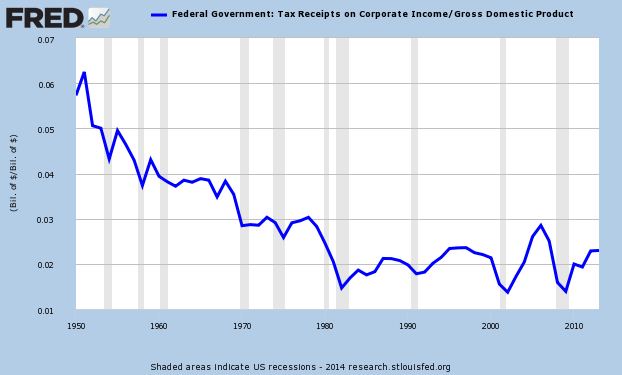
CaptureThe Business Insider reporter, Danny Vinik, makes a very good argument for going further and completely eliminating the corporate income tax for the following reasons:

  • Corporate taxes don’t collect that much revenue. As shown above the revenue from this tax has dropped to about 2% of GDP which is about $300 billion at the present time. This is roughly 10% of total annual federal tax revenue.
  • Tax capital gains and dividends at the same rate as earned income. This would make up for the lost revenue and is justified because there would no longer be double taxation of corporate earnings.
  • The corporate tax is not progressive. It is now paid for by both workers (with lower wages) and shareholders. Eliminating this tax (and replacing it with higher taxes on dividends and capital gains) makes the tax more progressive.
  • Corporations waste huge amounts of money trying to reduce their tax bill.  What they now spend on tax lawyers and lobbyists could be put to more productive use.
  • The current system disadvantages new businesses. It’s the old firms which have collected all the deductions. New firms start out paying the full 35% rate which puts them at a large competitive disadvantage.
  • It will make our financial system safer. Since debt payments are tax deductible and equity financing is not, debt financing is currently incentivized. The elimination of the corporate tax would end this preference of debt over equity.

Taking this action would not only have all of these benefits, it would make the U.S. the most desirable place in the world to locate a business.  We would experience a huge economic boom, creating millions of new jobs.  It would end our present economic funk and put us back on a rapid growth trajectory.   What are we waiting for!

Frustration Has Deep Economic Roots


My last two posts have dealt with the racial unrest in Ferguson MO and how American society should respond to the basic underlying causes.  In particular Omaha NE where I live is in the process of setting up a large scale pilot project in early childhood education to better prepare children from low-income families to succeed in school.
The St. Louis Post Dispatch had a recent article “Frustration in North County Has Deep Economic Roots” pointing out, for example, that unemployment for young black men in St. Louis is 47% compared to 16% for young white men.  Said the author, David Nicklaus, “If police tactics were the spark which set off the explosion in Ferguson this week, then poverty and hopelessness were the tinder.  Those in charge of the police can begin the healing process, but it won’t be complete unless we tackle the deeper economic issues too.”
CaptureThe Equality of Opportunity Project at Harvard University has published a chart (above) showing the degree of upward mobility for children born into low-income families in different parts of the country.  Omaha ranks much higher than St. Louis but not as high as it could.  The current unemployment rate in Omaha is 3.8% which essentially represents full employment.  This means that there are plenty of jobs available for well qualified applicants.
Capture1However the above chart shows the extent of the achievement gap in metro Omaha between middle class children and children living in poverty.  It is already substantial for fourth grade reading proficiency and becomes much worse in the higher grades. Conclusion:  in Omaha NE the root cause of lack of economic opportunity for racial minorities living in poverty is not the availability of jobs but the inadequate educational achievement to hold a good job.
Omaha is a prosperous community in a prosperous state.  But it could do a better job of educating children living in poverty.