The Need to Put Medicaid on a Budget

The GOP healthcare plan, both the House version and the Senate version, are highly imperfect. Yet they each do one thing which is badly needed. They put Medicaid on a budget. The current open-ended Medicaid program, whereby each state is reimbursed by the federal government for a percentage of its costs (the average is 53%), would be replaced by an annual per-capita payment which would increase only at the rate of inflation. It is estimated that the new per-capita budget would reduce federal Medicaid payments by about 25% after 10 years.


In order to get the federal debt under control, all three major entitlement programs, Social Security, Medicare and Medicaid, must be reined in and the current GOP plan would start doing this for Medicaid.
Reining in spending like this will force states to alter the way they regulate and administer Medicaid and the New York Times columnist Ron Lieber points out some of the challenges which will arise if Medicaid has to operate more efficiently:

Nursing homes. One third of people who turn 65 will eventually end up in a nursing home. Furthermore, 62% of nursing home residents cannot pay for nursing homes on their own. The average annual cost of a semi=private room is $82,000.
Home and community-based care. Medicaid is required to pay for nursing homes and may also pay for home and community-based care which is much less expensive and lets seniors stay in their own homes.
Optional services for low-income people and the disabled. Optional services besides long-term home care include dental care for adults, therapy for disabled children at school, prosthetic limbs and prescription drugs.

Conclusion. Changing Medicaid from open-ended funding to a strict federal budget which grows at the rate of inflation will put a large burden on state Medicaid administrators and require some difficult tradeoffs to control spending. But this is absolutely essential as a first step towards controlling the rapid increase of entitlement spending.

Follow me on Twitter:
Follow me on Facebook:

Can the GOP Produce on Healthcare?


The House of Representatives, after much struggle, was finally able to pass a healthcare bill, The American Health Care Act.  Now it’s the Senate’s turn to pass its own version and it, too, is turning out to be a struggle.


The healthcare policy expert, Avik Roy, considers the Senate bill to be a huge step forward:


  • Medicaid is finally put on a budget with annual increases in spending, starting in 2025, tied to the overall rate of inflation. In return, states will gain substantial latitude to use funds more effectively and efficiently.
  • Tax Credits in the Senate bill are means adjusted and will also encourage younger people to enroll for coverage. This is an improvement over the AHCA.
  • Expanded coverage. Mr. Roy predicts that passage of the Senate bill would increase (not decrease as the CBO predicts) the number of Americans with health insurance five years from now. This will result because the near poor in states like Texas and Florida, which have not expanded Medicaid, will be eligible for the new means-tested tax credits.
  • The 10th Amendment is strengthened because so much more authority for regulating healthcare insurance is transferred to the states. This represents huge progress because states are so much more fiscally responsible than the federal government (they have to balance their budgets)!


Conclusion. There are certainly many imperfections in the Senate bill.  It does nothing to limit tax credits for employer-sponsored insurance.  This is sorely needed to put the overall cost of American healthcare on a sustainable course.  It does nothing to help low income people who struggle with high deductibles (for example, by helping to set up Health Savings Accounts). It also does nothing to rein in the cost of Medicare, such as by introducing means adjusted premiums and allowing Medicare to negotiate lower drug prices.
Nevertheless it is a huge step forward in controlling excessive healthcare costs as well as expanding health insurance coverage to more Americans in a fiscally responsible way.

Follow me on Twitter: https://twitter.com/jack_heidel
Follow me on Facebook: https://www.facebook.com/jack.heidel.3


An Emerging Democratic Agenda


I am just as personally embarrassed by President Donald Trump as most other people I know. He is rude towards other world leaders and especially our own allies.  His destructive behavior endangers even his own policy initiatives.  He was elected by blue-collar workers who feel left behind in today’s global economy.  But how can he possibly lead others in implementing policies to help even his most avid supporters?


What is the Democratic Party doing about this?  First of all, they are trying to stop acting so elitist toward the working class.  But more fundamentally a new progressive social agenda apparently is emerging, here and here.  It has many attractive features but there is one big thing missing, namely fiscal responsibility:

  • A “public apprenticeship” jobs program. The idea here is to maintain the employment rate for prime-age workers without a bachelor’s degree at the 2000 level of 79%. This would require the creation of 4.4 million jobs, ideally at a living wage of $15 per hour plus Social Security and Medicare payroll taxes, and therefore at a wage of $36,000 per year. This would cost $158 billion per year.
  • A universal child allowance of $250 per month. This would cost $190 billion per year, although half could be offset by consolidating less-efficient existing programs. This would cut child poverty by 40%.
  • An expansion of the earned income tax credit. A family of four making $40,000 per year would get a tax credit of $6000 instead of the current credit of $2000. This would cost $1 trillion over ten years. The idea here is extra motivation to hold a job.


Conclusion. Who is opposed to creating millions of new living wage jobs to put the unemployed and underemployed back to work? Such a program would give our economy a huge boost.  Who is opposed to cutting child poverty in half (or doing even better)?  But how in the world would we make room for such new programs in the federal budget?  With $500 billion annual deficit spending already, we need to curtail federal spending, not increase it.

Follow me on Twitter 
Follow me on Facebook 

The Cost of Higher Education Is Not What Is Holding Us Back

It is well known that the cost of higher education is increasing much faster than inflation and even faster than the cost of healthcare. In turn, student debt is also rising rapidly and creating a financial burden for lots of young people.


The New York Times writer, David Leonhardt, has an article in Sunday’s paper showing that most states have reduced their funding of higher education since 2009, some quite dramatically.  This is not surprising since higher ed has to compete with K-12 education, Medicaid, prison operations, public employee pensions, etc. and states have to balance their budgets.  But it means that the cost of tuition will continue to rise even faster than usual.
However, except for a few specific fields such as computer programming, high school STEM teaching and nursing, there is no overall shortage of college graduates to keep our economy going.  In fact there is a surplus of college graduates in many non-technical areas.


But there is a growing labor shortage more generally, first of all for construction and agriculture workers which can be filled by unskilled immigrants.  Furthermore, there are now millions of job openings for middle skill workers which are going unfilled for lack of qualified applicants.  Training for such jobs as emergency medical technician, robot-heavy factory worker, and wind turbine technician is where states and localities should invest more public resources.
The huge demand for middle- and high-skill blue collar workers provides an opportunity to put laid-off middle-aged (Trump voting!) factory workers back to work in high paying middle class jobs.  A little ingenuity at the local and state level should be able to figure out how to do this.
Conclusion. A college education is not the only path to a productive and satisfying middle class life.  In fact U.S. economic growth is being held back by a lack of qualified middle- and high-skill workers.

Follow me on Twitter
Follow me on Facebook

Responsible Tax Reform II. The Trump Plan


Responsible tax reform will be highly beneficial for the U.S. economy because:

  • Economic growth will be speeded up by lowering tax rates on businesses, thereby encouraging more investment.
  • National debt will shrink because faster growth will produce more tax revenue. But this only works if the revised tax plan is revenue neutral to begin with.

The Trump tax plan, described here and here, has the following features:

  • three tax brackets, reduced from seven. Simplification like this is a good idea.
  • double the standard deduction. This puts more money in the pockets of the average tax payer who does not itemize deductions and is therefore a good idea.
  • repeal of the alternative minimum tax. This only affects wealthy people and should be retained, if necessary, to make sure that overall reform does not increase the deficit.
  • lower capital gains tax. This will encourage more investment but should not be included unless the overall plan is revenue neutral.
  • repeal of inheritance tax. This tax feature should be retained until our annual budget deficits are eliminated, i.e. until we achieve balanced budgets on an annual basis.
  • preserving deductions for mortgage interest and charitable contributions. The mortgage interest deduction should be greatly reduced from its current level of $1 million per residence. Wealthy taxpayers don’t need that much help. Raising the standard deduction will already help middle income taxpayers.
  • cutting the corporate tax rate. This is an excellent idea as long as its revenue loss is made up elsewhere. It will encourage multinational corporations to bring their overseas profits back home for reinvestment in the U.S.

Conclusion. The Trump tax plan has some good features as well as some poor ones. Reducing tax rates is a good idea.  But adding to annual deficits is a very bad idea.  With some effort it is possible to reduce tax rates in a revenue neutral way.

Follow me on Twitter
Follow me on Facebook

Trump’s Bark Is Worse than His Bite


The anti-Trump fervor seems to be slowly dying down as his appointees take hold of their agencies and begin to promulgate new policies. I have expected this to happen because of the excellent quality of many of the people he has appointed.
Here are a few recent developments:

  • Interior Secretary Ryan Zinke has said that “the border is complicated as far as building a physical wall” and there are all sorts of problems to be resolved before it can be done.
  • Reality is setting in with regard to Russia policy “given Russia’s continued provocations in terms of weapon’s deployments, overtures to Iran, cyber intrusions and intervention in Ukraine.”
  • The Brookings Institution has just issued a new report showing that school choice options are increasing in the country’s largest school districts. This indicates that Education Secretary Betsy DeVos is in the mainstream by supporting more choice.
  • Coal jobs Trump vows to save no longer exist.  In other words, cancelation of the Obama Clean Power Plan will have little effect on the huge drop in coal use because coal has become so much more expensive than natural gas.
  • Of course, the Trump 2018 Budget Proposal will be heavily modified by Congress but it does contain some good ideas. Agriculture, Foreign Aid and Community Development Block Grants are all ripe for big cuts.
  • The biggest unknown with respect to administrative action concerns trade policy. The question here is what concessions he can get from China and Mexico without starting a disastrous trade war.

What is mainly lacking at this point is any significant action by Congress on the Trump agenda. What will happen with healthcare reform, tax reform and deficit reduction, for example?

Conclusion. Trump is doing fine so far but it is on relatively straightforward issues under his control. Hopefully he will be able to make progress on the bigger issues as well which require working with Congress.

Follow me on Twitter
Follow me on Facebook


Maybe the GOP Really Is the Stupid Party


The Nobel prize-winning economist, Paul Krugman, more recently turned partisan flack for the New York Times, has occasionally referred to Republicans as “the stupid party.” After the debacle with the House’s American Health Care Act, maybe he is right.  This bill is far from perfect but is a step in the right direction.  Its major virtue is a serious attempt to get Medicaid spending under control.
According to an astute analysis by the Wall Street Journal:

  • The AHCA would put Medicaid on a budget for the first time since its creation in 1965.
  • Medicaid insures more than 72 million people, or one in every five Americans.
  • Medicaid is now the third largest, and fastest growing, program in the federal budget. Federal outlays are now $360 billion per year, more than three times as much as in 2000.
  • The federal government matches between 50% and 74% of state costs for Medicaid recipients, which means that the states have little incentive to control spending by allocating resources toward high quality care for the most vulnerable.
  • A 2013 study by the New England Journal of Medicine found that “Medicaid generated no significant health improvements,” compared to the uninsured.
  • The AHCA would transition federal funding to a per-capita block grant that would grow with an index of medical inflation. In exchange, governors would gain reform flexibility over the current rigid rules.

Conclusion. It is completely nonsensical for the House Freedom Caucus to oppose such an attractive reform plan just because it isn’t perfect. The members of the Freedom Caucus claim to be fiscal conservatives and to support balanced budgets.  And yet they refused to take a simple, practical step to work toward that goal.

Follow me on Twitter
Follow me on Facebook

What, if Anything, Will Restrain Donald Trump?


The Atlantic magazine has just released a remarkable essay written by the political commentator, David Frum, entitled, “How to Build an Autocracy.”  Says Mr. Frum, “Donald Trump will not set out to build an authoritarian state.  His immediate priority seems likely to be to use the presidency to enrich himself.  But as he does so, he will need to protect himself from legal risk.  Being Trump, he will also inevitably wish to inflict payback on his critics.  Construction of an apparatus of impunity and revenge will begin haphazardly and opportunistically.  But it will accelerate.  It will have to.”

capture99
Let’s assume that Mr. Frum is correct that Trump’s top priority is to enrich himself.  What will stop him from doing this?  A recent column in the New York Times points out that:

  •  54% of registered voters in congressional districts represented by Republicans view Mr. Trump favorably compared with only 42% who view him unfavorably.
    In these same districts, 87% of registered Republicans view Mr. Trump favorably.
  • In other words, the Republican dominated Congress is unlikely to strongly oppose his sleazy and self-enriching behavior.

But there are other constraints on what he does in office:

  • As I said in a recent post in order for Mr. Trump to be reelected in 2020, he will need to substantially speed up economic growth in order to increase the wages of his key blue-collar supporters. He clearly wants to accomplish this.
  • On the other hand, the conservative Republican base, including its representatives in the House such as the Freedom Caucus, will simply not support huge increases in deficit spending for anything (except an emergency) including infrastructure, the military or unfunded tax cuts.
  • In fact, Rep Mick Mulvaney (R, SC), a deficit hawk, has been nominated to become the Trump Administration’s Budget Director. In March the debt ceiling will have to be raised. I expect the many fiscal conservatives in Congress to insist on significant fiscal restraint (e.g. a ten year plan to balance the budget) as a tradeoff for raising the debt ceiling.

Conclusion. Just because Republicans are tolerant of Mr. Trump’s personal behavior does not mean he can successfully ignore the strong Republican desire for fiscal restraint.

Follow me on Twitter
Follow me on Facebook


Fixing Obamacare: Keep it Simple and Low Cost


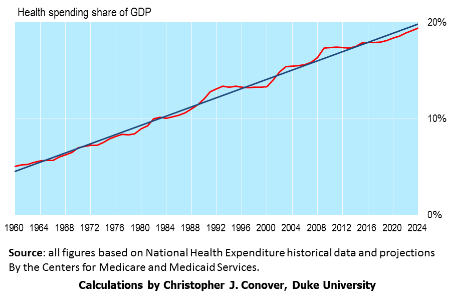
Straightening out healthcare insurance is a high priority for the new Trump Administration and Congress as it should be. The U.S. spends 18% of GDP on healthcare, public and private, twice as much as any other developed country and this percentage is likely to keep on increasing without major changes.

capture
Republican thought is converging, see here and here, on a plan with these broad features:

  • Repeal of both the individual and employer mandates so that health insurance can be individually tailored and purchased at a much lower cost than under the ACA.
  • A Universal (and refundable) tax credit sufficient to pay for catastrophic insurance coverage.
  • Health Savings Accounts to pay for routine healthcare expenses up to the deductible for catastrophic insurance. Such HSAs could be funded, at least initially, with (refundable) tax credits.
  • High risk pools and coverage for pre-existing conditions. It is estimated that 500,000 people with pre-existing conditions would need protection if the ACA is repealed. This would cost about $16 billion annually, much less than the full cost of the ACA.

Conclusion. Such a plan will insure coverage for all Americans who want it. The high deductibility feature, coupled with HSAs, will strongly encourage healthcare consumers to shop around for the best price on routine care.  Such price consciousness by consumers is the only way (short of a single payer system with severe rationing) to get our national healthcare costs under control.
A modification of such a plan, proposed by Senator Bill Cassidy (R, LA) and Senator Susan Collins (R, ME) would give each state the choice of either keeping the ACA or replacing it with a version of the above plan.  This is a poor idea because the ACA has no cost control and this is what is sorely needed.  In other words, the above plan should be made universal, identical for all states.  Let the states provide and pay for supplemental coverage if they wish.

Follow me on Twitter
Follow me on Facebook


On Evaluating President Trump: Put Substance over Style


In Sunday’s New York Times, the Ethics and Public Policy Center’s Peter Wehner wrote: “Donald Trump is a transgressive personality.  He thrives on creating disorder, in violating rules, in provoking outrage.  He is a shock jock.  . . . For Mr. Trump, nothing is sacred.  The truth is malleable, instrumental, subjective.  It is all about him.  It is always about him.”

capture97
I understand that he is a narcissist but I am paying as much attention to what he does as to what he says.  For example:

  • Economic Policy. A major focus of his campaign was to get the economy growing faster. His appointments so far will help in this regard. Mnuchin at Treasury is for tax reform and financial deregulation. Price at HHS is for healthcare deregulation. Pruitt at EPA is for loosening environmental rules. He may try to negotiate modifications to NAFTA but he is too smart to start a trade war which would be devastating to the overall economy. His best hope for being re-elected in 2020 is to create more jobs and better paying jobs for his fervent blue-collar supporters.
  • Education Policy. K-12 public education for minorities in many big inner cities is a disaster. Betsy DeVos is an education reform activist in Michigan. Shaking up the education establishment is a good idea.
  • Fiscal Policy. Our public debt is much too large and must be reduced, sooner rather than later, before we have a new fiscal crisis. This will be very difficult to do because it means modifying entitlements such as Social Security and Medicare which Mr. Trump has said he won’t do. The Republican House is adamant about shrinking the debt and it is hard to imagine Mr. Trump standing in the way. It will be fascinating to see how he finesses this critical issue.

Conclusion. Far from being a detriment to performing his presidential duties, Mr. Trump’s rhetorical skills could come in very handy in moving our nation forward.

Follow me on Twitter
Follow me on Facebook