The Reality of Today’s Healthcare: Cost Is Critical


My last two posts have been devoted to discussing the prospects for a true free-market healthcare system in the U.S.  Let’s bring this discussion down to earth with two specific examples.
CaptureIn Omaha NE, where I live, there are three major hospital systems and one of them, Catholic Health Initiatives, is 30% more expensive than the other two.  The major insurer, Blue Cross Blue Shield, has reacted by canceling its contract with CHI, making it out-of-network for Blue Cross policy holders.
As reported in today’s Omaha World Herald, “Non-CHI health clinics, hospitals handling influx,” the Nebraska Medical Center and Methodist Hospital System are seeing a large influx of Blue Cross insured patients.  This is exactly what has been expected to happen and will eventually put pressure on CHI to lower its prices in line with the other two hospital systems.
The second example, “Unable to Meet the Deductible or the Doctor” is the title of an article in yesterday’s New York Times.  The article reports that 7.3 million Americans are now enrolled in insurance coverage through the Affordable Care Act.  However the average deductible for a bronze plan on the exchange – the least expensive coverage – is $5,081 for an individual.  This compares to the average deductible of $1,217 for individual coverage in employer-sponsored plans.
Not surprisingly, relatively low-income people obtaining subsidized coverage through an exchange are likely to want a low cost policy.  But with a high deductible they will then be hard-pressed to have to pay the full price of routine care out of there possibly meager budgets.  This is going to be a larger and larger problem as more and more people obtain coverage through the exchanges.
Since all of an individual’s medical bills should go through the insurer for processing, insurance companies are in a position to, and should be expected to, help control costs by bargaining with providers to make sure that prices are not excessive.
Conclusion: here are two examples of price competition in today’s healthcare market place.  This is the reality that more and more Americans are going to have to learn to live with.  It is the only way that our excessive healthcare costs can be brought under control.

Colorado Was “Reckless to Legalize Marijuana”


So declared incumbent Colorado governor, John Hickenlooper, in a recent re-election campaign debate.  Many states have relaxed marijuana laws, such as for medical use or by decriminalization, and two states, Colorado and Washington, have legalized its recreational use.  Furthermore, public opinion at the national level is gradually swinging over in support of legalization (see below).
CaptureThe New York Times published five lengthy editorials on this subject last summer under the heading of “High Time,” taking the position that the health risks of marijuana use are minimal (except for adolescents) and that it should be left up to the states to decide on the issue of legalization.
But now a new study has just been published by an Australian researcher, Wayne Hall, “What has research over the past two decades revealed about the adverse health effects of recreational cannabis use?” in a highly rated journal, Addiction.  Its key findings are:

  • Driving while cannabis intoxicated doubles the risk of an accident; this risk substantially increases if users are also alcohol-intoxicated.
  • Cannabis use during pregnancy slightly reduces birth weight.
  • 1 in 10 cannabis users develop a dependence syndrome; 1 in 6 for adolescents.
  • Regular cannabis users double the risk of experiencing psychotic disorders.
  • Regular adolescent cannabis users have lower educational attainment.
  • Regular adolescent cannabis users are more likely to use other illicit drugs.
  • Regular cannabis smokers have a higher risk of developing chronic bronchitis.
  • Cannabis smoking in middle age increases the risk of myocardial infarction.

These adverse effects of marijuana use are serious.  My own opinion is that Colorado and Washington probably made a mistake by legalizing the recreational use of marijuana. At any rate, an experiment is now being conducted in these two states and in a few years we will know how it works out.  Other states should be reluctant to follow suit until then.  In the meantime, I support national legislation to decriminalize marijuana use but not to legalize it.
Drug use and misuse has huge economic ramifications and so it is very important to have a sensible and rational national policy on this issue.

Income Inequality and Rising Health-Care Costs


There seems to be a general consensus on the reality of increasing income inequality in the U.S. and even some agreement on its two main causes: globalization and the rapid spread of technology. The slow growth of the economy since the end of the recession has made the inequality problem that much worse.
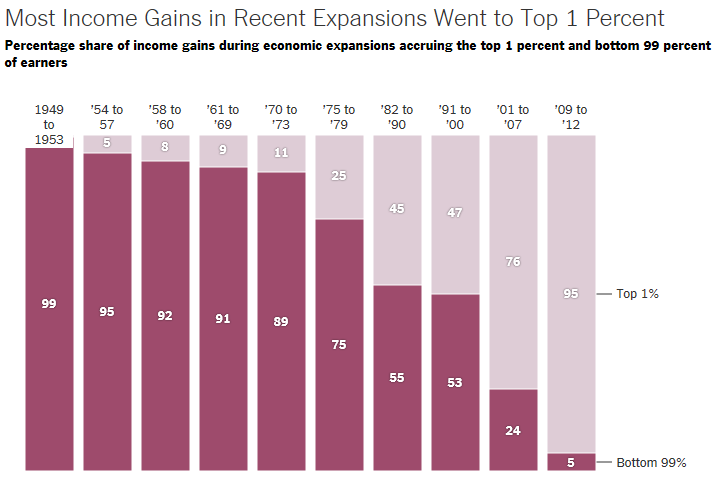
CaptureNot surprisingly, slow economic growth in the past five years has led to stagnant wages for many workers.  My last post addressed this problem.  The above chart from the New York Times shows that incomes for top wage earners have been rising in recent years while they have been stagnant for middle- and lower-income workers.
But there is more to it than this.  In yesterday’s Wall Street Journal, Mark Warshawsky and Andrew Biggs point out that, “Income Inequality and Rising Health-Care Costs,” in the years 1999 – 2006, total pay and benefits for low income workers rose by 41% while wages rose by only 28%, barely outpacing inflation.  For workers making $250,000 or more total compensation rose by a lesser 36% while wages grew by a greater 35%.  This apparent anomaly is explained by the fact that health insurance costs are relatively flat across all income categories, thus comprising a much larger percentage of the total pay package of low-income workers than for high-income workers.
Capture1In fact, the Kaiser Foundation has shown that low-wage workers tend to pay higher health insurance premiums, as well as receiving lower insurance benefits, than higher paid workers (see the above chart).
Overall, what this means is that employer provided healthcare is taking a huge chunk out of the earnings of low-income workers which makes income inequality much worse than it would be otherwise. Of course, the cost of healthcare is a huge burden for the entire U.S. economy, currently eating up 17.3% of GDP, twice as much as for any other developed country.
For both of these reasons it is an urgent matter for the U.S. to get healthcare costs under control.  Avik Roy of the Manhattan Institute has an excellent plan to do just this as I have discussed in several recent posts.

Economic Expansion Is Not Enough


The Washington Post reporter Robert Samuelson gives our economy today a B-, because the unemployment rate has inched down to 6.1%, fulltime employment is up to 105.8 million in 2013 from 99.5 million in 2010, and full-time women’s pay reached a high of 78% of men’s pay in 2013.  The big negative, of course, is that median household income was $51,939 in 2013, down from $56,436 in 2007, just before the financial crisis.
The Bard College economist Pavlina Tcherneva, as summarized by the reporter Neil Irwin in yesterday’s New York Times, shows what has gone wrong with economic and monetary policy since the end of the Great Recession in June 2009. The American Recovery and Reinvestment Act of 2009 (an $850 billion stimulus package) did boost the economy but it primarily aided “the skilled, employable, highly educated, and relatively highly-paid wage and salary workers.”
Capture2On the other hand the Federal Reserve’s quantitative easing policies have kept interest rates remarkably low and have thereby caused investors to buy stocks rather than bonds in order to get higher returns.  This has artificially boosted stock prices and has been especially advantageous to the top 10% and, even more so, the top 1%.
CaptureWhat is needed, according to Ms. Tcherneva, is a targeted, bottom-up approach to fiscal policy, which provides more and better paying jobs directly to middle- and lower-income wage earners.  Her suggestion is for public works jobs, public service employment, green jobs, etc., all of which would require large infusions of federal money thereby worsening the federal deficit.
A much better approach would be broad based tax reform, lowering tax rates across the board, paid for by closing the loopholes and deductions which primarily benefit the rich.  Since the 64% of taxpayers who do not itemize deductions would receive an effective pay boost, this would amount to a tax reform program targeted to exactly the middle- and low-income wage earners who have not yet recovered from the recession.  These folks would most likely spend their extra income, thus further boosting the economy (see my previous post).

What Happens When We All Live to 100?


This is the title of an article in the current issue of Atlantic. Of course, it is a rhetorical question, but it raises a very serious issue.  There are 43 million Americans age 65 or older today and this number is expected to reach 108 million by 2050.  How will society cope with so many more senior citizens?
CaptureThis blog is concerned with the most critical fiscal and economic problems facing our country.  The biggest fiscal problem we have is how to pay for the three major entitlement programs: Social Security, Medicare and Medicaid.  Social Security can be shored up with small adjustments to either the benefits formula or by raising taxes a little bit.  Medicaid can be kept under control by block-granting the program to the states.  But Medicare is a much bigger problem.
Capture1The cost of healthcare, both public and private, is rising rapidly as shown in the above chart from the New York Times.  We badly need a new approach to control costs and Avik Roy from the Manhattan Institute has given us such a plan “Transcending Obamacare: A Patient-Centered Plan for Near-Universal Coverage and Permanent Fiscal Solvency.”
The problem is that, as Mr. Roy explains, “by creating a universal, single-payer health care program for every American over 65, regardless of financial or medical need, the drafters of Medicare made the program extremely difficult to reform.”  But now we have to reform it because the costs are becoming so huge.  How do we do it?
First of all, Mr. Roy’s plan keeps the exchanges created by the Affordable Care Act and turns them all into state-based exchanges.  It also eliminates both the individual and employer mandates, replacing these mandates with financial incentives.
Mr. Roy’s core Medicare reform is very simple.  The plan increases the Medicare eligibility age by four months each year.  The result is to preserve Medicare for current retirees, and to maintain future retirees – in the early years of their retirement – on their exchange-based or employer-sponsored health plans.  In other words, retirees will gradually be migrated to the same system, with the same level of subsidy, as for working people.
Everyone, workers and retirees alike, will be treated the same. Not only is this an eminently fair system, it insures that Medicare remains affordable, for both retirees and the whole country.

The High Cost of U.S. Health Care and What To Do About It


The United States spends 17.2% of GDP on healthcare costs, public and private, almost twice as much as any other developed country, and this percentage is gradually increasing.  In today’s New York Times there is a good discussion about these rising costs (see below).
Capture1My recent post, “Fixing Obamacare Rather Than Replacing It,” discusses a comprehensive new healthcare reform proposal by Avik Roy of the Manhattan Institute.  Mr. Roy’s plan both expands health insurance coverage beyond ACA levels as well as reining in the huge costs of healthcare. As Mr. Roy says “Among the industrialized member countries of the OECD, the average hospital stay cost $6,222 and lasted 7.7 days in 2009.  In the United States, the average hospital stay cost $18,142, despite lasting only 4.9 days.  In other words, the average daily cost of a hospital stay in the U.S. was 4.6 times the OECD average.”  Mr. Roy goes on to show that it is hospital system consolidation which is especially responsible for driving up the cost of health insurance.
CaptureThere is a clear example of this situation in Omaha NE where I live.  There are three hospital systems here: Catholic Health Initiatives, the Nebraska Health System and the Methodist Health System.  As stated by the CEO of Blue Cross and Blue Shield of Nebraska in the Omaha World Herald on August 28, 2014, “Our experience in addressing health care costs is precisely what led us to our current negotiations with Denver-based Catholic Health Initiatives.  CHI’s Alegent Creighton Health network of hospitals and physicians charges our members up to 30 percent more than other providers in Omaha for the same services. … These numbers reinforce a simple truth: We cannot allow one provider group to charge our members more for the same services they can receive elsewhere.”
We are fortunate in Omaha to have a choice of three different hospital systems and an insurance company with sufficient clout and integrity to fight price gouging by one of these systems.  But not every community is as fortunate as Omaha in this respect.  This is just one simple example of why cost control needs to be at the center of healthcare reform.

Five Sectors to Blame for Economic Weakness


Several of my recent blog posts have addressed various issues relating to our slow growing economy.  In particular I have proposed a simple way to speed up economic growth: namely, broad-based tax reform at both the individual and corporate levels.  The idea is to lower tax rates across the board, paid for by closing loopholes and shrinking deductions.  At the individual level this could have the effect of putting as much as $250 billion per year in the hands of the middle and lower income wage earners who will surely spend most of it, thereby giving the economy a big boost.  The U.S. corporate tax rate is not internationally competitive.
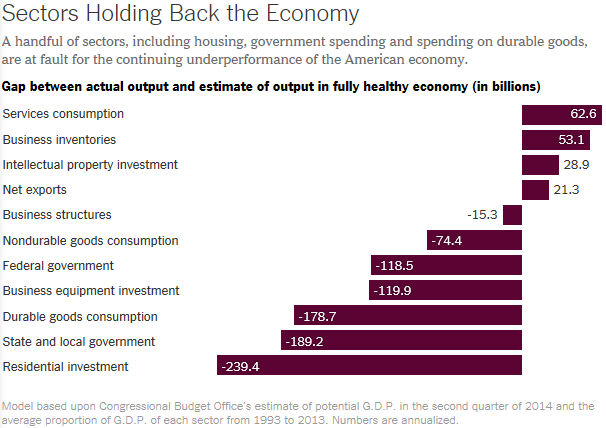
In today’s New York Times the economics writer, Neil Irwin, has an article “Why Is the Economy Still Weak?  Blame These Five Sectors.”  The five sectors are, in order of magnitude of effect: housing, state and local governments, durable goods consumption, business equipment investment, and federal government.  See the chart below.
CaptureLet’s look in turn at each of these top five barriers to faster economic growth:

  • Housing. Not at all surprising with 24 million people either unemployed or underemployed. Young people especially cannot afford to buy their first home today.
  • State and Local Governments. These governmental units have to balance their budgets. When people have more money to spend, tax revenues will increase and so will public spending.
  • Durable Goods Consumption. These same 24 million people aren’t buying much new furniture or many new cars either. It makes complete sense.
  • Business Equipment Investment.  Lower corporate tax rates will incentivize our multinational firms to bring their foreign profits back home for reinvestment.
  • Federal Government. Unfortunately nothing can be done about this category! Federal deficit spending is way too high as it is and must come down.

Conclusion:  Using broad-based tax reform to put a large amount of money in the hands of middle and lower-income wage earners, and also reforming corporate taxes, will boost spending for four of the five main barriers to faster economic growth.  Why don’t we do it?

How to Increase Growth and Decrease Inequality at the Same Time!


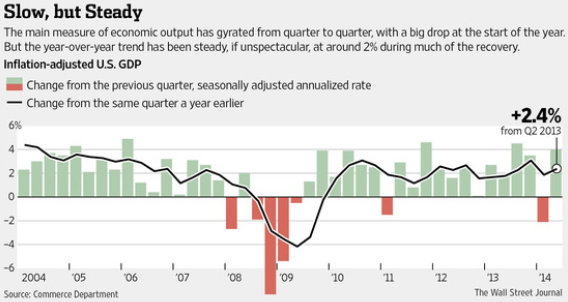
The Department of Commerce has just reported basic economic data for the second quarter of 2014.  As the chart below shows, the economy gradually lost steam from 2004 – 2008, sunk badly in 2008 and 2009, and has now grown at a slow but steady rate of about 2% during the period 2010 – 2014.
CaptureOne of my favorite journalists, the New York Times’ economics reporter Eduardo Porter, has just written again on the topic of inequality, “Income Inequality and the Ills behind It.”  He quotes the economist Tyler Cowen as saying “The right moral question is ‘are poor people rising to a higher standard of living?’  Inequality itself is the wrong thing to look at.  The real problem is slow growth.”  The economist Gregory Mankiw is quoted as saying that “Policies which address the symptom (of inequality) rather than the cause include higher taxes and a more generous safety net.  The magnitude of what we can plausibly do with these policy tools is small compared to the size of the growing income gap.”
What Mr. Cowen and Mr. Mankiw are both suggesting is that we can’t effectively attack income inequality without also increasing economic growth.  I believe that it is possible to address both problems at the same time by implementing broad-based tax reform as follows:

  • Individual income tax rates should be lowered across the board, paid for by closing loopholes and shrinking deductions, in a revenue neutral way.
  • The 64% of all taxpayers who do not itemize deductions will get a significant tax cut. Since they are largely the middle and lower-income wage earners with stagnant incomes, they will tend to spend their tax savings, thereby giving the economy a big boost.
  • At the same time the 36% of taxpayers who do itemize their deductions will, on average, see their income taxes go up. But these are, on the whole, the wealthier wage earners who can afford to pay higher taxes.
  • A plan such as this represents a shift of net after-tax income from more wealthy people to the less wealthy. It therefore reduces income inequality.

If we can cut tax rates, increase economic growth and reduce income inequality all at once, why can’t our national leaders come together and act along these lines?

The Truth behind the Latest Job Figures


Mortimer Zuckerman, writing a few days ago in the Wall Street Journal, “The Full-Time Scandal of Part-Time America,” points out that the latest employment figure of 288,000 net jobs created in June is highly misleading.  “Full-time jobs last month plunged by 523,000, according to the Bureau of Labor Statistics.  What has increased are part-time jobs.  They soared by about 800,000 to more than 28 million.” Mr. Zuckerman goes on to say, “Since 2007 the U.S. population has grown by 17.2 million, according to the Census Bureau, but we have 374,000 fewer jobs since a November 2007 peak and are 10 million jobs shy of where we should be.”
CaptureInterestingly, the New York Times discusses the same problem from a different point of view, ”A Push to Give Steadier Shifts To Part-Timers”.   The NYT does recognize that there are now about 7.5 million part-time workers who would prefer full time employment but are unable to find it.  But the emphasis is on giving them more advance notice for changes in work schedules.
The only way that we’ll get what we really need, more jobs, more good jobs and more fulltime jobs, is by faster economic growth beyond the anemic 2.2 average growth rate since the recession ended five years ago.  Here are several ways to accomplish this:

  • The most obvious and immediate thing we should do is to lower the corporate tax rate from its currently highest in the world level of 35%. This will stop the hemorrhaging of U.S. companies moving overseas and encourage multinational corporations to bring their profits home and reinvest them in the U.S.
  • Broad-based individual tax reform, with lower tax rates for all, offset by closing loopholes and shrinking deductions which primarily benefit the wealthy. This will put more money in the hands of the two thirds of Americans who do not itemize their tax deductions. Since these are the middle and lower income wage earners with stagnant incomes, they will spend their extra income thereby giving the economy a big boost.
  • The employer mandate in Obamacare is responsible for some of the shift from fulltime to part-time employment, and should be repealed (it has already been suspended for two years by the Obama Administration).

These are just common sense reforms which should be doable by Congress without a huge ideological fight.  We badly need leadership capable enough to do this!

Now Is the Time to Solve Our Illegal Immigration Problem!


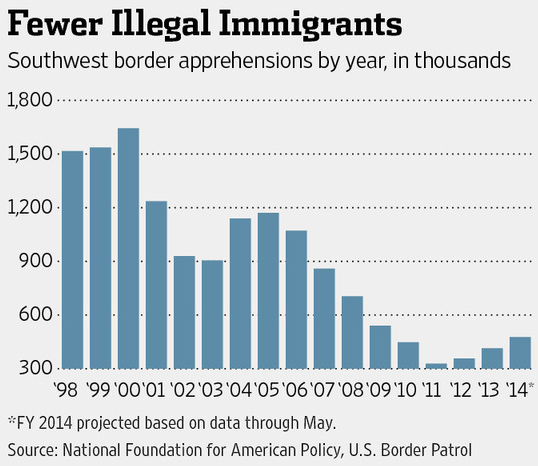
The sight of thousands of children from Central America sitting in camps at the U.S. border should knock some sense into those members of Congress who are dragging their feet on comprehensive immigration reform.  Overall, illegal border crossings are at their lowest level in many years (see chart below).  Now is the time to get things straightened out before the illegal traffic starts building up again.
CaptureWhen the New York Times, “The Border Crisis,” and the Wall Street Journal, “A Better Border Solution,” agree on an issue, I tend to agree with them.  Both newspapers say that the current crisis is the result of illegal immigrants in the U.S. trying to rescue their children from deplorable conditions back home.  If they had legal status they would go home themselves and bring their children back to the U.S. but they can’t risk doing this without a visa.
As I pointed out in a recent blog, “Immigration Reform Will Benefit Nebraska,” it shouldn’t be that hard to achieve a comprehensive solution as follows:

  • All businesses would compile a list of their current employees who are illegal. Everyone on this list, without a criminal record, would receive a guest worker visa as of a certain date. Visas would be transferable from one employer to another.
  • Companies would be authorized to hire additional foreign workers in their home countries who would then receive a guest worker visa to enter the U.S.
  • Once the system was set up and operational, all businesses would be required to periodically demonstrate the legal status of all workers.
  • Guest workers would be eligible to apply for citizenship after a relatively lengthy period of time.

America needs immigrant labor to do the hard low skilled physical work such as in agriculture, meatpacking, and construction, which most Americans don’t want to do.  An adequate guest worker system would virtually eliminate illegal immigration, thereby solving a huge current law enforcement problem.  It would also give the U.S. economy a big boost by providing all businesses with an adequate source of labor.
We have got to get beyond our hang-up about amnesty to solve this incredibly serious problem!