The President Plays Small Ball


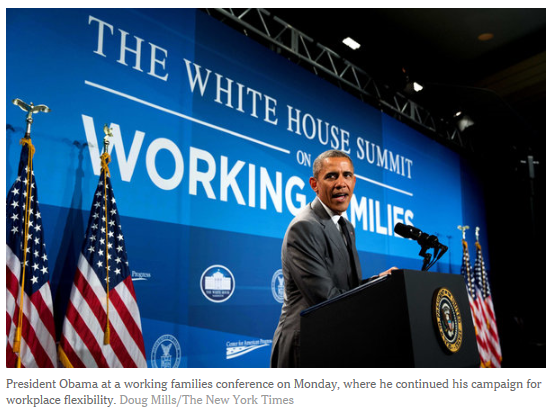
As reported in today’s New York Times, ”Personal Tack by Obama in an Effort to Aid Parents”, the President held an all-day conference yesterday for working families, saying that

  • “Family leave, child care, workplace flexibility, a decent wage – these are not frills – they are basic needs.”
  • “There is only one developed country in the world that does not offer paid maternity leave. And that is us. And that is not the list you want to be on by your lonesome.”
  • “We need you to tell Congress, don’t talk about how you support families: actually support families.”
Capture

The economic journalist, Robert Samuelson, pointed out in the Washington Post a few days ago, ”The Jobs Mystery”, that even though our unemployment rate has now dropped to 6.3%, there are still 9.8 million officially unemployed people, plus an additional 7 million who would like a job but are not looking.  There are also 7.3 million part-time workers who would like longer hours.  This gives a really quite shocking total of 24.1 million unemployed or underemployed workers.
Granted we had a bad recession which was not the President’s fault, but it ended in June 2009, a full five years ago.  In the meantime his administration has done much to retard economic growth (passing ObamaCare and the Dodd-Frank Act) and little, besides huge deficit spending, to boost it.  He and the Democratic Party should be held responsible for this neglect and they probably will be.
One thing which would do a lot to boost economic growth is apparently contrary to liberal ideology and therefore off the discussion table.  I am referring to fundamental, broad-based tax reform whereby individual tax rates would be lowered across the board, but in a revenue neutral manner, by closing or greatly shrinking the loopholes and deductions which primarily benefit the wealthy.  The two-thirds of Americans who do not itemize their tax deductions would get a big boost in take home pay.  Since they are primarily middle and lower income workers whose wages have been stagnant since the recession began, they will tend to spend this extra income, thereby giving the economy a big boost.
If the President were to sincerely ask the House Republican leadership to work with the Democratic Party to boost economic growth, something along this line could be acted upon.  This is the way to really aid families.  Why doesn’t he do it?
A Balanced and Sensible Anti-Poverty Program


The American Enterprise Institute’s Robert Doar recently testified before the U.S. Senate Committee on the Budget with ”Back to Work: How to improve the prospects of low-income Americans”.  His recommendations are based on the four principles:

  • Work requirements as a condition of public assistance.  The work first approach has been shown to have better outcomes with regard to attachment to the labor force than even approaches which focus on training and education.
  • Robust work supports for those who are working at low wages.  The Earned Income Tax Credit accomplishes this and should be extended to childless adults.
  • Business growth and investment.  Policies that raise the cost of doing business and deter growth do little to create what the poor need most: jobs.
  • Foster married, two-parent families.  We need to mitigate marriage penalties in public assistance programs and we need to be honest about the consequences for children of single parenthood.

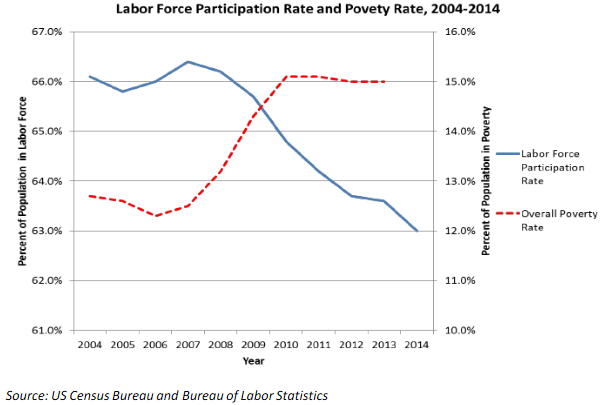
Mr. Doar points out that 10.2 million American’s are unemployed at the present time, 3.6 million have been jobless for more than 27 weeks, 7.3 million are involuntarily working part-time and 837,000 workers are so discouraged that they have stopped looking for work.  Labor force participation has dropped from over 66% in 2007 to 63% today while the poverty rate has risen from 12.5% to 15%.
CaptureRaising the minimum wage will not help the job prospects of most poor Americans.  Only 11.3% of individuals who would benefit from raising the minimum wage are living below the poverty line.  The Congressional Budget Office estimates that raising the minimum wage to $10.10 per hour would lead to 500,000 people losing their jobs.  CBO also estimates that the Affordable Care Act will reduce full-time employment by 2.3 million by 2021.  Given the strong anti-correlation (see the above chart) between labor participation and poverty, this means that the poverty rate may go higher yet.
The conclusion to draw from this excellent poverty synopsis (with lots of references) is that there are intelligent and effective ways to fight poverty and also much poorer ways to try to do it.  Good intentions are not enough!

The Economic Effect of ObamaCare

Last week’s report from the Congressional Budget Office “The Economic Outlook: 2014 – 2024” (which I discussed in my last post) caused a big stir with its prediction that ObamaCare will cause a loss of 2,000,000 mostly low wage jobs by 2017 and 2,500,000 such jobs by 2024.  The lost jobs aren’t necessarily from workers being fired or fewer workers being hired but rather the overall decreased incentive for individuals to find work.  The CBO analysis is based on the research of the economist Casey Mulligan featured in yesterday’s Wall Street Journal as “The Economist Who Exposed ObamaCare”.
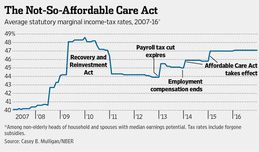
CaptureThe above chart of Mr. Mulligan interprets several recent government subsidy programs as a new marginal tax rate, i.e. the “extra taxes paid and government benefits foregone as a result of earning an extra dollar of income.”  The 2009 stimulus, the Recovery and Reinvestment Act, had an effect like this but it was temporary.  The marginal tax increase of the Affordable Care Act will last as long as it remains in effect.
Capture1The above chart from the same CBO report, showing the steady decline in the Labor Force Participation Rate from the year 2000 onward, demonstrates the critical nature of this problem.  Lower labor force participation means lower growth in overall labor productivity which in turn means slower economic growth.  Since the Great Recession ended in June 2009, GDP growth has averaged only about 2% annually.
Slow GDP growth means, in addition to a higher unemployment rate, that America’s standard of living will not increase very rapidly if at all.  But the problem is really much worse than this.  We have an enormous debt problem which is only getting worse every year that we continue to have large deficits.  The CBO report predicts increasing growth in the size of our national debt.  By far the least painful way of shrinking our debt (relative to the size of the economy) is to grow the economy as fast as we reasonably can.  But our economy is actually slowing down, not speeding up!
This is a very serious problem which many of our national leaders are much too complacent about!

Controlling the Cost of Healthcare

Capture

The New York Times is running a series of articles, “Paying Till It Hurts,” giving many examples of the very high cost of healthcare in the U.S. today.  The latest article “As Hospital Prices Soar, A Single Stitch Tops $500”, focuses on the high cost of emergency room treatment around the country.
We spend 18% of GDP on healthcare, twice as much as any other country in the world.  It is specifically the cost of healthcare entitlements, Medicare and Medicaid, which is driving our huge deficits and rapidly growing national debt.  But to limit the cost of these entitlement programs, we first have to address the more fundamental problem: how to control the overall cost of healthcare in general.
Our current healthcare system, a combination of private insurance and government programs, is very inefficient. The basic problem is that the tax treatment of employer provided health insurance takes away the incentive for individuals to control the cost of their own care.   And Obamacare does not solve this problem, because it just extends the present system to more people, rather than revamping it.
There are essentially two different ways to transform our current healthcare system to make it far more efficient.  One way is to turn it into a single payer system, like what most of the rest of the world has.  This could be accomplished by simply expanding Medicare to everyone.  Costs would then be controlled by government regulation which would, of course, include rationing.  Given the unpopularity of Obamacare, with all of its mandates and uniform coverage requirements, it is unlikely that Americans would be happy with such a highly proscribed single payer system.
The alternative is to change over to a truly consumer based, market oriented system.  This could be accomplished by limiting the present tax exemption for employer provided insurance.  For example, the current system could be replaced by a (refundable) tax credit equal to the cost of catastrophic insurance (i.e. insurance with a very high deductible).  All other healthcare costs, whether paid for directly by consumers or through insurance, would be with after tax dollars.  Subsidies could be provided to lower income people through the Obamacare exchanges.  Once such a system is set up and running smoothly, it could fairly easily be extended to encompass Medicare and Medicaid.
Insurance companies selling catastrophic coverage would negotiate with hospitals and other healthcare providers to get the lowest possible prices for their customers.  In other words, both insurance companies and providers would compete in the open market to deliver healthcare products at the lowest possible cost.
Something along this line will have to be done and the sooner we get started the better!

Why Is Obamacare So Unpopular? Because It’s Too Coercive!


The individual mandate for health insurance, upheld by the Supreme Court a year and a half ago, is now leading to millions of policy cancellations in the individual insurance market.  The mandate overrides any existing policy which does not provide minimum coverage.  The employer mandate, stipulating that any business with 50 or more employees must provide health insurance for all fulltime employees, has caused many businesses to replace fulltime employees with part-timers.
But these are not the only forms of coercion under Obamacare.  As reported in yesterday’s New York Times, “Court Confronts Religious Rights of Corporations”, the Supreme Court is expected to accept a case involving the Hobby Lobby’s refusal, on religious grounds, to pay for insurance coverage for the contraceptive coverage which is required to meet minimum standards.
It would be much better to replace all of these coercive mandates with economic incentives.  This could actually be done in such a way that would also make healthcare less expensive, thereby giving a big boost to our economy.  Here is one way to do this, as I discussed in my November 14, 2013 post:

  • Provide a flat and universal tax credit for health insurance coverage which applies to everyone and not just for employer provided healthcare.  The (refundable) credit would be roughly the amount necessary for catastrophic insurance coverage.
  • Convert Medicare and Medicaid into a means-based addition to this tax credit.
  • Everyone with continuous coverage (paid for by the tax credit) would be protected from price spikes or cancellations if they get sick.  This provides a strong incentive for everyone to buy and retain coverage.

It is entitlement spending which is driving our country’s fiscal crisis.  And healthcare programs such as Medicare and Medicaid make up a big part of entitlements.  In order to get these costs under control, we need to first get the cost of private healthcare under control.  The best way to do this is with economic incentives rather than coercive mandates.
Obamacare doesn’t need to be repealed.  It could just as well be modified and improved as described above.

Is Expanding The Social Safety Net Compatible With Fiscal Restraint?

Yesterday’s New York Times addresses this issue with an article “Ohio Governor Defies G.O.P. With Defense of Social Safety Net”.  It describes how Republican Governor John Kasich has maneuvered to expand Medicaid coverage in Ohio to 275,000 low income Ohioans under the new healthcare law, over the objections of his own Republican dominated state legislature.
Mr. Kasich is a former congressional deficit hawk and there is little doubt about his fiscal conservatism.  He recently balanced his state budget by cutting revenues to local government by $720 million.  But he has also expanded state aid for the mentally ill and supported efforts to raise local taxes for improving education.  He says “for those who live in the shadows of life, for those who are the least among us, I will not accept the fact that the most vulnerable in our state should be ignored.”
Especially after the disastrous debt ceiling debate, with Tea Party Republicans willing to default on our national debt in order to defund Obama Care, it is critical for fiscal conservatives to publicly demonstrate that they are not opposed to helping the poor in a reasonable manner, as long as it is cost effective.
To be in favor of controlling entitlement spending is not the same thing as wanting to abolish entitlement programs.  In fact, it is just the opposite.  We must control their costs so that the government will have the means to continue to support them.  It is just plain ordinary common sense.  If our national debt continues to grow unchecked, we risk not only entitlement programs but our entire way of life.
Take Medicaid as a concrete example.  Right now the federal government pays a percentage of the costs incurred by state governments in running the program.  The more a state spends for Medicaid, the greater the reimbursement from the federal government. This increases spending for both the states and the federal government.  A more cost effective approach is to give each state a block grant from the federal government and enough leeway to operate its own program as efficiently as it can.  Exactly this approach is being used in Rhode Island and is working very well at a much lower overall cost.
Being a fiscal conservative is not the same thing as being mean spirited!  The future of our country depends on getting this crucial message out far and wide!

When Will Young Obama Supporters Wake Up and See the Light?

Yesterday’s weekend interview in the Wall Street Journal with money manager Stanley Druckenmiller, “How Washington Really Redistributes Income”, vividly illustrates how disastrous Obama economic policy has been for the young people who form the core of his coalition.  “High unemployment is paired with exploding debt that they will have to finance whenever they eventually find jobs.”
“I thought that tying Obama Care to the debt ceiling was nutty”, says Mr. Druckenmiller. “I did not think it would be nutty to tie entitlements to the debt ceiling because there’s a massive long term problem.  And this president, despite what he says, has shown time and time again that he needs a gun at his head to negotiate in good faith.”
How about the “rat through the python” theory which holds that the fiscal disaster will only be temporary while the baby-boom generation moves through the benefit pipeline and then entitlement costs will become bearable.  Unfortunately for taxpayers, “the debt accumulates while the rat’s going through the python,” so that by the 2030’s the debt and its enormous interest payments become bigger problems than entitlements.  “That’s where Greece was when it hit the skids”, he says.
What is Mr. Druckenmiller’s solution?  Raise taxes on dividends and capital gains up to ordinary income rates and eliminate corporate taxes all together.  This is justified because it ends double taxation of corporate profits.  But, in addition, the people who run the corporations would be more incentivized to invest the profits in growth and expansion.  Ending corporate taxation also ends crony capitalism and corporate welfare.  All of this would be “very, very good for growth which is a good part of the solution to the debt problem long-term.  You can’t do it without growth.”
Bottom line:  we urgently need to rein in entitlement spending but we also need smarter policies to grow the economy faster.  Young people ought to be totally on board with all of this.  When will they wake up and see the light?

What Should the Republicans Do Now?


An editorial in yesterday’s Wall Street Journal, “A GOP Shutdown Strategy”, offers good advice to the House Republicans for how to proceed in the shutdown stalemate.  “ …the best chance to move Democrats is Louisiana Senator David Vitter’s amendment that would annul the exemption from Obama-Care that the White House carved out for Congressmen and their staff.  These professionals will receive special subsidies unavailable to everybody else on the insurance exchanges, and preserving this deeply unpopular privilege would be a brutal vote for Democrats.”
The House Republican Caucus should attempt to line up 218 votes to attach this provision to a continuing resolution to fund the government for all or part of the new fiscal year at the current level.  If 218 votes to support this approach cannot be found, then the House should pass a clean funding resolution.  Nothing else has a chance of succeeding (the idea of trying to defund Obama-Care for even one year is absurd) and the American people will grow increasingly impatient. 
The bigger issue by far is the need to raise the debt limit by October 17th at the latest.  Here the Republicans have major leverage, namely the sequester, which takes a bigger bite out of discretionary spending each year for nine more years.  The Republican House can give the Democratic Senate a choice:  either agree to a sensible long range plan for spending restraint (including entitlements), or else we’ll agree to raise the debt limit for six months or so, into early 2014, and then revisit the debt limit issue after the 2014 tighter sequester limits take effect. 
This is what I suggest.  Now we’ll wait and see what happens!

A Much Better Republican Strategy for Obama Care


On the eve of its implementation, the Affordable Care Act (aka Obama Care) is more unpopular than ever amongst the general public.  But the House Republican strategy of trying to defund the ACA as part of a continuing resolution to fund the government for the new fiscal year is a very poor idea.  It will never pass both houses of Congress and be signed by the President.  All it can possibly do is lead to a temporary shutdown of the government and therefore cause mass confusion.
The Wall Street Journal recently suggested a much more effective way for the House Republicans to proceed in “Carve-0uts for Congress”.  The legislation establishing the ACA contains a provision requiring all members of Congress and their staffs (11,000 people in all) to purchase their own health insurance on the new exchanges which are being set up to enroll uninsured Americans.  The idea behind this provision is to insure that members of Congress and their staffs and their families will obtain their insurance just like everyone else so that they will fully experience how healthcare reform actually works in practice.
But just a month ago the Administration personnel team issued a regulation exempting all Members and aides from the requirement to use the exchanges.  A recent poll taken by Independent Women’s Voice shows that 92% of likely voters, regardless of their views of the ACA, think that this exemption is unfair.
The implication is clear.  Republicans should show their dissatisfaction with the ACA by attaching the repeal of this exemption, which is contrary to law, as well as highly unpopular, to the continuing resolution to fund the government for the next fiscal year.  Let the Democratic Senate defend this exemption if it wants too.  It’s an opportunity for the House Republicans to do the right thing and also to stand with the “little guy” against the Washington elite.

Is the Cost of Health Care Under Control?


Today’s New York Times reports that “Health Care Costs Climb Moderately, Survey Says”.  The average annual insurance premium for a family rose 4% in 2013 compared with a 1.1% overall rate of inflation, according to the Kaiser Family Foundation which conducted the survey.  Since 1999 health insurance premiums have increased by almost 300% while consumer prices have increased by 40%.  As insurance premiums rise, deductibles are also getting bigger.  About 38% of all covered workers now face an annual deductible of $1000 or greater.  Dr. Drew Altman, CEO of the Kaiser Foundation, refers to this “quiet revolution” as an attempt by consumers to keep the cost of health insurance from rising even more quickly.
A 4% increase in insurance costs may seem moderate, but at almost four times the rate of inflation, it is really very large.  Obama Care is unlikely to have any impact in holding down such a rapid increase and, in fact, is likely to make matters worse because of massive new health care regulations which are coming.  The basic problem is that America spends 18% of GDP overall on health care, almost twice as much as any other country.
What can we do about this?  One major step would go a long way.  We need to remove the tax exemption from employer provided health insurance.  Employers could still provide health insurance for their employees, but the cost would be added to an employee’s salary for tax purposes.  This can be offset with a lower tax rate, of course.  But it would make employees, i.e. all consumers, far more conscious of the cost of healthcare and therefore to have a direct incentive to hold down these costs.  For example, Dr. Altman’s “quiet revolution” would pick up steam as employees raise deductibles even higher in order to lower overall costs.
How can we get going in this direction?  The Employer Mandate of Obama Care should be repealed, and not just postponed for a year.  Ideally, removing the tax exemption for employer provided health insurance would become part of the broad based tax reform which is so badly needed to stimulate the economy.
Our fiscal and economic problems can be addressed with smart leadership.  We should insist that our national leaders get going on such badly needed reforms!