Solving the Student Debt Problem


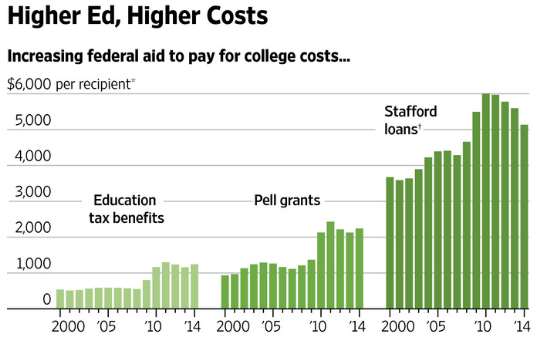
I have devoted several posts recently, herehere, and here, to discussing the rapidly increasing costs of higher education (see chart below) and the corresponding rapid rise of student debt.
Capture7Here are the basic facts:

  • There are too few college graduates in the U.S. At least ten OECD countries have a higher percentage of college graduates than we do.
  • America is graduating inequality. College degree attainment has increased between 1970 and 2011 for all income groups; however this is happening much more quickly for higher income groups.
  • Not all college degrees are created equal. Students at private, nonprofit institutions graduate at higher rates, and with lower debt, than students from public institutions who, in turn, graduate at higher rates and with lower debt, than students from for-profit institutions.
  • The Federal Reserve Bank of New York has found a close connection between subsidized loan and Pell Grant limits and the increase in college tuition costs.
  • The Federal Reserve Bank of St. Louis has found that “white and Asian college grads do much better than their counterparts without degrees, while college-grad Hispanics and blacks do much worse proportionately.”
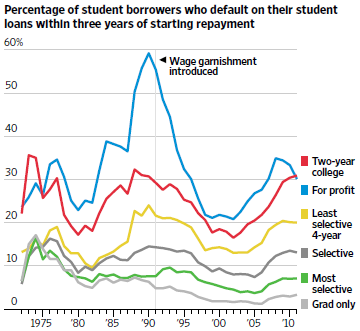
  • The percentage of student borrowers at for-profit as well as community colleges who default on their loans has greatly increased since the year 2000 (see below)
    Capture1In other words, our current federal student loan program is not only driving up college costs for everyone but is also creating a huge financial burden for the very low-income students who are most in need of financial aid to succeed in college.
    The way to respond to this is to put strict lids on the amount of subsidized loans available to both undergraduate and graduate students ($30,000 and $60,000 respectively) and, at the same time, use the savings achieved in doing this to increase the size of Pell Grants available for the lowest income students who need the most help.
    Conclusion: our high-tech society needs more college trained workers and we should especially encourage capable low-income young people to go to college. We could also do a much better job of targeting Pell grants instead of loans to this group of students.
The Pope, the United Nations and Global Poverty


This is a big week in the U.S. Pope Francis is coming here and the UN will convene a conference in NYC to endorse international development goals for the next 15 years. As I explained in a recent post, “The Dung of the Devil,” the Pope should pay more attention to the recent accomplishments of free enterprise in decreasing the amount of poverty and economic inequality around the world.
In an article just a few days ago in the Wall Street Journal, Bjorn Lomborg, the Director of the Copenhagen Consensus Center, explains that the U.N. is likely to endorse 169 targets for global investment for the next 15 years. Mr. Lomborg demonstrates with cost-benefit analysis that focusing on just 19 of these goals would accomplish far more than adopting everything on the U.N.’s much longer list.
Capture1Here are a few of Mr. Lomborg’s items:

  • Completing the World Trade Organization’s Doha agreement would return $2000 for every dollar spent to retrain and compensate displaced workers.
  • The elimination of fossil fuel subsidies would be worth $15 for every dollar spent in direct support of the very poor who are unable to afford higher fuel prices. By contrast, trying to drastically increase the production of renewable energy would return less than a dollar for every dollar spent because renewable forms of energy remain so expensive.
  • Tripling access to preschool in sub-Saharan Africa would have benefits worth more than $30 for every dollar spent because of improved future earnings. On the other hand, efforts to improve exams and teacher accountability are much harder to achieve and the benefits would only amount to $5 for every dollar spent.
  • Other actions: boosting agricultural yields, cutting indoor air pollution with clean cook stoves, increasing access to family planning, fighting malaria and combatting malnutrition are other examples where investment would lead to big dollar returns.

Conclusion: Free enterprise economics has done much in recent years to eliminate poverty and inequality around the world. Additional public and private investment, focusing on just a relatively few major goals, can accomplish even more.

Jeb Bush’s Tax Plan: Both Good and Bad


Republican presidential candidate Jeb Bush has just released his tax reform proposal, “My Tax Overhaul to Unleash 4% Growth.” It has many good features such as:

  • Lowering and consolidating seven current tax brackets into three: 10%, 25% and 28%.
  • Essentially doubling the standard deduction for most filers, thereby achieving huge simplification for millions of average income filers.
  • Eliminating the state and local income tax deductions and capping all others, except for charitable deductions, at 2% of Adjusted Gross Income.
  • Doubling the Earned Income Tax Credit for childless filers, thus encouraging more low income people to work.
  • Exempting taxpayers over the age of 67 from the employee-side payroll tax, encouraging them to stay in the workforce longer.
  • Cutting the corporate tax rate from 35% to 20%.
  • Allowing 100% immediate expensing for all capital investments, including inventories.
  • Creating a territorial tax system so that multinationals are not taxed on foreign earnings, and therefore incentivized to bring their foreign profits home.
  • Eliminating the deductibility of interest expenses.

The lower individual and corporate tax rates, together with the separate investment and work incentives, will create a significant economic stimulus estimated to raise GDP by at least .5% per year or higher, depending you who ask.
According to the Tax Foundation, however, the plan would reduce federal revenue on a static basis by $3.66 trillion over ten years, and even by $1.6 trillion on a dynamic basis, taking into account the new tax revenue generated by the plan.
CaptureThis is, of course, a huge problem. We badly need to speed up economic growth but we also need to lower, not increase, our annual deficit spending in order to put our debt on a downward path as a percentage of GDP.
The resolution of this quandary is to tighten up on those deductions, such as for mortgage interest, remaining in the code and also lessening the amount of the tax cuts if necessary in order to achieve overall revenue neutrality for the plan.

Needed: A New U.S. Foreign Policy


Wall Street Journal columnist Bret Stephens had a prescient article last November, “Yes, America Should Be the World’s Policeman” in which he said, “No great power can safely ignore chaos and disorder in key regions of the world. It is time for the U.S. to take a new approach – enforcing rules and standards but not trying to remake failed societies.”
CaptureAs illustrated in the photo just above from a recent soccer game, Germany is stepping forward and welcoming the masses of refugees now sweeping across Europe from the Middle East. But Germany’s generosity will just encourage yet many more refugees to attempt to escape from their failed societies.
The Hudson Institute’s Walter Russell Mead discusses “The Roots of the Migration Crisis” in yesterday’s WSJ. “The humanitarian question of refugees and asylum seekers cannot be separated from the bankruptcy of Western security policy in Syria and Libya, and the bankruptcy of Western security policy cannot be separated from the longstanding difficulties that many European states have in taking a responsible attitude toward questions of military security.”
“The utter failure of Western policy in both Libya and Syria has to be seen for what it is: not just a political blunder but a humanitarian crime.”
“It is impossible to have a humane and sustainable asylum policy without an active and engaged foreign policy that from time to time involves military action.”
“The dream of a liberal humanitarian peace that both the Obama administration and the EU share … certainly cannot be achieved with the kind of policies now in favor in capitals on both sides of the Atlantic.”
Or as Mr. Stephens said a year ago, “If the world’s leading liberal-democratic nation doesn’t assume its role as world policeman, the world’s rogues will try to fill the breach, often in league with one another.”
In other words, it is not just our own peaceful and prosperous way of life which is threatened by chaos in the Middle East, but our liberal-democratic values as well which are the foundation of progress for all of humanity.

The Slow Growth Economy We’re Stuck In


We have very high debt and Paul Krugman says in “Debt Is Good” that we need more! The Congressional Budget Office’s latest report this week, “An Update to the Budget and Economic Outlook: 2015 – 2025” predicts slow economic growth for the next ten years, averaging 2.1% per year (see chart below).
CaptureUnfortunately, high debt and slow growth are a deadly, self-reinforcing, combination. Today’s Wall Street Journal has a chart (pictured below) showing clearly how budget deficits are likely to increase over the next ten years. The public debt (on which we pay interest) is predicted to grow from 74% of GDP today to 77% of GDP in 2025, increasing by a total of $7 trillion over this time period.
Capture1Here is another connection between slow growth and high debt:

  • Slow Growth means higher than necessary unemployment and under-employment as well as minimal raises for employed workers. The resulting economic slack leads to
  • Low Inflation. But low inflation means that the Federal Reserve can maintain
  • Low Interest Rates to try to encourage more borrowing to stimulate the economy. This means, in turn, that Congress can run up huge deficits without having to pay much interest on this almost “free” money. This eventually leads to:
  • Massive Debt. But what happens when inflation does take off, which has happened before and is likely to happen again? Then the Federal Reserve is forced to raise interest rates quickly and we are stuck with huge interest payments on our accumulated debt. And meanwhile entitlement spending on Social Security, Medicare and Medicaid is also growing rapidly. At this point debt increases very rapidly which leads to a severe
  • Fiscal Crisis.

Of course things don’t have to happen like this. Congress might become more responsible and either cut spending and/or raise taxes and start shrinking our huge deficits. Or perhaps slow growth really is the new normal and interest rates will remain low indefinitely. But slow growth is not pain free; there are many millions of unemployed and under-employed Americans who want to work and whose lives are stunted otherwise.
Slow growth is a very destructive path to be following. We badly need to adopt policies to speed it up!

Higher Ed: Higher Costs, More Inequality. What to do?


Several months ago I discussed “How the American Education System Contributes to Inequality.” It so happens that students from high-income families graduate from college in much greater numbers and also with much less debt, compared with students from low-income families.
CaptureA new study from the New York Federal Reserve has found a connection between a rapid increase in student aid in recent years and the rapid increase in college costs. In particular:

  • A $1 increase in the subsidized loan cap leads to a tuition increase of 65 cents, and
  • A $1 increase in the Pell Grant limit leads to a tuition increase of 55 cents.
  • Furthermore, private schools, both nonprofit and for-profit, are bigger offenders than public schools, even though declining state subsidies for higher education primarily affect public universities.
  • At the present time undergraduates can borrow a maximum of $57,500 from the federal government.
  • Under the decade-old Grad Plus program, graduate students can borrow any amount their school charges. In the seven years before Grad Plus, undergraduate tuition was rising faster than grad school costs. In the seven years after, the reverse occurred.
    Capture1Clearly this is an untenable situation. The solution, in my opinion, is to strictly limit the total amount of federal loans for both undergraduate and graduate students and force schools to compete on price. For example:
  • Limit the total amount borrowable by an undergraduate, from the federal government, to $30,000, the average amount borrowed today, and then let it adjust it each year for inflation.
  • Limit the total amount borrowable by a graduate student to $60,000, the average amount borrowed today, adjustable each year by inflation.
  • Students who want to borrow additional funds may do so on the private market, with no subsidies or guarantees provided by the federal government.

Such a program would provide much needed financial discipline to colleges and universities and reduce and stabilize ballooning student loan costs for the federal government.

Can America’s “Fourth Revolution” Be Avoided?


My last post, “America’s Fourth Revolution,” presented a persuasive argument by the political scientist, James Piereson, that our currently dysfunctional political system will be unable to solve our most fundamental problems of massive debt, accompanied by a rapidly aging population and slowing economic growth. This will result, according to Mr. Piereson, in a severe crisis leading to a fourth revolution, overthrowing the New Deal liberal consensus which has prevailed since 1932.
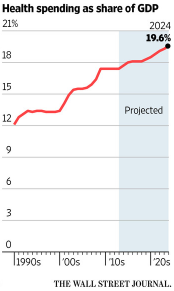
It is commonly understood that entitlement spending: Social Security, Medicare and Medicaid, is the main driver of our rapidly growing national debt. A recent report from the Centers for Medicare and Medicaid Services, summarized in the Wall Street Journal, shows that U.S. healthcare spending is likely to rise from just under 18% today to 19.6% of GDP in 2024.
Capture2Barron’s editor, Thomas Donlan, has just reported that the Director of the Congressional Budget Office, Keith Hall, stated in a recent hearing of the Senate Budget Committee that if spending for Medicare and Medicaid, as a percentage of GDP, fell by 25% over ten years, and then stayed in line with GDP after that, the U.S. would have a budget surplus of 2% of GDP in 2040 instead of the otherwise projected deficit of 6.6% of GDP. Furthermore debt held by the public would fall to 24% of GDP, a remarkable achievement.
This is significant because one country, The Netherlands, spends 12% of GDP on healthcare, and every other country in the world (except for the U.S.) spends less than 12%.
Conclusion: all the U.S. needs to do, so to speak, is to bring healthcare costs in line with the rest of the world and our entire deficit spending problem would be solved! Nobody is claiming that this will be easy but it certainly is within the realm of possibility. It is also far superior than waiting to act until we have another fiscal crisis and thus risking a huge change, a revolution, in our way of life.

Inequality and Growth


In my opinion the two most serious problems facing the U.S. at the present time are 1) stagnant growth and 2) massive debt. As discussed by William Galston in yesterday’s Wall Street Journal, the U.S. presidential campaign is now beginning to address the first of these issues.  For example:

  • Bernie Sanders rejects “growth for the sake of growth” and says that “our economic goals have to be redistributing a significant amount back from the top 1%.”
  • Hillary Clinton says that we have to build a “growth and fairness” economy. “We can’t create enough jobs and new businesses without more growth, and we can’t build strong families and support our consumer economy without more fairness.”
  • Jeb Bush argues that there is nothing wrong with household incomes that 4% growth wouldn’t solve.

The readers of this blog will have little difficulty figuring out where I stand on this continuum of economic values. My view is illustrated by the chart just below from the World Bank which shows that countries with the fastest growing economies also have the least amount of inequality.
CaptureLet’s be more specific. Mrs. Clinton would achieve more fairness by:

  • Raising the minimum wage.
  • Guaranteeing child care and other family friendly policies.
  • Encouraging profit sharing.
  • Encouraging more innovation by increasing public investment in infrastructure, broadband, energy and scientific research.

These are attractive goals but how do we achieve them? The best way to raise wages is to get the economy growing so much faster that it creates a labor shortage. Then businesses will be competing for labor and wages will go up. This is exactly what is happening in Omaha NE where I live and the unemployment rate is down to 2.9% (2.6% in Nebraska as a whole).
Furthermore, in a tight labor market, businesses will automatically try harder to keep good employees by providing extra benefits such as childcare and profit sharing.
Public investment in infrastructure, etc. will be more easily affordable with the higher tax revenue generated by a faster growing economy.
Conclusion: faster growth is the best way to create a more fair and equal society!

The Root of Greece’s Problem (and Ours)


Will it be the Euro or Drachma for Greece?  It’s down to the wire as Greece and the European Union negotiate the necessary conditions for Greece to remain in the Eurozone.  I have devoted several recent posts to the Greek fiscal crisis, pointing out the parallels between the Greek situation and our own.
Greece needs a bailout because its public debt is nearly 180% of GDP.  Our own public debt is “only” 74% of GDP at the present time but is predicted by the CBO to reach 175% of GDP by 2040, just 25 years from now.  Furthermore, Greece is currently receiving very favorable lending conditions from the European Central Bank, much better than are likely to apply in the U.S. in the long term.  This means we’re likely to have another deep crisis on our hands much sooner than 25 years from now.
CaptureConsider the data in the above charts from today’s Wall Street Journal.  It shows that Greece is spending 14.4% of GDP on pensions, more than any other major European country.  Furthermore, the efficiency of its VAT revenue collection is the poorest in the EU.  In other words, Greece has a very high rate of entitlement spending and has a poor tax collection system to support it.
Capture1In a general sense the U.S. is in a similar situation.  Today we spend about 13% of GDP on mandatory, i.e. entitlement, programs, compared to a total tax revenue level of 18% of GDP.  Just entitlement spending alone is projected to rise to 18% of GDP by 2050, unless changes are made.
Just as Greece needs to tighten up on pension spending, improve revenue collection and get its economy growing faster, the U.S. needs to tighten up on entitlement spending and speed up its stagnant economic growth as well.
We’re not yet as bad off as Greece is today.  But we’re headed in that direction with no one to bail us out when we get there!

Can the U.S. Economy Grow Faster?


The U.S. economy has grown at the rate of only 2.2% since the end of the Great Recession in June 2009.  This is much slower than the average rate of growth of 3% for the past fifty years.
CaptureThe economists Glenn Hubbard and Kevin Warsh, writing in the Wall Street Journal, “How the U.S. Can Return to 4% Growth,” point out that:

  • After the severe recession of 1973-1975, the economy grew at a 3.6% annual real rate during the 23 quarters that followed.
  • After the deep recession of 1981-1982, real GDP growth averaged 4.8% in the next 23 quarters.
  • Recent research has shown that steep recoveries typically follow financial crises.

The economist John Taylor, also writing in the WSJ, “A Recovery Waiting to Be Liberated,” explains that the growth of the economy, i.e. growth of GDP, equals employment growth plus productivity growth.  He then points out that:

  • Population is growing about 1% per year. However the labor-force participation rate has fallen every year of the recovery, from 66% in 2008 to 62.9% in 2014. Even turning this around slightly would increase employment growth above the 1% figure coming from population growth alone.
  • Although productivity growth has hovered around 1% for the past five years, this is less than half of the 2.5% average over the past 20 years.

Given the strong headwinds of globalization and ever new technology affecting the U.S. economy, we especially need new policies such as:

  • Fundamental tax reform directed at increasing the incentives for work and driving investment in productive assets.
  • Regulatory reform that balances economic benefits and costs (e.g. lightening the burdens of Obamacare and Dodd-Frank).
  • Trade agreements to break down barriers to open global markets.
  • Education policies to prepare all young people for productive careers.

In other words, rather than accepting our current situation as “the new normal” or as unalterable “secular stagnation,” we need to “give growth a chance”!