
Is a Balanced Budget Amendment Compatible with Economic Growth?


I have devoted several recent posts to discussing the desirability of a Balanced Budget Amendment to the U.S. Constitution as well as the specifics of how to set it up in an effective yet flexible manner.
CaptureThe Wall Street Journal’s Greg Ip has a pertinent article along this line in today’s paper, “Don’t Celebrate the End of Austerity” in which he argues that the recent congressional deal for the current 2016 budget year, which I and many others have criticized as being fiscally irresponsible, will finally contribute to economic growth after five years of overly “austere” budgets.
This raises the critical question: is it possible to speed up economic growth without the stimulus of deficit spending?  Would a BBA create a stranglehold on spending which would slow down the economy? I feel very strongly that fiscal responsibility and economic growth are compatible and, in fact, contribute to each other in the long run.  Here is what we should do:

  • First of all, either through Congressional action or with a Constitutional Convention, a BBA needs to be proposed, and then ratified, to put our fiscal house in order before our rapidly growing debt rises to ruinous levels. A flexible BBA would include a five year phase in period, after ratification, to give Congress time to prepare for it. There will be some pain in achieving this initial balance but it needs to be done and the sooner the better.
  • Secondly, a flexible BBA would also allow for a 2/3 majority of each House to override strict balance. This feature could be used not only for a wartime emergency, for example, but also for occasional recessionary periods where stimulus is needed.
  • Finally, keep in mind that the real goal is not a BBA per se, but rather to put our debt on a downward path over time as a percentage of GDP. This is what a flexible BBA will accomplish.

Once initial balance is achieved, it will be relatively easy to hold new debt down to manageable levels. Our current fiscal problem will then be largely solved and we can continue building a stronger, freer and more prosperous future for our country.

Follow me on Twitter: https://twitter.com/jack_heidel
Follow me on Facebook: https://www.facebook.com/jack.heidel.3

Republican Congress Approves Irresponsible Budget


Congress has adjourned for Christmas having passed a final budget for the 2016 Fiscal Year extending through next September. It puts into place for this year the two year spending agreement reached between Congress and the President in October.  However Congress started out the year by passing a ten year budget plan resolution leading to a balanced budget by 2025.  The budget just passed leads instead to a deficit of $1.1 trillion in 2025.
CaptureHere are the details as described by the nonpartisan Committee for a Responsible Federal Budget:

  • Revenue: decreased under new budget by a $650 billion (over ten years) by making various temporary tax deductions permanent.
  • Discretionary Spending: increased by $50 billion for the current budget year (by breaking the sequester cap).
  • Medicare: instead of saving $430 billion over ten years, Medicare spending is increased by $95 billion over ten years.
  • 2025 Deficit: instead of shrinking to zero in ten years, it is now projected to be more than $1 trillion in 2025.
  • 2025 Debt: currently the (public, on which we pay interest) debt is 74% of GDP. The ten year balanced budget plan would reduce the debt to 56% of GDP. Instead, the debt is now on track to reach 80% of GDP by 2025.

Granted the Republican Congress hopes to develop a tax reform plan in 2016 which would lower tax rates for everyone, paid for by closing many of the loopholes and deductions just approved last week. One very good way to do this has recently been proposed by the Tax Foundation. The TF plan would boost economic growth and thereby increase tax revenue substantially over ten years.
The problem is that real tax reform is unlikely to happen without a Republican president in office.  If a Democratic president is elected in 2016, then the dire predictions made by the CRFB (above) are likely to remain valid for the foreseeable future. Our fiscal and economic future remains quite precarious at the present time!

Follow me on Twitter: https://twitter.com/jack_heidel
Follow me on Facebook: https://www.facebook.com/jack.heidel.3

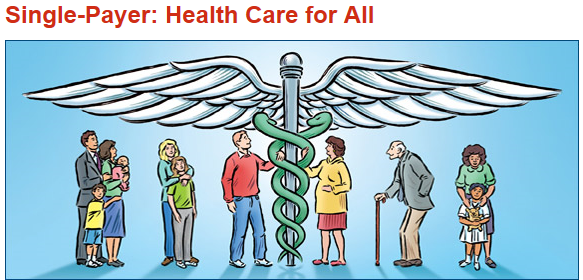
Lowering the Cost of American Healthcare III. Single Payer?


My last two posts, here and here, argue that the high costs of American healthcare, almost double what other developed countries pay per-capita, has two fundamental causes which must be addressed:

  • Very low out-of-pocket costs as a result of the tax exclusion for employer provided care.
  • The very expensive, and rapidly growing, government entitlement programs of Medicare and Medicaid.
    Capture4

It is often suggested that the best way to get these high costs under control is for the U.S. to adopt a single-payer, government run, healthcare system, like many other developed nations have done. Writing in yesterday’s Wall Street Journal, the policy analyst, Nathan Nascimento, makes a persuasive, and well referenced, counter argument to this suggestion:

  • The State of Vermont recently backed away from implementing a single payer system because of the very high tax increase which would have been required, more than doubling Vermont’s annual budget.
  • The State of Colorado will vote a year from now on a petition-supported single payer proposal, ColoradoCare, which would be paid for by a $26 billion annual state tax increase and is therefore unlikely to pass.
  • In Canada, which has a single payer system, the average wait between a general practitioner’s referral and delivery of treatment was more than four months in 2013.
  • Our own Veterans Affairs hospital system, a single payer system on an annual budget, is failing thousands of veterans who often die while waiting for treatment.
  • Medicare, an open ended single payer entitlement system, now costing almost $600 billion per year, is one of the main causes of our burgeoning, out of control, national debt.

Conclusion: For the U.S. to move to a national single payer system would be very risky and very costly. It is far better to wait and see if Colorado or some other state is willing to take such a leap of faith and then see how it works out in that context.

Follow me on Twitter: https://twitter.com/jack_heidel
Follow me on Facebook: https://www.facebook.com/jack.heidel.3

A Path for Climate Change beyond Paris


The United Nations climate conference has just opened in Paris.  The pledges that countries are making fall way short of what many say is needed to solve the problem of climate change.  The Deep Decarbonization Pathways Project based in Paris and New York describes what will be needed to get the job done:
Capture

  • The 2 degree C temperature increase benchmark is used even though it is an arbitrary threshold. “Hell is not going to break loose at two degrees – it will take hundreds of years to unfold.” The world has so far warmed .9 degree C since 1880, halfway to the threshold.
  • The technologies available today, such as solar power and wind turbines, while good enough to get a running start on the transition, are not good enough to finish it.
  • Many countries will need to keep burning coal or natural gas to generate power while capturing the carbon dioxide emerging from smoke stacks, compressing it and injecting it deep underground. In fact most fossil fuel energy producers do not appear to be putting much effort into this approach.
  • Governments could easily flub the energy transition by failing to plan far enough ahead. Most countries are setting 10 and 15 year targets that can be met with incremental changes.
  • To achieve emissions goals, entire economies, including transportation, needs to be electrified as much as possible. Spending a lot of effort, as the U.S. is doing, trying to make gasoline cars more efficient, may be going down a blind alley.
  • Another potential dead end would be an overreliance on natural gas, which emits only half as much carbon as coal. This helps in the short run but gas has to go away within a few decades. Thus heavy investment in natural gas pipelines and power plants now could undermine long term goals.

The point is that the DDPP, designed to hold a global temperature increase to just 2 degrees C from preindustrial times, is extremely demanding.  It will require massive governmental interference in the energy economies of both developed and developing countries all over the world.    A far, far better approach is for leading world economies such as the U.S., Western Europe, China and Japan to provide leadership by implementing a tax on carbon emissions and thereby create an economic incentive for the fossil fuel industry to decarbonize itself.

Follow me on Twitter: https://twitter.com/jack_heidel
Follow me on Facebook: https://www.facebook.com/jack.heidel.3


Does the U.S. Care About Europe?


“After Paris, Islamic State’s rise and Syria’s agony are shaking a weakened Europe – and the broader international system,” writes the Brookings Institution’s Robert Kagan in yesterday’s Wall Street Journal. “Can the U.S. summon the will to respond?”
Capture“What the U.S. now does or doesn’t do in Syria will affect the future stability of Europe, the strength of trans-Atlantic relations and therefore the well-being of the liberal world order. … Just as in the 1990s, when Europeans could address the crisis in the Balkans only with the U.S. playing the dominant military role, so again America will have to take the lead, provide the troops, supply the bulk of the air power and pull together those willing and able to join the effort.”
Such an effort would require:

  • Establishing a safe zone in Syria to avoid having more refugees flood Europe and provide a place to return for those who have already fled. This would require not only U.S. airpower but also ground forces numbering up to 30,000.
  • An additional 10,000 – 20,000 troops to uproot Islamic state from its havens in Syria and Iraq.
  • An internationally negotiated transition in Syria ushering Mr. Assad from power and establishing a new provisional government to hold nationwide elections.

As Mr. Kagan reminds us the U.S. has taken lots of police actions in the last 70 years since the end of WWII:  Korea, Vietnam, Panama, Kuwait, the Balkans, Afghanistan and Iraq being the big ones.  “Not today.  Americans remain paralyzed by Iraq, Republicans almost as much as Democrats, and Mr. Obama is both the political beneficiary and the living symbol of this paralysis.  He may be the first president since the end of WWII who simply doesn’t care what happens to Europe.”
Mr. Kagan concludes, “Perhaps there are Europeans today wishing that the U.S. will not compound its error of commission in Iraq by making an equally unfortunate error of omission in Syria.  They can certainly hope.”

Follow me on Twitter: https://twitter.com/jack_heidel
Follow me on Facebook: https://www.facebook.com/jack.heidel.3


How to Defeat ISIS


The lead story in yesterday’s New York Times, “Experts Explain How Global Powers Can Smash ISIS,” starts out “Much of the world agrees that the Islamic State needs to be crushed.  But how can that be accomplished?”
CaptureHere is the strategy espoused in the NYT article and also by Garry Kasparov, writing in the Wall Street Journal:

  • Assad must go. “For the U.S. and the West to ally with Iran, Russia and the Assad regime in Syria would be morally repugnant, strategically disastrous and entirely unnecessary.”
  • The importance of the Sunnis. “To beat ISIS you need the enlistment of the Sunnis and this won’t happen as long as Assad remains in power.” Removing Assad “would immediately have the support of Turkey and Saudi Arabia.” “The 2007 U.S. military surge in Iraq was so successful because it included the protection and recruitment of Sunni tribes to fight Sunni extremists.” “The hasty exit from Iraq left the Sunnis at the mercy of a hostile Shiite government.”
  • Troops on the ground. “Anything less than a major U.S. and NATO-led ground offensive against ISIS will be a guarantee of continued failure and more terror attacks in the West.”
  • Long term governance. “For the long term, eradicating the Islamic State and other violent Jihadi groups will require drastic reforms in the nature of Middle East governments. ISIS thrives on their failures.”

After the Paris attacks, the West now realizes that ISIS represents a huge threat to world peace and stability.  Hopefully the U.S. is also beginning to realize that only it can provide the leadership to organize an effective response.
I will soon return to talking about the fiscal and economic issues which I usually dwell on.  Every once in a while another major issue intervenes and takes precedence.

Follow me on Twitter: https://twitter.com/jack_heidel
Follow me on Facebook: https://www.facebook.com/jack.heidel.3

Avoiding World War III


What happened in Paris could also easily happen in London, New York City or Washington D.C. and soon will if our President does not adequately respond to the threat of terrorism.  As the Wall Street Journal declared yesterday, “For seven years Mr. Obama has used the unpopularity of the Iraq war as a shield for his retreat from anti-terror leadership and the Middle East.”
CaptureThe American Enterprise Institute’s Danielle Pletka informs us that:

  • NATO aircraft scrambled more than 500 times in 2014, with only a few exceptions, in reaction to Russian incursions into NATO member airspace.
  • In 2014, Japan scrambled aircraft almost 1000 times, with all but a few of these incidents attributed to either Russian or Chinese warplanes.
  • Russian bombers entered US airspace 10 times in 2014, double the previous average.

Ms. Pletka also suggests how we should respond to four years of carnage in the Middle East:

  • The first step is to actually have a strategy, rather than a series of reactive tactics and incremental escalations.
  • The second step is to build a coalition with sub-state and national partners that we trust and that trust us to stick with the job.
  • The good news is that there is still time to lead a decisive war against ISIS.
  • There is no need to launch broadsides against all Muslims, the Syrian people and refugees in general. It is Islam extremists who are attacking us, not mainstream Islamists.

The world is a dangerous place and we have many enemies.  On this website I am mostly focused on our own fiscal and economic problems which are very serious and need to be dealt with in a timely manner.  However the immediate safety and security of our country is the highest priority of all and, on occasion, takes precedence over everything else.  Now is a time for such heightened vigilance.


Combating the Politics of Distrust


My last post, “The Politics of Distrust” presents the view that the main reason for the divisiveness of today’s politics is “the stubborn torpor of the American economy.” If this is true then the solution is obvious: speed up economic growth!
CaptureA couple of weeks ago the economist Alan Blinder, a Hillary Clinton advisor, had an Op Ed in the Wall Street Journal, “A Fairness Agenda for Winning Over Angry Voters” with which I largely agree. Here are the highlights of Mr. Blinder’s fairness agenda:

  • A labor market tight enough to leave employers scouring the land for workers, the best tonic for workers the world has ever known. Mr. Blinder does say that looser purse strings by Congress would help create more demand but it is simply too risky to keep running up our already enormous national debt. Eventually interest rates will return to normal and interest payments on the debt will skyrocket.
  • Raising the federal minimum wage would be an enormous help for wage earners at the bottom. Many states and cities are doing this on their own which is a better way to go because of huge regional differences.
  • Increase the Earned Income Tax Credit, especially for childless workers. A very good way to incentivize work.
  • More Vocational Training and Apprenticeships. Strengthening community colleges and career education in high schools would go a long way to accomplish this.
  • Provide quality pre-K education for families who can’t afford it. Early childhood education for children from low-income families is another very good idea.
  • The tax code is a national disgrace. The corporate tax may be even more complex, inefficient and unfair than the personal tax. The mantra of tax reformers has always been: broaden the base, lower the rates. Amen!

What Mr. Blinder is calling a fairness agenda turns out to be a growth agenda in disguise. I would add a few more items like deregulation to encourage entrepreneurship and business expansion but basically Mr. Blinder has suggested an attractive program for economic growth which should appeal to a broad collection of political interests.

Follow me on Twitter: https://twitter.com/jack_heidel
Follow me on Facebook: https://www.facebook.com/jack.heidel.3
The Politics of Distrust


I define myself as a fiscal conservative with a social conscience, because I want to address budget deficits and income inequality at the same time.  There is so much divisiveness in politics these days that liberals accuse me of favoring austerity while, at the same time, conservatives accuse me of being soft on welfare.
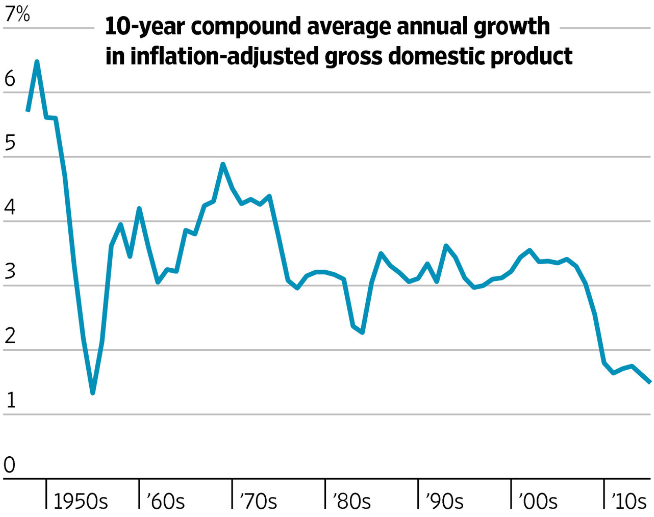
The author Jay Cost has an article, “The Politics of Distrust” on this topic in yesterday’s Wall Street Journal.  He says that the principal cause of this distrust is “the stubborn torpor of the American economy.”
Capture0According to Mr. Cost:

  • For roughly half a century after WWII economic growth averaged 3.6% a year.
  • Over the past 14 years, real growth has averaged only 1.7%.
  • Persistently weak economic growth has contributed to our sour civic mood in three important ways:
  1. It has prompted voters to turn against the incumbent party time and again.
  2. Underwhelming growth has heightened anxieties about economic anxiety – liberals blame the unfairness of market-based capitalism and conservatives blame the corrupting hand of government – in taxation, regulation and monetary policy.
  3. Finally, weak economic growth has damaged the credibility of the experts – the experts failed to foresee the slowdown of the early 2000s, failed to anticipate the housing bubble, failed to predict that economic growth would remain weak after it burst, and failed to implement policies to return it to our postwar norm.
  • These trends amount to a comprehensive assault on the political equilibrium of the past half century. During the postwar era public policy could evolve because broad agreement existed. Now the consensus has vanished and we are left with gridlock, indecision and drift.
  • The tonic to this stalemate is as obvious as it is elusive: economic growth that approximates the levels of the late 20th century.

Perhaps surprisingly there is a fair amount of agreement between liberals and conservatives on how to speed up economic growth. This will be the subject of my next post.

What the Federal Reserve Can and Can’t Do


I have a good impression of Ben Bernanke, chair of the Federal Reserve from 2006-2014. Partly because he comes across as being both competent and honest and partly because Sheila Bair, chair of the Federal Deposit Insurance Corporation from 2006-2011, and whom I greatly admire, gives him high marks in her book, “Bull by the Horns,” about the financial crisis.
CaptureMr. Bernanke has an excellent Op Ed in yesterday’s Wall Street Journal, “How the Fed Saved the Economy,” clearly describing what the Federal Reserve both can and can’t do. What it can do is:

  • Make recessions less severe. The unemployment rate has been steadily dropping and now is apparently almost back to normal at 5.1% even though the relatively low labor-force participation rate and lack of wage pressure indicate remaining weakness.
  • Keep inflation low and stable. The Fed’s expansionary monetary policy has helped bring down unemployment without igniting inflation whose underlying rate is currently only 1.5%.

Mr. Bernanke states that “the Fed has little or no control over long-term economic fundamentals – the skills of the workforce, the energy and vision of entrepreneurs, and the pace at which new technologies are developed and adapted for commercial use.” He goes on to say that “further economic growth will have to come from the supply-side, primarily from increases in productivity. … Fiscal-policy makers in Congress need to step up” by adopting policies to:

  • Improve worker skills. (how about immigration reform, better vocational education, reforming SSDI and expanding the EITC to boost incentives to work)
  • Foster capital investment. (how about both individual and corporate tax reform and relaxing Dodd-Frank regulations on main street banks)
  • Support research and development. (how about making life easier for entrepreneurs with fewer regulations)

Mr. Bernanke has a very good handle on our current financial situation. The Federal Reserve has done and is doing its job. It’s time (long past time!) for fiscal policy makers (i.e. Congress and the President) to adopt policies, such as above, to speed up economic growth.