
Why Is Political Progress So Difficult in the United States?


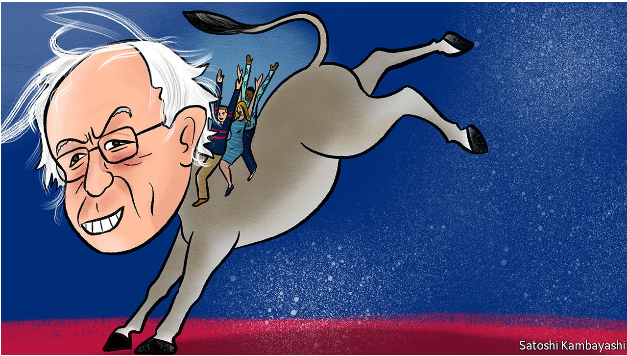
With Donald Trump expanding the culture wars and the Democrats lining up with the progressive policies of Bernie Sanders, the national political scene seems to be getting more confusing all the time.

And yet there is remarkable consensus on many levels about what the country really needs:

  • Faster economic growth would help provide more jobs and better paying jobs for the blue-collar workers which both parties are trying to appeal to.
  • Tax reform meaning to reduce tax rates, shrink deductions and generally simplify the tax code has widespread bipartisan support, as one way to provide the growth which everyone wants.
  • Shrinking the debt as a percentage of GDP is widely recognized as critical to the future well-being of our country and especially for the poor who are most dependent on social welfare programs.  How to curtail spending sufficiently to get this done is inevitably a highly contentious issue.
  • Healthcare for (almost) all is now the law of the land, given that the GOP has failed to repeal the Affordable Care Act. The emphasis going forward should be to control healthcare costs for both individuals and families as well as for the federal government (the taxpayers).
  • Immigration and DACA. There appears to be strong bipartisan support in Congress for giving the Dreamers legal status in the U.S. With a very low (4.4%), and still dropping, unemployment rate, a huge labor shortage is developing in many states, including Nebraska. What the U.S. needs is an expanded guest worker visa program so that all employers are able to find the (legal) employees they need to conduct business. Perhaps DACA reform will lead to broader immigration reform as well.

Conclusion. The above issues should be largely amenable to bipartisan consensus. Both parties would benefit from putting aside petty differences and working together to solve them.

Follow me on Twitter 
Follow me on Facebook 



Achieving Permanent, Revenue Neutral, Pro-Growth Tax Reform


As Congress turns its attention to tax reform, there is a clear bipartisan consensus on the fundamental principles to employ, see here, herehere, and here.


For example:

  • Promote growth and increase wages for working families
  • Modernize our outdated business and international tax system.
  • Rely on reasonable economic assumptions
  • Make sure that any rewrite of the tax code is revenue neutral

The Tax Foundation has outlined several different approaches to tax reform which meet the above guidelines.  Their Option A is especially attractive:

  • The corporate tax is reduced to 22.5% and full expensing for business investment is allowed.
  • GDP increases by 7.1% long term which translates to a .7% increase per year for ten years, which is substantial economic growth.
  • All income groups, except for the top 1%, will see an after-tax increase in income.
  • Individual Tax brackets are consolidated into the three rates of 12%, 20.5% and 37% and the standard deduction is nearly doubled (from $6350 to $12,000).
  • All itemized deductions are eliminated except for home mortgage interest (limited to $500,000) and charitable contributions.
  • Capital gains and dividends are taxed as ordinary income with individuals being allowed to deduct 40% of qualified dividends and long-term capital gains.
  • The estate tax is eliminated.
  • This tax plan is revenue neutral on a static basis.

Conclusion. There are many attractive features in this plan. Being revenue neutral, with strong economic growth, means that the increase in tax revenue will shrink our huge current annual deficits.  Only the very wealthy top 1% of taxpayers will see their income (slightly) decreased.  The substantial decrease in the corporate tax rate will incentivize multinational corporations to bring their overseas profits back home for reinvestment.

Follow me on Twitter 
Follow me on Facebook 
U.S. Income Inequality and Household Demographics


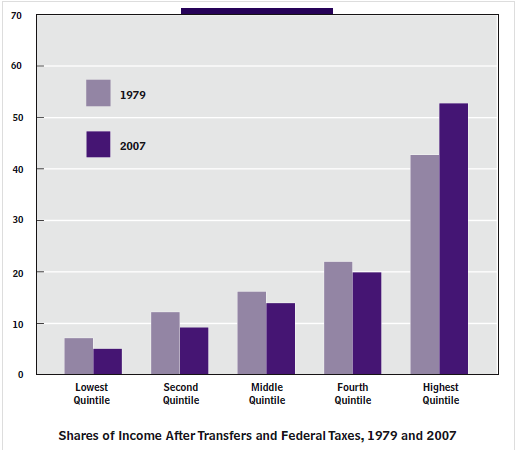
Income inequality is a hot political issue today and I have frequently discussed it on this blog.  In particular, the chart just below shows that income inequality is only slightly worse since 1979, after government transfers and federal taxes are taken into account.


The AEI scholar, Mark Perry, has analyzed the 2016 annual report from the Census Bureau on “Income and Poverty in the United States” and points out the very strong correlation between income inequality and household demographics.


For example:

  • The mean number of earners per household increases steadily from a low of .43 in the lowest income households to 2.04 in the top income households.
  • The marital status of householders. The share of married-couple households is only 17.3% in the bottom income quintile and then increases steadily to 76.5% for the top income quintile.
  • The age of householders. In the lowest income quintile only 42.4% of households included individuals in the prime earning years of ages 35-64, while 69.9% of households in the top quintile include individuals in this group.
  • The work status of householders. Only 18% of the lowest earning quintile households included an adult who was working full time, as compared to 77.7% of top earning households.
  • The education of householders. Only 14.6% of lowest earning households had a family member with a college degree and this percentage rose steadily to 64% for top earning households.

Conclusion. Household demographics are very highly correlated with household income. Specifically, high-income households have a greater average number of income-earners than households in the lower-income quintiles.  Individuals in high-income quintiles are far more likely to be well-educated, married, working full-time and in their prime working years. It is also true that individuals and households can and do move up and down the income quintiles as these key demographic variables change.

Follow me on Twitter 
Follow me on Facebook 

A Different Perspective on U.S. Healthcare Reform


U.S. healthcare policy is now in limbo. The Affordable Care Act has withstood Congressional attempts to repeal it, but it has many flaws which need to be repaired.  Primarily, the ACA expands access to healthcare in the U.S. (good) but does nothing to control burgeoning costs for both individuals and the federal budget (bad).


One option for both further expansion of access as well as cost control is Bernie Sanders’ single-payer “Medicare for All” plan.  A different option is universal catastrophic care for all Americans not already covered by Medicare or Medicaid (including those receiving employer provided health insurance).


A different perspective is provided by an editorial in the New England Journal of Medicine.  According to the authors, Eric Schneider and David Squires, the U.S. also faces (in addition to the challenge of much better cost control) several performance challenges such as:

  • Lack of access to affordable and comprehensive insurance coverage for too many people.
  • Relative underinvestment in primary care. Other developed countries have a higher percentage of their professional workforces dedicated to primary rather than specialty care and deliver a wider range of services at first contact.
  • Administrative inefficiency of the U.S. healthcare system. The solution here is to change our reimbursement systems to use global payments, fee schedules, formularies and defined benefits.
  • Disparities in the delivery of care. People with low incomes, low educational attainment, and other social and economic challenges face greater health risks and thus need even greater access to primary healthcare.

Conclusion. The U.S. compares poorly with other advanced countries in both the quality and cost efficiency of its healthcare system. Healthcare costs in the U.S, are a huge drain on the economy and will ultimately cause huge fiscal problems if not brought under much greater control.

Follow me on Twitter 
Follow me on Facebook 

Moving Forward on Healthcare Reform: Single payer?


It is frequently stated that the current Republican Congress is ineffective in getting anything done. That is not entirely true.  A big issue was decided this past summer.  The failure of Congress to repeal and/or replace the Affordable Care Act means that the goal of universal healthcare for all Americans is here to stay.


The question now is the best way to implement universal healthcare.  Senator Bernie Sanders (D, VT) has just introduced a single payer universal plan, “Medicare for All.”  Here are some of the problems associated with such a plan:

  • At least three states, Vermont, Colorado and California have recently rejected state-wide single-payer plans because of the huge costs involved.
  • The Urban Institute estimates that Medicare for All would increase federal spending by $32 trillion for the first ten years (compared to a very high current total national debt of $20 trillion).
  • Medicare is an inefficient hidebound system with over 140,000 procedure codes where private sector cost-saving measures, like competitive bidding for routine services, are rarely used.
  • There are now 155 million Americans who receive and like their employer provided health insurance and who will resist moving to a Medicare for All plan especially at the cost of a huge tax increase.

On the other hand the cost of healthcare in the U.S., public and private, now eats up 18% of GDP, almost twice as much as for any other developed country, and major changes need to be made to give individuals more direct responsibility for the cost of their own healthcare.
One attractive alternative is to limit the tax deduction for employer provided care to the cost of catastrophic coverage, at a cost of about $3000 per person per year.  It could be made progressive by tying deductibles to income.

Conclusion. Healthcare spending in the U.S. is way too high and something major needs to be done. Universal catastrophic care for all Americans not already covered by Medicare and Medicaid is an attractive alternative to single-payer Medicare for All.

Follow me on Twitter 
Follow me on Facebook 


Why Our National Debt Is a Very Serious Problem for All Americans, but Especially the Poor


Congress has just postponed the debt ceiling until December 8 but at least they didn’t repeal it.  It is crucial to retain regular and explicit debt ceilings as a reminder of the urgency of putting our debt on a downward course (as a percentage of GDP).
As a reminder:

  • The debt now stands at 77% of GDP (for the public part on which we pay interest), the highest it has been since right after WWII. The $15 trillion public debt right now is essentially “free” money because interest rates are so low. But interest rates will inevitably return to more normal, and higher, historical levels and, when this happens, interest payments on the debt will skyrocket.
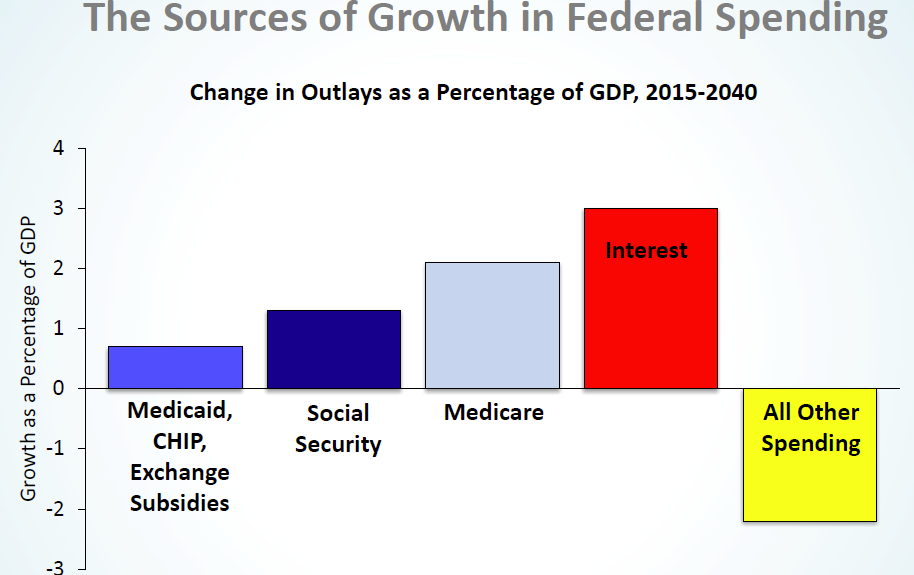
  • The entitlement programs of Social Security. Medicare and Medicaid are the drivers of our debt problem because their costs are increasing so rapidly. Medicaid costs the federal government almost $400 billion per year. Medicare costs the federal government $400 billion per year more than it receives in FICA taxes and premiums paid.

The attached chart demonstrates the scope and urgency of the problem.  By 2032, just fifteen years from now, all federal tax revenues will be required to pay for Social Security, Medicare, Medicaid and interest payments on the debt. This means that all of ordinary discretionary spending: on defense, various government operations and social welfare programs will be paid for entirely from new deficit spending and, in the process, will almost inevitably suffer huge cutbacks.  The lower-income and poor people, who are the most reliant on government programs to get by, will be the most adversely affected.

Conclusion. Such a dreary scenario of drastically tightened government spending does not have to occur. It can be avoided by immediately starting to make sensible curtailments, not actual spending cuts, all along the line.  Do our national leaders have the common sense and fortitude to do this?

Follow me on Twitter 
Follow me on Facebook 


Don’t Get Rid of the Debt Ceiling!


Congress has just voted to postpone the debt ceiling by three months until December 8. That’s okay; it’s just a tactic which also provides quick federal help for the damage caused by Hurricane Harvey.  The important thing is not to repeal the debt ceiling entirely.
As I have said before, global warming and national debt are both creeping catastrophes.  We ignore them at our great peril.  Right now hurricanes Harvey and Irma are reminding us of the huge devastation which can be caused by extreme weather events (which are made more likely by global warming).
In the same way, having an explicit debt ceiling reminds us at regular intervals that we have a very serious problem which will eventually catch up with us if we don’t take strong action to address it.


I know that I’m repeating myself but I can’t help it!

  • The National Debt, now 77% of GDP (for the public part on which we pay interest), is the highest it has been since right after WWII. It is predicted by the non-partisan Congressional Budget Office that it will keep getting steadily worse without major changes in current policy.
  • The urgency of the debt problem is based on the fact that interest rates are now so low that our debt is almost “free” money. But interest rates will inevitably return to more normal, and higher, historical levels and, when this happens, interest payments on the debt will increase dramatically. This will eventually lead to a new Fiscal Crisis, much worse than the Financial Crisis of 2008.
  • The solution to this problem need not be drastic. Federal spending is growing by 5% per year while tax revenues are increasing by 3% per year. All we need to do, so to speak (because it will take some restraint!), is to hold spending increases to about 2.5% per year and then the federal budget would be balanced in a few years and debt would start shrinking as a percentage of GDP.

Conclusion.  Congress, the President and the American people need to be reminded often and loudly how serious the debt problem is.  Hopefully the message will eventually sink in.  The sooner the better!

Follow me on Twitter 
Follow me on Facebook 


Why Entitlement Spending Is So Difficult to Control


The readers of this blog know that my favorite topic is our very large national debt, now 77% of GDP (for the public part on which we pay interest) and predicted by the Congressional Budget Office to keep steadily getting worse, without major changes in current policy.


It is also well documented (see chart)  that our entitlement programs of Social Security, Medicare and Medicaid are the drivers of the huge annual budget deficits which make the accumulated debt so much worse and worse.
The economist John Cogan has an informative interview in yesterday’s Wall Street Journal explaining why entitlement spending is so difficult to control. First of all, according to Mr. Cogan, only three modern presidents have made any effort to control entitlement spending:

  • FDR who persuaded Congress to repeal unjustified disability entitlements to 400,000 WWI, Philippine War and Boxer Rebellion veterans.
  • Ronald Reagan “slowed the growth of entitlements like no other president ever had.”
  • Bill Clinton’s welfare-reform plan not only reduced welfare’s burden on taxpayers but also benefitted the recipients, whom the old program had been harming.


Mr. Cogan identified three necessary political conditions for any entitlement reform. They are:

  • Presidential leadership “without which there has never been a significant reduction in an entitlement.”
  • Significant agreement among the general public and the elected representatives that there’s a problem.
  • Bipartisan consensus on the solution for correcting the problem.

Conclusion.  Think about it.  This is a quite a gloomy assessment.  Nothing will get done on the primary reason for our huge debt problem without both presidential leadership and bipartisan political support. When is this going to happen?

Follow me on Twitter 
Follow me on Facebook 

Why Can’t Democrats and Republicans Work Together?


I am a non-ideological fiscal conservative and social moderate. I agree with Republicans on some issues and Democrats on others.  It seems to me that there is a lot of common ground between the two national parties and plenty of opportunity for working together.


For example:

  • The economy. Donald Trump was elected President with the support of blue-collar workers. He wants to help them out by speeding up economic growth.  But the Democrats also want to give a boost to the working class.  Why not lower the corporate tax rate to encourage multi-national companies to bring their profits back to the U.S.? Why not exempt small community banks from Dodd-Frank so they can lend more money to main street businesses?
  • Sustainable healthcare. After failing to repeal and replace the ACA, Republicans now have to accept that universal health insurance is here to stay even though it needs much better cost control. The popularity of employer provided health insurance makes single payer healthcare unacceptable to many. Two major changes are needed to lower healthcare costs.  The ACA Cadillac tax should be replaced by an upper limit on the tax exemption for employer provided insurance. The Medicare Part B premium covers only 25% of the cost of that program and should be increased on a means adjusted basis.
  • Immigration policy. With the unemployment rate now 4.4% and dropping, a huge labor shortage is beginning to develop which will retard economic growth. We now need more skilled and unskilled immigrants alike.  An expanded guest-worker program to meet the needs of employers should be created. Enhanced border security can be part of the mix.
  • Military spending. In a dangerous world we need a strong military defense. But there is a lot of waste in the Pentagon budget. Do we really need 800 foreign bases in over 70 different countries?  Nebraska’s own Chuck Hagel identified $25 billion a year in military waste while he was Secretary of Defense.

Conclusion. Here are just a few ways that the two parties can work together to address some of our biggest national problems. Faster economic growth and fiscal restraint just make common sense.

Follow me on Twitter 
Follow me on Facebook 
How Should We Respond to Global Warming?


In my last post I summarized the scientific evidence which convinces me that global warming is occurring and is primarily caused by the emission of carbon dioxide from the use of fossil fuels for energy production.
Several Face Book comments on my post suggest that there could be other causes such as a decrease in cloud cover over the earth, sunspot activity and even the carbon dioxide which is exhaled by the 7 billion (and growing number of) humans now alive on earth.  I am personally unable to evaluate the validity of these possible causes.  I rely on the overwhelming consensus of climate experts that the problem is caused by the burning of fossil fuels.


Perhaps the scariest evidence is the warming of the oceans and the related rising of sea levels by 1/8 of an inch per year (which is equivalent to a one foot rise per century). When I referred to the three recent catastrophic hurricanes of Katrina (2005), Sandy (2012) and now Harvey, several readers responded that there is no proof that the severity of these storms was caused by global warming.
I agree!  It is just that warmer oceans mean more evaporation and therefore more rainfall around the world.  This means that severe storms will become more likely as the oceans become warmer.


Take a look at the two charts from the current issue of The Economist.  They show that various types of natural disasters have been increasing in recent years and that record-breaking precipitation events are on the increase.
Conclusion. Global warming is already happening.  But we can act to keep it from getting worse.  More renewable energy (wind and solar) is only part of the answer.  The best way to cut back on carbon emissions is with a (revenue neutral) carbon tax.  This would be much more efficient than ad hoc regulations like the Clean Power Plan and ever higher auto gas mileage standards.

Follow me on Twitter 
Follow me on Facebook