“Nebraska Is Not a Tea Party State”


So declares Jim Jenkins, an independent candidate for the U.S. Senate from Callaway in western Nebraska. Several weeks ago I endorsed Jim based on his common-sense centrist views on many important issues such as fixing the debt, tax reform, Obamacare, and immigration reform.  Check out his campaign website for the details.

CaptureNow Jim has come out with additional common-sense reform ideas:

                                      My 5-Point Bipartisan Reform Agenda

Nebraska doesn’t belong to a political party; Nebraska belongs to our people. Unless you can develop a framework in Congress by which you actually debate, discuss and negotiate, we’re not going to be able to move forward. Here’s my 5-point, bipartisan reform agenda to end gridlock in Washington.

  1. Fix the Debt. Debate recommendations from the bipartisan National Commission on Fiscal Responsibility and Reform, more commonly known as the Simpson-Bowles Commission that presented Congress and the President with a comprehensive plan to reduce the deficit.
  2. Biennial Budget. Congress should adopt a biennial budget process, an approach to budgeting utilized by many states, including Nebraska that allows for a more thorough evaluation of budget proposals in year one and a review of budget effectiveness in year two.
  3. No Budget, No Pay. Unless Congress passes a budget by the end of its fiscal year members of Congress will not receive pay. I also support legislation that suspends Congressional recesses until it has passed a budget. Failure to pass budgets undermines the greater economy and undermines the credibility of Congress with its citizens.
  4. Immigration Reform. President George W. Bush presented a bipartisan plan on immigration that had the backing of a significant number of Democrats. The passage of immigration reform will require a meeting in the messy middle. Both Democrats and Republicans are going to have to yield.
  5. Leadership Council. Congress should adopt a bipartisan leadership group each session that would identify the top legislative priorities.

We need leaders in Washington who will work together to find common-sense solutions to our very challenging national problems. Jim Jenkins is such a person and I hope you will consider voting for him on November 4!

What Happens When We All Live to 100?


This is the title of an article in the current issue of Atlantic. Of course, it is a rhetorical question, but it raises a very serious issue.  There are 43 million Americans age 65 or older today and this number is expected to reach 108 million by 2050.  How will society cope with so many more senior citizens?
CaptureThis blog is concerned with the most critical fiscal and economic problems facing our country.  The biggest fiscal problem we have is how to pay for the three major entitlement programs: Social Security, Medicare and Medicaid.  Social Security can be shored up with small adjustments to either the benefits formula or by raising taxes a little bit.  Medicaid can be kept under control by block-granting the program to the states.  But Medicare is a much bigger problem.
Capture1The cost of healthcare, both public and private, is rising rapidly as shown in the above chart from the New York Times.  We badly need a new approach to control costs and Avik Roy from the Manhattan Institute has given us such a plan “Transcending Obamacare: A Patient-Centered Plan for Near-Universal Coverage and Permanent Fiscal Solvency.”
The problem is that, as Mr. Roy explains, “by creating a universal, single-payer health care program for every American over 65, regardless of financial or medical need, the drafters of Medicare made the program extremely difficult to reform.”  But now we have to reform it because the costs are becoming so huge.  How do we do it?
First of all, Mr. Roy’s plan keeps the exchanges created by the Affordable Care Act and turns them all into state-based exchanges.  It also eliminates both the individual and employer mandates, replacing these mandates with financial incentives.
Mr. Roy’s core Medicare reform is very simple.  The plan increases the Medicare eligibility age by four months each year.  The result is to preserve Medicare for current retirees, and to maintain future retirees – in the early years of their retirement – on their exchange-based or employer-sponsored health plans.  In other words, retirees will gradually be migrated to the same system, with the same level of subsidy, as for working people.
Everyone, workers and retirees alike, will be treated the same. Not only is this an eminently fair system, it insures that Medicare remains affordable, for both retirees and the whole country.

The Economic Effect of ObamaCare

Last week’s report from the Congressional Budget Office “The Economic Outlook: 2014 – 2024” (which I discussed in my last post) caused a big stir with its prediction that ObamaCare will cause a loss of 2,000,000 mostly low wage jobs by 2017 and 2,500,000 such jobs by 2024.  The lost jobs aren’t necessarily from workers being fired or fewer workers being hired but rather the overall decreased incentive for individuals to find work.  The CBO analysis is based on the research of the economist Casey Mulligan featured in yesterday’s Wall Street Journal as “The Economist Who Exposed ObamaCare”.
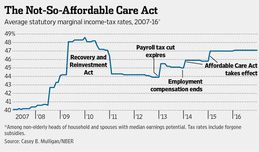
CaptureThe above chart of Mr. Mulligan interprets several recent government subsidy programs as a new marginal tax rate, i.e. the “extra taxes paid and government benefits foregone as a result of earning an extra dollar of income.”  The 2009 stimulus, the Recovery and Reinvestment Act, had an effect like this but it was temporary.  The marginal tax increase of the Affordable Care Act will last as long as it remains in effect.
Capture1The above chart from the same CBO report, showing the steady decline in the Labor Force Participation Rate from the year 2000 onward, demonstrates the critical nature of this problem.  Lower labor force participation means lower growth in overall labor productivity which in turn means slower economic growth.  Since the Great Recession ended in June 2009, GDP growth has averaged only about 2% annually.
Slow GDP growth means, in addition to a higher unemployment rate, that America’s standard of living will not increase very rapidly if at all.  But the problem is really much worse than this.  We have an enormous debt problem which is only getting worse every year that we continue to have large deficits.  The CBO report predicts increasing growth in the size of our national debt.  By far the least painful way of shrinking our debt (relative to the size of the economy) is to grow the economy as fast as we reasonably can.  But our economy is actually slowing down, not speeding up!
This is a very serious problem which many of our national leaders are much too complacent about!

Controlling the Cost of Healthcare

Capture

The New York Times is running a series of articles, “Paying Till It Hurts,” giving many examples of the very high cost of healthcare in the U.S. today.  The latest article “As Hospital Prices Soar, A Single Stitch Tops $500”, focuses on the high cost of emergency room treatment around the country.
We spend 18% of GDP on healthcare, twice as much as any other country in the world.  It is specifically the cost of healthcare entitlements, Medicare and Medicaid, which is driving our huge deficits and rapidly growing national debt.  But to limit the cost of these entitlement programs, we first have to address the more fundamental problem: how to control the overall cost of healthcare in general.
Our current healthcare system, a combination of private insurance and government programs, is very inefficient. The basic problem is that the tax treatment of employer provided health insurance takes away the incentive for individuals to control the cost of their own care.   And Obamacare does not solve this problem, because it just extends the present system to more people, rather than revamping it.
There are essentially two different ways to transform our current healthcare system to make it far more efficient.  One way is to turn it into a single payer system, like what most of the rest of the world has.  This could be accomplished by simply expanding Medicare to everyone.  Costs would then be controlled by government regulation which would, of course, include rationing.  Given the unpopularity of Obamacare, with all of its mandates and uniform coverage requirements, it is unlikely that Americans would be happy with such a highly proscribed single payer system.
The alternative is to change over to a truly consumer based, market oriented system.  This could be accomplished by limiting the present tax exemption for employer provided insurance.  For example, the current system could be replaced by a (refundable) tax credit equal to the cost of catastrophic insurance (i.e. insurance with a very high deductible).  All other healthcare costs, whether paid for directly by consumers or through insurance, would be with after tax dollars.  Subsidies could be provided to lower income people through the Obamacare exchanges.  Once such a system is set up and running smoothly, it could fairly easily be extended to encompass Medicare and Medicaid.
Insurance companies selling catastrophic coverage would negotiate with hospitals and other healthcare providers to get the lowest possible prices for their customers.  In other words, both insurance companies and providers would compete in the open market to deliver healthcare products at the lowest possible cost.
Something along this line will have to be done and the sooner we get started the better!

Why Is Obamacare So Unpopular? Because It’s Too Coercive!


The individual mandate for health insurance, upheld by the Supreme Court a year and a half ago, is now leading to millions of policy cancellations in the individual insurance market.  The mandate overrides any existing policy which does not provide minimum coverage.  The employer mandate, stipulating that any business with 50 or more employees must provide health insurance for all fulltime employees, has caused many businesses to replace fulltime employees with part-timers.
But these are not the only forms of coercion under Obamacare.  As reported in yesterday’s New York Times, “Court Confronts Religious Rights of Corporations”, the Supreme Court is expected to accept a case involving the Hobby Lobby’s refusal, on religious grounds, to pay for insurance coverage for the contraceptive coverage which is required to meet minimum standards.
It would be much better to replace all of these coercive mandates with economic incentives.  This could actually be done in such a way that would also make healthcare less expensive, thereby giving a big boost to our economy.  Here is one way to do this, as I discussed in my November 14, 2013 post:

  • Provide a flat and universal tax credit for health insurance coverage which applies to everyone and not just for employer provided healthcare.  The (refundable) credit would be roughly the amount necessary for catastrophic insurance coverage.
  • Convert Medicare and Medicaid into a means-based addition to this tax credit.
  • Everyone with continuous coverage (paid for by the tax credit) would be protected from price spikes or cancellations if they get sick.  This provides a strong incentive for everyone to buy and retain coverage.

It is entitlement spending which is driving our country’s fiscal crisis.  And healthcare programs such as Medicare and Medicaid make up a big part of entitlements.  In order to get these costs under control, we need to first get the cost of private healthcare under control.  The best way to do this is with economic incentives rather than coercive mandates.
Obamacare doesn’t need to be repealed.  It could just as well be modified and improved as described above.

Beyond ObamaCare: Where Do We Go From Here?

Last Sunday’s Washington Post has an Op Ed column by Jon Kingsdale, “Beyond Healthcare.gov, Obamacare’s Other Challenges” which describes the many challenges confronting ObamaCare besides just the website problems and the millions of individual policies which will be cancelled for not meeting the minimum requirements of the Affordable Care Act.  Based on his experience setting up the Massachusetts Health Insurance Exchange from 2006-2010, there will  be huge problems in getting enrollment, billing and premium collections working smoothly for such a large government program.  For example, an estimated 27% of those who will be eligible for tax credits under the ACA do not have checking accounts.  How will their monthly premiums be paid and tracked for these people if they’re late?
Considering all of the problems involved in the implementation of ObamaCare, and the fact that it does not really reform our current very costly healthcare system but rather just extends it to cover more people, it makes much sense to move toward real healthcare reform, which will control costs.
A column in today’s Wall Street Journal by Ramesh Ponnuru and Yuval Levin, “A Conservative Alternative to ObamaCare”, lays out several basic features which should be included in a sensible, market oriented approach to healthcare reform.   The principles are:

  • A flat and universal tax credit for coverage which applies to everyone and not just for employer provided healthcare.  The (refundable) credit would be roughly the amount necessary for catastrophic coverage.
  • Medicaid could be converted into a means-based addition to this tax credit.
  • Everyone with continuous coverage (which would be provided by the tax credit) would be protected from price spikes or cancellations if they get sick.  This provides a strong incentive to buy and retain coverage without the need for a mandate.

A market oriented healthcare system like this is not only preferable to all of the mandates and restrictions of Obamacare, it also improves our current system by both expanding coverage to more people as well as controlling costs by giving health consumers (all of us) a much bigger stake in purchasing healthcare.
The United States spends 18% of GDP on healthcare, twice as much as any other country in the world.  Our fiscal stability and future prosperity depend on getting this huge and growing cost under control.  The ObamaCare fiasco provides an excellent opportunity to get started on doing this.

A Much Better Republican Strategy for Obama Care


On the eve of its implementation, the Affordable Care Act (aka Obama Care) is more unpopular than ever amongst the general public.  But the House Republican strategy of trying to defund the ACA as part of a continuing resolution to fund the government for the new fiscal year is a very poor idea.  It will never pass both houses of Congress and be signed by the President.  All it can possibly do is lead to a temporary shutdown of the government and therefore cause mass confusion.
The Wall Street Journal recently suggested a much more effective way for the House Republicans to proceed in “Carve-0uts for Congress”.  The legislation establishing the ACA contains a provision requiring all members of Congress and their staffs (11,000 people in all) to purchase their own health insurance on the new exchanges which are being set up to enroll uninsured Americans.  The idea behind this provision is to insure that members of Congress and their staffs and their families will obtain their insurance just like everyone else so that they will fully experience how healthcare reform actually works in practice.
But just a month ago the Administration personnel team issued a regulation exempting all Members and aides from the requirement to use the exchanges.  A recent poll taken by Independent Women’s Voice shows that 92% of likely voters, regardless of their views of the ACA, think that this exemption is unfair.
The implication is clear.  Republicans should show their dissatisfaction with the ACA by attaching the repeal of this exemption, which is contrary to law, as well as highly unpopular, to the continuing resolution to fund the government for the next fiscal year.  Let the Democratic Senate defend this exemption if it wants too.  It’s an opportunity for the House Republicans to do the right thing and also to stand with the “little guy” against the Washington elite.

Our Dire Fiscal Situation I. The Facts

Capture

Take a look at the front page of a new report from the Congressional Budget Office, “The 2013 Long-Term Budget Outlook”.  It shows very clearly the huge fiscal mess confronting our country in the near future.
First of all, our national debt has almost doubled as a percentage of GDP in the last five years, from about 38% of GDP at the end of 2008 to 73% today.  Although the debt is actually projected to dip to 68% of GDP in 2018, it then begins a steady climb because of increasing interest costs as well as increasing spending on Social Security and government healthcare programs (Medicare, Medicaid and the Affordable Care Act).  The debt will be back to 71% of GDP by 2023 and then climb rapidly to about 100% of GDP by 2038.
Notice from the graph that federal tax revenues have just about recovered from the recession and will soon level off at their historical level of about 19.5% of GDP.  But federal spending will resume a steady climb, reaching 26% of GDP by 2038.  As the gap between revenue and spending gets wider and wider, the national debt grows faster and faster.  This is the enormous fiscal problem we are faced with in the next 25 years.   The worse it gets the harder it becomes to turn around.  It is imperative to address this problem without delay.
In order to reduce the debt from its current level of 73% of GDP down to the historical average of 38% by 2023, Congress would have to pass an additional $4 trillion in spending cuts or tax increases over the next decade.  The only way such enormous savings can be achieved is by reining in entitlement spending: Social Security, Medicare, Medicaid and ACA.  I will outline one way to do this in my next post!