
Fundamental Tax Reform Is the Key to Solving Our Economic and Fiscal Problems II. The Graetz Plan

The Yale Tax Law Professor, Michael Graetz, has proposed a new tax system “100 Million Unnecessary Returns: A Simple, Fair, and Competitive Tax Plan for the United States” which would do wonders towards straightening out the huge fiscal and economic problems now facing our country.
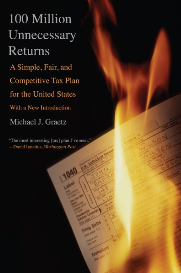
CaptureHow do we rev up the national economy in order to put more people back to work and, at the same time, raise the revenue needed to operate the government in the 21st century without mountains of debt?  Mr. Graetz’s basic idea is to tax consumption rather than relying totally on an income tax.  Under his plan both savings and investments will be taxed at a lower rate which will encourage more of both.  The Plan has these features:

  • A broad based Value Added Tax of about 14% is enacted on goods and services.  The U.S. is the only advanced economy without a VAT.
  • Families earning less than $100,000 are exempted from the income tax.  For incomes between $100,000 and $250,000, the tax rate would be 15%.  For income over $250,000, the rate would be 25%.
  • The corporate income tax rate is lowered to 15%.
  • The Earned Income Tax Credit (EITC) is used to provide relief from the VAT burden to low-income families by using payroll tax offsets.
  • The plan is designed to be revenue neutral as verified by the Tax Policy Center.

This plan has many advantages including:

  • Taxing consumption and lowering the corporate tax rate to 15% from its current level of 35% would dramatically encourage investment in the U.S. thereby stimulating the economy and creating both new jobs and higher wages for American workers.
  • It would eliminate more than 100 million of the 140 million U.S. tax returns.
  • With many fewer Americans paying income taxes there would be far less temptation for Congress to use income tax exclusions, deductions and credits to try to address social and economic problems.
  • The plan retains all of the progressive features of our current tax system whereby higher income earners pay higher tax rates.

The point of describing the Graetz Plan in some detail is not to suggest that it is the best way to implement tax reform but rather that here, at least, is one attractive way to do it.  The purpose is to move the discussion forward.  We badly need to make changes along these lines!

Oklahoma’s Senator Tom Coburn: We Need More like Him!

Senator Tom Coburn of Oklahoma has an Op Ed column in the Wall Street Journal from two days ago “The Year Washington Fled Reality”, discussing many of the things that are wrong with our national government.  Granted that all elected officials “play politics” to some extent or another, nevertheless Dr. Coburn, an obstetrician, is amazingly independent of the reigning political culture.  He spent three consecutive terms in the House of Representatives, left Congress for four years, and now is back serving his second term in the Senate.  He has announced that he will not run for re-election in 2016 when his present term ends.
CaptureDr. Coburn is constantly drawing attention to, and attacking, the enormous amount of wasteful and inefficient spending approved by Congress.  The Popular Romance Project, pictured above, is an example. His office has just published its fourth annual report on government waste, “Wastebook 2013”, detailing 100 different “examples of government mismanagement and stupidity. … Collectively these cost nearly $30 billion in a year when Washington would have you believe everything that could be done, has been done to control unnecessary spending.”
Dr. Coburn has prevailed upon the Government Accounting Office to issue annual reports called “Actions Needed to Reduce Fragmentation, Overlap and Duplication and Achieve Other Financial benefits.”  Three of these reports have now been issued. Altogether they list almost 400 individual actions which could be taken to improve the efficiency and effectiveness of 162 different program areas.
In spite of all the good work he is doing, Dr. Coburn would be even more effective if he had more help.  Fiscal conservatives should stop wasting their time on senseless gestures like trying to defund Obamacare.  They need to get down in the trenches with serious deficit hawks like Tom Coburn and whittle away at wasteful programs one by one.
                                                  

How to Get the Economy Back on Track


Harvard Economist, Martin Feldstein, has an Op Ed column in yesterday’s New York Times, “Saving The Fed From Itself”, which gets our current economic situation half right.  First of all, Mr. Feldstein says that the Fed’s quantitative easing policy is inadequate because “the magnitude of the effect has been too small to raise economic growth to a healthy rate.  … The net result is that the economy has been growing at an annual rate of less than 2 percent.  … Weak growth has also meant weak employment gains.  … Total private sector employment is actually less than it was six years ago.  … While doing little to stimulate the economy, the Fed’s policy of low long-term interest rates has caused individuals and institutions to take excessive risks that could destabilize the economy just as it did before the 2007-2009 recession.”  So far he’s right on the button!
But then he goes on to say, “To get the economy back on track,” Congress should enact a five year plan to spend a trillion dollars or more on infrastructure improvement and that this would “move the growth of gross domestic product to above three percent a year.”  An artificial stimulus like this might work temporarily but then it ends and we’re back where we started.  We need a self-generating stimulus that will keep going indefinitely on its own.  How do we accomplish this?
The answer should be obvious.  We do it by stimulating the private sector to take more risk in order to generate more profits. In the process they will hire more employees and boost the economy.
How do we motivate the private sector?  By lowering tax rates and loosening the regulations which stifle growth.  Closing tax loopholes and lowering deductions (which will raise revenue to offset the lower tax rates) has the added benefit of attacking the corporate cronyism which everyone deplores.
We really do need to put first things first.  If we can jump start the economy by motivating the private sector to invest and grow, we will have more tax revenue to spend on new and expanded government programs as well as shrinking the federal deficit.
Why is this so hard for so many people to understand?

Is Expanding The Social Safety Net Compatible With Fiscal Restraint?

Yesterday’s New York Times addresses this issue with an article “Ohio Governor Defies G.O.P. With Defense of Social Safety Net”.  It describes how Republican Governor John Kasich has maneuvered to expand Medicaid coverage in Ohio to 275,000 low income Ohioans under the new healthcare law, over the objections of his own Republican dominated state legislature.
Mr. Kasich is a former congressional deficit hawk and there is little doubt about his fiscal conservatism.  He recently balanced his state budget by cutting revenues to local government by $720 million.  But he has also expanded state aid for the mentally ill and supported efforts to raise local taxes for improving education.  He says “for those who live in the shadows of life, for those who are the least among us, I will not accept the fact that the most vulnerable in our state should be ignored.”
Especially after the disastrous debt ceiling debate, with Tea Party Republicans willing to default on our national debt in order to defund Obama Care, it is critical for fiscal conservatives to publicly demonstrate that they are not opposed to helping the poor in a reasonable manner, as long as it is cost effective.
To be in favor of controlling entitlement spending is not the same thing as wanting to abolish entitlement programs.  In fact, it is just the opposite.  We must control their costs so that the government will have the means to continue to support them.  It is just plain ordinary common sense.  If our national debt continues to grow unchecked, we risk not only entitlement programs but our entire way of life.
Take Medicaid as a concrete example.  Right now the federal government pays a percentage of the costs incurred by state governments in running the program.  The more a state spends for Medicaid, the greater the reimbursement from the federal government. This increases spending for both the states and the federal government.  A more cost effective approach is to give each state a block grant from the federal government and enough leeway to operate its own program as efficiently as it can.  Exactly this approach is being used in Rhode Island and is working very well at a much lower overall cost.
Being a fiscal conservative is not the same thing as being mean spirited!  The future of our country depends on getting this crucial message out far and wide!

Must America Resign Itself to Much Slower Economic Growth?

The cover story in this week’s Barron’s, by Jonathan Laing, “The Snail Economy, Slowing to a Crawl”, makes a well-documented argument that “over the next 20 years, the U.S. economy is likely to grow only 2% a year.  That’s down from 3% or better since World War II.  Blame it on an aging population and sluggish productivity growth.  Bad news for stocks and social harmony.”
Here’s an example of the argument he makes.  “Mean incomes of minorities in the U.S. population have remained at about 60% of white incomes in recent decades.  Unless that pattern changes, and minorities earn bigger incomes, that augers slower income growth for the overall population as the baby boomers, predominately white, retire over the next 20 years. …At the same time the minority population, particularly Hispanic, will expand. …If income relationships remain the same, U.S. median income growth will drop by an estimated 0.43% a year through 2020 and 0.52% a year over the succeeding decade.”
This demographic trend can be offset to some extent by boosting the ages at which Social Security benefits are received in order to lighten the burden on those who are working.  Immigration policy could be reformed to attract more highly skilled (and therefore more highly paid as well) workers to further offset the growing number of retirees.  “And most of all, the U.S. should engage in a crash educational program to close the gap in skills and income levels among different parts of the American population.”
In addition to the demographic challenge well described by Mr. Laing, there is the problem that growing economic efficiency (caused by advances in technology and ever more globalization) will continue to replace American workers by both machines and lower cost foreign workers.
It is imperative for us to set aside partisan ideology and dramatically confront all of these economic challenges to continued American supremacy on the world stage.  First and foremost we need fundamental tax reform, significantly lowering tax rates for all productive aspects of our economy, especially for investors, risk takers, entrepreneurs and corporations.  (Lower tax rates can be made revenue neutral by eliminating deductions and closing loopholes.)  We should simplify and streamline regulatory processes, again, to give all possible support to the businesses which can make the economy grow faster.
Our status in the world and therefore the future of our country depend on our success in this urgent endeavor!

Where Are the Jobs? II. How to Create More of Them

My previous post, two days ago, introduced a new book by two economists, John Dearie and Courtney Geduldig, “Where the Jobs Are, Entrepreneurship and the Soul of the American Economy”.  They make a very strong case that net job creation comes primarily from businesses less than one year old, true “start-ups”.  But, unfortunately, there has been a huge drop off in the number of new businesses created each year since 2007 and, furthermore, the historical average of seven new jobs created by a firm in its first year has now fallen to less than five.
How do we reverse this alarming trend?  Here is what the authors have learned from the many entrepreneurs they have talked to:

  • “Not enough people with the skills we need”
  • “Our immigration policies are insane”
  • “Regulations are killing us”
  • “Tax payments can be the difference between survival and failure”
  • “There’s too much uncertainty and it’s Washington’s fault”

Although there are 24 million Americans either unemployed or underemployed, there are also 3 million advertised high skill job openings going begging and many more potential jobs available for qualified individuals.  A greater emphasis on STEM (Science, Technology, Engineering and Mathematics) education in the U.S. would help.  But also immigration reform is urgently needed.  The Senate has passed legislation to raise the annual cap on H1-B visas (for high skilled workers) from 65,000 currently to 110,000.  Hopefully the House will concur.
A Preferential Regulatory Framework for New Businesses could be devised to help fragile new businesses in their first five years.  A Regulatory Improvement Commission could be created to streamline the entire federal regulatory process.  Likewise a Preferential Tax Framework for New Business should be created and could, for example, recommend taxing income for the first five years at a much lower rate than normal.
Regarding policy uncertainty the authors refer to the U.S. Economic Policy Uncertainty Index which is at a very high level since the Great Recession.  Economic uncertainty obviously discourages business growth.
Conclusion:  A very good way to boost the economy and create more new jobs is to put greater emphasis on supporting entrepreneurs who are trying to start new businesses.  There are a number of concrete actions that the federal government can take to do this and doing so should be a very high priority for our national leaders.

The Intergenerational Financial Obligations Reform (INFORM) Act

On page nine of today’s New York Times is published a full page letter to Congress and President Obama, “Enact The Inform Act”, signed by over one thousand economists as well as former government officials.  It would require “the Congressional Budget Office, the Government Accountability Office and the Office of Management and Budget to do fiscal gap and generational accounting on an annual basis to assess the sustainability of fiscal policy and measure, on a comprehensive basis, the fiscal obligations facing our children and future generations.
“Unlike the measurement of the official federal debt, fiscal gap and generational accounting are comprehensive.  They leave nothing off the books, be it defense spending, Medicare expenditures, or the profits of the Federal Reserve, in assessing the sustainability of fiscal policy and the size of the fiscal bills being left to our own children.”
The INFORM Act is sponsored by a nonpartisan and millennial driven organization which goes by the name, The Can Kicks Back . This is very significant because it is precisely the younger generation of Americans who should be most concerned about the fiscal irresponsibility of so many of our national leaders.  They are the ones who will be stuck with the huge national debt which is being generated by the profligacy of federal spending and also the ones who may have their own retirement benefits greatly curtailed because of it.
Young people should be especially incensed by such irresponsible behavior which will affect them so greatly.  We should support their efforts to turn around this ugly situation!

Can We Solve Our Fiscal Problems by Taxing the Rich? II. Robert Reich’s View


One of America’s foremost liberal writers, Robert Reich, a Professor of Public Policy at UC Berkeley, argues in his latest book, “Beyond Outrage”, that “America’s economy and democracy are working for the benefit of ever-fewer privileged and powerful people.”  He presents “a plan for action for everyone who cares about the future of America.”  Mr. Reich’s tax policy:

  • Raise the tax rate on the rich to what it was before 1981

“Sixty years ago Americans earning over $1 million in today’s dollars paid 55.2 percent of it in income taxes, after taking all deductions and credits.  If they were taxed at that rate now, they’d be paying at least $80 billion more annually.”

  • Put a two percent surtax on the wealth of the richest one-half of one percent

“The richest on-half of one percent of Americans, each with over $7.2 million of assets, own 28 percent of the nation’s total wealth.  Given this almost unprecedented concentration, and considering what the nation needs to do to rebuild our schools and infrastructure, as well as tame the budget deficit, a surtax is warranted.  It would generate another $70 billion a year.”

  • Put a one-half of one percent tax on all financial transactions

“This would bring in more than $25 billion per year.”

These new tax provisions would together raise tax revenue by $175 billion per year.  But our deficit this fiscal year, ending September 30, 2013, is about $700 billion.  In a few years, without significant changes in either discretionary or entitlement spending, annual deficits will be back up over a trillion dollars per year and climbing.  Mr. Reich’s steep taxes on wealth and wealth creation are not enough to seriously tame deficit spending, let alone end it.
Let’s be honest and admit that some new tax revenue is probably going to be necessary in the future if we are ever going to be able to eliminate the deficit.  But it makes no sense to start out with a tax increase which will be strongly opposed anyway.  It is far more sensible to first wring out the hundreds of billions of dollars in wasteful federal spending which now exists.  After this is done there likely will still be a big deficit.  Then, and only then, would it be appropriate to generate significant new revenue by raising taxes.

Can We Solve Our Fiscal Problems by Taxing the Rich? I. The Third Way

“I enjoy your blogs and always look forward to the next one.”
“I am amazed when listening to my liberal friends, who could care less about any of the arguments you are making. Their basic belief is that any deficit can be solved in short order by simply raising taxes on the rich. One of these friends just bought a home in Palm Springs and came back declaring, ” Jerry Brown solved the financial problem in California. He raised taxes on the rich and the deficit is gone. California no longer has a financial problem.” He then went on to say that with 40 million people, California will set a good example for the country. After listening to this, I think you should address the issue of why simply increasing taxes will never work. I would start with Simpson Bowles and then go on to more recent findings. I think this argument has to be made over and over again. There are precious few Democrats who think we have a serious or fundamental financial problem that cannot be solved by simply raising taxes on the rich. I believe Obama is leading the charge.”

One response to this argument is provided by the President, Jon Cowan, and the Senior Vice President for Policy, Jim Kessler, of the Third Way, a center-left think tank, in a June 2013 memo, “The Four Fiscal Fantasies” .

  • Fantasy #1: Taxing the rich solves our problems.

Mr. Cowan and Mr. Kessler look at a plan that “completely soaks the rich.”  They stipulate that the top tax rate increases ten points to 49.6%.  They impose the Buffett Rule requiring all millionaires to pay at least 30% in taxes (after deductions).  They raise the estate tax to allow a $3.5 million exemption with a 45% rate.  “If we leave entitlements on auto-pilot in this scenario, our deficit in 2030 will be close to a stunning $1.3 trillion in 2013 inflation-adjusted dollars.”
The authors then show that to keep our finances even roughly in check, a middle income family with a $65,000 income, for example, would have to pay several thousand dollars a year in new taxes.
Conclusion:  We cannot keep entitlements on auto-pilot.  Something has to give!

A Much Better Republican Strategy for Obama Care


On the eve of its implementation, the Affordable Care Act (aka Obama Care) is more unpopular than ever amongst the general public.  But the House Republican strategy of trying to defund the ACA as part of a continuing resolution to fund the government for the new fiscal year is a very poor idea.  It will never pass both houses of Congress and be signed by the President.  All it can possibly do is lead to a temporary shutdown of the government and therefore cause mass confusion.
The Wall Street Journal recently suggested a much more effective way for the House Republicans to proceed in “Carve-0uts for Congress”.  The legislation establishing the ACA contains a provision requiring all members of Congress and their staffs (11,000 people in all) to purchase their own health insurance on the new exchanges which are being set up to enroll uninsured Americans.  The idea behind this provision is to insure that members of Congress and their staffs and their families will obtain their insurance just like everyone else so that they will fully experience how healthcare reform actually works in practice.
But just a month ago the Administration personnel team issued a regulation exempting all Members and aides from the requirement to use the exchanges.  A recent poll taken by Independent Women’s Voice shows that 92% of likely voters, regardless of their views of the ACA, think that this exemption is unfair.
The implication is clear.  Republicans should show their dissatisfaction with the ACA by attaching the repeal of this exemption, which is contrary to law, as well as highly unpopular, to the continuing resolution to fund the government for the next fiscal year.  Let the Democratic Senate defend this exemption if it wants too.  It’s an opportunity for the House Republicans to do the right thing and also to stand with the “little guy” against the Washington elite.