It’s Easy to be Pessimistic about America’s Future


As I remind readers from time to time, this blog is concerned with America’s fundamental fiscal and economic problems: a slow economy, massive debt, and increasing income inequality. Largely because of these apparently intractable problems, more and more people are becoming pessimistic about the future of our country.
CaptureAlthough I am by nature an optimist, these matters weigh on me as well:

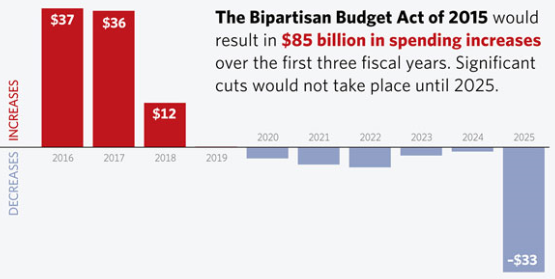
  • The just introduced “Bipartisan Budget Act of 2015” is a sell-out to the status quo. It breaks the agreed upon sequester spending limits by $112 billion over two years with essentially no attempt to create long term spending restraint.
  • As pointed out recently by the Washington Post’s Robert Samuelson, the presidential candidates are talking mainly about new entitlements (the Democrats) or tax cuts (the Republicans). In both cases this represents a flight from reality.
  • Entitlements: The number of people aged 65 or older will increase from 15% of the population today to 22% of the population in 2040. The cost of Social Security, Medicare and Medicaid will jump from 6.5 % of GDP today to 14% of GDP in 2040. We simply must control these costs by raising eligibility ages for SS and Medicare and increasing premiums for wealthier recipients.
  • Economic Growth: Annual growth has averaged only 2% of GDP since the end of the Great Recession in June 2009. Slow growth means weaker gains in wages, more unemployment and larger spending deficits. This can be fixed long term with honest tax reform, but not with unrealistic tax cuts.

Conclusion: Isn’t it obvious that we need political candidates who will speak forthrightly with the people about the need for addressing these humongous problems? Americans aren’t dumb.  They will respond to straight talk from their supposed leaders.   

Follow me on Twitter: https://twitter.com/jack_heidel
                    Follow me on Facebook: https://www.facebook.com/jack.heidel.3

Combating the Politics of Distrust


My last post, “The Politics of Distrust” presents the view that the main reason for the divisiveness of today’s politics is “the stubborn torpor of the American economy.” If this is true then the solution is obvious: speed up economic growth!
CaptureA couple of weeks ago the economist Alan Blinder, a Hillary Clinton advisor, had an Op Ed in the Wall Street Journal, “A Fairness Agenda for Winning Over Angry Voters” with which I largely agree. Here are the highlights of Mr. Blinder’s fairness agenda:

  • A labor market tight enough to leave employers scouring the land for workers, the best tonic for workers the world has ever known. Mr. Blinder does say that looser purse strings by Congress would help create more demand but it is simply too risky to keep running up our already enormous national debt. Eventually interest rates will return to normal and interest payments on the debt will skyrocket.
  • Raising the federal minimum wage would be an enormous help for wage earners at the bottom. Many states and cities are doing this on their own which is a better way to go because of huge regional differences.
  • Increase the Earned Income Tax Credit, especially for childless workers. A very good way to incentivize work.
  • More Vocational Training and Apprenticeships. Strengthening community colleges and career education in high schools would go a long way to accomplish this.
  • Provide quality pre-K education for families who can’t afford it. Early childhood education for children from low-income families is another very good idea.
  • The tax code is a national disgrace. The corporate tax may be even more complex, inefficient and unfair than the personal tax. The mantra of tax reformers has always been: broaden the base, lower the rates. Amen!

What Mr. Blinder is calling a fairness agenda turns out to be a growth agenda in disguise. I would add a few more items like deregulation to encourage entrepreneurship and business expansion but basically Mr. Blinder has suggested an attractive program for economic growth which should appeal to a broad collection of political interests.

Follow me on Twitter: https://twitter.com/jack_heidel
Follow me on Facebook: https://www.facebook.com/jack.heidel.3

The Politics of Distrust


I define myself as a fiscal conservative with a social conscience, because I want to address budget deficits and income inequality at the same time.  There is so much divisiveness in politics these days that liberals accuse me of favoring austerity while, at the same time, conservatives accuse me of being soft on welfare.
The author Jay Cost has an article, “The Politics of Distrust” on this topic in yesterday’s Wall Street Journal.  He says that the principal cause of this distrust is “the stubborn torpor of the American economy.”
Capture0According to Mr. Cost:

  • For roughly half a century after WWII economic growth averaged 3.6% a year.
  • Over the past 14 years, real growth has averaged only 1.7%.
  • Persistently weak economic growth has contributed to our sour civic mood in three important ways:
  1. It has prompted voters to turn against the incumbent party time and again.
  2. Underwhelming growth has heightened anxieties about economic anxiety – liberals blame the unfairness of market-based capitalism and conservatives blame the corrupting hand of government – in taxation, regulation and monetary policy.
  3. Finally, weak economic growth has damaged the credibility of the experts – the experts failed to foresee the slowdown of the early 2000s, failed to anticipate the housing bubble, failed to predict that economic growth would remain weak after it burst, and failed to implement policies to return it to our postwar norm.
  • These trends amount to a comprehensive assault on the political equilibrium of the past half century. During the postwar era public policy could evolve because broad agreement existed. Now the consensus has vanished and we are left with gridlock, indecision and drift.
  • The tonic to this stalemate is as obvious as it is elusive: economic growth that approximates the levels of the late 20th century.

Perhaps surprisingly there is a fair amount of agreement between liberals and conservatives on how to speed up economic growth. This will be the subject of my next post.

Dodd-Frank Is Hurting the Recovery!


The Federal Reserve Bank plays an important role in our economy by trying to keep inflation low and stable but also by trying to make recessions less severe by increasing the money supply when the unemployment rate is high. My last post, “What the Federal Reserve Can and Can’t Do” emphasizes that, as Ben Bernanke says, “the Fed has little or no control over long term fundamentals,” such as economic growth which depends on increases in productivity which, in turn, are heavily influenced by fiscal and regulatory policy.
Capture8The American Enterprise Institute’s Peter Wallison explains very clearly in “The slow economic recovery explained,” why, for example, the Dodd-Frank Act of 2010 is having a harmful effect on economic growth:

  • Regulatory burdens imposed by Dodd-Frank have been particularly harsh for community banks, with $10 billion or less in assets; 98.5 % of U.S. banks fall into this category. Since Dodd-Frank was enacted in 2010, community banks’ share of banking assets has shrunk by 12%.
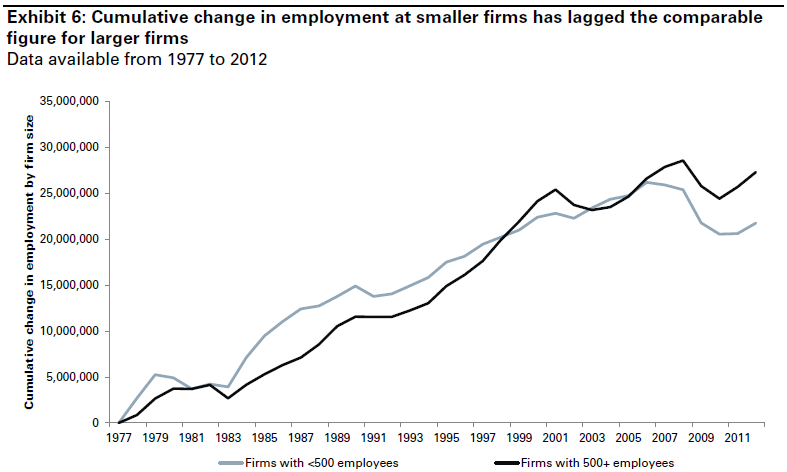
  • According to the Small Business Administration, there were approximately 23 million small businesses (with fewer than 500 employees) in 2012, compared to 18,500 firms with more than 500 employees. Large businesses have access to capital markets whereas small businesses rely on local banks for their credit needs.
  • Regulatory costs affect small banks more than large banks because the costs are fixed, independent of size of the institution. When the Consumer Financial Protection Bureau sends out voluminous regulations on mortgage lending, for example, then extensive legal fees, compliance officers and technology retooling must be paid for up front.
    Capture
  • A recent report from Goldman Sachs, “The Two-Speed Economy,” shows that large firms have grown faster than usual after 2010 while small firms have grown much slower than usual (see chart above).

Conclusion. Monetary policy alone, as conducted by the Federal Reserve, cannot return our economy to good health. This can only be accomplished by increasing productivity which is aided by smart fiscal and regulatory policy. Dodd-Frank is an example of regulatory policy which is hurting economic growth by having a harmful effect on main street banks.                                 

What the Federal Reserve Can and Can’t Do


I have a good impression of Ben Bernanke, chair of the Federal Reserve from 2006-2014. Partly because he comes across as being both competent and honest and partly because Sheila Bair, chair of the Federal Deposit Insurance Corporation from 2006-2011, and whom I greatly admire, gives him high marks in her book, “Bull by the Horns,” about the financial crisis.
CaptureMr. Bernanke has an excellent Op Ed in yesterday’s Wall Street Journal, “How the Fed Saved the Economy,” clearly describing what the Federal Reserve both can and can’t do. What it can do is:

  • Make recessions less severe. The unemployment rate has been steadily dropping and now is apparently almost back to normal at 5.1% even though the relatively low labor-force participation rate and lack of wage pressure indicate remaining weakness.
  • Keep inflation low and stable. The Fed’s expansionary monetary policy has helped bring down unemployment without igniting inflation whose underlying rate is currently only 1.5%.

Mr. Bernanke states that “the Fed has little or no control over long-term economic fundamentals – the skills of the workforce, the energy and vision of entrepreneurs, and the pace at which new technologies are developed and adapted for commercial use.” He goes on to say that “further economic growth will have to come from the supply-side, primarily from increases in productivity. … Fiscal-policy makers in Congress need to step up” by adopting policies to:

  • Improve worker skills. (how about immigration reform, better vocational education, reforming SSDI and expanding the EITC to boost incentives to work)
  • Foster capital investment. (how about both individual and corporate tax reform and relaxing Dodd-Frank regulations on main street banks)
  • Support research and development. (how about making life easier for entrepreneurs with fewer regulations)

Mr. Bernanke has a very good handle on our current financial situation. The Federal Reserve has done and is doing its job. It’s time (long past time!) for fiscal policy makers (i.e. Congress and the President) to adopt policies, such as above, to speed up economic growth.

The Slow Growth Economy We’re Stuck In


We have very high debt and Paul Krugman says in “Debt Is Good” that we need more! The Congressional Budget Office’s latest report this week, “An Update to the Budget and Economic Outlook: 2015 – 2025” predicts slow economic growth for the next ten years, averaging 2.1% per year (see chart below).
CaptureUnfortunately, high debt and slow growth are a deadly, self-reinforcing, combination. Today’s Wall Street Journal has a chart (pictured below) showing clearly how budget deficits are likely to increase over the next ten years. The public debt (on which we pay interest) is predicted to grow from 74% of GDP today to 77% of GDP in 2025, increasing by a total of $7 trillion over this time period.
Capture1Here is another connection between slow growth and high debt:

  • Slow Growth means higher than necessary unemployment and under-employment as well as minimal raises for employed workers. The resulting economic slack leads to
  • Low Inflation. But low inflation means that the Federal Reserve can maintain
  • Low Interest Rates to try to encourage more borrowing to stimulate the economy. This means, in turn, that Congress can run up huge deficits without having to pay much interest on this almost “free” money. This eventually leads to:
  • Massive Debt. But what happens when inflation does take off, which has happened before and is likely to happen again? Then the Federal Reserve is forced to raise interest rates quickly and we are stuck with huge interest payments on our accumulated debt. And meanwhile entitlement spending on Social Security, Medicare and Medicaid is also growing rapidly. At this point debt increases very rapidly which leads to a severe
  • Fiscal Crisis.

Of course things don’t have to happen like this. Congress might become more responsible and either cut spending and/or raise taxes and start shrinking our huge deficits. Or perhaps slow growth really is the new normal and interest rates will remain low indefinitely. But slow growth is not pain free; there are many millions of unemployed and under-employed Americans who want to work and whose lives are stunted otherwise.
Slow growth is a very destructive path to be following. We badly need to adopt policies to speed it up!

America’s Fourth Revolution


The Manhattan Institute’s James Piereson has written a fascinating new book, ”Shattered Consensus: The Rise and Decline of America’s Postwar Political Order” in which he argues that the New Deal liberal consensus has broken down and will soon be replaced by a new model containing several specific features. The coming new model will be the result of a Fourth Revolution of comparable scope to the first three:

  • A Democratic-expansionist regime from 1800 until 1860 which dissolved in the midst of the slavery and secession crisis.
  • A Republican-capitalist regime from 1860-1930, which was brought down by the Great Depression.
  • A Democratic-welfare regime from 1932 until the present, although with faltering support after 1980.

America’s third regime is in the process of fading out or collapsing for three reasons:

  • Debt. The national debt of $18 trillion today, at about 100% of GDP, is comparable to the debt at the end of WWII. But once the war ended the government cut spending and stopped borrowing and the U.S. economy grew at 4% for the next 20 years. Nothing comparable to this major debt reduction is in sight today.
  • Demography. Today there are about 160 million people in the U.S. workforce of whom 120 million have full time jobs. The workforce will grow by 1 million per year for the next ten years while the number of people turning 65 will grow at nearly twice that rate. The nation will soon reach a point where 150 million working people will be paying payroll taxes to support 80 million people on Social Security and Medicare. Political leaders are doing nothing to address this looming crisis.

    Capture5

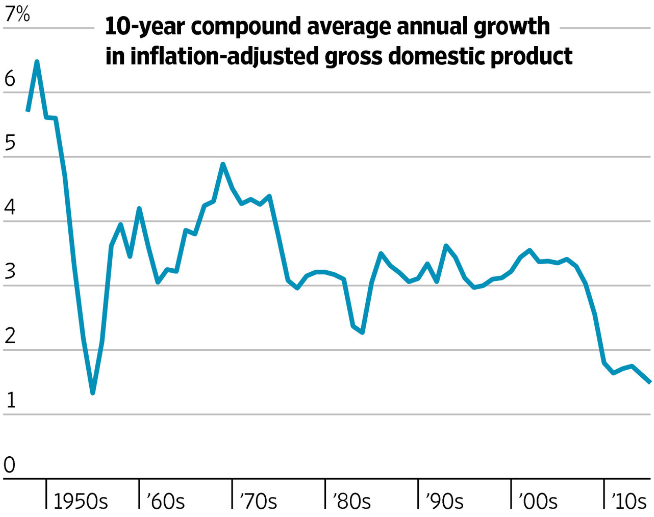
  • Slowing Economic Growth. The chart above shows how the U.S. economy has been slowing since the 1960’s. Since the end of the Great Recession in 2009, GDP has grown at only 2.2% and is likely (CBO) to continue growing indefinitely at this slow rate under current policies. The second chart shows the enormous difference between 2% growth and, for example, even 3% growth over time.

    Capture6Why don’t Congress and the President deal with these problems now, before they reach the point of crisis?   It’s because Congress has become increasingly polarized, with Democrats having moved leftward and Republicans moving rightward. Polarization is characteristic of regimes as they begin to tear themselves apart in conflicts which defy resolution within the existing structure of politics.
    My approach on this blog is that these very severe problems can be solved by politicians working together in a cooperative way. Mr. Piereson makes a very persuasive case that this is not likely to happen and that it will take a huge new crisis, a revolution, to straighten things out.
    I hate to say so but he may be right.

Richer and Poorer


As I often remind readers, this blog is primarily concerned with three basic fiscal and economic problems facing the U.S. They are: 1) our stagnant economy, 2) our massive debt, and 3) income inequality. Today I discuss inequality. The March 16 2015 issue of the New Yorker contains an extensive article on this topic by Jill Lapore, “Richer and Poorer.” However it suffers a common defect of only presenting one side of a complex issue.
There are facts about inequality which more people need to be aware of. For example:

  • The scope of income inequality is greatly reduced once incomes are adjusted for government transfers and federal taxes as shown in the following chart from the Congressional Budget Office.
    Capture
  • There is a strong correlation between inequality and growth as shown by the second chart just below from the World Bank.
    Capture2
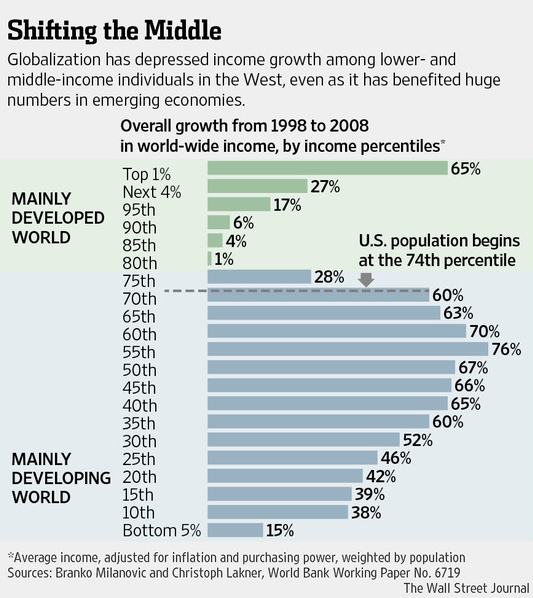
  • Globalization has had a dramatic effect on incomes world-wide as low skill work has shifted from the developed world to the developing world as shown in the chart below from the Wall Street Journal. Hundreds of millions of people in the developing world have been lifted out of poverty at the cost of lost jobs to low skill workers in the U.S. and other developed countries.
    Capture3Any effective strategy for decreasing income inequality needs to be reality based. Yes, it exists but its severity is exagerated. The Americans who need help the most are the ones unlikely to either attend or graduate from college. What they need most is vocational training to prepare them for the millions of high skill jobs going begging in the U.S.
    The best thing we can do to decrease income inequality in the U.S. is to get our economy growing faster. Since the end of the Great Recession in June 2009, it has grown at the historically slow rate of 2.2% of GDP and this slow rate of growth is predicted (by the CBO) to continue indefinitely under current government policies. A return to the historical 3% growth rate would create jobs and better jobs for millions of the unemployed and under-employed as well as providing bigger raises for the middle class as employers have to compete for qualified workers.
    How can we make the economy grow faster? I have addressed this critical issue many times and will return to it soon.

Inequality and Growth


In my opinion the two most serious problems facing the U.S. at the present time are 1) stagnant growth and 2) massive debt. As discussed by William Galston in yesterday’s Wall Street Journal, the U.S. presidential campaign is now beginning to address the first of these issues.  For example:

  • Bernie Sanders rejects “growth for the sake of growth” and says that “our economic goals have to be redistributing a significant amount back from the top 1%.”
  • Hillary Clinton says that we have to build a “growth and fairness” economy. “We can’t create enough jobs and new businesses without more growth, and we can’t build strong families and support our consumer economy without more fairness.”
  • Jeb Bush argues that there is nothing wrong with household incomes that 4% growth wouldn’t solve.

The readers of this blog will have little difficulty figuring out where I stand on this continuum of economic values. My view is illustrated by the chart just below from the World Bank which shows that countries with the fastest growing economies also have the least amount of inequality.
CaptureLet’s be more specific. Mrs. Clinton would achieve more fairness by:

  • Raising the minimum wage.
  • Guaranteeing child care and other family friendly policies.
  • Encouraging profit sharing.
  • Encouraging more innovation by increasing public investment in infrastructure, broadband, energy and scientific research.

These are attractive goals but how do we achieve them? The best way to raise wages is to get the economy growing so much faster that it creates a labor shortage. Then businesses will be competing for labor and wages will go up. This is exactly what is happening in Omaha NE where I live and the unemployment rate is down to 2.9% (2.6% in Nebraska as a whole).
Furthermore, in a tight labor market, businesses will automatically try harder to keep good employees by providing extra benefits such as childcare and profit sharing.
Public investment in infrastructure, etc. will be more easily affordable with the higher tax revenue generated by a faster growing economy.
Conclusion: faster growth is the best way to create a more fair and equal society!

“The Dung of the Devil”


My last post, “The Moral Case for Free Enterprise,” was motivated in part by a recent speech of Pope Francis comparing the excesses of global capitalism to the “dung of the devil.”
Capture2The scholar Mark Perry of the American Enterprise Institute has just published an interesting chart (just below) demonstrating an 80% reduction in world poverty in the 36 year period from 1970 to 2006.  He quotes AEI President Arthur Brooks that “if you love the poor, if you are a good Samaritan, you must stand for the free enterprise system, and you must defend it, not just for ourselves but for people around the world.  It is the best anti-poverty measure ever invented.”
CaptureIn a previous post, a year and a half ago, “A Global Perspective on Income Inequality,”  I referred to another chart (just below) to demonstrate the massive growth of income in the developing world.  To a large extent this is the result of economic globalization shifting low-skill employment from the developed world to the developing world where the cost of labor is less expensive. As Arthur Brooks says, “It was globalization, free trade, the boom in international entrepreneurship.  In short, it was the free enterprise system, American style, which is our gift to the world.
Capture1So, yes, the world as a whole is now much better off but American workers have paid a price for the global shift in low-skill work.  The answer is not to impede globalization but rather to:

  • Speed up the growth of our own economy in order to raise wages and provide more jobs for the unemployed and underemployed.
  • Improve K-12 educational effectiveness and expand career educational opportunities to better prepare present and future workers for the many new high-skill jobs being created all the time.

The world is changing rapidly but there are effective ways for the U.S. to adapt if only we have the good sense to move forward!