“Manana Is Not a Credible Fiscal Plan”


Thus spoke George Osborne, Great Britain’s Chancellor of the Exchequer, in a recent speech to the Economic Club of New York.  “By applying a consistent and long-term economic plan, we can ensure that our best days lie ahead.  If we reduce our high debt so we can weather new shocks, and take the difficult decisions to make our economies more productive, we can provide rising living standards for our citizens.”
CaptureAccording to Mr. Osborne, any long term economic plan needs to include three elements:

  • An activist monetary policy to do whatever it takes to sustain sufficient demand in the economy.
  • A credible commitment to sustainable fiscal policy. Some have argued that fiscal consolidation is incompatible with economic recovery. But recent experience, e.g. sequestration in the U.S. and a balanced budget in the U.K., has shown the reverse.
  • An ambitious program of supply-side reform. The U.S. has a booming technology sector and the fracking revolution. The U.K. has cut its corporate tax rate to 20%, welcomes disruptive innovation and is pushing ahead on shale gas.

In the U.S. things are moving in the right direction and so the focus needs to be on keeping the momentum going.  Monetary stimulus has accomplished much but now a sound exit policy is needed.  Sequestration has slowed down the growth of government debt but has not ended it.  Further progress will require entitlement reform, especially for Medicare and Medicaid.  But first, the Affordable Care Act needs to be improved to do a better job of controlling the overall cost of healthcare.  Infrastructure improvement, tax reform and expanding trade are the supply side keys to increasing productivity and shared prosperity.
Activist monetary policy, credible fiscal policy, and ambitious supply side reform: these are the policies which will lead to future progress!
The American People Are Amazingly Upbeat!


I think of myself as a political moderate, conservative on fiscal matters and somewhat liberal on social issues.  My blog posts are usually based on a recent newspaper article or think tank study presenting one side or the other of an important issue in an intelligent way.  In other words, I seldom bother to refute what I consider to be dumb ideas.  I assume that they will eventually die of their own dead weight.  My favorite approach is to respond to an attractive article with which I may have a somewhat different point of view.
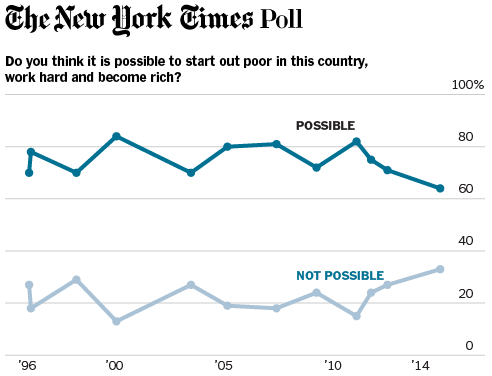
CaptureToday’s New York Times has such an article, “Many Feel American Dream is Out of Reach, Poll Shows,” pointing out that 64% of a NYT Poll respondents think that it is possible to start out poor and become rich (see above chart), which opinion has dropped from 72% in 2009.  The Poll also reports that:

  • 81% of Americans have confidence in their own local banks whereas only 41% have confidence in Wall Street bankers and brokers.
  • 52% think the economic system in the U.S. is basically fair, since all Americans have a chance to succeed, whereas 45% think it is unfair.
  • 54% of Americans think that over-regulation of the economy, which interferes with economic growth, is a bigger problem than under-regulation, which may create an unequal distribution of wealth.

For almost two-thirds of Americans to be upbeat about the American Dream, after six or seven years of recession and slow recovery is to me a very positive sign.  After a severe financial crisis, it is not at all surprising that “main street” bankers have a much higher favorability rating than “Wall Street” bankers.
Several months ago I reported on a survey taken by the progressive Global Strategy Group showing that 80% of voters consider economic growth more important than income inequality.
Both today’s NYT Poll and the previous GSG Survey are saying loud and clear that Americans put a high premium on economic growth and this is where our national leaders should be concentrating their time and energy.  The new Republican majority in Congress has an almost historic opportunity to get this right.  Let’s hope they don’t blow it!

Let’s Keep the Economic Momentum Going


There has been lots of good economic news lately:

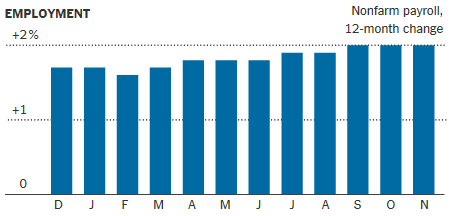
  • The economy added 321,000 jobs in November, the most in one month since January 2012.
  • The unemployment rate of 5.8% remains steady and is down from 7% in November 2013.
  • The average hourly earnings for workers is up by 2.1% from a year earlier.
  • Economic growth for the third quarter is up 3.9% from the previous quarter.
  • The deficit for the 2014-2015 fiscal year was “only” 2.8% of GDP and is predicted by the Congressional Budget Office to drop to 2.6% for the current year.
  • The price of a gallon of gasoline has dropped to $2.71 on average, its lowest level since 2010 and is still dropping.

CaptureThe New York Times predicts that the “Brighter Economy Raises Odds of Action in Congress.”  Jason Furman, Chairman of the White House Council of Economic Advisors, is quoted as saying that “At least there will be less of a philosophical debate on infrastructure, tax reforms and expanding exports.  You can have that agenda because the economy is not in free fall.” These three items would make a great agenda for the 114th Congress in the following way:

  • Infrastructure. The continuing drop in the price of gasoline offers the opportunity to replenish the inadequately funded Highway Trust Fund in a fiscally responsible manner. Congress should raise the federal gasoline tax above its current 18 cents per gallon to a level which is sufficient to fund the entire federal share of highway construction and repair.
  • Tax reform. Individual and corporate tax reform will give the economy a huge boost. The idea here is to lower tax rates in a revenue neutral way by closing loopholes and deductions.
  • Expanding Exports. What’s needed here is to give the President fast track negotiating authority so that Congress has to vote any trade agreement up or down without modification. This is the only way to get other countries to make concessions.


Of course there are many other issues which need to be seriously addressed by the new Congress.  But relatively quick action on just these three less controversial items would be a great start!

Inequality Does Not Reduce Prosperity


In the national elections this year four states: Alaska, Arkansas, Nebraska and South Dakota raised their state minimum wage rates above the national rate of $7.25 per hour and, at the same time, elected Republicans to the U.S. Senate, in three cases replacing Democratic incumbents.  Does this represent contradictory behavior by the voters?
CaptureThe American Enterprise Institute’s James Pethokoukis recently reported (see above) that the U.S. has the third highest rate of billionaire entrepreneurs behind only Hong Kong and Israel, as well as by far the most billionaires over all.  These are the high-impact innovators like Bill Gates, Steve Jobs and Mark Zuckerberg and the Google Guys.
These observations are put in context by the Manhattan Institute’s Scott Winship who recently reported that “Inequality Does Not Reduce Prosperity.” Here is a summary of his findings:

  • Across the developed world, countries with more inequality tend to have higher living standards.
  • Larger increases in inequality correspond with sharper rises in living standards for the middle class and poor alike.
  • In developed nations, greater inequality tends to accompany stronger economic growth.
  • American income inequality below the top 1 percent is of the same magnitude as that of our rich-country peers in continental Europe and the Anglosphere.
  • In the English-speaking world, income concentration at the top is higher than in most of continental Europe; in the U.S., income concentration is higher than in the rest of the Anglosphere.
  • With the exception of a few small countries with special situations, America’s middle class enjoys living standards as high as, or higher than, any other nation.
  • America’s poor have higher living standards than their counterparts across much of Europe and the Anglosphere.

Conclusion: Americans are fair-minded and would like to help the working poor do better.   But Americans also appreciate the value of innovation and entrepreneurship.  When there is a tradeoff between increasing prosperity and reducing inequality, greater prosperity comes first.

Is It Feasible to Cut Tax Preferences to Pay for Lower Tax Rates?


I have been focusing lately on America’s two biggest fiscal and economic problems:

  • How to boost the economy in order to put more people back to work
  • How to either cut spending or raise revenue in order to shrink the deficit.

A few days ago in “The Great Wage Slowdown and How to Fix It,” I laid out a fairly specific proposal to make a substantial reduction in tax preferences in order to cut tax rates across the board and especially for the 64% of taxpayers who do not itemize deductions.  These are the middle- and lower-income workers with stagnant incomes who would likely spend any tax savings they received thereby giving the economy a big boost. Let’s examine whether or not this is a realistic course of action.
CaptureThe above chart from the Congressional Budget Office document, “The Distribution of Major Tax Expenditures in the Individual Income Tax System,” shows that, for example, the upper 10% of households by income receive about 40% of the total $1 trillion in individual tax expenditures per year.  Furthermore, this same top 10% of tax payers have an income of about $140,000 or more (Congressional Research Service). My basic idea is to shrink tax preferences by $250 billion per year and to lower tax rates for middle- and lower-income non-itemizers by this same amount.  If we assume that they would spend 2/3 of this new income, it would boost the economy by $170 billion per year which is 1% of GDP.
A reasonable way to achieve this savings is to expect higher income earners to contribute a greater percentage of their tax preference savings.  For example:

  • top 1% contribute $110 billion (2/3 of their total deductions).
  • top 96th % to 99th % contribute $50 billion (1/2 of their total deductions).
  • top 91st % to 95th % contribute $30 billion (1/3 of their total deductions).
  • top 81st % to 90th % contribute $30 billion (1/4 of their total deductions).
  • top 61st % to 80th % contribute $30 billion (1/5 of their total deductions).
  • this gives a total of $250 billion in tax preference savings.

This back-of-the-envelope calculation is not intended to be definitive but rather to suggest what can be done along these lines.  Those who are more well-off need to make bigger sacrifices in getting our economy back on track.

Straight Talk about the National Debt


The deficit for fiscal year 2014-2015 just ended is “only” $483 billion, about 2.7% of current GDP, and some observers are saying this means that our deficit and debt problems are now under control and we should stop fretting so much about them.
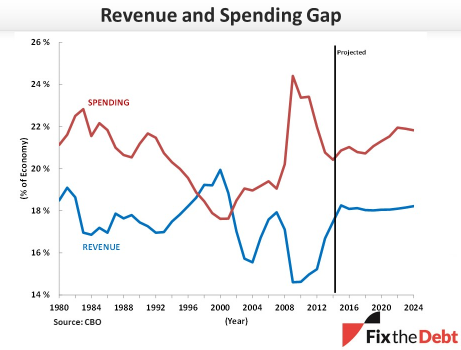
CaptureThere is a nonpartisan outfit in Washington DC, “Fix the Debt,” which focuses on this very problem and they’re saying not so fast.  In their document, “Common Myths about the Debt,” they debunk several false impressions about the national debt:

  • Myth: Deficit levels are falling and therefore debt is no longer a concern.
  • Fact: Over the next decade our debt is on track to grow about $8 trillion (see above chart). Its growth will accelerate after 2018 and will exceed the size of the entire economy by 2035.
  • Myth: Deficit reduction is just code for austerity which will ultimately hurt the economy.
    Fact: A comprehensive and gradual deficit reduction plan can replace austerity with targeted and pro-growth reforms which promote economic recovery and accelerate long-term wage growth.
  • Myth: Deficit reduction will harm low-income and vulnerable populations.
  • Fact: Every recent bipartisan deficit reduction plan has included progressive reforms that ask more from those who can afford it and protect low-income programs.
  • Myth: The debt can be solved with faster economic growth.
  • Fact: Economic growth must be part of the solution, but it can’t solve the debt problem alone. Productivity growth would have to be 50% higher over the next quarter century just to hold debt to its current record-high levels.
  • Myth: Taxing the wealthy more will solve the debt problem.
  • Fact: Our debt problems are too large, and the top 1% too few, to solve the entire problem by raising taxes on the wealthy.

Conclusion: Our debt problem is so large that it can only be solved by stern measures, such as tax reform, including reducing tax breaks, and also spending reform to slow the growth of entitlement programs. Stay tuned for further discussion of this critical problem!

How Bad Is Income Inequality and How Do We Fix It?


The latest news on the American economy is mixed. The unemployment rate fell to 5.9% in September but the labor force also fell by 97,000 last month.  The labor participation is now down to 62.7%, a level last seen in 1978.  On the plus side 248,000 new jobs were created but the share of the population employed stayed at 59%, less than its 59.4% level at the end of the recession in June 2009.  In other words, job growth is definitely picking up but not fast enough.
CaptureHow about income inequality?  One simple way of describing and understanding the degree of income inequality in the U.S. is to look at median household income and how it changes over time.  The above chart from the WSJ shows how the median U.S. household income fell from an all-time high of $56,895 in 1999 to $51,939 in 2013.  However it also climbed back up to $56,436 in 2007 before dropping precipitously until 2012.
Capture1The Global Strategy Group discovered in a recent survey that registered voters overwhelmingly rate economic growth as a higher priority than economic fairness.  This means that any policy designed to speed up economic growth is likely to receive favorable support by the electorate.
In a recent post I describe a plan for broad-based tax reform specifically designed to speed up economic growth.  It would involve an across-the-board cut in tax rates totaling about $500 billion per year, but completely paid for by closing loopholes and deductions which primarily benefit the wealthy.  The 64% of taxpayers who do not itemize deductions would receive a tax cut.  And they would likely spend this extra money in their pockets because they are precisely the middle- and lower-income wage earners with falling incomes.
An income tax redistribution like this would greatly reduce inequality but in a way which is designed to give the economy a big boost!

Economic Expansion Is Not Enough


The Washington Post reporter Robert Samuelson gives our economy today a B-, because the unemployment rate has inched down to 6.1%, fulltime employment is up to 105.8 million in 2013 from 99.5 million in 2010, and full-time women’s pay reached a high of 78% of men’s pay in 2013.  The big negative, of course, is that median household income was $51,939 in 2013, down from $56,436 in 2007, just before the financial crisis.
The Bard College economist Pavlina Tcherneva, as summarized by the reporter Neil Irwin in yesterday’s New York Times, shows what has gone wrong with economic and monetary policy since the end of the Great Recession in June 2009. The American Recovery and Reinvestment Act of 2009 (an $850 billion stimulus package) did boost the economy but it primarily aided “the skilled, employable, highly educated, and relatively highly-paid wage and salary workers.”
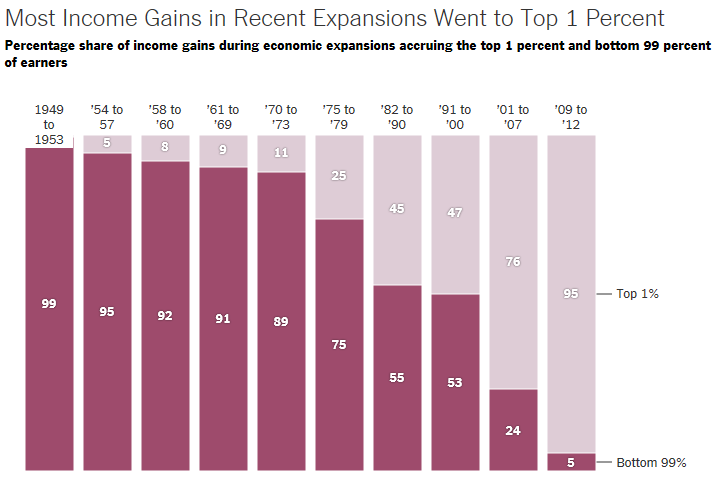
Capture2On the other hand the Federal Reserve’s quantitative easing policies have kept interest rates remarkably low and have thereby caused investors to buy stocks rather than bonds in order to get higher returns.  This has artificially boosted stock prices and has been especially advantageous to the top 10% and, even more so, the top 1%.
CaptureWhat is needed, according to Ms. Tcherneva, is a targeted, bottom-up approach to fiscal policy, which provides more and better paying jobs directly to middle- and lower-income wage earners.  Her suggestion is for public works jobs, public service employment, green jobs, etc., all of which would require large infusions of federal money thereby worsening the federal deficit.
A much better approach would be broad based tax reform, lowering tax rates across the board, paid for by closing the loopholes and deductions which primarily benefit the rich.  Since the 64% of taxpayers who do not itemize deductions would receive an effective pay boost, this would amount to a tax reform program targeted to exactly the middle- and low-income wage earners who have not yet recovered from the recession.  These folks would most likely spend their extra income, thus further boosting the economy (see my previous post).

Let’s Raise Nebraska’s Minimum-Wage but Not the Whole Country’s


In his State of the Union address last January, President Obama proposed raising the national minimum wage to $10.10 per hour from its current level of $7.25 per hour. The Congressional Budget Office has estimated that this would raise the wages of 16.5 million workers but also put at least 500,000 out of work. At a time of high unemployment, with an estimated 24 million people either unemployed or underemployed, this would be a bad tradeoff.
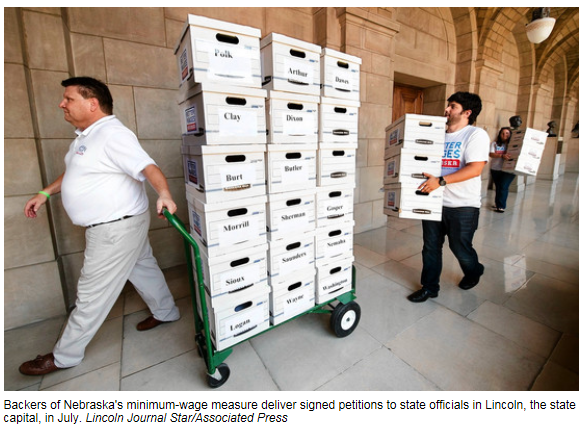
CaptureThe Wall Street Journal reports, “Some Republicans Back State Minimum-Wage Increases,” that five states, including Nebraska where I live, have minimum-wage proposals on the ballot this year. In Nebraska the minimum-wage would increase in two steps to $9.00/hour from $7.25.  Nebraska’s unemployment rate is currently 3.6%, and it is estimated that there are only 27,000 people in the state being paid the minimum wage.  In other words, Nebraska actually has a labor shortage and it is unlikely that a mild increase in the minimum wage will put very many people out of work.
Capture2A minimum wage contributes to fairness but not to growth.  Both are important but growth is the more important of the two.  A minimum-wage increase in Nebraska will increase fairness without hurting economic growth and so I support this.
At the national level, an increase in the minimum wage would increase fairness but also hurt economic growth (by causing substantial unemployment) and so I oppose it.

Which Is More Important: Increasing Growth or Decreasing Inequality?


The progressive Global Strategy Group has recently released a new survey report “Focus on Growth to Frame Priorities” with a valuable message for all political candidates, left, right and center.
CaptureGSG surveyed 3000 registered voters earlier this year and discovered that they overwhelmingly rate economic growth as a higher priority than economic fairness, economic justice, expanding the middle class, increasing wages or decreasing income inequality.  In fact, economic growth trumped all of these alternative policy strategies by wide margins as shown below.
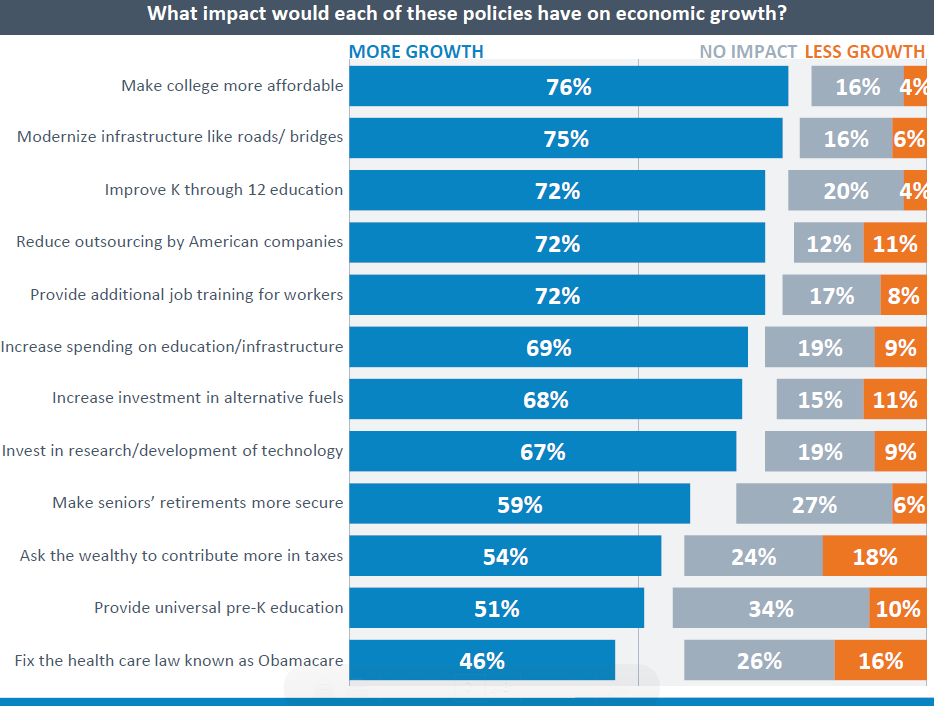
Capture1GSG then goes on to list various possible growth strategies in order of voter popularity such as making college more affordable, modernizing infrastructure, improving K-12 education and others (see below). This list of possible growth strategies is made up mostly of new spending programs.  The less costly might be doable by reforming existing spending programs.  But expensive new programs simply will not fly in today’s high deficit environment.
Capture2What is needed is a growth strategy which does not require new spending.  The obvious choice is tax reform.  For example, the fourth item in the above chart, reduce outsourcing by American companies, could be addressed by reforming corporate taxes.
But an even better growth strategy is individual tax reform whereby tax rates are lowered across the board, paid for by shrinking the many loopholes and deductions which primarily benefit the wealthy.
I described such a plan in detail in a previous post, but here is a brief summary: 64% of taxpayers do not itemize their deductions.  This means that any reduction in tax rates will put money in their pockets.  Since these are primarily the same middle- and lower-income workers with stagnant incomes, they will likely spend most of their increased pay, thus giving the economy a big boost.
In summary, the GSG report provides ammunition for political candidates of all ideological stripes.  Let’s have a contest to see which party can be the most pro-growth.  The winner will be the American people!