The Land of the Free and the Home of the Brave


As we celebrate the 239th anniversary of the signing of the Declaration of Independence in 1776, Americans have much to be thankful for.  It is often said that the United States is the strongest, wealthiest and freest country the world has ever known.  Although this may be somewhat of an exaggeration (see below), it is still indicative of how fortunate we are compared to the rest of the world.
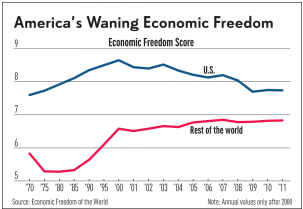
CaptureAs we celebrate our good fortune, we need to be acutely aware that our continued success as a great nation is not automatically assured.  In fact we face a number of troubling and persistent problems which are not likely to disappear unless we take strong action to address them.  For example we have:

  • A stagnant economy with only 2.2% annual growth since the end of the Great Recession. And the Congressional Budget Office predicts no speed up over at least the next ten years, based on current policy. Such slow growth condemns 20 million unemployed and underemployed citizens to unfulfilling lives, as well as lackluster pay raises for many more tens of millions.
  • Massive debt. Our public debt (on which we pay interest) is now at 74% of GDP, highest since the end of WWII, and predicted by the CBO to grow rapidly under current policies. When interest rates return to the normal 5% level, interest payments on the debt will skyrocket, making it much more difficult to fund all of the federal programs we depend on for our quality of life.
  • Increasing Income Inequality is real even if overhyped in the media. America is still a land of great opportunity but basic fairness demands that all citizens be able to share in our national abundance.
  • Threats from abroad. ISIS now controls much of Iraq, Syria and northern Africa and must be defeated. NATO needs our very strong support, all the more so with the Eurozone and European Common Market under increasing pressure from within.


As the strongest nation in the world we have much responsibility for continued world peace and prosperity.  We can’t fulfill this role adequately unless our own internal fiscal and economic policies are in fundamentally sound shape.
Let’s be thankful for what we have and bear down hard to insure that we keep it!


Can the U.S. Economy Grow Faster?


The U.S. economy has grown at the rate of only 2.2% since the end of the Great Recession in June 2009.  This is much slower than the average rate of growth of 3% for the past fifty years.
CaptureThe economists Glenn Hubbard and Kevin Warsh, writing in the Wall Street Journal, “How the U.S. Can Return to 4% Growth,” point out that:

  • After the severe recession of 1973-1975, the economy grew at a 3.6% annual real rate during the 23 quarters that followed.
  • After the deep recession of 1981-1982, real GDP growth averaged 4.8% in the next 23 quarters.
  • Recent research has shown that steep recoveries typically follow financial crises.

The economist John Taylor, also writing in the WSJ, “A Recovery Waiting to Be Liberated,” explains that the growth of the economy, i.e. growth of GDP, equals employment growth plus productivity growth.  He then points out that:

  • Population is growing about 1% per year. However the labor-force participation rate has fallen every year of the recovery, from 66% in 2008 to 62.9% in 2014. Even turning this around slightly would increase employment growth above the 1% figure coming from population growth alone.
  • Although productivity growth has hovered around 1% for the past five years, this is less than half of the 2.5% average over the past 20 years.

Given the strong headwinds of globalization and ever new technology affecting the U.S. economy, we especially need new policies such as:

  • Fundamental tax reform directed at increasing the incentives for work and driving investment in productive assets.
  • Regulatory reform that balances economic benefits and costs (e.g. lightening the burdens of Obamacare and Dodd-Frank).
  • Trade agreements to break down barriers to open global markets.
  • Education policies to prepare all young people for productive careers.

In other words, rather than accepting our current situation as “the new normal” or as unalterable “secular stagnation,” we need to “give growth a chance”!

Letting Young People Drift and the Liberal Disconnect


The New York Times had an excellent lead editorial on Sunday, “The Cost of Letting Young People Drift,” describing how 5.5 million young Americans, ages 16 – 24, are neither working nor in school.  “At a time when the economy is requiring workers to have higher levels of skills, one in seven of America’s young adults can’t even get started.”
CaptureThe NYT editorial is based on new research, “Zeroing In on Place and Race: youth disconnection in America’s cities” performed by Measure of America.  The report points out that the problem has gotten much worse since the Great Recession in 2008, as shown in the chart below.
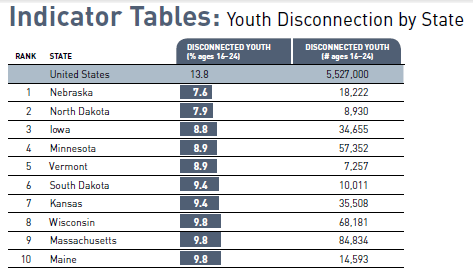
Capture1It also breaks down the youth disconnection rate by state.  For example, Nebraska (7.6%), North Dakota (7.9%) and Iowa (8.8%) have the lowest percentages, while Mississippi (18.5%), West Virginia (19.6%) and Louisiana (19.8%) have the highest percentages (as shown below).
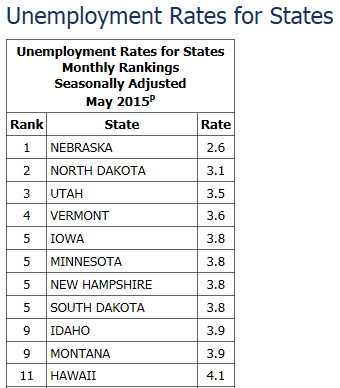
Capture2Capture3But also look at the latest “Unemployment Rates for States” published by the Bureau of Labor Statistics.  There is a very close connection between a state’s unemployment rate and its youth disconnection rate, as shown below. In other words, one of the best ways to keep young people connected is to give them a better chance of finding a job.
Capture4Capture6But it requires faster economic growth to provide more jobs.  Just yesterday the NYT had an editorial, “Obstacles to Economic Growth,” lamenting our very slow rate of economic growth of about 2.2% for the past six years.  According to the NYT, “What’s needed most is public and private investment in the economy sufficient to support strong growth and rising productivity.”  The editorial then goes on to berate Congress for being more interested in budget cuts than in new spending programs to stimulate the economy.  According to the NYT, “the pathway to prosperity is clear for leaders who will dare to take it.”
The NYT thus recognizes the need for more private investment to stimulate the economy but has no apparent interest in policy measures to encourage it.  How can a news organization as sophisticated as the NYT be so passionate about wanting to improve society and so clueless about the best way to do it?

Are Economics and Social Progress Related to Each Other?


“Your (last post) is one of the most active and positive that I have read of yours. You do put your time to where your values are. Those of us who see you as too economically focused and ourselves as more humanely concerned need to act as well. Thanks for your focus and attention.”
from a reader of my blog

I am a fiscal conservative and a social moderate. The primary reason I write this blog is because I am so concerned about the fiscal recklessness of our national leaders. Our national debt is much too large and still growing too fast. We need to either cut spending or raise taxes (or do both).
But I am also a social progressive. I voted in favor of Nebraska raising its minimum wage last fall. I support gay marriage as a civil right. I support having Nebraska expand Medicaid in order to cover more low-income people (where Medicaid needs to be fixed is at the federal level).
CaptureThere is in fact a very close connection between having a sound economy and social progress. As the above chart shows, the U.S. ranks very high in both GDP per person and social progress. All of the countries which are most socially progressive also have sound economies. This is not a coincidence.
My last post talks about what society can do to help blacks improve their socio-economic status. This includes improving educational opportunity in the inner city. But improved educational opportunity needs to be closely directed toward improved economic opportunity. This means, for example, having good jobs available for new high school and community college graduates. But this, in turn, means having strong economic growth with intelligent tax and regulatory policies to encourage entrepreneurship and business expansion.
In short, a sound economy is essential for social progress.

Why Is U.S. Productivity Growth Declining?


The economist Alan Blinder has just reported, “The Mystery of Declining Productivity Growth” that U.S. productivity growth has fallen dramatically in the last few years.  “The healthy 2.6% a year from 1995-2010 has since been an anemic 0.4%.  What’s scary is that we don’t know why.”
CaptureThe economists Edward Prescott and Lee Ohanian believe the productivity slowdown is caused by a corresponding slowdown in new startups (as illustrated by the above chart).  They point out, for example, that:

  • The creation rate of new businesses in 2011 was 30% lower than the average rate of the 1980s.
  • New startups are critical for growth since many of today’s heavyweights will decline as new businesses take their place. For example, only half of the Fortune 500 firms in 1995 remained on that list in 2010.
  • Startups in high technology have also declined since 2000 even though there is no slowdown in the development of new technology.

Consistent with the recommendations of James Bessen in a recent post of mine, “Learning by Doing,” Messrs. Prescott and Ohanian recommend policy changes such as:

  • Better training, plus immigration reform, to produce more skilled workers.
  • Streamlining regulations that raise cost, especially for small businesses.
  • Tax reform to reduce marginal tax rates.
  • Reforming Dodd-Frank to make it easier for small businesses to obtain loans from main street banks.

In today’s New York Times, the economist Tyler Cowen wonders whether our economy is in the midst of a “Great Reset.”  “Perhaps the most crucial issue is whether economies will return to normal conditions of steady growth, or whether we are witnessing a fundamental transformation” to a less productive economy.
Here’s another way to put it: shall we attempt to adopt better pro-growth policies or shall we just give in to the status quo and accept that we can’t do any better?  Are we optimists or are we pessimists?

Learning By Doing II. The negative influence of lobbyists


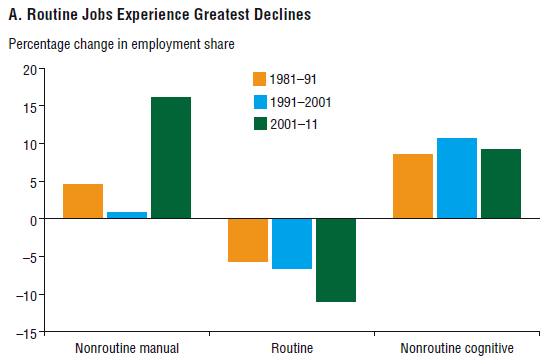
My last post reported on a new book by James Bessen, “Learning by Doing: the real connection between innovation, wages and wealth.”  It makes several recommendations for how the U.S. can better meet the challenges posed by the hollowing out of the middle class, as illustrated in the chart just below from the Dallas Federal Reserve.
Capture Mr. Bessen blames one primary culprit for this problem: the growing role of money in politics.  For example:

  • The dramatic growth in occupational licensure from 70 occupations covering 5% of the workforce in the 1950s to over 800 occupations covering over 29% of the workforce in 2008. Such a major change can only be understood as the outcome of massive lobbying.
  • Defense procurement. For example, in 2012 the defense industry spent $132 million on over 900 lobbyists. It is hardly surprising that defense procurement rules have favored established defense contractors at the expense of start-up technology firms.
  • The best patent law money can buy. Patent trolls have continued to file more lawsuits, despite the America Invents Act of 2011. A new legislative effort for patent reform in 2013 passed the House by a margin by a margin of 325 to 91 but then was killed by the Senate in May 2014.
  • Changes in trade secret law. The problem is that more uniform trade law, which sounds desirable, also broadens its scope which then limits employee mobility and the creation of spin-offs.
  • Strong enforcement of non-compete agreements in Massachusetts protects established firms but hurts startups. This has given Silicon Valley companies a big advantage over the companies on Route 128 outside of Boston.

Mr. Bessen makes a very strong case for the harmful effects of lobbyists and their money in retarding economic growth.  But how can we possibly curtail the influence of lobbyists without limiting their freedom of speech?  Stay tuned for the next post!

Learning By Doing


The two biggest problems facing our country today are a stagnant economy and an exploding national debt.  Faster economic growth would help pay our bills by bringing in more tax revenue.  It would also create more jobs and give a boost to stagnant wages.  One of the causes of this stagnation is that our economy has become less entrepreneurial over time as shown by this often cited chart from the Brookings Institution.
CaptureA very interesting new book by James Bessen, “Learning by Doing: the real connection between innovation, wages and wealth.” looks at both our economic history and our current economy to understand how society can best meet the challenges posed by new technology.  Mr. Bessen  identifies the basic problems as follows:

  • Funds have been shifted away from vocational education and community colleges at a time when large numbers of workers could acquire valuable skills at these institutions.
  • The rapid growth of occupational licensing restricts training and jobs open to mid-skill workers and, in many cases, limits their use of technology.
  • Military procurement favors large defense contractors over start-up firms, while heightened secrecy requirements limit the development of open standards and the broad sharing of knowledge.
  • Job mobility has declined, limiting knowledge sharing and weakening labor markets.
  • Abusive patent litigation has exploded, making it harder for startups and small firms to develop new technology.

Mr. Bessen concludes:“The practical skills of ordinary people have been a wellspring of widely shared wealth for 200 years, and the economic power of mighty nations rests on the technical knowledge of the humble.  Provide the means for ordinary workers to acquire the skills and knowledge to implement new technology today and the economic bounty will not only grow, it will be widely shared.”
What are the roadblocks to implementing Mr. Bessen’s recommendations?  I will return to this question later.

Why Inequality Is Harmful and What to Do About It


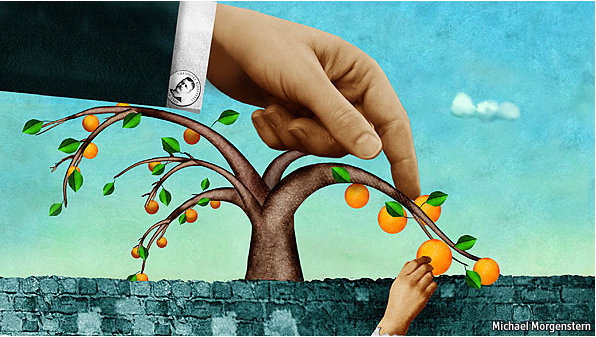
I describe this blog as addressing our fiscal and economic problems, meaning deficits and debt on the one hand and slow economic growth on the other.  But these topics, while being of critical importance to our national welfare, are also somewhat on the dry side.  The subject of economic inequality stirs up lots more interest and response. In the Fall of 2012 The Economist declared that “a new form of radical centrist politics is needed to tackle inequality without hurting economic growth.”
CaptureSays The Economist:

  • There’s too much cronyism in the rich world. Banks which are “too big to fail” have an implicit subsidy. From doctors to lawyers, many high paying professions are full of unnecessarily restrictive practices. Social spending often helps the rich more than the poor. For example housing subsidies for the top 20% (mortgage-interest deductions) are four times the amount spent on public housing for the poorest 20%.
  • If income gaps become too wide, they can lead to less equality of opportunity, especially in education. The gap in test scores between rich and poor American children is 30 – 40% wider than it was 25 years ago.
  • If those on the top of the heap resist equalizing changes, it could lead to political pressure which serves nobody’s best interests.

Here are The Economist’s proposals for a True Progressive Agenda to attack inequality:

  • Compete.   A Rooseveltian attack on monopolies and vested interests is needed. School reform is crucial: no Wall Street financier has done as much damage to social mobility as the teacher’s unions have.
  • Target. Government spending need to be focused on the poor and the young. Governments can’t hope to spend less on the elderly but they can reduce the pace of increase.
  • Reform. Eliminate tax deductions which primarily benefit the wealthy such as for mortgage-interest; narrow the gap between tax rates on wages and capital income.

“The right is still not convinced that inequality matters.  The left’s default position is to raise income tax rates for the wealthy and to increase spending still further – unwise when sluggish economies need to attract entrepreneurs and when governments are overburdened with promises of future spending.”
Surely there is a better way!

Baltimore Is About Economics, Not Racism


The death of another black man at the hands of the police, this time Freddie Gray of Baltimore, has again set off a national debate about poverty, inequality and racial injustice.
CaptureThe Washington Post journalist Marc Thiessen wrote about this several days ago in, “The Baltimore Democrats Built,” saying that:

  • Although 63% of Baltimore residents are black, so are 40% of police officers.
  • City officials injected $130 million into the Sandtown-Winchester community (where the riots took place) in a failed effort to transform it.
  • The poverty rate in Baltimore is 24% compared with 14.5% nationally.
  • The unemployment rate for black men in Baltimore between the ages of 20 – 24 is 37%.
  • Among the nation’s 100 largest counties, the one where children face the worst odds of escaping poverty is the city of Baltimore.
  • In 2014, Baltimore public schools ranked third in the country in per-pupil spending, yet 55% of Baltimore fourth graders scored below basic in reading.
  • In the Sandtown-Winchester community, nearly half of all high school students missed at least 20 days of school in 2011.
  • This community’s murder rate is double the average for Baltimore, which in turn had the fifth highest murder rate last year among major U.S. cities.

In other words, Baltimore’s problems cannot be blamed on racial prejudice or on a lack of resources to combat poverty and low educational performance.  Clearly needed are better schools and more employment opportunities.  Better state and local leadership would help in this respect. But what is most needed is faster economic growth for the whole country.  There are many things which could be done to accomplish this.  It’s a shame that our current political system is too fractured to allow this to happen.

Are We Doing Enough to Help the Poor?


Income inequality in the U.S. is getting worse and one reason is that the middle class is being “hollowed out” by a lack of sufficient job opportunities.
CaptureThe result is more people at the bottom end of the income scale.  Not surprisingly, it turns out that many of these low-wage workers are receiving public assistance, as documented by the UC Berkeley Labor Center, and the New York Times.
Capture1The authors point out that if these workers received higher wages, they would not require as much public support which, in turn, would save money for the taxpayers.  This is a true but not a practical means for helping the poor.  Employees are paid what they’re worth based on the law of supply and demand.  Companies will pay as much as they have to in order to find and retain well qualified workers.  Furthermore, a minimum wage which is too high will simply lead to a higher rate of unemployment.
There is really only one good way to raise the overall wage level, especially at the bottom end of the scale.  It is to speed up economic growth, thereby lowering the unemployment rate and creating more demand for workers.
This is exactly what has happened in Omaha NE where I live.  The official unemployment rate is 3.2% and there is a labor shortage.  A new minimum wage ($8/hour now, $9/hour next January) was approved by the voters last November.  But low-skill entry level jobs are paying $10/hour or more because of the scarcity of workers.
There are plenty of opportunities to succeed in Omaha.  Support yourself with a low-wage job and go to Metropolitan Community College to learn a high-skill, high-wage trade.  Most people are capable of following this route to a better life!