The Financial Crisis III. How Do We Sort Out What Happened?


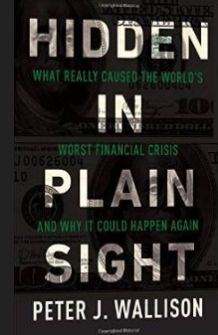
The Financial Crisis in 2008 was one of the most disruptive events in U.S. history.  It is crucial that we understand what caused it so that we can recover from it more fully and avoid a recurrence.  My favorite books about the crisis are: The Financial Crisis and the Free Market Cure by John Allison, President of the CATO Institute and former CEO of the large financial services company, BB&T;  Bull By the Horns by Sheila Bair, Chair of the FDIC from 2006-2011; and Hidden in Plain Sight by Peter Wallison, an economics policy scholar at AEI and former member of the FCIC.
CaptureNot surprisingly, these three very well informed individuals have somewhat different points of view.
Mr. Wallison says that the government’s affordable housing policies caused the financial crisis by essentially requiring the GSEs Fannie Mae and Freddie Mac to acquire increasingly large numbers of subprime mortgages.  The financial power of the GSEs forced private lenders to lower their own lending standards in order to compete (this last assertion is in dispute). When the resulting housing bubble burst, large numbers of subprime mortgages defaulted causing huge losses for both GSEs and private financial institutions alike.
Ms. Bair says that “the subprime lending abuses could have been avoided if the Federal Reserve Board had simply used the authority it had since 1994 under the Home Ownership Equity Protection Act to promulgate mortgage lending standards across the board.”  In March 2007 she testified strongly in favor of the Fed issuing an anti-predatory lending regulation under HOEPA and was rebuffed by the Fed.  As FDIC Chair she constantly urged, largely without success, that other federal agencies use their regulatory powers to curtail the abuses of private lenders.
Mr. Allison agrees with Mr. Wallison that “the whole origination market relaxed its standards to compete with Freddie and Fannie.”  However he goes on to say that “the investment banks (including Bear Stearns and Lehman Brothers) magnified the misallocation of credit to the housing market.  They created a series of financial innovations (CDOs, derivatives, etc.) that leveraged an already overleveraged product. … Investment bankers unquestionably made irrational decisions based on pragmatic, short-term thinking. … Those who made these mistakes should have been fired and their companies allowed to fail.”
Can these disparate points of view be melded into a coherent framework for the financial crisis which suggests a way forward from where we are today?  I will attempt to do this in my next post.

The Financial Crisis II. Is Peter Wallison Credible?


“It was a great mistake to push lower-income people into housing they couldn’t afford and couldn’t really handle once they had it.
 
                                                             former Congressman Barney Frank, 2010

“The ferocity of the left in defending Fannie Mae, Freddie Mac, and the government’s housing policies before 2008 is sometimes shocking, especially when even Barney Frank has given up.  It makes you wonder why this is so important to them.  They have no data, no policy arguments, just a virulent denial that anything other than the private financial sector could possibly be responsible for the financial crisis.”
                                                  “Hidden in Plain Sight,” p 42, by Peter Wallison, 2015

My last post, “The Financial Crisis I. The Cause” reported on a new book “Hidden in Plain Sight: What Really Caused the World’s Worst Financial Crisis and Why It Could Happen Again” by Peter Wallison, a financial policy analyst at the American Enterprise Institute.  He makes a very strong case, with voluminous documentation, that the basic cause of the financial crisis was the HUD policy requiring government agencies like Fannie Mae, Freddie Mac and the FHA to gradually acquire an increasing percentage of subprime mortgages.  When the housing bubble finally burst in 2007, the enormous number of delinquencies and defaults among these nontraditional mortgages, aggregate value over $5 trillion, drove down housing prices and caused the financial crisis.
CaptureAs noted above by Mr. Wallison himself, such an explanation is simply unacceptable to people who insist on blaming the private sector for the crisis.  Rather than dealing with public records and data available, they instead try to discredit Mr. Wallison.  My purpose today is to give two vivid examples of the types of documents which Mr. Wallison uses to make his case:

  • (Fannie Mae 10-K report, 2006). “We have made, and continue to make, significant adjustments to our mortgage loan sourcing and purchase strategies in an effort to meet HUD’s increased hosing goals and new subgoals.  These strategies include entering into some purchase and securitization transactions with lower expected economic returns than our typical transactions.  We have also relaxed some of our underwriting criteria to obtain goals-qualifying mortgage loans and increased our investments in higher-risk mortgage loan products that are more likely to serve the borrowers targeted by HUD’s goals and subgoals, which could increase our credit losses.
  • (statement by Daniel Mudd, former Fannie Mae CEO, April 2010). “Fannie Mae’s mission regulator, HUD, imposed ever-higher housing goals that were very difficult to meet during my tenure as CEO.  The HUD goals greatly impacted Fannie Mae’s business, as a great deal of time, resources, energy and personnel were dedicated to finding ways to meet these goals.  HUD increased the goals aggressively over time to the point where they exceeded the 50% mark, requiring Fannie Mae to place greater emphasis on purchasing loans in underserved areas.  This became particularly problematic when goal requirements grew to far exceed the proportion of eligible mortgages originated in the primary market.”

Mr. Wallison’s book is filled with this type of detailed documentation for the case he is making.  It should be persuasive to anyone with an open mind.  It certainly is to me.  Now that Mr. Wallison’s credibility is established, it is time to discuss the implications of his thesis.  Stay tuned!

The Financial Crisis I. The Cause


Only by understanding the factors that led to and amplified the crisis can we hope to guard against a repetition.                                                                                                         Ben Bernanke, September 2, 2010

An outstanding new book by Peter Wallison, ”Hidden in Plain Sight: What Really Caused the World’s Worst Financial Crisis and Why It Could Happen Again” gives a voluminous and highly compelling explanation of the main cause of the financial crisis of 2008.  Mr. Wallison worked at the Treasury Department in the 1980s, was a member of the Financial Crisis Inquiry Commission (2009 – 2011) and is currently a scholar at the American Enterprise Institute.
CaptureHere is the outline of Mr. Wallison’s story:

  • The Department of Housing and Urban Development gradually increased the requirement that loans acquired by Fannie Mae and Freddie Mac be made to low- and moderate-income borrowers from 30% in 1992 to 56% in 2008.
  • As a result of these policies, by the middle of 2008 there were 31 million Nontraditional (low down payment and/or poor credit) Mortgages (NTMs) in the U.S. Financial system, more than half of all mortgages outstanding, with an aggregate value of more than $5 trillion. At least 76% of these were on the books of government agencies such as Fannie, Freddie and the FHA or banks and S&L institutions, holding loans which they were required to make by the Community Reinvestment Act.
  • The 24 million NTMs acquired or guaranteed by government agencies were major contributors to the growth of the housing bubble and its lengthy extension in time.
  • The growth of the bubble suppressed the losses that would ordinarily have brought NTM type Private Mortgage-Backed Securities (PMBS) to a halt but rather made these instruments look like good investments.
  • When the bubble finally burst, the unprecedented number of delinquencies and defaults among NTMs drove down housing prices.
  • Falling home prices produced losses on mortgages, whether they were government backed or PMBS.
  • Losses on mortgages caused investors to flee the PMBS market, reducing the liquidity of the financial institutions that held the PMBS.
  • Once the housing bubble burst, four major errors were made by our top government financial officials: The first and major error was the rescue of Bear Stearns. The moral hazard created by this action reduced the incentive for other firms to restore their capital positions. Once Bear had been rescued it was essential to rescue Lehman Brothers. Treasury Secretary Paulson and Fed Chairman Bernanke’s arguing that they did not have legal authority to rescue Lehman provided an excuse for Congress to pass the destructive Dodd-Frank Act. Finally, TARP accomplished little but caused much popular resentment against the banks which supposedly got bailed out.

Conclusion: as long as the American people don’t understand that government housing policies were the main cause of the financial crisis, we are likely to repeat the same mistakes over again.

Is the Democratic Party Giving Up On Growth?


Prospects for future economic growth are decidedly grim.  The Congressional Budget Office has just reported that after a brief improvement for a couple of years, annual GDP growth will likely hover around 2.2% for the remainder of the ten year window 2015 – 2025.  This means, in turn, that the unemployment rate will also not likely fall much below its current level of 5.7% for the same ten year period.
CaptureA new report from the McKinsey Global Institute makes the even gloomier prediction that average U.S. GDP growth rate for the next 50 years will be only 1.9% per year, given current trends and policies.  A summary of this report is provided by the Brookings Institution social economist, William Galston.
On the other hand, according to New York Times columnist, Nate Cohn, the Democratic Party may be adopting a new policy direction, “The Parent Agenda, The Democrats’ New Focus.”  By this new focus he means:

  • Paid family leave
  • Universal preschool
  • An expanded earned-income tax credit and child tax credit
  • Free community college
  • Free four year college in time

Mr. Cohn points out that both President Obama as well as Hillary Clinton have endorsed such ideas.  Initiatives such as these are unlikely to go far in the current Republican Congress but they may still sound very attractive to the many hard-pressed middle class families with stagnant incomes.
The problem is that to emphasize a “family” political agenda like this is in effect to accept the conventional wisdom that faster economic growth is unattainable.  This is a defeatist attitude which is very harmful to the 20 million Americans who are either unemployed or under-employed. Here, briefly, is what could be done to boost economic growth in the short term:

  • Implement broad-based tax reform with lower tax rates for all, paid for by closing loopholes and limiting deductions.
  • Reduce regulatory burdens on business by, for example, streamlining (not repealing!) the Affordable Care Act and the Dodd-Frank Financial Reform Act.
  • Expand legal immigration with additional high-skill visas as well as an adequate guest worker program.
  • Expand international trade with new trade agreements.

These are all political footballs, of course, but also policies with much potential to speed up economic growth.  Either we take initiatives such as these or we consign our country to a future of relative economic stagnation with slow wage growth, high unemployment and increasing income inequality.

The Bush Deficits vs the Obama Deficits


As I like to remind readers, I am a fiscal conservative and a social moderate.  I started writing this blog in November 2012, after running unsuccessfully in a Republican congressional primary in May of that year.  I am appalled by our reckless fiscal policies in recent years.  We simply have to get federal spending in much better alignment with tax revenue and do this in a relatively short period of time.
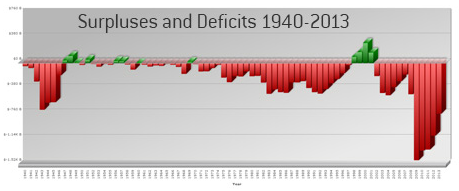
Both political parties are responsible for our current predicament.  Nevertheless, we need to have the best factual information available to help us get back on track.  Today I compare the Bush deficits with the Obama deficits.  The most objective way to do this, in my opinion, is to divide the transition budget years, 2001 and 2009, between the incoming and outgoing presidents.  In other words, October, November and December of the year 2000 are assigned to President Clinton and the last nine months of the 2001 budget year, i.e. January 2001 – September 2001, are assigned to President Bush.  Likewise for the 2009 budget year, when Bush was leaving office and President Obama was coming in.
CaptureA good source for such detailed budget information is the website of David Manuel, “an online repository of financial and political information that is often searched for but is generally hard to find.”
Here is what I’ve come up with:

President Bush

  • 2001 budget year (last 9 months)                $129.6 (billion) surplus
  • 2002 budget year                                         $157.8 (billion) deficit
  • 2003 budget year                                         $377.6 (billion) deficit
  • 2004 budget year                                         $413   (billion) deficit
  • 2005 budget year                                         $318   (billion) deficit
  • 2006 budget year                                         $248   (billion) deficit
  • 2007 budget year                                         $161   (billion) deficit
  • 2008 budget year                                         $459   (billion) deficit
  • 2009 budget year (first 3 months)                $332.5 (billion) deficit
  •                                                                   $2,337.3 (billion) deficit TOTAL

President Obama

  • 2009 budget year (last 9 months)               $1080.5 (billion) deficit
  • 2010 budget year                                        $1294  (billion) deficit
  • 2011 budget year                                        $1299  (billion) deficit
  • 2012 budget year                                        $1100  (billion) deficit
  • 2013 budget year                                         $ 683  (billion) deficit
  • 2014 budget year                                         $ 483   (billion) deficit
  • 2015 budget year (CBO estimate)               $ 468   (billion) deficit
  • 2016 budget year (CBO estimate)               $ 467   (billion) deficit
  • 2017 budget year (first 3 months, CBO)      $ 163     (billion) deficit
  •                                                                   $7,037.5   (billion) deficit TOTAL  

These totals represent, of course, the amounts that were added (Bush) or will be added (Obama) to the national debt during their terms of office.  George Bush made little, if any, effort to control deficit spending.  But the Obama debt is three times as bad as the Bush debt.  Getting the debt under control is by far our biggest and most urgent national problem.  By failing to take our debt seriously, both Bush and Obama have been huge failures as president!

Omaha: What Happens When There’s a Labor Shortage?


The unemployment rate in Nebraska is now down to 2.9% and even in Omaha, a relatively large metropolitan area of 850,000, it is only 3.2%.  As reported by the Omaha World Herald today, such a low unemployment rate creates big problems for employers at all levels.
CaptureFor example:

  • In fast foods, beginning salaries are up to $10 or more per hour, well above Nebraska’s new minimum wage of $8 per hour, and raises for responsible employees are frequent. Manager’s salaries are increasing rapidly. Benefits are being expanded into such areas as tuition reimbursement.
  • For the predominantly minority residential area of North Omaha, with a traditional unemployment rate of up to 20%, local manufacturers are beginning to provide transportation vans to pick up and drop off workers.
  • The Omaha Chamber of Commerce is running an ad campaign in Seattle to appeal to soon-to-be-laid-off Microsoft workers, because there are lots of vacant tech positions in Omaha.
  • Both the Greater Omaha Chamber of Commerce and the Lincoln Chamber of Commerce have endorsed LB 586 in the Nebraska Legislature to ban discrimination in the workplace based on sexual orientation and gender identity. The purpose, as expressed by both chambers of commerce, is to create a more attractive work environment in order to attract more workers from other states. The neighboring states of Iowa and Colorado have passed such laws.

What more can be done?  The welcoming labor market should provide a bigger incentive for both high school and college students to finish their studies and graduate.  Jobs will be waiting for them!  The labor shortage should also help create more interest in immigration reform.  This would insure that Nebraska has an adequate number of legal guest workers to meet the needs of the agricultural and meatpacking industries.

The President’s Budget: Stabilization of the Debt Is Not Enough!


President Obama has proposed a $3.99 trillion budget for next year, a $340 billion increase from the current 2015 budget year.  As shown in the charts below, it projects deficits of about 2.6% over the next ten years equal to its (optimistic in comparison to the CBO) growth projections for GDP.  This means that the debt would stabilize at about 73% of GDP.  And, of course, achieving his predicted stabilization of debt will require big tax increases over this ten year period.
CaptureHere are the major weaknesses in the budget:

  • Sequestration. The President declares that “I’m not going to accept a budget that locks in sequestration going forward.” Everyone deplores the mindlessness of sequestration but the only responsible alternative is to make targeted cuts throughout the budget. The President makes no attempt to do this. And he wants to add spending for various new education and research initiatives, as well as an expanded Earned Income Tax Credit for low-income workers.
  • Infrastructure. Spending over the next six years would increase by $238 billion to be raised from a 14% repatriation tax on the $2 trillion in foreign earnings held overseas by American multinational corporations. The problem is that any repatriation tax should be tied in with overall corporate and business tax reform, exchanging lower tax rates in return for closing loopholes and deductions, in order to make U.S. business taxes competitive with those of other countries. Fundamental tax reform is the key to getting our economy growing faster.
  • Entitlements. The President’s budget does not even mention the biggest threat to long-term fiscal sustainability, namely the rapidly increasing spending for Social Security, Medicare and Medicaid. It will be very difficult to make progress on this critical issue without presidential leadership.
  • Stabilization of the Debt. The President’s budget, with quite optimistic revenue and growth projections, stabilizes the debt over ten years. But this is not nearly good enough. To be satisfied with a public debt of 73% of GDP indefinitely into the future is simply too risky. What’s going to happen when we have another financial crisis, as we surely will? How are we going to cope with our growing rivalry with China with very little budget flexibility? And one can imagine any number of other possible emergencies which might occur. Putting the debt on a clear downward trajectory is the only prudent thing to do!

It’s Paul Krugman Who Is Being Irresponsible!


The New York Times columnist, Paul Krugman, writes provocatively on fiscal and economic issues and is well-known as a liberal icon.  Usually I ignore his diatribes.  But his column yesterday, “The Long-Run Cop-Out” goes way overboard.
CaptureI will refute several of the statements from this column.

  • “Think about it: Faced with mass unemployment and the enormous waste it entails, for years the beltway elite devoted all most all its energy not to promoting recovery, but to Bowles-Simpsonism – to devising “grand bargains” that would address the supposedly urgent problem of how we’ll pay for Social Security and Medicare a couple of decades from now.” Worrying about our enormous and rapidly increasing national debt, does not mean ignoring our sluggish economy and the high unemployment it causes. The way to increase economic growth is to enact broad based tax reform by lowering tax rates, offset by closing loopholes and limiting deductions. This will further boost the economy in the same way that lower gasoline prices is already doing.
  • “Many projections suggest that our major social insurance programs will face financial difficulties in the future (although the dramatic slowing of increases in health costs makes even that proposition uncertain).” Healthcare costs dropped to 4.1% in 2014 but this is still more than double the inflation rate of 1.7%. This isn’t nearly good enough.
  • “Why, exactly, is it crucial that we deal with the threat of future benefit cuts by locking in plans to cut future benefits?” The point is to protect benefits, not curtail them. If we act now, to increase revenue and/or slow down the growth of entitlement spending, then we won’t have to cut future benefits.
  • “So why the urge to change the subject (from austerity) to structural reform? The answer, I’d suggest, is intellectual laziness and lack of moral courage.” $6 trillion added to our debt in the last six years is profligacy, not austerity. It is immoral to burden future generations with such massive new debt.
  • “In today’s economic and political environment, long-termism is a cop-out.” Preparing for the future is just plain common sense. Should we ignore festering problems like global warming, illegal immigration and increasing poverty until they get much worse? Of course not. We should address these problems now and get our debt under control at the same time.  

What Will True Healthcare Reform Look Like?


My last post, “Progress on Medicaid Reform,” discusses innovations that several states have adopted to improve the delivery of Medicaid and to make it more cost efficient. But what we really need is a complete overhaul of American healthcare, including the Affordable Care Act, as I have also recently discussed, in order to eliminate perverse marketplace incentives as well as to achieve real cost control.
CaptureAn excellent discussion of what real healthcare reform would look like is given by John Goodman in, “Healthcare Solutions for Post-Obamacare America.” Mr. Goodman gives six principles for commonsense reform:

  • Choice. People should be free to choose a health plan that fits individual and family needs, rather than one designed by bureaucrats in Washington. This means no mandates, either for individuals or employers.
  • Fairness. Any subsidy should be in the form of a fixed sum tax deduction or credit and everyone should get it as long as they obtained credible private health insurance. The amount of the subsidy would be comparable to the cost of Medicaid enrollment.
  • Universal Coverage. Since some people will turn down the offer of a tax credit, unclaimed credits can be used to reimburse safety net healthcare institutions.
  • Portability. Portability insurance should be available to employees in case they change jobs or become self-employed.
  • Patient Power. Health Savings Accounts need to be made more available and also more flexible so that they can wrap around any third-party insurance plan, as indicated in the above chart.
  • Real Insurance. Under ACA millions of people are losing access to out-of-network providers. People should be allowed to purchase “change-of-health-status insurance” in case they develop expensive-to-treat conditions.

The ACA addresses the access problem for healthcare but has little effect on the cost problem.  American healthcare, both public and private, is way too expensive.  This is why fundamental change is still needed.

Solving the Student Debt Problem?


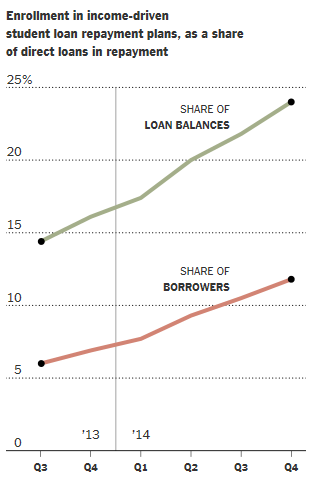
Today’s New York Times has an excellent article by Kevin Carey on the current status of federal student loans, “A Quiet Revolution is Helping Lift the Burden of Student Debt.” Our current system, called Income-Based Repayment, allows former students to repay their college loans, on a monthly basis, at a rate of 10% of net income, after deducting basic living expenses.  It forgives all loan balances after 20 years, reduced to only 10 years for people who work for government or non-profits.  As shown in the chart below, participation in the IBR program is increasing rapidly.
CaptureMr. Carey shows by example, that the IBR program is quite generous to low paid workers.  Take a teacher who borrows the national average of $29,000 for a bachelor’s degree and another $13,000 for a master’s degree and then takes a teaching job starting at $35,000 and paying $50,000 ten years later.  The teacher’s monthly payments will start at $117 and rise to about $200 in the tenth year.  The teacher will pay back a total of $18,360 and be forgiven the remainder of $48,840 of principal and interest after 10 years.
It makes sense to subsidize college education for teachers and others who work in low wage occupations.  The problem, of course, is that it is very expensive to do so.  The federal government is now committing over $100 billion each year to student loans.  There is over $1 trillion in outstanding federal student loan debt.
Many people have pointed out that our very generous student loan program is subsidizing the rapidly increasing cost of American higher education.  Here are two specific ways to address this problem:

  • Put limits on the amount of money an individual can borrow for college expenses. One such suggestion, from the political scientist, Peter Salins, would set the maximum value of a loan at 50% of the full prevailing average cost of educating undergraduates at U.S. public colleges.
  • Require all colleges to cover 20% of a defaulting student’s loan out of their own pockets. Sheila Bair makes this suggestion for for-profit colleges only but it should apply to all colleges, public and private as well as for-profit.

There are lots of low-cost and high quality educational institutions around the country, including the University of Nebraska at Omaha where I work!  Both students (and their families), as well as the colleges they attend, need to have higher stakes in limiting the explosive costs of higher education.