Is A Free Market Possible in Health Care?


With a total national debt of $17.8 trillion, of which close to $13 trillion is public debt (on which we pay interest), it is easily understood that the U.S. has a very serious fiscal problem. At the present time the public debt is 74% of GDP and this already high percentage is predicted by the Congressional Budget Office to keep growing indefinitely.
The biggest driver of spending growth going forward is the cost of healthcare.  For example just the three programs, Medicare ($492 billion), Medicaid ($280 billion) and Veterans Healthcare ($54 billion), cost a total of $826 billion per year in federal dollars.  And these costs are all increasing rapidly.  Of course, private healthcare spending, currently about $2 trillion per year, is also growing rapidly.  Overall, the U.S. spends 17.3% of GDP on healthcare spending, public and private, almost twice as much as any other developed country.
How are we going to address this enormous cost issue going forward? The Affordable Care Act (aka Obamacare) doesn’t do it.  What it does do is to provide healthcare to more people under our current model of employer provided health insurance with Medicare for the elderly and Medicaid for the poor.  It is this model which is broken and must be reformed. Basically we have two choices for how to do this.  Either we switch over to a “single payer” system like most of the other developed countries have or we establish a far more efficient free market system.
Capture  As the above chart shows, right now we have a composite system and it is just not cost-effective. There are plenty of experts who claim that a free market cannot work in healthcare.  For example, the tax lawyer, Edward Kleinbard, in a new book, “We Are Better than This: how government should spend our money” argues that what a free market gives us is:  unavoidable controversy for excluded pre-existing conditions, moral hazard for risky behavior, uncertain premiums for permanent insurance, fragmented healthcare markets, monopoly provider organizations leading to price opacity, very high administrative costs, etc.
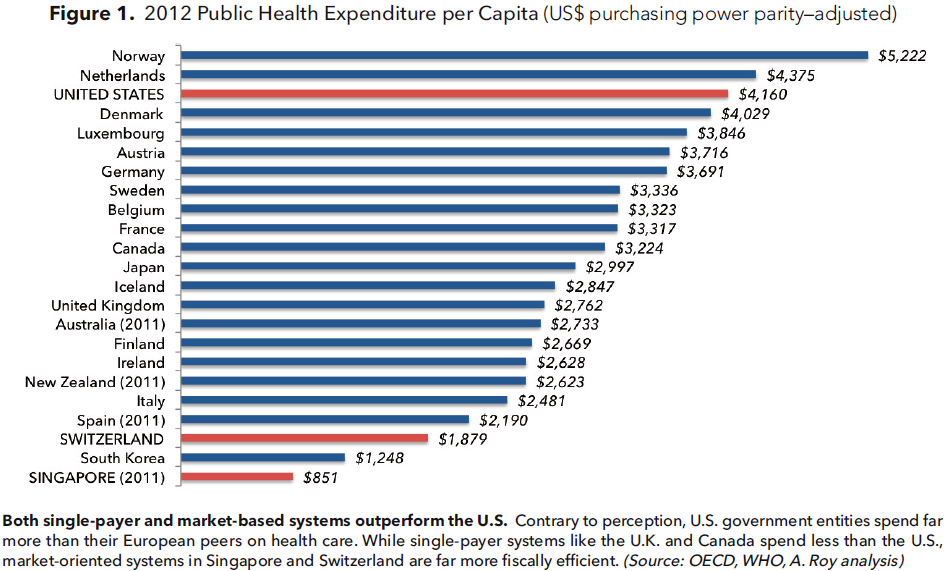
Capture1The Manhattan Institute’s Avik Roy has a different point of view.  In his proposal, “Transforming Obamacare,” (http://www.manhattan-institute.org/pdf/mpr_17.pdf) he points out that there are two countries, Switzerland and Singapore, which operate highly regarded free-market healthcare systems at very low public cost. Stay tuned for further discussion!

What Happens When We All Live to 100?


This is the title of an article in the current issue of Atlantic. Of course, it is a rhetorical question, but it raises a very serious issue.  There are 43 million Americans age 65 or older today and this number is expected to reach 108 million by 2050.  How will society cope with so many more senior citizens?
CaptureThis blog is concerned with the most critical fiscal and economic problems facing our country.  The biggest fiscal problem we have is how to pay for the three major entitlement programs: Social Security, Medicare and Medicaid.  Social Security can be shored up with small adjustments to either the benefits formula or by raising taxes a little bit.  Medicaid can be kept under control by block-granting the program to the states.  But Medicare is a much bigger problem.
Capture1The cost of healthcare, both public and private, is rising rapidly as shown in the above chart from the New York Times.  We badly need a new approach to control costs and Avik Roy from the Manhattan Institute has given us such a plan “Transcending Obamacare: A Patient-Centered Plan for Near-Universal Coverage and Permanent Fiscal Solvency.”
The problem is that, as Mr. Roy explains, “by creating a universal, single-payer health care program for every American over 65, regardless of financial or medical need, the drafters of Medicare made the program extremely difficult to reform.”  But now we have to reform it because the costs are becoming so huge.  How do we do it?
First of all, Mr. Roy’s plan keeps the exchanges created by the Affordable Care Act and turns them all into state-based exchanges.  It also eliminates both the individual and employer mandates, replacing these mandates with financial incentives.
Mr. Roy’s core Medicare reform is very simple.  The plan increases the Medicare eligibility age by four months each year.  The result is to preserve Medicare for current retirees, and to maintain future retirees – in the early years of their retirement – on their exchange-based or employer-sponsored health plans.  In other words, retirees will gradually be migrated to the same system, with the same level of subsidy, as for working people.
Everyone, workers and retirees alike, will be treated the same. Not only is this an eminently fair system, it insures that Medicare remains affordable, for both retirees and the whole country.

Three Cheers for Blue Cross Blue Shield Nebraska!


As I reported in my last post healthcare costs in the U.S. are expected to start climbing rapidly in next few years as the economy continues to recover and insurance coverage expands.
The Manhattan Institute’s Avik Roy has proposed a comprehensive new plan, ”Transforming Obamacare” to achieve, at the same time, both near-universal coverage and stringent cost control for healthcare.  Mr. Roy emphasizes the need to regulate hospital system consolidation which is especially responsible for driving up the cost of healthcare.
CaptureIn Omaha NE, where I live, there are three hospital systems: Catholic Health Initiatives, the Nebraska Medical Center and the Methodist Hospital System.  According to the insurance company, Blue Cross Blue Shield Nebraska (OWH 9/6/14), “CHI prices are 10 to 30 percent higher than for the Nebraska Medical Center and Methodist Hospital System.”  BCBS insists that CHI cut its prices.  As of September 1, CHI hospitals are out of network for BCBS and so patients who are insured by BCBS have to pay higher hospital rates.
“We are ready and willing to meet with them when they propose an agreement that gets serious about the cost issue,” said Lee Handke, a senior vice-president for Blue Cross Blue Shield.
Reports the OWH  “Blue Cross’ biggest customers are the region’s employers, whose 560,000 workers and family members supply 80% of Blue Cross’ revenue each year.  A big share of these people are CHI customers, too. … Blue Cross has told us (an insurance benefits broker) they understand that they might lose some business over this deal, but they feel that the point they have to make on the cost disparity is more important.”
For one hospital system to charge 30% more than two others for the same services is totally unacceptable.  It means that customers for the other two systems are paying higher insurance costs in order to subsidize the system with the higher prices.
In the Omaha market, Blue Cross has the clout and the will to force CHI to lower its prices.  But many other communities may not be as fortunate.

The High Cost of U.S. Health Care and What To Do About It


The United States spends 17.2% of GDP on healthcare costs, public and private, almost twice as much as any other developed country, and this percentage is gradually increasing.  In today’s New York Times there is a good discussion about these rising costs (see below).
Capture1My recent post, “Fixing Obamacare Rather Than Replacing It,” discusses a comprehensive new healthcare reform proposal by Avik Roy of the Manhattan Institute.  Mr. Roy’s plan both expands health insurance coverage beyond ACA levels as well as reining in the huge costs of healthcare. As Mr. Roy says “Among the industrialized member countries of the OECD, the average hospital stay cost $6,222 and lasted 7.7 days in 2009.  In the United States, the average hospital stay cost $18,142, despite lasting only 4.9 days.  In other words, the average daily cost of a hospital stay in the U.S. was 4.6 times the OECD average.”  Mr. Roy goes on to show that it is hospital system consolidation which is especially responsible for driving up the cost of health insurance.
CaptureThere is a clear example of this situation in Omaha NE where I live.  There are three hospital systems here: Catholic Health Initiatives, the Nebraska Health System and the Methodist Health System.  As stated by the CEO of Blue Cross and Blue Shield of Nebraska in the Omaha World Herald on August 28, 2014, “Our experience in addressing health care costs is precisely what led us to our current negotiations with Denver-based Catholic Health Initiatives.  CHI’s Alegent Creighton Health network of hospitals and physicians charges our members up to 30 percent more than other providers in Omaha for the same services. … These numbers reinforce a simple truth: We cannot allow one provider group to charge our members more for the same services they can receive elsewhere.”
We are fortunate in Omaha to have a choice of three different hospital systems and an insurance company with sufficient clout and integrity to fight price gouging by one of these systems.  But not every community is as fortunate as Omaha in this respect.  This is just one simple example of why cost control needs to be at the center of healthcare reform.

Why Medicare Needs to Be Reformed and How to Do It


My last post, “Fixing Obamacare Rather Than Repealing It,”presents a comprehensive new healthcare reform proposal by Avik Roy of the Manhattan Institute.  His plan has the ambitious goal of expanding health insurance coverage beyond ACA levels and at the same time achieving a huge deficit reduction compared with current CBO projections.
Capture1Mr. Roy points out, for example, that for all of Medicare’s huge cost, $635 billion in 2014 alone, it does not provide catastrophic coverage against long-term hospitalizations.  The supplemental insurance program, “Medigap,” accelerates Medicare’s wasteful spending by wiping out cost-sharing features such as co-pays and deductibles.  Medigap has proven hard to change because it generates huge royalty fees for the AARP, $458 million in 2011, for example.  For all of these reasons and others, Medicare needs big changes.
The core Medicare reform of Mr. Roy’s Universal Exchange Plan is to increase the eligibility age by four months per year forever, beginning in 2016.  This means that current seniors can stay in the existing Medicare program but that future retirees will remain in the universal state-based exchanges for an increasing period of time.  This is estimated to save $6.5 trillion over 30 years.
Additional features of the new Medicare program are:

  • Reduce Medicare subsidies for hospital’s uncollected bills saving $4 billion per year.
  • Exempt Medicare Part C and Part D from state and local taxes.
  • Combine Part A and Part B into a single insurance product saving $30 billion per year by reforming Medigap.
  • Introduce additional means-testing into Part D premiums.
  • Reduce waste, fraud and abuse systematically, saving approximately $50 billion per year.
  • Restore the ability of seniors to opt out of Medicare.
  • Restore the pre-ACA tax subsidy for employer-sponsored retiree coverage (to encourage more employers to sponsor retiree health benefits).
  • Address the physician shortage through additional medical education funding costing $6 billion per year.

Medicare spends 30% of its overall budget on end-of-life care (for the last six months of life).  The reforms suggested by Mr. Roy will allow it to operate much more efficiently and thereby put a greater focus on the end-of-life care which is its fundamental purpose.

Fixing Obamacare Rather Than Repealing It


The Manhattan Institute’s Avik Roy has just released a comprehensive and very impressive new study of the American healthcare system, “Transcending Obamacare: A Patient-Centered Plan for Near-Universal Coverage and Permanent Fiscal Solvency.”  By 2025 it will increase insurance coverage by 12.1 million above Affordable Care Act levels.  It will at the same time achieve a 30 year deficit reduction of $8 trillion compared to current CBO projections (see chart below).
CaptureMore specifically Mr. Roy’s new Universal Exchange Plan will

  • Expand coverage well above ACA levels without an individual mandate
  • Improve the quality of coverage and care for low-income Americans
  • Make all U.S. healthcare entitlement programs permanently solvent
  • Reduce the federal deficit without raising taxes
  • Reduce the cost of health insurance

The five core elements of Mr. Roy’s Plan are:

  • Exchange Reform. The ACA’s individual mandate is repealed. The Plan restores the primacy of state-based exchanges and insurance regulation. Insurers are encouraged to design policies of high quality tailored to individual need. By lowering the cost of insurance for younger and healthier individuals, the Plan will expand coverage without a mandate.
  • Employer-sponsored Insurance Reform. The employer mandate is repealed, thereby offering employers a wider range of options for subsidizing employees insurance.
  • Medicaid Reform. The Plan migrates the Medicaid acute-care population onto the reformed state-based exchanges with 100% federal funding. The Plan returns to the states full financial responsibility for the Medicaid long-term care population.
  • Medicare Reform. The Plan gradually raises the Medicare eligibility age by four months each year forever. The end result is to preserve Medicare for current retirees and to maintain future retirees on their exchange-based or employer sponsored health plans.
  • Other Reforms. The Plan tackles the growing problems of hospital system monopolies and malpractice litigation and also accelerates the pace of medical innovation by reforming the Food and Drug Administration.

These reform proposals are amazingly ambitious and far reaching in scope.  How can they possibly be achieved?  Stay tuned!

Conservatives Need to Take Income Inequality More Seriously


Americans are currently having a lengthy discussion about income and wealth inequality. A contribution by the Manhattan Institute’s Diana Furchtgott-Roth, “The Myth of Increasing Income Inequality”, points out, for example, that

  • The lowest 20% income quintile only has 1.7 persons per family unit while the highest quintile has 3.1 persons per family unit.
  • In 1970, 18% of households had only one person as compared with 27% of households in 2012.
  • In 1970 62% of women were married compared with 52% of women in 2012.

Clearly each of these factors will increase income disparities between households. Another recent study, from the National Bureau of Economic Research “Is the United States Still a Land of Opportunity? Recent Trends in Intergenerational Mobility”, concludes that, although the rungs of the income ladder have grown further apart, the chances of climbing from lower to higher rungs has not changed.
CaptureBut from a public perception point of view the Pew Research Center’s recent report, “Most See Inequality Growing, but Partisans Differ over Solutions”, is much more significant. It points out that:

  • 54% of all Americans say that taxes should be raised on the wealthy and corporations in order to expand programs for the poor.
  • Only 35% believe that lowering taxes on the wealthy to encourage investment and economic growth would be a better approach.
  • Unfavorable opinions of the Tea Party have increased from 25% in 2010 to 49% today.
  • The public has more confidence in Democrat’s handling of healthcare by a 45% to 37% margin.
  • Just 42% to 38% favor Republicans in handling the economy.

My conclusion from all of this data is that fiscal conservatives need to do a much better job of showing sympathy and concern for those who are struggling at the lower ends of the income scale. Success in implementing the sound policies which are needed to turn things around depends on accomplishing this!