The Origins of Trumpism


Everyone is trying to figure out what Donald Trump is all about and I am no exception. My last two posts, here and here, compare his positives and negatives and what he is doing well so far and also not so well.
The American Enterprise Institute’s political economist, Nicholas Eberstadt, has an article in the current issue of Commentary, “Our Miserable 21st Century,” describing very cogently the economic and social conditions which have led to the election of Donald Trump as President of the United States. Says Mr. Eberstadt:

  • The year 2000 marks a grim historical milestone for our nation. The warning lights have been flashing for 15 years and now these signals are impossible to ignore.
  • First of all, the estimated net worth of American households has more than doubled between 2000 and 2016, from $44 trillion to $88 trillion (see below).capture103
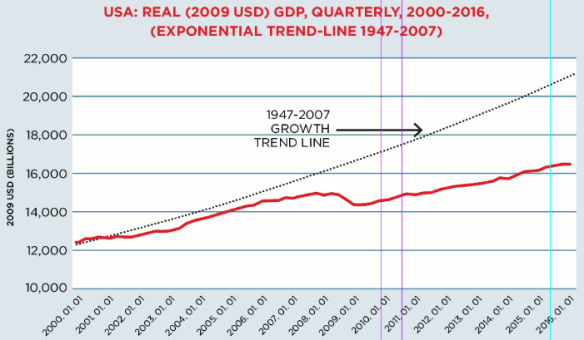
  • At the same time the recovery from the crash of 2008 has been singularly slow and weak. By late 2016 per capita output was just 4% higher than in late 2007. In effect the American economy has suffered something close to a lost decade (see below).capture104
  • Then there is the employment situation. Between 2000 and 2016 the work rate for Americans aged 20 and older declined by 4% from 66% to 62%. To put this in different words: if our nation’s work rate today were back up to its start-of-the-century highs, 10 million more Americans would currently have paying jobs (see below).capture105
  • Half of all prime working-age male labor-force dropouts (totaling 7 million men) take opioid medication on a daily basis, typically paid for by Medicaid. In fact, 53% of prime-age males not in the labor force are enrolled in Medicaid.
  • Of the entire un-working prime-age male Anglo population in 2013, 57% were collecting disability benefits.
  • Currently 17 million men in America have a felony conviction somewhere in there past. This amounts to one of every eight adult males in the country. It is difficult for felons to find work and therefore to become productive members of society.

Concludes Mr. Eberstadt, “The abstraction of inequality doesn’t matter a lot to ordinary Americans. The reality of economic insecurity does.  The Great American Escalator is broken – and it badly needs to be fixed.  With the election of 2016, Americans within the bubble (of affluence) finally learned that the 21st century has gotten off to a very bad start in America.  Welcome to the reality.  We have a lot of work to do together to turn this around.”

Follow me on Twitter
Follow me on Facebook
 

Fiscal Policy after the Election


As the presidential election tightens and the likely margin of victory for either candidate continues to shrink, it becomes ever more apparent that we need a bipartisan approach to solving our most basic problems.  My last post discusses the need for fundamental tax reform to get our economy growing faster to create more and better paying jobs.  Today I remind my readers of the need for better fiscal policies as well to address our massive and steadily deteriorating debt problem.
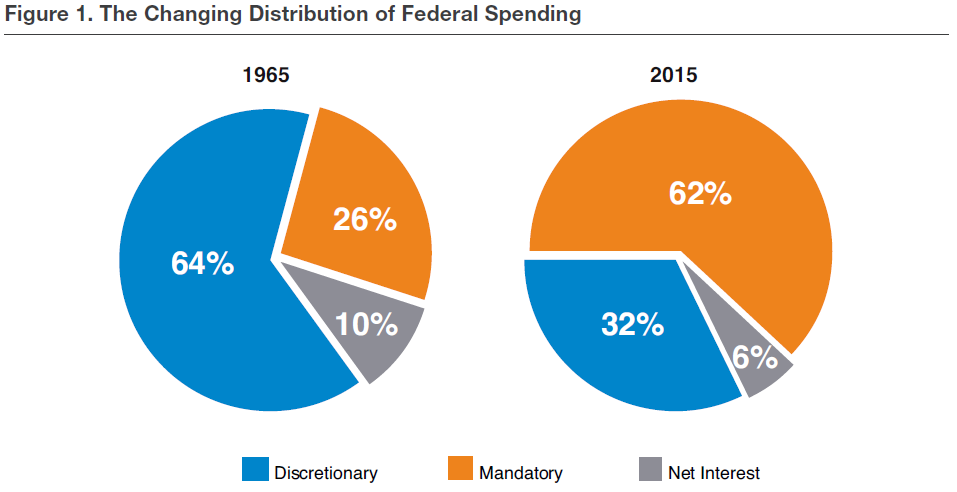
As the American Enterprise Institute,  among many other think tanks, makes abundantly clear, we are spending more and more of our federal budget on entitlements  as opposed to all of the many other federal responsibilities which are lumped together as discretionary spending.  In other words, the only way to fix our deficit and debt problems is to achieve better control over entitlement spending.

capture78
AEI has some excellent ideas on how to do this:

  • Social Security should move towards providing a universal flat benefit, set at the federal poverty level, for all U.S. residents aged 65 and older. Social Security would then become a guarantee against poverty in old age rather than a scheme for partially replacing pre-retirement earnings for middle and higher earning households.
  • Health Care. The Affordable Care Act should be replaced with a less regulated system (i.e. no mandates). The federal tax preference on employer plans could be limited to the cost of catastrophic (high deductible) insurance plus a contribution to health savings accounts. Households without employer coverage would receive a comparable tax credit.
  • Medicare would be converted into a premium support system with a fixed level of support comparable to that provided by employers.
  • Medicaid would be converted into a block grant program for the states based on the fixed, per capita costs for enrolled populations.
  • Other Safety-Net Programs should emphasize work as the key to improved economic prospects plus greater state control over resources in order to encourage innovation.

Conclusion. It should be emphasized as strongly as possible that the purpose of entitlement reform is to preserve and strengthen entitlements, not to weaken or destroy them.  Without such action we are headed for a much worse financial crisis than the one we had in 2008-2009 which will put all government social programs at risk.

Follow me on Twitter
Follow me on Facebook


Our Dire Fiscal Situation: A Summary


We are currently living in a high risk fiscal bubble. Low interest rates mean that our enormous and rapidly growing national debt is virtually “free” money.  When interest rates return to historically normal (much higher) levels, interest payments on the debt will explode putting us in a precarious fiscal situation.
As I have pointed out in the last few posts, it is the cost of entitlements and, in particular, health care entitlements, i.e. Medicare and Medicaid, which is driving our debt problem. The most effective way to control these entitlement costs is to control overall health care costs by insisting that all of us have more “skin in the game,” meaning that we must pay more of our health care costs directly from our own pockets as opposed to having them paid by third party insurance companies.
Capture20The latest report from the Congressional Budget Office, just a few days ago, shows that our debt problem is even worse than was projected just a year ago (see above).
Capture21The second chart (just above) shows the magnitude of the effort it will take to get our debt under control.  Just to stabilize the debt, i.e. to keep it from getting any worse than it is right now, will require a combination of spending cuts and/or revenue increases of 1.7% of GDP which amounts to $330 billion in 2016 dollars.
Conclusion. We have a huge national debt problem which is only going to keep getting worse until we make somewhat painful changes in federal policy.  We have to either restrain spending increases and/or increase taxes by significant amounts.  Health care entitlements are the biggest problem area and Medicare is worst of all.
Our two presumptive presidential candidates, Hillary Clinton and Donald Trump, are completely ignoring this grave problem.  And indeed their proposed policy initiatives will only make it worse!
Do we have the strength to deal with this dire problem short of another crisis?

Follow me on Twitter
Follow me on Facebook

Health Care Spending is Driving Budget Deficits


In my last post, “Annual Deficits are Starting to go Back Up,” I refer to a new report from the Congressional Budget Office to show that it is the large annual increases in federal healthcare spending (Medicare, Medicaid, CHIP and Obamacare) which is the main driver of our annual deficit spending which is going to start increasing again unless we do something serious about it.
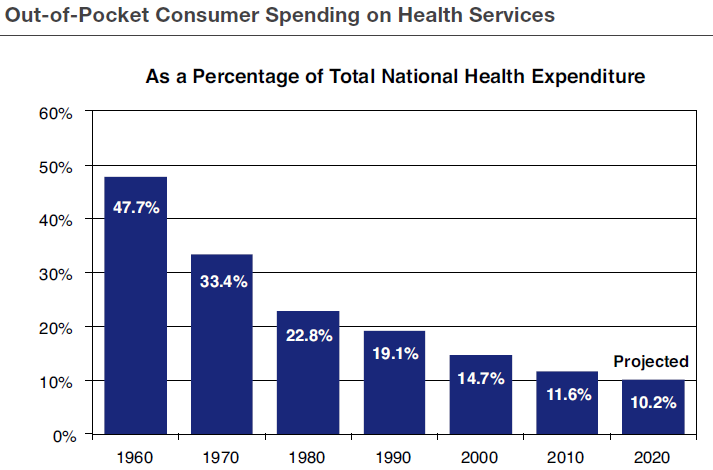
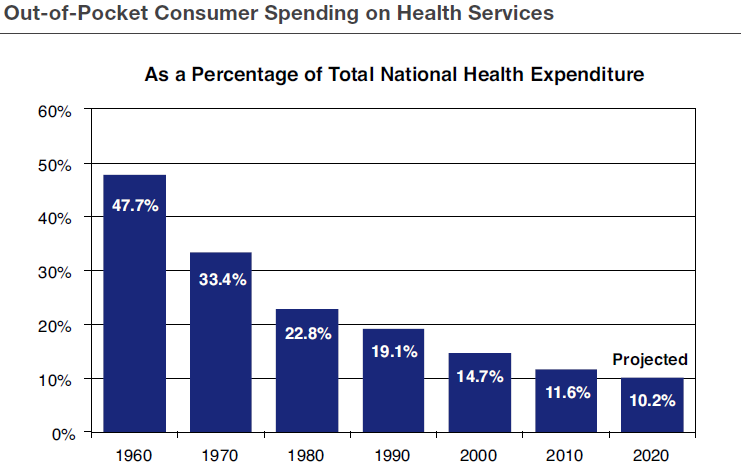
CaptureThe basic problem is, as shown by the above chart, that Americans, in general, don’t have enough skin in the healthcare game, i.e. we don’t pay enough of our health care expenses out of our own pockets, and therefore we don’t directly feel the pain of high and rapidly increasing health care costs.
A group of policy experts from the American Enterprise Institute have come up with a practical plan to address this problem.  Its elements are:

  • Retain employer provided coverage. This is how half of Americans get health insurance. The only change would be an upper limit on the tax preference for employer-paid premiums so that only the most expensive plans would exceed it.
  • Tax Credits. Individuals without employer coverage would get a tax credit with no strings attached to pick any state-approved plan that meets their needs.
  • Continuous coverage protection. As long as people stay insured, they cannot be denied enrollment based on health status.
  • Medicaid reform. The federal government would give states fixed, per-person payments based on historical spending patterns. Able bodied adult and their children could combine Medicaid and the (refundable) federal tax credit to enroll in a private insurance option.
  • Medicare reform. Medicare would provide a fixed level of assistance which seniors would use to purchase a health plan of their own choosing.
  • Expanded Health Savings Accounts. These are intended to be used with catastrophic insurance with a high deductible. HSAs could be established with a one-time $1000 tax credit and unused funds rolled over from one year to the next.

Such a system does not repeal, but rather improves the Affordable Care Act. It keeps the ACA exchanges and introduces cost controls in a flexible manner, i.e. without mandates.  It is the type of system the U.S. needs to get health care costs, and therefore overall deficit spending, under control.

Follow me on Twitter: https://twitter.com/jack_heidel
Follow me on Facebook: https://www.facebook.com/jack.heidel.3

Lowering the Cost of American Healthcare III. Single Payer?


My last two posts, here and here, argue that the high costs of American healthcare, almost double what other developed countries pay per-capita, has two fundamental causes which must be addressed:

  • Very low out-of-pocket costs as a result of the tax exclusion for employer provided care.
  • The very expensive, and rapidly growing, government entitlement programs of Medicare and Medicaid.
    Capture4

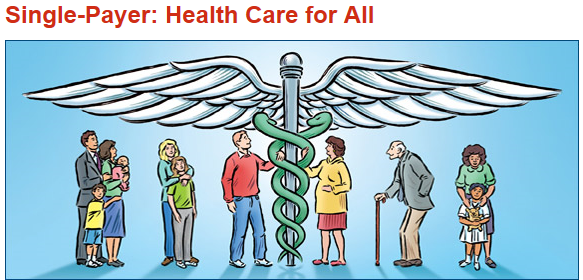
It is often suggested that the best way to get these high costs under control is for the U.S. to adopt a single-payer, government run, healthcare system, like many other developed nations have done. Writing in yesterday’s Wall Street Journal, the policy analyst, Nathan Nascimento, makes a persuasive, and well referenced, counter argument to this suggestion:

  • The State of Vermont recently backed away from implementing a single payer system because of the very high tax increase which would have been required, more than doubling Vermont’s annual budget.
  • The State of Colorado will vote a year from now on a petition-supported single payer proposal, ColoradoCare, which would be paid for by a $26 billion annual state tax increase and is therefore unlikely to pass.
  • In Canada, which has a single payer system, the average wait between a general practitioner’s referral and delivery of treatment was more than four months in 2013.
  • Our own Veterans Affairs hospital system, a single payer system on an annual budget, is failing thousands of veterans who often die while waiting for treatment.
  • Medicare, an open ended single payer entitlement system, now costing almost $600 billion per year, is one of the main causes of our burgeoning, out of control, national debt.

Conclusion: For the U.S. to move to a national single payer system would be very risky and very costly. It is far better to wait and see if Colorado or some other state is willing to take such a leap of faith and then see how it works out in that context.

Follow me on Twitter: https://twitter.com/jack_heidel
Follow me on Facebook: https://www.facebook.com/jack.heidel.3

Lowering the Cost of American Healthcare II. Entitlements


My last post emphsizes that any solution to our nation’s long term debt problem must include reining in the cost of American healthcare.  There are two major drivers to this problem as is made clear by a new report from the American Enterprise Institute, “Improving Health and Health Care: An Agenda for Reform.”
Capture1First of all, out-of-pocket consumer spending on healthcare has been steadily declining for many years. The less we pay directly for our own healthcare, the less incentive we have to control costs.
Capture2Secondly, the cost of healthcare entitlement spending, for Medicare and Medicaid , is growing rapidly as a percentage of GDP.  Such a rapid increase is unsustainable and must be curtailed. Here is what the AEI report recommends for doing this.

  • Medicaid. It serves two groups of people: 1) able bodied adults and their children and 2) the disabled and elderly. The federal government should make fixed, per-capita payments to the states based on historical spending patterns for these two groups. The able-bodied adults and children would get the same (refundable) federal tax credits as everyone else supplemented by Medicaid payments. The states would be totally responsible for the second group.
  • Medicare. The current system would be gradually migrated to a premium support system which would provide enough to pay for a choice of competing insurance options. The eligibility age would gradually rise to 67, consistent with Social Security.
    Capture3
  • Health Savings Accounts. HSAs are tax-preferred vehicles for saving for medical expenses until the (perhaps high) deductible amount is reached. Their use is growing rapidly. A one-time $1000 federal tax credit for establishing an HSA would increase their number even more. Their use should be expanded into Medicaid and Medicare as well.

Such reforms as these can significantly lower the cost of providing healthcare to the poor, the elderly and everyone else as well. If we don’t do something along these lines, we will eventually end up with a government run single payer system much to our detriment.


Follow me on Twitter: https://twitter.com/jack_heidel
Follow me on Facebook: https://www.facebook.com/jack.heidel.3


Can America’s “Fourth Revolution” Be Avoided?


My last post, “America’s Fourth Revolution,” presented a persuasive argument by the political scientist, James Piereson, that our currently dysfunctional political system will be unable to solve our most fundamental problems of massive debt, accompanied by a rapidly aging population and slowing economic growth. This will result, according to Mr. Piereson, in a severe crisis leading to a fourth revolution, overthrowing the New Deal liberal consensus which has prevailed since 1932.
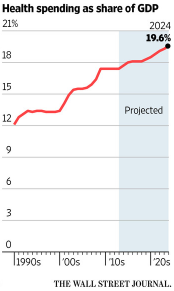
It is commonly understood that entitlement spending: Social Security, Medicare and Medicaid, is the main driver of our rapidly growing national debt. A recent report from the Centers for Medicare and Medicaid Services, summarized in the Wall Street Journal, shows that U.S. healthcare spending is likely to rise from just under 18% today to 19.6% of GDP in 2024.
Capture2Barron’s editor, Thomas Donlan, has just reported that the Director of the Congressional Budget Office, Keith Hall, stated in a recent hearing of the Senate Budget Committee that if spending for Medicare and Medicaid, as a percentage of GDP, fell by 25% over ten years, and then stayed in line with GDP after that, the U.S. would have a budget surplus of 2% of GDP in 2040 instead of the otherwise projected deficit of 6.6% of GDP. Furthermore debt held by the public would fall to 24% of GDP, a remarkable achievement.
This is significant because one country, The Netherlands, spends 12% of GDP on healthcare, and every other country in the world (except for the U.S.) spends less than 12%.
Conclusion: all the U.S. needs to do, so to speak, is to bring healthcare costs in line with the rest of the world and our entire deficit spending problem would be solved! Nobody is claiming that this will be easy but it certainly is within the realm of possibility. It is also far superior than waiting to act until we have another fiscal crisis and thus risking a huge change, a revolution, in our way of life.

Progress on Medicaid Reform


It is widely understood that the rapid increase in spending for entitlements (Social Security, Medicare and Medicaid) is the main driver of our debt problem.  Anything that can be done to get spending for these programs under control is of great value.
The problem with Medicaid is that a fixed percentage of each state’s costs is paid for by the federal government.  The more a state spends, the more that is contributed by the federal government which is a disincentive for states to control their own spending.  From 1989 to 2013, the share of state budgets devoted to Medicaid rose from 9% to 19%.  This upward trend is a problem for both state and federal government and is clearly unsustainable.
One way to change the spending incentive is to turn Medicaid into a block-grant program whereby the federal government contributes a specific amount of money to each state each year and gives states more leeway in designing their own programs.  States would then have a much bigger incentive to hold down costs and the flexibility to be able to do it.
CaptureProgress is being made in this direction with the use of waivers:

  • Rhode Island received a waiver in 2009 to try out various cost-saving measures such as wellness programs, co-payments, etc. It has been quite successful and very well received.
  • Last year Pennsylvania agreed to expand Medicaid to an additional 500,000 people along with a waiver allowing people above the poverty line to be charged premiums of up to 2% of their household income as well as being charged an $8 copayment for use of emergency rooms.
  • Now Indiana (http://www.wsj.com/articles/indiana-governor-to-expand-medicaid-coverage-1422371729) has agreed to an expansion with a waiver under which beneficiaries above the poverty level would be charged premiums of 2% of income and would be locked out of benefits for six months if they fall behind in their payments.
  • Additional states such as Idaho, Wyoming, Utah, Tennessee, Alabama and Florida are also considering Medicaid expansions and likely will be influenced by the possibility of receiving similar waivers.

Waivers are not as cost effective as block-grant funding but they are an improvement over the existing one-size-fits-all federal rules.  If more individual states are able to show that waivers really do work to reduce costs, this will increase the likelihood of implementing a block-grant system.

Status Quo on the Budget Is Not Good Enough II. Look at the Big Picture!


In my last post, “Status Quo on the Budget Is Not Good Enough,” I discussed a report from the outgoing chair of the Senate Budget Committee, Patty Murray (D-WA), and explained how it epitomizes the lack of progress made on the massive debt problem which has developed since the Great Recession of 2008 -2009.
CaptureThe basic problem is that Senator Murray’s analysis simply does not recognize the seriousness of our debt problem as shown in the above chart.  Right now our public debt (on which we pay interest) is “sitting” at 74% of GDP for a year or two, before it continues its rapid increase.  This projection assumes an historically “normal” growth rate of 3% and no new recessions, neither of which assumption is assured.  It also assumes that the sequester budget cuts and new top tax rate of 39.6% stay in effect.  In other words it is a best case scenario based on current policy.
Breaking it down, the debt will continue to increase because annual deficits will continue to exceed the rate of growth of the economy.  The main driver of these increasing deficits is the cost of the health care entitlements of Medicare and Medicaid.  Medicare costs will increase rapidly because of the aging of the American people.  Medicaid costs will increase rapidly because: 1) more low-income people are being covered by the ACA and 2) since the recession there are more low-income people to be covered.  I certainly support expanded healthcare coverage but we have to figure out how to pay for it!
How do we contain the increasing costs of Medicare and Medicaid?  We do it by controlling the overall rapid growth (at twice the rate of inflation) of healthcare costs in general, i.e. for private healthcare. How do we do this?  See a couple of my recent posts either here or here.
Senator Murray, along with many other progressives, argues that we need more deficit spending in order to stimulate the economy and create new jobs.  More jobs are badly needed but more deficit spending is the wrong way to get them.  Then how?  With tax reform among other things.
Based on the outcome of the 2014 elections, I am optimistic that something along the lines of what I have just described will be tried by the next Congress.  We’ll soon find out!

Fix the Debt


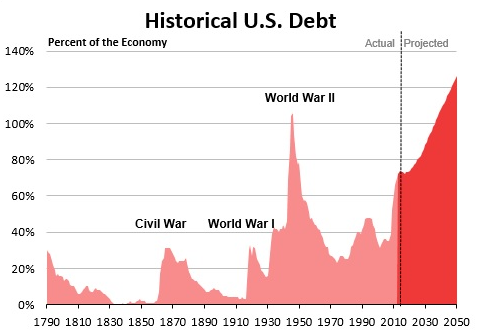
Recently I have had several posts about our national debt, for example, “Why the National Debt Is Such a Threat to the U.S.,” showing graphically that our current public debt at 74% of GDP is very high by historical standards and rising rapidly under current fiscal policies.
CaptureYesterday I attended a workshop in Washington D.C. put on by Fix the Debt.  All expenses were paid and, in return, the attendees agree to make at least three presentations to local community groups during the following year.  This means that I will soon be sending out a letter to such groups as Kiwanis and Rotary Clubs around the Omaha area where I live, offering my services as a speaker at one of their meetings.  The purpose is to build more public awareness of the threat of a huge and growing national debt to the long-term welfare of our country. Here is a summary of talking points from the workshop:

  • The deficit for the 2013-2014 fiscal year is almost $500 billion.
  • Under current fiscal policies the debt will increase to 270% of GDP by 2080.
  • Reasons for our debt problem:
  1. An aging population which means expanded Social Security spending
  2. Healthcare costs are growing for both Medicare and Medicaid
  3. Interest costs will grow rapidly as the economy recovers and interest rates rise
  • All bipartisan reform plans call for both spending cuts and revenue increases.
  • The benefits of taking action are:
  1. Increased budget flexibility
  2. Lower exposure to changes in interest rates
  3. Reduced risk of another financial crisis
  • The longer we wait:
  1. The older our population gets
  2. The higher the debt will rise
  3. The less time we have to phase in changes
  4. The slower our economy will grow
  5. The fewer tools we will have to fix it
  • How do we bring debt under control?
  1. Enact policies that grow the economy
  2. Health care cost containment
  3. Spending cuts
  4. Tax reform and tax expenditure cuts

Let me know if you’d like a speaker on this topic at your club!