Considering a Wealth Tax for the U.S.


What should a country do when it has

  • Massive accumulated debt and annual deficits predicted to grow indefinitely.
  • A rapidly growing population of retirees heavily dependent on expensive entitlement programs such as Social Security and Medicare.
  • A national Congress which is unwilling to make significant spending cuts for fear of offending powerful constituent groups.
  • Growing income inequality and wealth inequality.
  • A stagnant economy and high unemployment which makes inequality worse.
  • An inefficient income tax system which does not take in enough tax revenue to pay the bills.

The best response by far is to implement broad-based, pro-growth, tax reform.  I have often discussed how to make major changes to our current income tax system.  I have also described an attractive way to introduce a consumption tax, the so-called Graetz Plan.
CaptureAnother way to reform taxes is to introduce a wealth tax.  The economist Ronald McKinnon has described a way to do this in a Wall Street Journal column, “The Conservative Case for a Wealth Tax”.  His plan is to implement a federal wealth tax in addition to the federal income tax.  It would consist of a flat tax of about 3% imposed on household wealth in excess of a $3 million exemption which would exclude 95% of the population.  In addition to bringing in a significant amount of new revenue each year, which is its principal objective, it would serve the purpose of making a flatter, pro-growth, income-tax system more palatable to people who are concerned about inequality, and therefore to a much wider audience.
The economics journalist, Daniel Altman, recently reported in the New York Times, “To Reduce Inequality, Tax Wealth, not Income” that American household wealth totaled more than $58 trillion in 2010.  The most recent issue of Forbes Magazine reports that there are now 492 billionaires in the U.S. with a total wealth of $2.3 trillion.  A 2% tax on the wealth of just these billionaires alone would raise $46 billion.  A 0.5% tax on the wealth of all Americans would raise $290 billion annually.  These examples show that a “moderate” wealth tax could bring in a significant amount of new tax revenue which would make a big dent in shrinking our annual deficit.
We have to do something and do it quickly.  The problem will occur when interest rates return to their normal level as they surely will before long.  When this happens, interest payments on our national debt will sky rocket.  It’s going to be painful regardless, but let’s try to head for the softest landing we can manage!


Wealth and Taxation


As I reported in my last blog post a few days ago, wealth inequality in the United States and the rest of the developed world is growing rapidly and is likely to get much worse in the foreseeable future.   This is happening because income from wealth, i.e. the return on investment, typically grows faster than wages and GDP.  As income inequality also grows, and top wage earners have more and more money to invest, then the gap between investment income and wage income will become even wider.  There is nothing wrong with this and the more money that is reinvested in our economy, the faster it will grow and the more jobs that will be created.
At the same time that huge new wealth is being created we have an archaic tax system in the U.S. which is not only incredibly complicated and inefficient, but also discourages investment because the top individual and corporate rates are so high.  And it doesn’t collect enough tax to pay our bills.  We have huge deficits already and the CBO says that they’ll just keep getting worse.
Making government operate more efficiently with less spending is highly desirable but will only go so far.  Every government program has a constituency of supporters who complain when their own program is targeted for cuts.  And the biggest and most expensive, the entitlement programs of Social Security and Medicare, have the largest constituency of all, over 50 million retirees at the present time and growing rapidly as the baby boomers retire at the rate of 10,000 per day.
This huge crunch can only be resolved by fundamental tax reform.  Several different ways have been proposed to do this:

  • Reform the current income tax system by broadening the base, lowering rates and eliminating deductions and loopholes to pay for it.  The problem with this approach is that no one wants to give up their own deductions (for mortgage interest, charitable contributions, employer provided healthcare, state and municipal taxes, etc.)
  • Introduce a consumption tax such as the Graetz Plan which I described in my January 7, 2014 post.  It would establish a 14% Value Added Tax on consumption, supplemented by a lower but still progressive tax on incomes over $100,000.  It would avoid being regressive on low wage workers by using an Earned Income Tax Credit to offset the Payroll Tax.
  • Introduce a wealth tax.

Sorry, I’m over my (self-imposed) word limit already.  I’ll describe a possible wealth tax in my next post!

Does Tax Reform Have a Future?


My post on February 27, “A Breath of Fresh Air” praises the new tax reform proposal from the House Ways and Means Committee which both lowers and consolidates tax rates in a revenue neutral way as well as greatly simplifying the tax code.  It would be a big step in the right direction.  But the Washington Post’s Robert Samuelson makes a good case in ”Does Tax Reform Have a Future?” that the House bill does not go far enough.
CaptureMr. Samuelson argues that if we’re going to eliminate tax deductions and loopholes, and thereby alienate lots of special interest groups, in order to get lower tax rates, then we should avoid half measures and eliminate virtually all deductions in order to get the lowest possible rates.  In other words, eliminate the mortgage interest deduction rather than just limiting it, eliminate deductions for charitable contributions as well as deductions for state and local taxes.  Eliminate the deduction for employer provided healthcare (which by itself would go a long way towards reforming healthcare.)
Mr. Samuelson would retain only the Earned Income Tax Credit (which encourages low-income people to work) and also the tax preference for contributions to retirement accounts (without which most Americans wouldn’t save for retirement.)
We badly need broad based tax reform to stimulate our economy.  Douglas Holtz-Eakin, the former director of the Congressional Budget Office, has estimated “Reforming Taxes, Goosing the Economy”, that even the imperfect House tax reform proposal would raise GDP by .5% annually for 10 years and create 500,000 new jobs each year over this time period.
Full-fledged tax reform, a la Samuelson, would provide an even greater stimulus but let’s at least do something to put the millions of unemployed and underemployed people back to work and reduce our staggering budget deficits!

A Breath of Fresh Air


U.S. Representative David Camp (R, Michigan), Chair of the House Committee on Ways and Means, has just introduced the “Tax Reform Act of 2014” and describes it in a column in yesterday’s Wall Street Journal, “How to Fix Our Appalling Tax Code”.  This legislation, developed over the past three years by the committee he chairs, has lots of attractive features.  Mainly, however, it would give the economy a substantial boost.  Congress’s Joint Committee on Taxation estimates that it would increase GDP by $3.4 trillion over the next ten years and create 1.8 million new jobs.
CaptureIt will accomplish this goal by trimming or eliminating tax breaks and loopholes for the wealthy in order to reduce tax rates for almost everyone.  For example, the home mortgage deduction will be cut, for new homeowners, from the current value of $1,000,000 to $500,000.  The deduction for state and local taxes will be eliminated.  The charitable deduction will only apply for contributions in excess of 2% of income.  The middle class is protected by raising the standard deduction to $11,000 per individual or $22,000 per couple.  This means that 95% of taxpayers will be able to avoid itemizing.
The two basic tax rates would be 10% up to $75,000 in income, then 25% up to $400,000.  Over $400,000 there would be a 10% surcharge on salaried or “non-production” income.  The corporate tax rate would be cut from 35% to 25%, again by eliminating special exemptions and loopholes.
All of these features add up to a dramatic simplification of our tax code which will save an estimated $168 billion annually in preparation fees.
But always keep in mind the larger purpose of broad based tax reform like this.  In the words of the economist Glenn Hubbard, it is “a policy shift in favor of mass prosperity – dynamism and inclusion.”  It will do more for the poor than raising the minimum wage because it will actually create new jobs and better paying jobs.
This legislation represents a fantastic starting point for a national discussion on pro-growth tax reform.  Let’s get on with it!

Truth and Myth about Inequality


Two of my favorite columnists are the Brooking Institution’s William Galston, a social economist who has a weekly column in the Wall Street Journal and the economics journalist Robert Samuelson who writes for the Washington Post.  
Most people agree that income inequality in the U.S. is steadily getting worse.  Mr. Galston make a good case (see my last post) that it is primarily caused by the large gap between the rising productivity of American workers and the stagnant level of their pay which has developed since 1973.  He thinks that we need a fundamentally new social contract which links worker compensation to productivity.  This, of course, is a tall order and it is not at all clear how such a new order would be achieved.
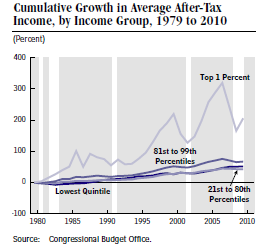
CaptureMr. Samuelson has a different perspective: “Myth-making about Economic Inequality”.  For example:

  • The poor are not poor because the rich are rich
  • Most of the poor will not benefit from an increase in the minimum wage because only 6% of the 46 million poor people have full time jobs
  • All income groups have gained in the past three decades, even though the top 1% has gained the most (see the above chart from the CBO, December 2013)
  • Widening economic inequality did not cause the Great Recession

These two perspectives on inequality are quite different but not contradictory.  Basically what Mr. Samuelson is saying is that we have to be careful in how we address this problem or we’ll just make it worse.  Raising taxes on the rich is unlikely to help and might hurt if it slows down the economy.  Raising the minimum wage will only raise a fairly small number of people out of poverty and may cause a lot of unemployment along the way.
My solution: focus on boosting the economy to create more jobs in the short run (tax reform, immigration reform, trade expansion) and improved educational outcomes for the long run (early childhood education, increasing high school graduation rates, better career education).
But I agree with Mr. Galston that it is imperative to lessen income inequality, one way or another.  Otherwise as a society we’ll have big trouble on our hands.

What Is the State of the U.S. Economy?


On the eve of the President’s State of the Union address, the New York Times gives an answer to this question in today’s paper, “Obama’s Puzzle: Economy Rarely Better, Approval Rarely Worse”.  The charts below do show the basic trends all moving in the right direction.  But is this good enough?
CaptureThe unemployment rate is moving steadily downward but it is still a high 6.7% almost five years after the recession ended in June 2009.  And this is with a labor participation rate of only 58.6%, which is historically very low.
The budget deficit is dropping but is still unsustainably high.  In the five years, 2009 – 2013, deficits have totaled $6 trillion dollars.  As soon as interest rates return to their historical average of 5%, interest on this $6 trillion in new debt alone will total $300 billion per year, forever!  Furthermore, the Congressional Budget Office, the most credible source of budget information, predicts that the deficit is likely to resume an inexorable climb within a few years as baby boomers retire in ever greater numbers, rapidly driving up entitlement costs.
Economic growth was stronger than expected in the last quarter of 2013 and this is a good sign.  But it has averaged only about 2% since the recession ended which is very low by historical standards, in a post recessionary period.
The point is, do we really need to settle for such mediocre performance: a stagnant economy, high unemployment and massively accumulating debt?  Should we just declare that in a highly competitive global economy with an ever higher premium on information and technology, that we just can’t do any better than we already are?  Isn’t there some way to make our economy grow faster in order to provide more and higher paying jobs?
I think that the answer to this last question is an emphatic yes!  In fact, this is what my blog is all about.  Just read some of the other recent posts and let me know if you disagree with what I am saying!

A Global Perspective on Income Inequality II. Where Are the Jobs?


My last post on January 23 shows vividly what the challenges are in restoring the American middle class to the prosperity which existed up until the Great Recession hit in late 2007.  The problem, of course, is the gale strength force of globalization which is lifting up low wage workers all over the developing world and creating huge competition for the many low-skilled workers in the United States.
In today’s New York Times, the former Obama Administration car czar, Steven Rattner, writes about “The Myth of Industrial Rebound” in the United States, explaining why manufacturing jobs are coming back much more slowly than other jobs.  “Manufacturing would benefit from the same reforms that would help the broader economy: restructuring of our loophole-ridden corporate tax code, new policies to bring in skilled immigrants, added spending on infrastructure and, yes, more trade agreements to encourage foreign direct investment.”
CaptureThe above chart shows the huge decline in manufacturing jobs relative to other parts of the economy such as the education and health sector as well as the professional and business sector.  Of course, these more rapidly growing service sectors are the ones benefitting from the information technology revolution.  In manufacturing, on the other hand, the low skill jobs are going overseas while the high skill jobs, using technology such as robots, are much fewer in number.
Conclusion: in order to increase manufacturing jobs in the U.S., we better government policies, as outlined above by Mr. Rattner.  But we also need to recognize that there aren’t going to be as many high skilled manufacturing jobs in the future.  We are going to need much better K-12 and post-secondary educational outcomes to prepare the middle class for the high skilled service jobs which will predominate in the future.

Harnessing Market Forces versus Offsetting Market Forces


The economist Matthew Slaughter writes in today’s Wall Street Journal that ’High Trade’ Jobs Pay Higher Wages. He points out that the 22.9 million Americans who work for U.S. headquartered multinational companies made an average of $73,338 in 2011 compared with the overall average wage of about $55,000 that year.  “Workers in multinational firms earn more, as global engagement fosters innovation and productivity growth.”
“There is a growing concern about stagnant or falling incomes, yet most of the measures proposed to deal with the issue – raising the minimum wage and reinstating unemployment benefits – purport to help workers by offsetting market forces.  Less attention is given to harnessing market forces.”
CaptureThis can be done by “liberalizing U.S. trade, investment, immigration and tax policies.”  In other words, we need more trade agreements like NAFTA, which has been so successful in increasing trade in North America.  We need more high skilled workers, both domestic and foreign.  We need lower corporate tax rates to encourage multinational corporations to bring their trillions of dollars in overseas profits back home.
We should always strive for a more equal society with less income inequality.  But the best single way to do this is to create more opportunity by growing the economy, i.e. by harnessing market forces.

Should Government Address Inequality Directly?


Wall Street Journal columnist William Galston suggests in “Where Right and Left Agree on Inequality”, that both sides of the political spectrum agree that economic inequality is increasing in America and that government needs to address this problem.  “Poverty is part of the explanation, as liberals insist.  But so are parenting and family structure, as conservatives believe.”
CaptureIt so happens that we have a broadly supported federal program which simultaneously addresses both poverty and family structure.  It is the Earned Income Tax Credit program.  It provides $3,305 a year to low-income working families with one child and up to $6,143 for families with three or more children.  The U.S. spends $61 billion a year on this program and it has proven to be very successful in encouraging low-income people to find and keep jobs.  In fact, the economist, Gregory Mankiw, recommends the EITC over a higher minimum wage as a better way to increase the earnings of the working poor.
The New York Times’ Eduardo Porter reports in “Seeking Ways to Help the Poor and Childless”, that New York City is conducting an experiment to see if a locally run program similar to the EITC  will have the same positive effect in increasing employment of childless adults.  It is understood that many of the jobs being created in today’s economy are low paying service jobs.  As Mr. Porter says, “for the American market economy to remain viable, being employed must, one way or another, provide for workers’ needs.”
Conclusion:  as important as it is for Congress and the President to adopt measures to increase economic growth (e.g. tax reform, fiscal stability, expanded foreign trade, immigration reform), in order to create more and better paying jobs, government also has a responsibility to provide direct help to the needy who are trying to help themselves.  The EITC program is an excellent way to do this!

Why a High Corporate Income Tax Is So Damaging to Our Economy


My previous post, “Fundamental Tax Reform Is the Key to Solving Our Economic and Fiscal Problems II.  The Graetz Plan”, describes a tax reform plan which establishes a 14% national consumption (VAT) tax, exempts families earning under $100,000 from paying any income tax and also reduces the Corporate Income Tax to 15%.  All of this is done in a revenue neutral manner while also preserving all of the progressivity of our current income tax system.
CaptureA recent Op Ed column in the New York Times, by the economist Lawrence Kotlikoff, “Abolish the Corporate Income Tax”, makes the case that such a proposal “might sound like a gift to the rich, but it would actually help workers. … Apple’s tax return says it all:  The company, according to one calculation, paid only 8% of its worldwide profits in United States corporate income taxes, thanks to piling up most of its profits and locating far too many of its operations overseas.”
Our corporate income tax rate, at 35%, is one of the highest in the world and this is what encourages American multinational companies to move their business to other countries.  Whether we abolish the corporate income tax entirely, or just reduce it to 15%, is less important than recognizing the need to overcome popular prejudice about big business and make fundamental changes in our tax structure.
Solving our country’s many problems, from rising inequality at home to projecting adequate strength around the world, requires that the U.S. have a strong economy.  An annual growth rate of 2% of GDP is not nearly good enough to end our current economic stagnation.  To accomplish this will require overcoming the strong headwinds of increasing global competition and the replacement of people with machines.  We will need innovative thinking and initiative to break out of the old ways of doing things which are holding us back.
Are the American people “exceptional” enough to accomplish this challenging task?