Fundamental Tax Reform Is the Key to Solving Our Economic and Fiscal Problems II. The Graetz Plan

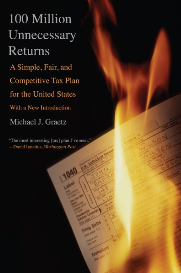
The Yale Tax Law Professor, Michael Graetz, has proposed a new tax system “100 Million Unnecessary Returns: A Simple, Fair, and Competitive Tax Plan for the United States” which would do wonders towards straightening out the huge fiscal and economic problems now facing our country.
CaptureHow do we rev up the national economy in order to put more people back to work and, at the same time, raise the revenue needed to operate the government in the 21st century without mountains of debt?  Mr. Graetz’s basic idea is to tax consumption rather than relying totally on an income tax.  Under his plan both savings and investments will be taxed at a lower rate which will encourage more of both.  The Plan has these features:

  • A broad based Value Added Tax of about 14% is enacted on goods and services.  The U.S. is the only advanced economy without a VAT.
  • Families earning less than $100,000 are exempted from the income tax.  For incomes between $100,000 and $250,000, the tax rate would be 15%.  For income over $250,000, the rate would be 25%.
  • The corporate income tax rate is lowered to 15%.
  • The Earned Income Tax Credit (EITC) is used to provide relief from the VAT burden to low-income families by using payroll tax offsets.
  • The plan is designed to be revenue neutral as verified by the Tax Policy Center.

This plan has many advantages including:

  • Taxing consumption and lowering the corporate tax rate to 15% from its current level of 35% would dramatically encourage investment in the U.S. thereby stimulating the economy and creating both new jobs and higher wages for American workers.
  • It would eliminate more than 100 million of the 140 million U.S. tax returns.
  • With many fewer Americans paying income taxes there would be far less temptation for Congress to use income tax exclusions, deductions and credits to try to address social and economic problems.
  • The plan retains all of the progressive features of our current tax system whereby higher income earners pay higher tax rates.

The point of describing the Graetz Plan in some detail is not to suggest that it is the best way to implement tax reform but rather that here, at least, is one attractive way to do it.  The purpose is to move the discussion forward.  We badly need to make changes along these lines!

An Optimistic View of America’s Future!


In the latest issue of Barron’s, Frederick Rowe, the managing partner of Greenbrier Partners Capital Management, asks in “More Than a Sugar High?” , “Can you imagine a country that is managed in an economically rational manner, creating the wealth that’s necessary to take proper care of the citizens who get left behind? … What if our economic recovery is more than a sugar high?  What if there is more here than insanely stimulative monetary policy from the Federal Reserve?  What if the U.S. has already begun to steer an economic course to a period of unprecedented and genuine prosperity, achievement, and problem solving?”
Here are eight factors which Mr. Rowe gives to point us in the right direction:

  • North American Energy Independence (already on the horizon).
  • Sensible Immigration Reform: encouraging our most enterprising and hard-working people to become citizens rather than chasing them away.
  • Repatriation of Corporate Income: if a company domiciled in the U.S. makes money in Argentina and wants to invest it in the U.S. we double-tax the daylights out of it.  It would be hard to imagine a more counterproductive tax policy.
  • Changing Directors and Their Thinking: the once unthinkable mindset of corporate directors acting on behalf of long-term owners (rather than the CEOs with whom they play golf) is actually gaining traction.
  • Lowering Corporate Taxes: the tax-writing committees in Congress are working on this.
  • Increasing Technological Leadership: the most dynamic technology companies in the world are domiciled in the U.S. Technology, in the short run, displaces workers.  But eventually workers catch up because new technology creates new kinds of jobs that were never imagined before.
  • Americanization of the World: more than three billion people around the world will soon be able to afford to live much more like the 300 million Americans do.  So companies which make it big here have an automatic global opportunity.
  • Obamacare:  Even this bureaucratic catastrophe provides a large opportunity for economic opportunity.  Think of Jimmy Carter’s failures which led to Ronald Reagan’s successes.

“Let your imagination run and consider all the things that can be accomplished by an energy-independent, cash-generating, cash-repatriating country that is a hotbed of technological innovation.”
I can’t possibly say it any better than this!

Inequality III: Is the Game Rigged?


The economist Joseph Stiglitz has an Op Ed column in today’s New York Times, “In No One We Trust”, blaming the financial crisis on the banking industry.  “In the years leading up to the crisis our traditional bankers changed drastically, aggressively branching out into other activities, including those historically associated with investment banking.  Trust went out the window. … When 1 percent of the population takes home more than 22 percent of the country’s income – and 95 percent of the increase in income in the post-crisis recovery – some pretty basic things are at stake. … Reasonable people can look at this absurd distribution and be pretty certain that the game is rigged. … I suspect that there is only one way to really get trust back.  We need to pass strong regulations, embodying norms of good behavior, and appoint bold regulators to enforce them.”  
CaptureMr. Stiglitz is partially correct.  Although the housing bubble, caused by poor government policy – loose money, subprime mortgages, and lax regulation – was the primary cause of the financial crisis, nevertheless, poorly regulated banking practices made the crisis much worse.  But this is all being fixed with Dodd-Frank, a just recently implemented Volker Rule, and a soon coming wind-down of Fannie Mae and Freddie Mac. 
Mr. Stiglitz concludes, “Without trust, there can be no harmony, nor can there be a strong economy.  Inequality is degrading our trust.  For our own sake, and for the sake of future generations, it is time to start rebuilding it. 
But how do we reduce the inequality in order to restore the trust which is necessary for a strong economy?  Mr. Stiglitz doesn’t say!
What we need is faster economic growth in order to create more new jobs.  The last four years have demonstrated that the Federal Reserve can’t accomplish this with quantitative easing.  It needs to be done by private business and entrepreneurship.  Tax reform and the easing of regulations on new businesses is what we need.  It’s too bad that ideological blinders prevent so many people from understanding this basic truth!    
    

How to Get the Economy Back on Track


Harvard Economist, Martin Feldstein, has an Op Ed column in yesterday’s New York Times, “Saving The Fed From Itself”, which gets our current economic situation half right.  First of all, Mr. Feldstein says that the Fed’s quantitative easing policy is inadequate because “the magnitude of the effect has been too small to raise economic growth to a healthy rate.  … The net result is that the economy has been growing at an annual rate of less than 2 percent.  … Weak growth has also meant weak employment gains.  … Total private sector employment is actually less than it was six years ago.  … While doing little to stimulate the economy, the Fed’s policy of low long-term interest rates has caused individuals and institutions to take excessive risks that could destabilize the economy just as it did before the 2007-2009 recession.”  So far he’s right on the button!
But then he goes on to say, “To get the economy back on track,” Congress should enact a five year plan to spend a trillion dollars or more on infrastructure improvement and that this would “move the growth of gross domestic product to above three percent a year.”  An artificial stimulus like this might work temporarily but then it ends and we’re back where we started.  We need a self-generating stimulus that will keep going indefinitely on its own.  How do we accomplish this?
The answer should be obvious.  We do it by stimulating the private sector to take more risk in order to generate more profits. In the process they will hire more employees and boost the economy.
How do we motivate the private sector?  By lowering tax rates and loosening the regulations which stifle growth.  Closing tax loopholes and lowering deductions (which will raise revenue to offset the lower tax rates) has the added benefit of attacking the corporate cronyism which everyone deplores.
We really do need to put first things first.  If we can jump start the economy by motivating the private sector to invest and grow, we will have more tax revenue to spend on new and expanded government programs as well as shrinking the federal deficit.
Why is this so hard for so many people to understand?

Should the Minimum Wage Be Raised?

In today’s New York Times, the economist Arindrajit Dube has an Op Ed column in the Great Divide series, “The Minimum We Can Do”, pointing out that today’s minimum wage of $7.25 per hour is only 37% of today’s median hourly wage of about $20 per hour.  This compares with the 1968 minimum wage of $10.60 per hour (in today’s dollars, adjusted for inflation) which was 55% of the median wage at that time.  This is in line with the current Democratic proposal to raise the minimum wage to $10.10 per hour.
The standard argument against raising the minimum wage is that it will reduce employment because “when labor is made more costly, employers will hire less of it.”  However Mr. Dube offers empirical data which “suggest that a hypothetical 10% increase in the minimum wage affects employment in the restaurant or retail industries by much less than 1 percent” and therefore very little.
Basically Mr. Dube is arguing that raising the minimum wage won’t hurt the economy and it will help many low-paid workers.  The problem with this point of view is that it distracts attention from what we really should be doing: namely, everything we possibly can to speed up economic growth.  By far the best way to raise wages is to increase the value of labor by creating more jobs!
I may sound like a broken record, repeating the same thing over and over again, but we badly need to concentrate on the fundamentals of growing the economy: lowering tax rates, individual and corporate, to stimulate business investment and risk taking by entrepreneurs; removing onerous regulatory burdens, especially on new businesses and existing small businesses; and emphasizing career education and job training to fill the millions of high skill job openings which exist.
There are strong headwinds facing our economy: bad demographics (rapidly retiring baby boomers), pressure from technological progress and globalization which put a high premium on education and advanced skills, and massive national debt which will become a huge burden as interest rates inevitably increase.
These strong headwinds aren’t going away.  To overcome them we need national leaders who are able to rise above ideology and focus on the fundamentals.
Conclusion: we should raise the minimum wage when unemployment drops to 6% or, perhaps, tie a raise in the minimum wage to a tax reform measure which significantly lowers tax rates.

How to Create a More Just and Equal Society


In a recent Washington Post column, “Government is Not Beholden to the Rich”, the economics writer Robert Samuelson shows that the federal government is actually “beholden to the poor and middle class.  It redistributes from the young, well-off and wealthy to the old, needy and unlucky.”
For example, in 2006 “53% of non-interest federal spending represented individual benefits and healthcare.  Of these transfers (nearly $1.3 trillion), almost 60% went to the elderly.  Of the non-elderly’s $550 billion of benefits and healthcare, the poorest fifth of households received half.  The non-elderly paid about 85% of the taxes, with the richest fifth covering two-thirds of that.  If government taxes and transfers – what people pay and get – are lumped together, the average elderly household received a net payment of $13,900 in 2006; the poorest fifth of non-elderly households received $12,600.  By contrast, the net tax payment for the richest fifth of non-elderly households averaged $66,000.”
A couple of months ago a Wall Street Journal Op Ed “Obama’s Economy Hits His Voters Hardest” by the economist Stephen Moore, points out that during the time period 1981 – 2008, the Great Moderation, income for black women was up by 81%, followed by white women up 67%, black men up 31% and, finally, white men up only 8%.  Of course, all of these groups have lost income in the last four years, during the very weak recovery from the Great Recession.
The answer is clear.  The best way to help low income people lift themselves up is not to redistribute even more government resources to them but rather to boost the economy to create more and better jobs.  There are tried and true methods to get this done: tax reform (to encourage more risk taking and entrepreneurship), immigration reform (to provide more willing workers) and true healthcare reform (to get healthcare spending under control).
We need national leaders who understand how to make the economy grow faster and are able to stay focused on this urgent task.

The Floundering of America


In yesterday’s Wall Street Journal, columnist William Galston talks about “The Floundering of America”.  Based on recent reports from the Congressional Budget Office, Mr. Galston says that “Today we are hurtling toward a less dynamic economy, a meaner society and a riskier world.”
His argument is based on these observations:

  • For the past 40 years, 1970-2010, the labor force expanded at an average rate of 1.6% per year.  It will soon slow to only .4% annual growth, because of more retirements and a plateauing of women’s labor-force participation. This means that growth in GDP will slow down to about 2% annually from its historical average of over 3%.
  • America is aging very fast.  Today there are 57 million Social Security beneficiaries which will increase to 76 million in 2023.  Obviously this will rapidly increase entitlement spending on retirees.
  • America already spends 18% of GDP on healthcare costs and the CBO projects that this will grow to 22% by 2038.

“In sum, current trends and policies will yield lower rates of economic growth, painfully slow gains in real incomes, huge increases in outlays for expenses related to an aging population, and a health sector that devours more and more of the national product”, he says.
These trends are all contributing to an explosion of the national debt.  The only current strategy to keep this debt even roughly stable during the next decade, let alone reduce it, is to shrink discretionary spending through sequestration.  This will lead to a decline in discretionary spending to 5.3% of GDP by 2023.  This means roughly 2.6% of GDP for national defense with an equal share or all other domestic purposes.
“This is pure folly”, says Mr. Galston. “The country needs a new national strategy for a viable future.”
How do we achieve a new strategy?  Immigration reform will increase the size of the workforce.  Tax reform could boost the economy by encouraging business expansion, risk taking and entrepreneurship.  True (consumer-driven) healthcare reform could dramatically lower the cost of healthcare.  In other words there are potential policies out there that address our national floundering. We simply need leaders who are capable of going beyond partisanship in order to help create a better future!

Labor’s Share of National Income Is Falling

The latest issue of the Economist shows quite dramatically in the article “Labour Pains” that labor’s share of national income is dropping.  In the U.S. workers’ wages have historically been about 70% of GDP.  In the early 1980s this figure started falling and is now 64%.  Similar declines are occurring in many other countries.
This phenomenon is closely related to what others are observing as I have reported recently.  Tyler Cowen’s new book “Average is Over” discusses the threat of technology to the middle class.  Daniel Alpert in “The Age of Oversupply” talks about the increase of competition from various global forces.  Stephen King’s “When the Money Runs Out” makes the case that “a half-century of one-off developments in the industrialized world will not be repeated.”
Historically the stability of the wage to GDP ratio “provides the link between productivity and prosperity.  If workers always get the same slice of the economic pie, then an improvement in their average productivity – which boosts growth – should translate into higher average earnings. … A falling labour share implies that productivity gains no longer translate into broad rises in pay.  Instead, an ever larger share of the benefits of growth accrues to the owners of capital.”
A shrinking share of a GDP which itself is slowing down is a double whammy.  The only way to address the problem effectively is to deal with the root causes.
First of all, we need to boost overall economic growth by the proven methods of broad based tax reform, especially including much lower corporate tax rates, making regulations less onerous, carrying out immigration reform, and giving special attention to helping entrepreneurs create new businesses.
How can we, additionally, help low skilled and low waged workers move up the ladder?  Long term the most worthwhile action is to change K-12 education by putting more emphasis on career education to produce more highly skilled workers.  Short term, we should provide crash job training for the estimated three million current job openings in the U.S. which require skilled workers.
Economic inequality in the U.S. is becoming progressively worse all the time.  There are fiscally sound ways to address this alarming problem and it is important that they be clearly and forcefully advocated.

Why Growth Is Getting Harder

The Cato economist, Brink Lindsey, has just issued a new report, “Why Growth Is Getting Harder”.  See also Robert Samuelson’s Op Ed in yesterday’s Omaha World Herald, “Economic growth potion slowing to anemic trickle”.  Annual GDP growth has averaged over 3% since 1950.  But for the past four years, since the end of the Great Recession in June 2009, it has averaged barely 2% annually and, as Mr. Lindsey notes, this low growth rate is widely predicted to continue.
Historically the rate of GDP growth is attributed to four factors:

  • greater labor force participation, mainly by women
  • better educated workers, as reflected in high school and college graduation rates
  • more invested capital per worker
  • technological and organizational innovation

For example, women’s labor force participation went from 30.9% in 1950 to 59.9% in 2000.  Since then it has started to lag.  The national high school graduation rate is stuck at about 70% and realistically can’t go much higher.  Mr. Lindsey shows that both the national savings rate and domestic investment rate have been falling steadily since 1950.  Productivity growth was high from 1950 – 1979, high again from 1996 – 2004 and has fallen off again since.
Mr. Lindsey concludes “In the quest for new sources of growth to support the American economy’s flagging dynamism, policy reform now looms as the most promising “low-hanging fruit” available.”
What policy changes and improvements will counteract these negative trends?  Here are several more or less obvious suggestions:  Immigration reform can bring our 11,000,000 illegals into the main stream economy.  Education reform, especially including an early childhood emphasis, will improve the quality of education for low-income kids, and maybe even boost graduation rates.  Tax reform, with lower tax rates (offset by closing loopholes) has much potential for boosting investment and risk taking, as well as for boosting innovation and entrepreneurship.
Faster economic growth is so beneficial for so many reasons, that we should insist that our national leaders make it a top priority.  Ideological objections, such as providing “tax breaks for the rich” are not acceptable and must be constantly batted down!

What Is the Best Budget Outcome in the Current Standoff?


In yesterday’s Wall Street Journal, columnist Holman Jenkins describes “The Best Budget Outcome: Tax Reform”.  His point is that the only way we can possibly continue to pay for our rapidly growing entitlement programs of Social Security, Medicare and Medicaid, is by speeding up the growth of our economy.
All of the various fiscal reforms of these programs which have been suggested such as means testing for Medicare, raising the Social Security wage base ($113,700 in 2013), changing the way the COLA is computed, raising eligibility age limits for both Social Security and Medicare, and block granting Medicaid to the states, can at best slow down the growth of their costs.  This is because the number of retirees is growing so rapidly as well as the number of eligible recipients for Medicaid.
Most sensible people know that we have to do a much better job of controlling the cost of entitlement programs, even though it is tough in practical terms to agree on specifically which costs to rein in.
In addition to holding down the growth of government spending, the other way to shrink the deficit and slow down our soaring national debt, is by speeding up economic growth.  The best way to do this is by lowering tax rates (offset by closing tax loopholes) in order to encourage more entrepreneurial investment and risk taking.
But too many people are ideologically opposed to lowering tax rates because they think that it increases economic inequality.  As Mr. Jenkins says, such people would rather “see the lives of the young and unskilled be blighted by a slow-growth economy than approve a reform of rates and loopholes that …(could be mislabeled)… as a tax cut for the rich.”
In other words, the two sides in the budget debate can probably hammer out some reasonable ways to rein in entitlement spending.  But they probably will not be able to agree on sensible tax reforms which would grow the economy faster and put more people back to work.  What a shame!