Basic Requirements for a Balanced Budget

The Budget Committees for both the House of Representatives and the Senate have set a goal for balancing the federal budget over the next ten years.  As can be seen in the chart below, the two committees are in remarkably close agreement as to how this ambitious goal can be reached.  Once each chamber passes its own plan, then it will be up to a conference committee to produce a single unified plan.
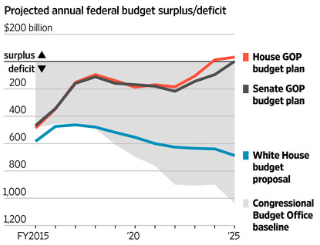
CaptureThe roughly $5 trillion in savings needed to get this done represents 10% of the approximately $50 trillion otherwise projected to be spent in the next ten years.  This means that the entire federal budget, including both discretionary and mandatory (entitlements) spending, will have to be examined for savings:

  • Preserve the Sequester spending limits but give more budget flexibility to each department. Defense hawks complain that the military budget is too tight already. But every government agency can operate more efficiently if it has to, including the Defense Department. Some very good suggestions for doing this have been given by the Heritage Foundation.
  • Social Security. Simple adjustments, such as eliminating the income cap, raising the age limits for eligibility and/or moving to a more accurate index for inflation, will make the Social Security trust fund solvent indefinitely into the future. Also, eligibility for Social Security Disability Income should be tightened to allow it to operate more efficiently.
  • Medicaid. The current arrangement whereby state spending is matched by the federal government, at a set percentage, is costly to both. Turning Medicaid into a block-grant program would control federal costs and give the states a big incentive to be more efficient.
  • Medicare. This is the toughest nut to crack. An attractive alternative, proposed by Avik Roy of the Manhattan Institute, is to migrate Medicare over time onto the Insurance Exchanges created by Obamacare, thereby providing seniors with the same level of subsidy as everyone else.

With both the House and Senate giving high priority to setting up a ten year balanced budget plan, it is critical to seize this opportunity to address an unusually difficult problem.  The future security and prosperity of our country depends on it!

Frustration Has Deep Economic Roots


My last two posts have dealt with the racial unrest in Ferguson MO and how American society should respond to the basic underlying causes.  In particular Omaha NE where I live is in the process of setting up a large scale pilot project in early childhood education to better prepare children from low-income families to succeed in school.
The St. Louis Post Dispatch had a recent article “Frustration in North County Has Deep Economic Roots” pointing out, for example, that unemployment for young black men in St. Louis is 47% compared to 16% for young white men.  Said the author, David Nicklaus, “If police tactics were the spark which set off the explosion in Ferguson this week, then poverty and hopelessness were the tinder.  Those in charge of the police can begin the healing process, but it won’t be complete unless we tackle the deeper economic issues too.”
CaptureThe Equality of Opportunity Project at Harvard University has published a chart (above) showing the degree of upward mobility for children born into low-income families in different parts of the country.  Omaha ranks much higher than St. Louis but not as high as it could.  The current unemployment rate in Omaha is 3.8% which essentially represents full employment.  This means that there are plenty of jobs available for well qualified applicants.
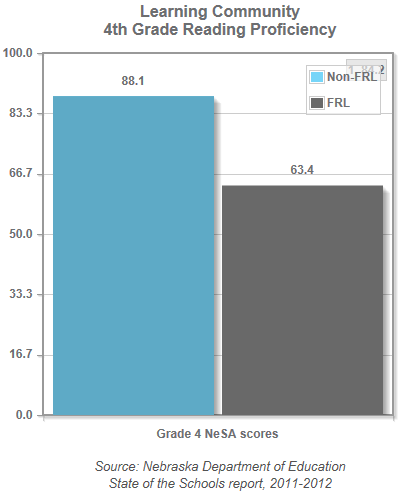
Capture1However the above chart shows the extent of the achievement gap in metro Omaha between middle class children and children living in poverty.  It is already substantial for fourth grade reading proficiency and becomes much worse in the higher grades. Conclusion:  in Omaha NE the root cause of lack of economic opportunity for racial minorities living in poverty is not the availability of jobs but the inadequate educational achievement to hold a good job.
Omaha is a prosperous community in a prosperous state.  But it could do a better job of educating children living in poverty.

Conservatives Need to Take Income Inequality More Seriously


Americans are currently having a lengthy discussion about income and wealth inequality. A contribution by the Manhattan Institute’s Diana Furchtgott-Roth, “The Myth of Increasing Income Inequality”, points out, for example, that

  • The lowest 20% income quintile only has 1.7 persons per family unit while the highest quintile has 3.1 persons per family unit.
  • In 1970, 18% of households had only one person as compared with 27% of households in 2012.
  • In 1970 62% of women were married compared with 52% of women in 2012.

Clearly each of these factors will increase income disparities between households. Another recent study, from the National Bureau of Economic Research “Is the United States Still a Land of Opportunity? Recent Trends in Intergenerational Mobility”, concludes that, although the rungs of the income ladder have grown further apart, the chances of climbing from lower to higher rungs has not changed.
CaptureBut from a public perception point of view the Pew Research Center’s recent report, “Most See Inequality Growing, but Partisans Differ over Solutions”, is much more significant. It points out that:

  • 54% of all Americans say that taxes should be raised on the wealthy and corporations in order to expand programs for the poor.
  • Only 35% believe that lowering taxes on the wealthy to encourage investment and economic growth would be a better approach.
  • Unfavorable opinions of the Tea Party have increased from 25% in 2010 to 49% today.
  • The public has more confidence in Democrat’s handling of healthcare by a 45% to 37% margin.
  • Just 42% to 38% favor Republicans in handling the economy.

My conclusion from all of this data is that fiscal conservatives need to do a much better job of showing sympathy and concern for those who are struggling at the lower ends of the income scale. Success in implementing the sound policies which are needed to turn things around depends on accomplishing this!

Do We Need a New School of Economics?


“Consider the following scenario. You are an airline pilot charged with flying a planeload of passengers across the Atlantic. You are offered the choice of two different aircraft. The first aircraft has been prepared by chief engineer Keynes and the second by chief engineer Hayek.
You have to choose which plane to use, so naturally you ask the advice of the two engineers. Keynes urges you to use his aircraft, offering a convincing explanation of why Hayek’s plane will crash on take-off. Hayek urges you to use his aircraft, offering an equally convincing explanation of why Keynes’s plane will crash on landing.

At loss as to which plane to choose, you seek the advice of two leading independent experts – Karl Marx and Adam Smith. Marx assures you that it does not matter which aircraft you choose as both will inevitably suffer catastrophic failure. Similarly, Smith also reassures you that it does not matter which aircraft you choose, as long as you allow your chosen craft to fly itself.”
Thus begins a fascinating new book, “Money, Blood and Revolution: How Darwin and the doctor of King Charles I could turn economics into a true science,” by the fund manager and economist, George Cooper.
CaptureMr. Cooper sets up a circulatory model of democratic capitalism whereby rent, interest payments and profits flow from low income people at the bottom of the pyramid to the wealthy at the top. And then tax revenue (collected mostly from the wealthy) is redistributed downward in the form of government programs.
According to Mr. Cooper, the financial crisis was caused by a combination of lax regulation and excessive credit and monetary stimulus. The question is what to do about it. Mr. Cooper says:

  • Stop adding to the problem. High student debt and high mortgage debt are still being supported by government programs.
  • Change the course of the monetary river. Quantitative easing does not work because it just puts money into the hands of the wealthy and they have no incentive to spend it.
  • Change the course of the fiscal river. Instead put money into the hands of the people at the bottom of the pyramid with expanded government spending on infrastructure (paid for by taxing the wealthy).

Without endorsing all of Mr. Cooper’s suggestions, he nevertheless has many good ones and expresses them in a highly entertaining style!

The Long Run and the Short Run


“I agree with you that something must be done now. The trick is what will work the best in the short term to trigger the agreement between the fiscal conservatives and the modern liberals to cut costs and balance the budget that we both agree on. We can agree to disagree on the solution details but I hope you are successful in achieving the short term goals you are working tirelessly on.
Just as big a question is what will work the best in the long run to prevent it from happening again. I will continue to work on changing the intellectual environment that I see as a precondition to solidifying your short-term gains and preventing a re-occurrence.”
Capture
These are the words of my Omaha libertarian friend, David Demarest, with whom I have an ongoing dialogue.  He wants to cut back and limit the scope of government.  I’m willing to have a more expansive government as long as we’re willing to pay for it.
The secret to solving many of our current problems (stagnant economy, high unemployment, massive debt, increasing inequality) is to grow our economy faster.  The best way to accomplish this is by boosting investment and entrepreneurship with broad-based tax reform, by lowering tax rates for both individuals and corporations, paid for by eliminating deductions and closing loopholes.
But some people think that lowering tax rates means lower taxes on the rich.  To counteract this perception, and at the same time to raise additional tax revenue to lower the deficit, I propose to  levy a new wealth tax of 1% of assets with an exemption of $10 million per person to make sure that the tax only applies to the “truly wealthy.”
I believe that a program along these lines is the best way to get our economy back on track.  But, at the same time we need to figure out how to avoid falling back into another slow growth, high debt trap anytime soon.
A good way to achieve long run protection is with a balanced budget amendment.  It would need to be flexible, allowing for emergencies, and also phased in over several years to allow citizens and legislators time to make the necessary adjustments to spending and taxes.

Should We Be Optimistic or Pessimistic about Our Country’s Future?

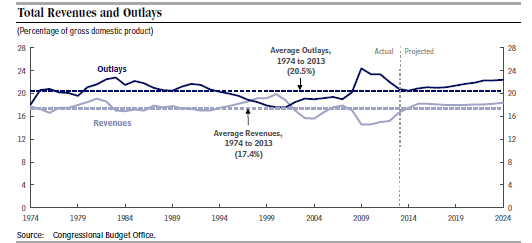
Last month the Congressional Budget Office issued the report “The Budget and Economic Outlook: 2014 to 2024”, giving an updated prediction on economic performance.  It predicts continued slow growth of GDP leveling off in the next few years at a rate of about 2.2% per year.  The public debt (on which we pay interest) will be 74% of GDP this year and increase to 79% of GDP by 2024.  Federal revenues will grow this year to 17.5% of GDP while federal spending will be 20.5% of GDP.  The problem is that the gap between revenue and spending will get worse as indicated by the chart below.
CaptureCBO estimates that interest rates on three month Treasury bills will rise from 0.1% today to 3.7% in 2018, and higher in subsequent years, which means that interest payments on our public debt will increase dramatically as shown in the chart below.  Inflation is predicted to average about 2% over this time period.  Unemployment will slowly drop to 5.8% in 2017 and not reach 5.5% until 2024.
Capture1In an article two days ago, an economics reporter for the New York Times, Floyd Norris, writes that this is “A Dire Economic Forecast Based on New Assumptions”.  Mr. Floyd argues that it is unlikely that we will continue to have both anemic growth and high interest rates at the same time.  Of course, if the economy does grow more quickly, then government revenues will also grow faster which will slow down the growth of the debt.  But CBO predicts that our recovery from the Great Recession will continue to be tortuously slow.
The problem is that when interest rates do go up, as they will sooner or later, interest payment on the national debt will rise quickly, as shown in the CBO chart.  This is going to happen and will be unpleasant to deal with.  Are we going to have slow growth in the meantime, with high unemployment along with it, and then also have expensive debt payment later?  This is indeed a pessimistic prospect!
We have a continuum of choices:

  • Do nothing until the big crunch hits in a few years (like Greece)
  • Cut spending dramatically, including for entitlements (politically infeasible)
  • Raise taxes dramatically (also politically infeasible)
  • Both cut spending and raise taxes (perhaps doable as we get closer to the big crunch)
  • Grow the economy faster which would both lower unemployment and raise revenue

I know what my choice is, how about you?

Closing the Productivity and Pay Gap

The social economist William Galston has a column, in last week’s Wall Street Journal, “Closing the Productivity and Pay Gap”, discussing the large gap between the rising productivity of American workers and the stagnant pay level which has developed since 1973 (see below).  He points out that “the erosion of the compensation/productivity link has made it harder to sustain robust domestic demand for goods and services, which constitutes more than two-thirds of our entire economy.  As the gap widened, U.S. households responded by sending more women into the workforce, expanding the numbers of hours worked, and taking on a greater burden of debt.  These strategies have hit a wall.  Unless compensation rises more rapidly, stagnant domestic demand will depress economic growth as far as the eye can see.”  In other words, workers are no longer receiving their fair share of the productivity gains.  And this retards the increased economic growth which we all desire.  Without detracting from the seriousness of Mr. Galston’s argument, I would like to make several observations which are pertinent to the discussion.
CaptureFirst of all, as pointed out by the Heritage Foundation (in the second chart), wage stagnation since 1973 does not take into account the growth of total compensation including healthcare and other benefits.  And since healthcare costs are twice what they are in any other country, this is a huge drag on the growth of worker’s pay.  In other words, if the U.S. were able to cut healthcare costs nearly in half, as should be possible with a more efficient system, then the hundreds of billions of dollars saved would give a huge boost to paychecks.
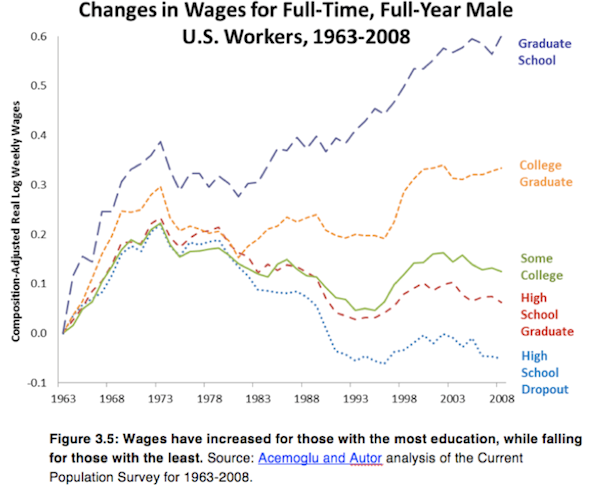
Capture2Secondly (as shown in the last chart), there is a direct correlation between wages and education level for U.S. workers.  Of course, boosting educational outcomes is much easier said than done and, in any event, is a long term process.  Nevertheless, any highly motivated and ambitious person can increase their earnings prospects by succeeding in school.
Capture1Finally, a combination of minimum wage increases and perhaps an expansion of the Earned Income Tax Credit can help those people at the lowest levels of the income scale earn a living wage as long as they are willing to work.
As Mr. Galston said in an earlier piece, “We need nothing less than a new norm – a revised social contract – that links compensation to productivity.  And because we cannot return to the conditions that once sustained that link, we need new policies to bring it about.”

The Economic Outlook: 2014 – 2024 II. How Can We Grow Faster?

Last week I summarized the latest economic report from the Congressional Budget Office which very clearly describes both the slow rate of growth of our economy since the end of the recession, the enormous buildup of our national debt in the past five years and also the likelihood that it will continue getting worse for the foreseeable future unless big changes are made.
CaptureAbout a week ago the two economists Edward Prescott and Lee Ohanian had an Op Ed in the Wall Street Journal, “U.S. Productivity Growth Has Taken a Dive”, pointing out that the productivity of U.S. workers has grown at an average annual rate of only 1.1% since 2011, much lower than the average annual rate of about 2.5% since 1948 (see the above chart).  They also point out that the rate of new business creation is 28% below where it was in the 1980s (see the chart just below).  Growth of worker productivity and growth of new business formation are the two main forces which drive economic growth.
Capture1“Why is the startup rate so low?  The answer lies in Washington and the policies implemented in the wake of the 2008 financial crisis that were, ironically, intended to grow and stabilize the economy.” Mr. Prescott and Mr. Ohanian continue that it is the “explosion in federal regulation, intervention and subsidies (which) has retarded productivity growth by protecting incumbents at the expense of more efficient producers, including startups.”
It is easy to be pessimistic about the prospects for change in the government policies which are retarding economic growth.  Unfortunately, many political and social leaders have the point of view that it is income inequality which is “the defining issue of our time.”
The best response to this pervasive attitude is to shift the conversation towards equality of opportunity rather than dwelling on income inequality.  By far the best way to increase opportunity for those who desire it and are willing to work for it is to grow the economy faster in order to create more and better jobs. If we are able to do this, we’ll all be much better off.

The Economic Effect of ObamaCare

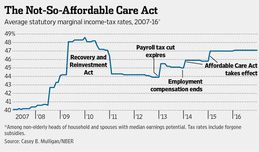
Last week’s report from the Congressional Budget Office “The Economic Outlook: 2014 – 2024” (which I discussed in my last post) caused a big stir with its prediction that ObamaCare will cause a loss of 2,000,000 mostly low wage jobs by 2017 and 2,500,000 such jobs by 2024.  The lost jobs aren’t necessarily from workers being fired or fewer workers being hired but rather the overall decreased incentive for individuals to find work.  The CBO analysis is based on the research of the economist Casey Mulligan featured in yesterday’s Wall Street Journal as “The Economist Who Exposed ObamaCare”.
CaptureThe above chart of Mr. Mulligan interprets several recent government subsidy programs as a new marginal tax rate, i.e. the “extra taxes paid and government benefits foregone as a result of earning an extra dollar of income.”  The 2009 stimulus, the Recovery and Reinvestment Act, had an effect like this but it was temporary.  The marginal tax increase of the Affordable Care Act will last as long as it remains in effect.
Capture1The above chart from the same CBO report, showing the steady decline in the Labor Force Participation Rate from the year 2000 onward, demonstrates the critical nature of this problem.  Lower labor force participation means lower growth in overall labor productivity which in turn means slower economic growth.  Since the Great Recession ended in June 2009, GDP growth has averaged only about 2% annually.
Slow GDP growth means, in addition to a higher unemployment rate, that America’s standard of living will not increase very rapidly if at all.  But the problem is really much worse than this.  We have an enormous debt problem which is only getting worse every year that we continue to have large deficits.  The CBO report predicts increasing growth in the size of our national debt.  By far the least painful way of shrinking our debt (relative to the size of the economy) is to grow the economy as fast as we reasonably can.  But our economy is actually slowing down, not speeding up!
This is a very serious problem which many of our national leaders are much too complacent about!

Fundamental Tax Reform Is the Key to Solving Our Economic and Fiscal Problems I. Why Change Is Needed

I have been writing this blog for just over a year.  It addresses what I consider to be the two biggest problems faced by our country at the present time.  First is our enormous national debt, now over $17 trillion, and the huge annual budget deficits which are continuing to make it worse.  The second problem, of equal magnitude, is our slow rate of economic growth, about 2% of GDP annually, ever since the Great Recession ended in June 2009.
CaptureThese two problems are closely related.  If the economy grew faster, federal tax revenue would grow faster and the annual deficit would shrink faster.  Not to mention that a faster growing economy would create more jobs and lower the unemployment rate, which is still a high 7%.
The impediments to solving these problems are huge.  Our public debt, on which we pay interest, is now over $12 trillion or 73% of GDP.  Although it may stabilize at this level for a few years, it will soon begin climbing much higher, without major changes in current policy.  This is primarily because of exploding entitlement spending for retirees (Social Security and Medicare) who will increase in number from about 50 million today to over 70 million in just 20 years.  As interest rates return to normal higher levels, just paying interest on the national debt will become, all by itself, a larger and larger drain on the economy.
The impediments to faster economic growth are increasing global competition, such as inexpensive foreign labor, as well as rapid advances in technology, such as electronics and robotics.  Both of these trends reduce the need for unskilled workers in America which in turn holds down wages and slows down economic growth.
At the same time we have an antiquated tax code to raise the huge sums of money necessary to pay for a large and complex national government.  It worked fine through the post-World War II period, as long as the U.S. had the dominant world economy with little significant competition from others.  But this situation no longer exists.  We now have a tax system which doesn’t raise enough money to pay our bills and at the same time is so progressive that the highest rates (39.6% on individuals and 35% for corporations) are not sufficiently competitive with other countries.  This discourages the entrepreneurship and business investment we need to grow the economy faster and create more jobs.
We have an enormous problem on our hands!  Is it possible to fundamentally change our tax system to turn things around?  My next post will answer this question in the affirmative!