Where Should the New 114th Congress Focus Its Attention?


The two main themes of this website are how to boost economic growth and how to get our national debt under control.  Faster economic growth will put more people back to work by creating more jobs.  Faster growth will also bring in more tax revenue and therefore potentially reduce deficit spending.
The latest monthly unemployment rate, 5.8% for November 2014, is much higher than it should be almost six years after the end of the Great Recession in June 2009.  The best thing that Congress could do to boost economic growth is to adopt broad-based tax reform, lowering tax rates in a revenue neutral way by closing loopholes and limiting deductions.  I’m still in favor of doing this but I no longer consider it to be the top priority for the following reason.
The huge drop in the price of gasoline is already providing a big economic stimulus.  At the current price of $2 per gallon, the average American family will save about $750 per year in driving expenses.  This is even more relief than a tax cut would provide.  The economy has already picked up steam in 2014 and is predicted to grow at the rate of 3% in 2015.  This will keep the unemployment rate decreasing steadily throughout 2015 and beyond, which represents much progress.
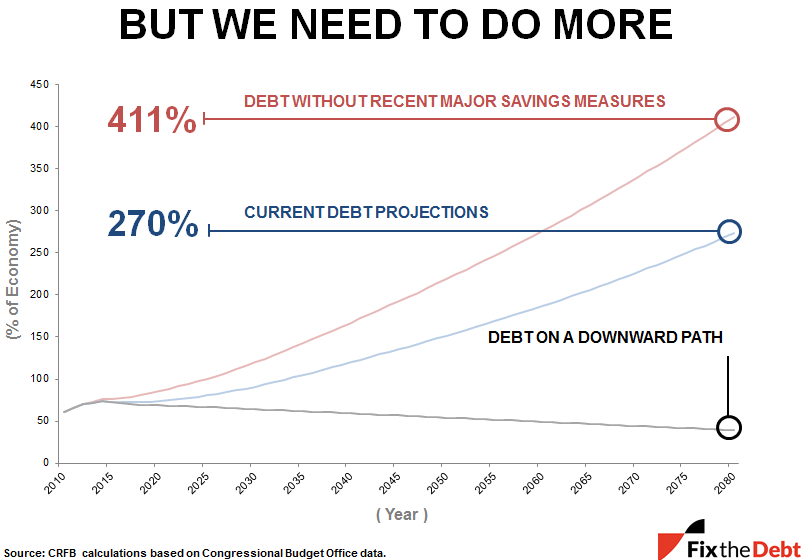
Capture1It’s now time for Congress to focus more strongly on putting the debt on a downward path.  This can only be done by shrinking our annual budget deficits well below the $483 billion deficit for the last (2014) budget year.  As the above chart from Fix the Debt shows, our current fiscal path leads inexorably to a growing debt which is completely unsustainable in the long run.  Annual deficits will have to be at least cut in half to be able to turn the debt trajectory downwards.
Getting this done will require much dedication and hard work by Congress.  Many programs will have to be eliminated.  Surviving programs will need to operate more efficiently.  The entitlement programs of Social Security, Medicare and Medicaid will have to be greatly tightened up.
Is Congress up to this task?  The future of our country depends on it!

The Legacy of Senator Tom Coburn


Oklahoma’s Senator Tom Coburn has just retired from Congress after serving six years in the House of Representatives and ten years in the Senate.  He will be sorely missed because his achievements were legion.
By ridiculing the “Bridge to Nowhere” in Alaska in 2006, he eventually prevailed upon Congress to totally eliminate earmark spending by 2011.
Beginning in 2010 his staff compiled an annual “Wastebook” each year listing numerous examples of wasteful spending by the federal government.  The “2014 Wastebook” gives 100 such examples totally $25 billion ranging from laughing classes for college students to a State Department program to dispel the perception abroad that Americans are fat and rude!
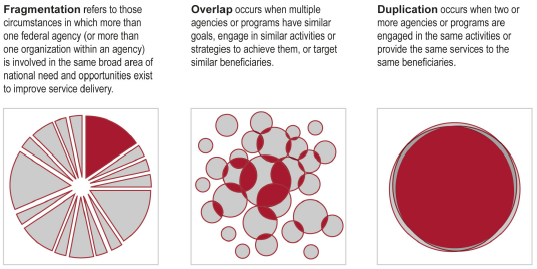
CaptureBeginning in 2011, Senator Coburn has prevailed upon the Government Accounting Office to issue annual reports entitled “Actions Needed to Reduce Fragmentation, Overlap and Duplication and Achieve Other Financial Benefits.”  Now, after four years, a total of 226 specific actions have been recommended by the GAO.  GAO’s Action Tracker shows that the government has addressed about 19% of the efficiency recommendations made by the GAO.  Be thankful for small progress!
His latest, finest and presumably last major effort along these lines is a 320 page report, the “Tax Decoder” which is intended to “decode the tax code for every taxpayer.  It reveals more than 165 tax expenditures costing over $900 billion this year.”  Although more than $1.7 trillion in tax revenue was collected by the government in 2014, the IRS will be unable to collect an additional $500 billion that is owed.  This would have been enough to cover the $483 billion deficit for fiscal year 2014!
As Senator Coburn points out in the introduction to this document, “ideally Congress would throw out the entire tax code and start over.  But at the very least, Congress should make the tax code simpler, fairer and flatter.”
It is rare that a single member of Congress makes such an extraordinary contribution to our country’s welfare!

We Agree There Is a Huge Debt Problem! How Do We Fix It?


Yesterday I gave my second “Fix the Debt” presentation, this time to the Greater Omaha Kiwanis Club.  The main slide (just below)
Captureis all they needed to appreciate the magnitude of the problem.  Their main interest was “How do we fix it?”  They listened politely to a bipartisan list of possible actions:

  • Policies that grow the economy
  • Health care cost containment
  • Social security reform
  • Defense spending cuts
  • Other spending cuts
  • Tax reform and tax expenditure cuts
  • Budget process reform

Then one member asked, “How about a balanced budget amendment?” and this became the focus of the discussion. A balanced budget amendment going forward would not pay off the debt but would stop adding to it.  It would shrink the debt over time as a percentage of GDP as the economy continues to grow.  This is the best we can do in a practical sense and represents a satisfactory solution. There are lots of problems, however, associated with passing a Balanced Budget Amendment:

  • First of all, it will be difficult to accomplish. It requires approval by a 2/3 vote of each house of Congress and ratification by ¾ of the states. This means that it could be stopped by just 13 state legislatures.
  • How would a BBA be enforced? By having the Supreme Court step in and require specific actions to raise taxes or cut spending? This seems problematic.
  • There would have to be a provision for override in the case of emergency (war or other catastrophe). A 2/3 vote by each house of Congress would be a logical way to handle a situation like this. But such a system could easily be abused.

The goal is to significantly shrink the debt as a percentage of GDP over time as the economy grows.  This does not require a balanced budget but only that annual deficits be lower on average than annual growth of the economy.  Representative Paul Ryan’s “Roadmap” plan, for example, would shrink the debt by 30% over a 20 year period without a single annual balanced budget. The important thing is to shrink the debt as a percentage of the economy, and to get going on this as soon as possible.  If it requires a somewhat rigid amendment to get this done, then that’s what we need to do!

Status Quo on the Budget Is Not Good Enough II. Look at the Big Picture!


In my last post, “Status Quo on the Budget Is Not Good Enough,” I discussed a report from the outgoing chair of the Senate Budget Committee, Patty Murray (D-WA), and explained how it epitomizes the lack of progress made on the massive debt problem which has developed since the Great Recession of 2008 -2009.
CaptureThe basic problem is that Senator Murray’s analysis simply does not recognize the seriousness of our debt problem as shown in the above chart.  Right now our public debt (on which we pay interest) is “sitting” at 74% of GDP for a year or two, before it continues its rapid increase.  This projection assumes an historically “normal” growth rate of 3% and no new recessions, neither of which assumption is assured.  It also assumes that the sequester budget cuts and new top tax rate of 39.6% stay in effect.  In other words it is a best case scenario based on current policy.
Breaking it down, the debt will continue to increase because annual deficits will continue to exceed the rate of growth of the economy.  The main driver of these increasing deficits is the cost of the health care entitlements of Medicare and Medicaid.  Medicare costs will increase rapidly because of the aging of the American people.  Medicaid costs will increase rapidly because: 1) more low-income people are being covered by the ACA and 2) since the recession there are more low-income people to be covered.  I certainly support expanded healthcare coverage but we have to figure out how to pay for it!
How do we contain the increasing costs of Medicare and Medicaid?  We do it by controlling the overall rapid growth (at twice the rate of inflation) of healthcare costs in general, i.e. for private healthcare. How do we do this?  See a couple of my recent posts either here or here.
Senator Murray, along with many other progressives, argues that we need more deficit spending in order to stimulate the economy and create new jobs.  More jobs are badly needed but more deficit spending is the wrong way to get them.  Then how?  With tax reform among other things.
Based on the outcome of the 2014 elections, I am optimistic that something along the lines of what I have just described will be tried by the next Congress.  We’ll soon find out!

Status Quo on the Budget Is Not Good Enough


I have now been writing this blog for just over two years.  I usually write three posts per week and this one is #280.  My top sources for background information are the New York Times and the Wall Street Journal.  My own local newspaper, the Omaha World Herald, carries the Washington Post economics journalist, Robert Samuelson, whom I greatly respect.
A column of his discusses a recent report from the Senate Budget Committee prepared by its outgoing chair, Patty Murray (D-WA), entitled “The updated fiscal outlook and its implications for the budget debate next year.”  To me this report clearly shows why there has been so little progress made in straightening out the budget over the past few years.
CaptureCapture1Here are some highlights of the report:

  • “Both our current fiscal situation and the outlook going forward have significantly improved, meaning we need a budget approach more focused on jobs and growth, not just on cuts.”
  • “Deficits have fallen dramatically over the last five years, and projected debt and deficits have also declined.”
  • “Revenue losses due to the recession and slow recovery were significant enough to counteract nearly half of the improvement in projected deficits, which highlights the need for new revenue from the wealthiest Americans and biggest corporations as part of any future deficit reduction effort.”
  • “It is clear that we need a federal budget approach more focused on jobs and growth, not on cuts for the sake of cutting. That leaves Republican leaders with a critical choice.”

In my opinion there are two basic problems with Senator Murray’s analysis:

  • Deficits have indeed fallen dramatically from their very high level in 2009, but not far enough! Deficits are projected to rise back to 3.9% in just ten years, as shown in the first chart. This means that debt will keep growing indefinitely, as shown in the second chart. This is unacceptable!
  • We do badly need to focus on jobs and growth but more deficit spending is not the way to do it. Although immigration reform and expanded trade would help, fundamental tax reform, individual and corporate, is what is really needed to grow the economy.

Hopefully a new Congress will be able to move in this direction next year!

Nebraska Does Not Need Charter Schools


A story in the World Herald on December 19, “OPS board preparing for charter school bills,” reports that several members of the OPS School Board expect charter school legislation to be introduced into the Nebraska Legislature next year, and want to be in a position to influence it.   According to proponents, charter schools provide more choice for families who are dissatisfied with their own neighborhood school.
In debating this issue, it is important to keep in mind that the Learning Community already provides expanded educational choice in the metro Omaha area.  In 2013-2014, 6,535 students, of whom 42% were eligible for Free and Reduced Lunch support, participated in the LC’s Open Enrollment program which allows great latitude in transferring into a different school district as long as space is available.  FRL eligible students are provided free transportation for these transfers, at a cost of $5.4 million last year.
CaptureThe above charts from the 2012-2013 LC Annual Report demonstrate very clearly the academic benefit provided by the Open Enrollment program.  For example, the 237 FRL students who transferred into low FRL elementary schools scored as high in reading proficiency as the resident students.  The 248 FRL students who transferred into high FRL elementary schools scored much higher in reading proficiency than the resident students.  Similar results are true for mathematics although the proficiency numbers are lower.
The LC staff believes (see the 2013-2014 Annual Report) that the number of FRL students participating in open enrollment is too small to have an appreciable difference on closing the profound socio-economic achievement gap which exists in the Learning Community.  However, the Open Enrollment program is still valuable as a safety valve for families who are looking for a different school environment.
Consider all of the educational choice which already exists for OPS students: many magnet programs, the Wilson Focus School in south Omaha, the Seventy-Five North partnership proposed for Howard Kennedy Elementary School, and the new privately funded Nelson Mandela Elementary School opening in Fall 2015.
On top of all this is the LC’s Open Enrollment program for any low-income student to transfer to a different school district with free transportation provided.
Nebraska does not need Charter Schools for the very simple reason that huge educational choice already exists where it is most needed, namely within the high poverty Omaha Public School District.

Fix the Debt II. The National Debt and You


As I reported earlier, I am a volunteer for Fix the Debt, the outreach arm for the Washington DC think tank, Committee for a Responsible Federal Budget. I recently attended a workshop in D.C. put on by Fix the Debt and, in return, I have agreed to make presentations about our debt problem to local organizations during the coming year.  Today I gave my first such talk to a local Kiwanis Club.
CaptureThe message is that a large debt means:

  • Lower Wages and Fewer Job Opportunities. The growing debt “crowds out” productive investments in people, machinery, technology and new ventures. For example, the Congressional Budget Office estimates that the average wage in 25 years will be $7000 lower if debt is on an upward path compared to a downward path (see above chart).
  • Increased Costs of Home, Auto, Student and Credit Card Loans. Although interest rates are currently low, they will almost certainly rise as the economy recovers, and they will rise much higher if debt continues to grow.
  • Less Room for Investment in Infrastructure, Research, and the Next Generation. The CBO projects that interest costs will nearly quadruple from $220 billion in 2013 to $800 billion in 2025. By 2030, 100% of all revenue will go towards interest payments and mandatory spending.
  • A Threatened Social Security Net. Both Social Security and Medicare are on a road to insolvency. By 2033 both Medicare’s hospital insurance trust fund and the Social Security trust fund will run out of money.
  • An Increased Likelihood of a New Fiscal Crisis. If investors lose confidence in our ability to service debt, there will be tanking markets, sharply rising interest rates, mass unemployment and rapid inflation.
  • A Missed Opportunity to Grow the Economy. Debt reduction, tax reform and modest entitlement reforms have the potential to increase economic growth by 9.5% by 2035. Think of all the new jobs this would create!

Do you belong to a club or other civic organization in metro Omaha which brings in outside speakers?  If so I’d be happy to bring Fix the Debt’s message to your group.  Shoot me an email at jackheidel@yahoo.com!

“Manana Is Not a Credible Fiscal Plan”


Thus spoke George Osborne, Great Britain’s Chancellor of the Exchequer, in a recent speech to the Economic Club of New York.  “By applying a consistent and long-term economic plan, we can ensure that our best days lie ahead.  If we reduce our high debt so we can weather new shocks, and take the difficult decisions to make our economies more productive, we can provide rising living standards for our citizens.”
CaptureAccording to Mr. Osborne, any long term economic plan needs to include three elements:

  • An activist monetary policy to do whatever it takes to sustain sufficient demand in the economy.
  • A credible commitment to sustainable fiscal policy. Some have argued that fiscal consolidation is incompatible with economic recovery. But recent experience, e.g. sequestration in the U.S. and a balanced budget in the U.K., has shown the reverse.
  • An ambitious program of supply-side reform. The U.S. has a booming technology sector and the fracking revolution. The U.K. has cut its corporate tax rate to 20%, welcomes disruptive innovation and is pushing ahead on shale gas.

In the U.S. things are moving in the right direction and so the focus needs to be on keeping the momentum going.  Monetary stimulus has accomplished much but now a sound exit policy is needed.  Sequestration has slowed down the growth of government debt but has not ended it.  Further progress will require entitlement reform, especially for Medicare and Medicaid.  But first, the Affordable Care Act needs to be improved to do a better job of controlling the overall cost of healthcare.  Infrastructure improvement, tax reform and expanding trade are the supply side keys to increasing productivity and shared prosperity.
Activist monetary policy, credible fiscal policy, and ambitious supply side reform: these are the policies which will lead to future progress!

America’s Best Health Care Practices


Peter G. Peterson is an 88 year old billionaire from Kearney NE.  His Peterson Foundation has just established the Peterson Center on Healthcare whose purpose is “developing a comprehensive approach to finding existing innovative solutions in healthcare that improve quality and lower costs, and accelerating their adoption on a national scale.”
Working with Stanford University’s Clinical Excellence Research Center (CERC), the Peterson team looked at 15,000 single and multi-specialty physician practices around the country and winnowed the list to those practices which were in the top 25% on quality measures and in the lowest 25% in cost.
CaptureThe second step was to identify the features of practices that help explain their exceptional performance.  This led to the identification of the 11 most exceptional physician practices (see above map) around the country.  The study found that total annual health spending was 58% lower for patients cared for by these exceptional practices compared to their national peers.  Further analysis finds that nationwide adoption of the observed features of these practices would conservatively save $300 billion per year.
These extraordinary high-performing practices shared three basic features distinguishing them from others as follows:

  • Their patient relationships are deeper: always on, conscientious observation, and complaints are gold.
  • They have wider interaction with the healthcare system: responsible in-sourcing, staying close, and closing the loop.
  • They have a team-based practice organization: upshifted staff roles, hived (highly collaborative) workstations, balanced compensation, and investment in people rather than space and equipment.

These findings debunk the myth that excellent value only exists by replicating methods used by very large health systems with an efficiency culture cultivated over many years.  For example, “an independent three physician practice in a low-income neighborhood can be among the best.”
The Peterson Center on Healthcare is in the process of showing that free enterprise health care can achieve remarkable gains in both high quality and low cost.  This is hugely important at a time when total U.S. spending on healthcare is already way too high and growing rapidly.
If private enterprise and the free market cannot figure out how to provide quality healthcare at a much lower cost, it is almost inevitable that the U.S. will eventually end up with a single-payer national healthcare system like most of the rest of the world.

The American People Are Amazingly Upbeat!


I think of myself as a political moderate, conservative on fiscal matters and somewhat liberal on social issues.  My blog posts are usually based on a recent newspaper article or think tank study presenting one side or the other of an important issue in an intelligent way.  In other words, I seldom bother to refute what I consider to be dumb ideas.  I assume that they will eventually die of their own dead weight.  My favorite approach is to respond to an attractive article with which I may have a somewhat different point of view.
CaptureToday’s New York Times has such an article, “Many Feel American Dream is Out of Reach, Poll Shows,” pointing out that 64% of a NYT Poll respondents think that it is possible to start out poor and become rich (see above chart), which opinion has dropped from 72% in 2009.  The Poll also reports that:

  • 81% of Americans have confidence in their own local banks whereas only 41% have confidence in Wall Street bankers and brokers.
  • 52% think the economic system in the U.S. is basically fair, since all Americans have a chance to succeed, whereas 45% think it is unfair.
  • 54% of Americans think that over-regulation of the economy, which interferes with economic growth, is a bigger problem than under-regulation, which may create an unequal distribution of wealth.

For almost two-thirds of Americans to be upbeat about the American Dream, after six or seven years of recession and slow recovery is to me a very positive sign.  After a severe financial crisis, it is not at all surprising that “main street” bankers have a much higher favorability rating than “Wall Street” bankers.
Several months ago I reported on a survey taken by the progressive Global Strategy Group showing that 80% of voters consider economic growth more important than income inequality.
Both today’s NYT Poll and the previous GSG Survey are saying loud and clear that Americans put a high premium on economic growth and this is where our national leaders should be concentrating their time and energy.  The new Republican majority in Congress has an almost historic opportunity to get this right.  Let’s hope they don’t blow it!