Progress on Medicaid Reform


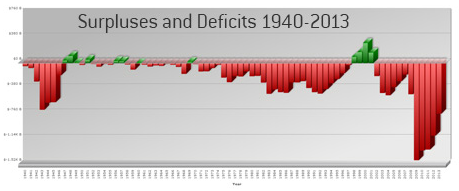
It is widely understood that the rapid increase in spending for entitlements (Social Security, Medicare and Medicaid) is the main driver of our debt problem.  Anything that can be done to get spending for these programs under control is of great value.
The problem with Medicaid is that a fixed percentage of each state’s costs is paid for by the federal government.  The more a state spends, the more that is contributed by the federal government which is a disincentive for states to control their own spending.  From 1989 to 2013, the share of state budgets devoted to Medicaid rose from 9% to 19%.  This upward trend is a problem for both state and federal government and is clearly unsustainable.
One way to change the spending incentive is to turn Medicaid into a block-grant program whereby the federal government contributes a specific amount of money to each state each year and gives states more leeway in designing their own programs.  States would then have a much bigger incentive to hold down costs and the flexibility to be able to do it.
CaptureProgress is being made in this direction with the use of waivers:

  • Rhode Island received a waiver in 2009 to try out various cost-saving measures such as wellness programs, co-payments, etc. It has been quite successful and very well received.
  • Last year Pennsylvania agreed to expand Medicaid to an additional 500,000 people along with a waiver allowing people above the poverty line to be charged premiums of up to 2% of their household income as well as being charged an $8 copayment for use of emergency rooms.
  • Now Indiana (http://www.wsj.com/articles/indiana-governor-to-expand-medicaid-coverage-1422371729) has agreed to an expansion with a waiver under which beneficiaries above the poverty level would be charged premiums of 2% of income and would be locked out of benefits for six months if they fall behind in their payments.
  • Additional states such as Idaho, Wyoming, Utah, Tennessee, Alabama and Florida are also considering Medicaid expansions and likely will be influenced by the possibility of receiving similar waivers.

Waivers are not as cost effective as block-grant funding but they are an improvement over the existing one-size-fits-all federal rules.  If more individual states are able to show that waivers really do work to reduce costs, this will increase the likelihood of implementing a block-grant system.

A Lull in the Storm


The Congressional Budget Office has a sterling reputation for collecting accurate data and making credible predictions about basic economic and fiscal trends.  CBO analyses, which are based on current law, are generally accepted as valid by both liberals and conservatives.  Considering the degree of hyper-partisanship in most discussions of fundamental policy, it is reassuring to at least have an unimpeachable source of basic information.
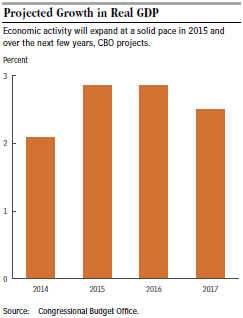
CaptureCBO has just released its regular annual report, ”The Budget and Economic Outlook: 2015-2025.” There is good news for the near term.  As shown above, GDP is projected to grow by 2.9% in the (budget) years 2015 and 2016, and dropping to 2.5% growth in 2017, which is still better than 2014. This means that our national debt will not grow from its current level of 74% of GDP for the next few years and might even decrease slightly.
Capture1Growth will then hover around 2.2% for the remainder of the 2015 – 2025 decade, which is the average GDP since the end of the Great Recession in June 2009.  Likewise, unemployment will likely not fall much below its current value of 5.6% for the next ten years.  In short, under current policy, except for the next couple of years, we are stuck in the same slow-growth rut where we have been for the past five and one-half years.
It should be obvious that we need new policies to speed up growth, put more people back to work, and raise the stagnant wages endured by many middle- and lower-income workers.  How can this be accomplished?

  • Tax reform, both individual and corporate, is the primary route to faster growth. Lower tax rates across the board, paid for by closing loopholes and shrinking deductions. This will put extra income in the pockets of the 64% of taxpayers who do not itemize deductions, which they will likely spend. It will also make it easier for potential entrepreneurs to successfully launch a new business.
  • Immigration reform, expanded foreign trade and deregulation will also create more business opportunities which will in turn grow the economy and create more jobs.

Hopefully the new Congress will be able to move forward in this direction.  A better future depends on it!


Solving the Student Debt Problem?


Today’s New York Times has an excellent article by Kevin Carey on the current status of federal student loans, “A Quiet Revolution is Helping Lift the Burden of Student Debt.” Our current system, called Income-Based Repayment, allows former students to repay their college loans, on a monthly basis, at a rate of 10% of net income, after deducting basic living expenses.  It forgives all loan balances after 20 years, reduced to only 10 years for people who work for government or non-profits.  As shown in the chart below, participation in the IBR program is increasing rapidly.
CaptureMr. Carey shows by example, that the IBR program is quite generous to low paid workers.  Take a teacher who borrows the national average of $29,000 for a bachelor’s degree and another $13,000 for a master’s degree and then takes a teaching job starting at $35,000 and paying $50,000 ten years later.  The teacher’s monthly payments will start at $117 and rise to about $200 in the tenth year.  The teacher will pay back a total of $18,360 and be forgiven the remainder of $48,840 of principal and interest after 10 years.
It makes sense to subsidize college education for teachers and others who work in low wage occupations.  The problem, of course, is that it is very expensive to do so.  The federal government is now committing over $100 billion each year to student loans.  There is over $1 trillion in outstanding federal student loan debt.
Many people have pointed out that our very generous student loan program is subsidizing the rapidly increasing cost of American higher education.  Here are two specific ways to address this problem:

  • Put limits on the amount of money an individual can borrow for college expenses. One such suggestion, from the political scientist, Peter Salins, would set the maximum value of a loan at 50% of the full prevailing average cost of educating undergraduates at U.S. public colleges.
  • Require all colleges to cover 20% of a defaulting student’s loan out of their own pockets. Sheila Bair makes this suggestion for for-profit colleges only but it should apply to all colleges, public and private as well as for-profit.

There are lots of low-cost and high quality educational institutions around the country, including the University of Nebraska at Omaha where I work!  Both students (and their families), as well as the colleges they attend, need to have higher stakes in limiting the explosive costs of higher education.

What Will It Take to ‘Fix the Debt’?


I have recently become a volunteer for the national bipartisan organization, Fix the Debt. It is the outreach arm for the Washington think tank, Committee for a Responsible Federal Budget, which is an offshoot of the Simpson-Bowles Commission from several years ago.
As such, I give presentations to local civic organizations about our national debt and what needs to be done to get it under control. Typically the audience will readily appreciate the seriousness of our debt problem.  What they want to talk about are practical ways to address it.  They have their own ideas and want to know what I think as well.  My first message is that we don’t have to pay off the debt or even balance the budget going forward.  Realistically we need to shrink our annual deficits in order to put the debt on a downward course as a percent of our growing economy,  as shown in the chart just below.

Capture It will be a huge challenge to accomplish even this!  Here are my ideas, in very general outline, on how to get this done:

  • Entitlements (Social Security, Medicare and Medicaid) are the biggest single problem because our population is aging so fast. Furthermore, in order to control the growth of Medicare and Medicaid, we have to do a much better job of controlling the overall cost of healthcare in the U.S. For example, even though healthcare costs slowed down to an increase of only 4.1% in 2014, this is still more than twice the rate of inflation!
  • The second thing we need to do is to make our economy grow faster than the roughly 2.3% growth we have achieved since the end of the Great Recession. The main way to get this done is through broad-based (and revenue neutral) tax reform at both the individual and corporate levels, by reducing tax rates, paid for by closing loopholes and limiting deductions.
  • Finally, there is enormous waste and inefficiency in the federal budget, with huge redundancy and overlap of programs between different federal departments. Responsibility for such programs as education, community development, transportation and social welfare, for example, should be returned to the states with block-grant funding to replace rigid federal control.

I have discussed each of these major reform ideas in much detail in previous blog posts and will continue to do so.  As large as our fiscal problems are, I remain optimistic that they can and will be successfully addressed.

Honoring Martin Luther King’s Legacy


Every year at this time, our nation is reminded of the progress our country has made in race relations as well as the work which remains to be done.  Here are three different approaches to concrete actions which can be taken to help black Americans improve their lot.
Not too long ago I quoted the black scholar, John McWhorter, as follows “Today’s struggle should focus on three priorities.  First, the war on drugs, a policy that unnecessarily tears apart black families and neighborhoods.  Second, community colleges and vocational education, which are invaluable for helping black Americans get ahead.  And third, the AIDS and obesity epidemics, which are ravaging black communities.”
An extensive report by the Hamilton Project (associated with the Brookings Institute), “Policies to Address Poverty in America,” focuses on four discrete areas where progress can be achieved:

  • Promoting Early Childhood Development
  • Supporting Disadvantaged Youth
  • Building Skills
  • Improving the Safety Net and Work Support

Capture Finally, the Budget Committee of the House of Representatives has recently released a new plan, “Expanding Opportunity in America,” proposing to redesign the American welfare system to help more people move off the bottom rung.  The idea is to let selected states experiment in consolidating separate means-tested programs such as SNAP, TANF, childcare and housing assistance programs, into a new holistic Opportunity Grant Program.  Here’s how it would work:

  • Each participating state will approve a list of certified providers who are held accountable for achieving results such as moving people to work, out of poverty and off of assistance.
  • Needy individuals will select a provider who will conduct a comprehensive assessment of that person’s needs, abilities and circumstances.
  • The provider and the recipient will develop a customized plan and contract both for immediate financial needs and also for long term goals towards self-sufficiency.
  • Successful completion of a contract will include able-bodied individuals obtaining a job and earning enough to live above the poverty line.

Here are three very distinct sources addressing the issue of black poverty in America. All three approaches are looking for practical solutions to a very difficult problem and they have a lot in common. This suggests that it should be possible for national leaders to come together and take effective action!

Why America Needs the Common Core


It is well understood that American educational standards are falling behind those of many other developed nations.  I have recently discussed this issue from the point of view of giving more public support to community colleges, as recently proposed by President Obama.
Capture1But the problem is much broader than this. American college students in general score very poorly in basic critical thinking and communication skills.  As the above chart shows, even college seniors are only 60% proficient in these skills and college freshmen do much more poorly.
A new book, “The Smart Society: Strengthening America’s Greatest Resource, its People,” by the political scientist, Peter Salins, provides a good description of the basic problem.  It starts long before college!  America actually has two different K-12 academic achievement gaps.  One, the “Megagap” is the huge test score disparity between middle class students and low-income students, who are largely minorities.  This achievement gap is best addressed with expanded early childhood education, as we are beginning to do in Omaha NE where I live.
But as Mr. Salins points out there is also a Mainstream Achievement Gap between what most non-disadvantaged American youth are capable of learning and what is actually expected of them in the typical U.S. public school.  It is this learning gap which is primarily responsible for America’s mediocre standing on international achievement tests.
CaptureMr. Salins argues that the Mainstream gap is closable because there is such an enormous variation in achievement scores among the 50 states, as shown in the above chart.  In particular, in Massachusetts, a top state, the Education Reform Act of 1995 included the following reforms:

  • The requirement for all state school districts to adhere to rigorous curriculum specifications.
  • A new statewide diagnostic testing protocol.
  • More rigorous testing of new teacher candidates.
  • A statewide uniform high school graduation standard.

Reforms such as these are what make up the Common Core State Standards Initiative.  Such high standards are working well in the top performing states.  Other states need to seriously implement these same standards.  America’s competitive edge depends on it!


Preventing the Next Housing Crisis: Shared Responsibility Mortgages


It is now commonly agreed that the Financial Crisis of 2008 was caused by the collapse of the housing bubble beginning in 2007. There were three main aspects to the huge collapse of wealth caused by the Financial Crisis:
Capture

  • It Destroyed Mainly Middle Class Wealth. During the Great Recession housing values collapsed by $5.5 trillion, a large fraction of the total $14 trillion economy. As shown in the above chart, most of this loss of wealth came at the expense of middle- and lower-income families.
  • Foreclosures on Underwater Mortgages Lowered Housing Values across the Board. When foreclosed houses are sold at steeply discounted prices, the appraised value of all other houses in the area are lowered as well.
  • The Loss of Wealth of Indebted Households Forced Them to Cut Back on Their Overall Spending. The decline in aggregate demand due to wealth loss of the indebted then becomes a problem for everyone in the economy.

In a new book, the economists Atif Mian and Amir Sufi have proposed a new way to set up mortgages, called Shared Responsibility Mortgages (SRM), to protect holders of underwater mortgages during a housing crisis.
Consider a house bought for $100,000 with a 20% down payment and a 30 year mortgage of $80,000 at 5% interest.  The annual mortgage payment is $5,204 per year.  Suppose the value of the house drops 30% to $70,000.  With an SRM the owner’s equity drops to 20% of $70,000 or $14,000.  The annual mortgage payment would also drop 30% to $3,643.  It would continue to be adjusted each year until the house returns to 100% of original value at which point the payment would revert to and remain at the original amount unless the value again drops below 100% of original value.
In return for sharing in the loss caused by a drop in value, the mortgage holder would receive 5% of any capital gain realized whenever the house was sold or refinanced in the future.
Suppose that all mortgages in 2007 had been SRMs.  All three of the problems outlined above would have been avoided.  The financial crisis would have been much less severe!

The Future of American Higher Education


President Obama’s proposal, to make community college free of cost for all Americans, is generating a lot of controversy.  Major complaints are that:

  • The projected cost of $6 billion per year is too high and the program is highly duplicative with other scholarship programs such as Pell grants.
  • Education is primarily a state and local responsibility, not federal.
  • The graduation rate at community colleges is only 21%, much lower than at other types of educational institutions.
  • There is a whole new marketplace of non-degree credentials such as competency-based programs and micro-certifications which often provide greater variety, quality and monetary value than community college programs.

These criticisms are largely valid and should largely be incorporated into the guidelines of the President’s proposal as they are drawn up and submitted to Congress.
CaptureBut they miss the larger point.  Today, about 30% of young people in the U.S. graduate from a four year college.  Tuition and fees at public college averages $9,000 per year while the comparable cost at private colleges is $31,000.  Loan debt for college graduates averages $27,000 per year, and is much higher for many.  And, according to the above chart from the New York Times, educational attainment in the U.S. lags behind the rest of the developed world.
Today’s increasingly high-tech and interconnected world puts a huge premium on educational attainment and America’s system of higher education is not meeting the challenge.  It is too expensive and not educating enough people, especially minorities and those with low-incomes.
The best way to address this problem in a cost-efficient manner, which is a necessity in today’s fiscal climate, is to expand opportunities at our 1100 community colleges. Community colleges are not only incredibly low cost operations, they accept all students and start them out at whatever academic level is necessary.  They provide the ideal venue to lift up large numbers of average and previously-failed students and turn them into productive members of society.  Boosting community college enrollments will, in turn, give our economy a big boost.
This is the real reason why President Obama’s free tuition plan should be taken seriously.  It will shine a strong light on an educational sector whose potential is greatly under-appreciated by many Americans.

Is Universally Free Community College a Good Idea?


President Obama has just proposed that two years of community college be free for all Americans “willing to work for it.”  Forty percent, or about nine million, of today’s college students are enrolled at one of America’s more than 1100 community colleges which have an average annual tuition of $3800.  First estimates are that such a program would cost about $6 billion per year when fully implemented. The advantages of such a program are:
Capture

  • The biggest advantage is to greatly increase college enrollments especially for the low-income, minority and first generation college students who typically attend community colleges.
  • It will make a contribution toward solving the college affordability issue. With tuition averaging $9,139 at public four-year colleges and universities and $31,231 at private institutions, students unsure of their future plans can start out with much lower expenses before deciding if they really want a four year degree. Equally important, it will put pressure on four-year institutions to do a better job of controlling their costs and focusing more strongly on what they do best.
  • Finally, such a plan will put great pressure on expensive for-profit educational institutions, whose primary source of income is from federal student loans, to demonstrate much more clearly their true educational value. Community colleges are likely to expand their course offerings under a big influx of new students and expand into specialized practical subjects where the for-profit institutions now have a virtual monopoly.

There is, of course, one nitty-gritty little thing to be concerned about with such an ambitious new education program.  How is it going to be paid for in our current era of high federal deficits and exploding debt?
I think there are two ways to approach this question.  First of all, the federal education budget is quite large, $141 billion for FY 2014.  We should be able to trim other education programs in order to pay for this new initiative.  This kind of budget discipline, which is absolutely necessary, might require cutting back the President’s proposal in order to reduce its cost.  This is quite appropriate.
There will always be good ideas for new programs which could prove to be quite valuable.  But they will need to be implemented very efficiently!

Is Europe’s Decline an Indication of America’s Future?


One of my favorite writer’s on current affairs is Arthur Brooks from the American Enterprise Institute.  His article in yesterday’s New York Times, “An Aging Europe in Decline” gives a good explanation for the current malaise in Europe.  “The optimists see the region’s economy growing by just 1% in 2015: many fear that a triple-dip recession is in the offing. … Predictions of decade-long deflation, low productivity and high unemployment are becoming conventional wisdom.” But Mr. Brooks makes a strong case that Europe’s core problems are as much demographic as economic:

  • In 2014, the average number of children per woman in the European Union was 1.6, well below the replacement rate of 2.1.
  • The labor participation rate in the EU in 2013 was just 57.5%, much lower than the 62.7% in the U.S..
  • In 2012 the median age of the national population in the EU was 41.9 while the average age of foreigners living in the EU was 34.7. But “anti-immigration sentiment is surging across the continent.”

In other words, Europe is “rejecting the culture of family, turning its back on work and closing itself off to strivers from the outside.”  This is a powerful indictment of contemporary European culture.
Capture1To a certain extent these same trends are evident in the U.S. although to a somewhat lesser degree:

  • Our own fertility rate (see the above chart) is down to 1.9 children per woman in 2012, and is dropping among all racial groups.
  • Our labor participation rate is better than Europe’s but is our own lowest in 36 years.
  • We admit over a million legal immigrants per year who lower the average age of our population. However we fail to accept many highly educated and skilled workers who would be able to give our economy a huge boost.

Demographics are a problem for the U.S. just as they are for Europe.  The only way to counteract strong demographic trends is with smarter economic policies.