The Government We Deserve


“As for the future, your task is not to foresee it, but to enable it.”
Antoine de Saint-Exupery, 1900 – 1944

An important new book, “Dead Men Ruling,” by the Urban Institute’s C. Eugene Steuerle, has just been published.  Here is the flavor of its message:
Capture“Dead and retired policymakers have put America on a budget path in which spending will grow faster than any conceivable growth in revenues. … The same policy makers also cut taxes so much below spending that they created huge deficits, which have now compounded the problem with additional debt.”
“Both sides have largely achieved their central policy goals – liberals have expanded social welfare programs, conservatives have delivered lower taxes.  Both now cling tenaciously to their victories.”
In short, “our central problem is the loss of fiscal freedom.” There are “four deadly economic consequences of this disease:

  • rising and unsustainable levels of debt,
  • shrinking ability of policymakers to fight recession or address other emergencies,
  • a budget that invests ever less in our future and is now a blueprint for a declining nation, and
  • a broken government, as reflected in antiquated tax and social welfare systems.”

In addition there are “three deadly political consequences:

  • a decline of ‘fiscal democracy’ depriving current and future voters of the right to control their own budget,
  • a classic ‘prisoner’s dilemma’ where both left and right leaning elected officials conclude that they will suffer politically if they lead efforts to impose either spending cuts or tax hikes, and
  • rising hurdles to changing our fiscal course because, to do anything new, requires reneging on past promises of rising benefits and low taxes, that voters have come to expect.”

In other words the U.S. is in a very difficult predicament.  Mr. Steuerle thinks it will take a major “fiscal turning point” to escape from the present danger.  Both sides will have to make big concessions in order for us to get out of this jam.  But how is this possibly ever going to happen?  More next time!
The Growth Deficit


I am a fiscal conservative, as well as a social moderate, which means that I don’t fit very easily into a standard mold.  I am non-doctrinaire, non-ideological and mostly nonpartisan.  I vote for candidates from both major parties as well as independents.  I prefer a balanced government with neither party in complete control.
My most direct sources of information on fiscal and economic issues are the Wall Street Journal and the New York Times, both of which I read assiduously on a daily basis.  When these two newspapers disagree on a particular issue, then I usually decide that the truth lies somewhere in between.
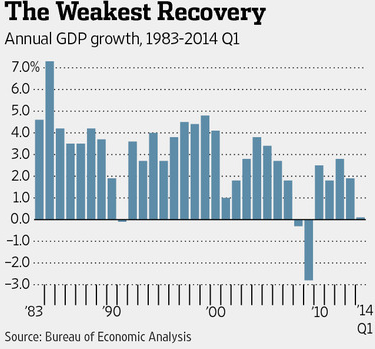
CaptureOur biggest national problem right now, in my opinion, is the stagnant economy.  In today’s WSJ, the lead editorial, “The Growth Deficit”, clearly describes how bad the situation is.  Since the Great Recession ended in June 2009, our rate of GDP growth has averaged 2.2% per year.  This compares with a 4.1% annual rate of growth for all post-1960 recovery periods.
Such a slow rate of growth causes all sorts of problems.  First of all, it explains why our unemployment rate is still so high at 6.7% after five years of recovery.  This means that between 15 and 20 million people are still unemployed or underemployed.  Such a large human toll means a huge increase in government welfare expenses for food stamps, unemployment insurance, etc.  Higher unemployment also means less tax revenue collected by the federal government.  This translates into much larger deficit spending, adding to the already massive national debt.
There are lots of things which can be done to increase growth, for example:

  • Lowering tax rates on individuals to put more money in the hands of the 2/3 of Americans who do not itemize deductions on their tax returns. They’ll spend this extra income and create more demand! Pay for this by closing loopholes and deductions, which are used primarily by the wealthy. Besides stimulating the economy, this will simultaneously address increasing income inequality.
  • Lowering tax rates on corporations to encourage multinationals to bring their foreign profits back home for reinvestment or paying dividends. Again, balanced by eliminating deductions enjoyed by privileged corporations.
  • Relax regulatory burdens on small businesses where most new jobs are created.
  • Reform immigration procedures by boosting the number of H1-B visas to attract more highly skilled, and entrepreneurial, foreign workers.
  • Grant trade promotion authority to the President to speed up new trade agreements.

We should be clamoring for our national leaders to be acting on these fronts.  A strong economy is the very backbone of our success as a nation!

Saving the System


I seldom use the New York Times sociological columnist, David Brooks, as a source for my blog posts because I am focused primarily on economic and fiscal issues.  But his column today, “Saving The System,” is highly pertinent to my message.
Capture1“All around, the fabric of peace and order is fraying.  The leaders of Russia and Ukraine escalate their apocalyptic rhetoric.  The Sunni-Shiite split worsens as Syria and Iraq slide into chaos.  China pushes its weight around in the Pacific. … The U.S. faces a death by a thousand cuts dilemma.  No individual problem is worth devoting giant resources to.  But, collectively, all the little problems can undermine the modern system.”
In addition to all of these pesky worldwide problems, our free enterprise economic system is under siege.  Wages have been largely stagnant since the early 1970s and income inequality is growing as the top 1%, and perhaps the top 10 or 15% as well, do much better than everyone else.  And just lately we have also learned from the French economist, Thomas Piketty, that wealth inequality has been growing steadily ever since about 1950 and is likely to get substantially worse in the future.
In other words, western civilization is under threat in more ways than one.  What are we going to do about it?  At the risk of oversimplifying, I believe that the single best thing we can do is to undertake fundamental tax reform to make our economy stronger.  Cut everyone’s tax rates and pay for it by closing loopholes and deductions which primarily benefit the wealthy.

  • Lower tax rates will put more money in the hands of the two thirds of Americans who don’t itemize their tax deductions. These are largely the same people with stagnant wages and so they will spend this extra income they receive.
  • The resulting increase in demand will put millions of people back to work and thereby increase tax revenues which will help balance the budget. This shift of income from the wealthy to the less wealthy will reduce income inequality.
  • Although harder to implement politically, a low (between 1% and 2%) wealth tax on financial assets above a threshold of $10 million per individual, would be a highly visible way to address wealth inequality. The substantial sum of revenue raised by this method could be used to fund national priorities as well as paying down the deficit.

I don’t want to leave the impression that I consider this program to be a panacea for strengthening our country.  But it would help and we need to make some big changes to maintain our status as world leader.

Is Capitalism in Crisis?


The economist and public lecturer, Richard Wolff, gave an address in Omaha NE last night, entitled “Capitalism in Crisis: How Lopsided Wealth Distribution Threatens Our Democracy”.  His thesis is that after 150 years, from 1820 – 1970, of steadily increasing worker productivity and matching wage gains, a structural change has taken place in our economy.  Since 1970 worker productivity has continued to increase at the same historical rate while the median wage level has been flat with no appreciable increase. This wage stagnation has been caused by an imbalance of supply and demand as follows:
Capture

  • Technology has eliminated lots of low skill and medium skill jobs in the U.S.
  • Globalization has made it less expensive for low skill jobs to be performed in the developing world at lower cost than in the U.S.
  • At the same time as jobs were being replaced by technology and disappearing overseas, millions of women entered the labor force.
  • A new wave of Hispanic immigration has caused even more competition for low skilled jobs.

In addition, stagnant wages for the low skilled and medium skilled worker have been accompanied by an increase in private debt through the advent of credit cards and subprime mortgage borrowing.  This enormous increase of consumer debt led to the housing bubble, its bursting in 2007-2008, and the resulting Great Recession.
Five years after the end of the recession in June 2009, we still have an enormous mess on our hands: a stagnant economy, high unemployment, massive and increasing debt and a fractious political process.  How in the world are we going to come together to address our perilous situation in a rational and timely manner?
Mr. Wolff believes that capitalism’s faults are too severe to be fixed with regulatory tweaks.  He also agrees that socialism has proven to be unsuccessful where it has been tried.  He proposes a new economic system of “Workers’ Self-Directed Enterprises” as an alternative.
I agree with Mr. Wolff that capitalism is in a crisis but I think that it can be repaired from within.  The challenge is to simultaneously give our economy a sufficient boost to put millions of people back to work and to do this while dramatically shrinking our annual deficits in order to get our massive debt on a downward trajectory as a percent of GDP. How to do this is the main focus of my blog, day in and day out!

Why Debt Matters II. “Go for the Heart”


The author and lecturer, David Horowitz, has just published a little pamphlet,”Go for The Heart: How Republicans Can Win” describing how conservatives are being outmaneuvered on the campaign trail.
Capture“Year after year the Democrats’ campaign themes are monotonously familiar. They rely on scaring the voters by accusing Republicans of the same imaginary crimes: Republicans are a party that wages war on women, minorities, and vulnerable Americans. They don’t care about the vulnerable and the poor. Their policies inflict pain on working families to benefit the wealthy few.”
“ ’Caring’ is not one among many issues in a democratic election. It is the central one. Since most issues are complex and require too much information, voters care less about policy than about the candidates themselves. Above everything else they want to know who they can trust. Far more important to voters than a particular policy, they want a candidate or party who cares about them.”
“Behind Republican campaign failures lies an attitude that reflects an administrative rather than political approach to election campaigns. Such an approach focuses on policies for running the country and fixing problems rather than the political aspect of the electoral battle.”
In other words, fiscal conservatives must make a compelling moral case why it is so important to stop spending money that we don’t have.

  • By piling up more and more debt year after year, we are creating a huge burden for future generations. Is this the legacy we want to leave for our children and grand- children?
  • If we do not control the growth of entitlement programs, we are endangering their very existence. It’s ordinary people with average incomes who will need Social Security and Medicare when they retire. It’s our moral obligation to keep these programs sound for their sake!
  • Boosting the economy with lower tax rates has nothing to do with helping the rich. In fact, it’s the rich who benefit from the tax loopholes and preferences which must be eliminated to pay for these rate cuts to benefit the people who really need them!
  • Insisting on a work requirement for welfare recipients is demonstrating the tough love that they need to gain the dignity of becoming productive citizens. We need to give them a hand as well as a handout!

These are just a few examples of ways that conservatives can address the debt and deficit issues in a positive, and non-punitive, manner. Thanks to Mr. Horowitz I will attempt to take this approach consistently from now on.

Why Debt Matters


The House Committee on Financial Services recently held a hearing on the topic “Why Debt Matters.” One of the speakers was David Cote, CEO of Honeywell International. He pointed out that the percentage of world GDP generated by the developed countries (the U.S., Western Europe, Canada and Japan) is predicted to decline from 41% in 2010 to 29% by 2030. High growth developing economies are expected to grow in GDP from 33% in 2010 to 47% in 2030. In order to compete in this new world we need an “American Competitiveness Agenda.”
Mr.Cote suggests eight components: debt reduction, infrastructure development, better math and science education, immigration reform, tort reform, stronger patent support, more energy generation and efficiency, and trade expansion. “To compete effectively on the increasingly competitive world stage, we have to have a strong balance sheet. We don’t have a strong balance sheet today and it will worsen over time with our current plan. … In 2025, just 11 years from now, we will be spending a trillion dollars a year just in interest.” And this is assuming no more recessions in the meantime!
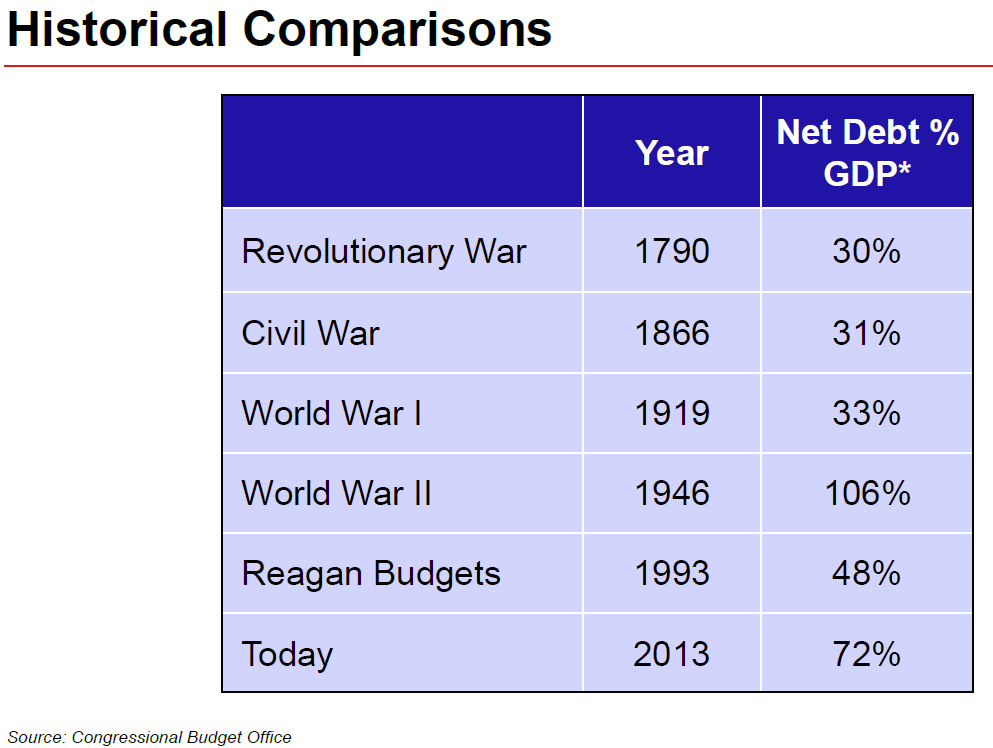
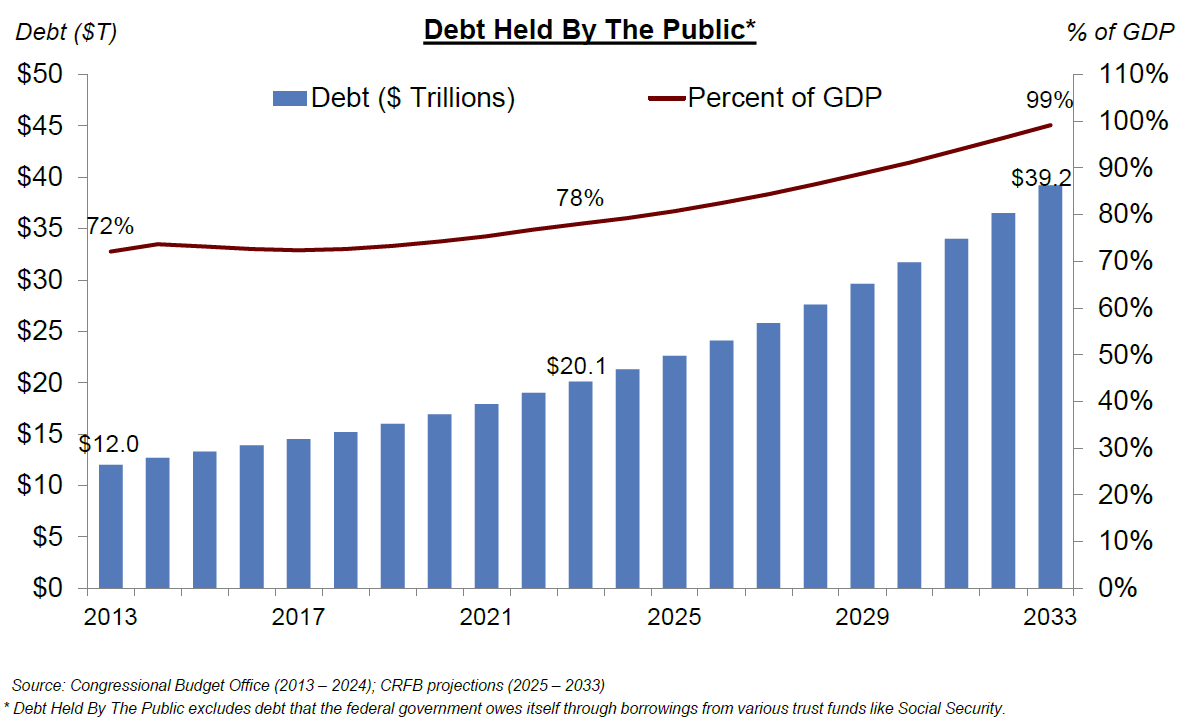
CaptureOur public debt level today, at 72% of GDP, is higher than at any time in our nation’s past, except for during World War II when the survival of the free world was at stake. And while public debt will be 78% of GDP in 2023, which might not sound much worse than today, it is also projected to be much higher, 99% of GDP, by 2033. Is this really the legacy that we want to leave for our children and grandchildren?
Capture1Some people say that we should run even bigger deficits right now until we are fully recovered from the Great Recession. But this is what we’ve been doing for the past five years and it’s not working. How much longer do we wait until we change course?
It’s possible to shrink our deficits and speed up the growth of our economy both at the same time. This is what Mr. Cote is saying and what I am constantly talking about on this website!

The Long Run and the Short Run


“I agree with you that something must be done now. The trick is what will work the best in the short term to trigger the agreement between the fiscal conservatives and the modern liberals to cut costs and balance the budget that we both agree on. We can agree to disagree on the solution details but I hope you are successful in achieving the short term goals you are working tirelessly on.
Just as big a question is what will work the best in the long run to prevent it from happening again. I will continue to work on changing the intellectual environment that I see as a precondition to solidifying your short-term gains and preventing a re-occurrence.”
Capture
These are the words of my Omaha libertarian friend, David Demarest, with whom I have an ongoing dialogue.  He wants to cut back and limit the scope of government.  I’m willing to have a more expansive government as long as we’re willing to pay for it.
The secret to solving many of our current problems (stagnant economy, high unemployment, massive debt, increasing inequality) is to grow our economy faster.  The best way to accomplish this is by boosting investment and entrepreneurship with broad-based tax reform, by lowering tax rates for both individuals and corporations, paid for by eliminating deductions and closing loopholes.
But some people think that lowering tax rates means lower taxes on the rich.  To counteract this perception, and at the same time to raise additional tax revenue to lower the deficit, I propose to  levy a new wealth tax of 1% of assets with an exemption of $10 million per person to make sure that the tax only applies to the “truly wealthy.”
I believe that a program along these lines is the best way to get our economy back on track.  But, at the same time we need to figure out how to avoid falling back into another slow growth, high debt trap anytime soon.
A good way to achieve long run protection is with a balanced budget amendment.  It would need to be flexible, allowing for emergencies, and also phased in over several years to allow citizens and legislators time to make the necessary adjustments to spending and taxes.

Should We Be Optimistic or Pessimistic about Our Country’s Future?

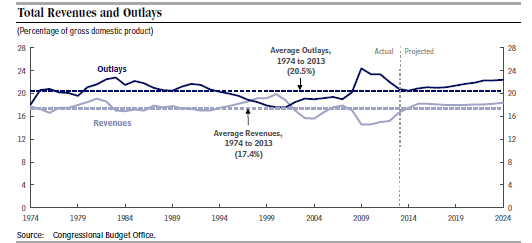
Last month the Congressional Budget Office issued the report “The Budget and Economic Outlook: 2014 to 2024”, giving an updated prediction on economic performance.  It predicts continued slow growth of GDP leveling off in the next few years at a rate of about 2.2% per year.  The public debt (on which we pay interest) will be 74% of GDP this year and increase to 79% of GDP by 2024.  Federal revenues will grow this year to 17.5% of GDP while federal spending will be 20.5% of GDP.  The problem is that the gap between revenue and spending will get worse as indicated by the chart below.
CaptureCBO estimates that interest rates on three month Treasury bills will rise from 0.1% today to 3.7% in 2018, and higher in subsequent years, which means that interest payments on our public debt will increase dramatically as shown in the chart below.  Inflation is predicted to average about 2% over this time period.  Unemployment will slowly drop to 5.8% in 2017 and not reach 5.5% until 2024.
Capture1In an article two days ago, an economics reporter for the New York Times, Floyd Norris, writes that this is “A Dire Economic Forecast Based on New Assumptions”.  Mr. Floyd argues that it is unlikely that we will continue to have both anemic growth and high interest rates at the same time.  Of course, if the economy does grow more quickly, then government revenues will also grow faster which will slow down the growth of the debt.  But CBO predicts that our recovery from the Great Recession will continue to be tortuously slow.
The problem is that when interest rates do go up, as they will sooner or later, interest payment on the national debt will rise quickly, as shown in the CBO chart.  This is going to happen and will be unpleasant to deal with.  Are we going to have slow growth in the meantime, with high unemployment along with it, and then also have expensive debt payment later?  This is indeed a pessimistic prospect!
We have a continuum of choices:

  • Do nothing until the big crunch hits in a few years (like Greece)
  • Cut spending dramatically, including for entitlements (politically infeasible)
  • Raise taxes dramatically (also politically infeasible)
  • Both cut spending and raise taxes (perhaps doable as we get closer to the big crunch)
  • Grow the economy faster which would both lower unemployment and raise revenue

I know what my choice is, how about you?

The Economic Effect of ObamaCare

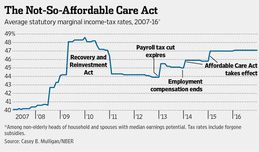
Last week’s report from the Congressional Budget Office “The Economic Outlook: 2014 – 2024” (which I discussed in my last post) caused a big stir with its prediction that ObamaCare will cause a loss of 2,000,000 mostly low wage jobs by 2017 and 2,500,000 such jobs by 2024.  The lost jobs aren’t necessarily from workers being fired or fewer workers being hired but rather the overall decreased incentive for individuals to find work.  The CBO analysis is based on the research of the economist Casey Mulligan featured in yesterday’s Wall Street Journal as “The Economist Who Exposed ObamaCare”.
CaptureThe above chart of Mr. Mulligan interprets several recent government subsidy programs as a new marginal tax rate, i.e. the “extra taxes paid and government benefits foregone as a result of earning an extra dollar of income.”  The 2009 stimulus, the Recovery and Reinvestment Act, had an effect like this but it was temporary.  The marginal tax increase of the Affordable Care Act will last as long as it remains in effect.
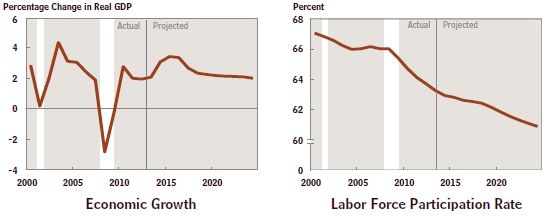
Capture1The above chart from the same CBO report, showing the steady decline in the Labor Force Participation Rate from the year 2000 onward, demonstrates the critical nature of this problem.  Lower labor force participation means lower growth in overall labor productivity which in turn means slower economic growth.  Since the Great Recession ended in June 2009, GDP growth has averaged only about 2% annually.
Slow GDP growth means, in addition to a higher unemployment rate, that America’s standard of living will not increase very rapidly if at all.  But the problem is really much worse than this.  We have an enormous debt problem which is only getting worse every year that we continue to have large deficits.  The CBO report predicts increasing growth in the size of our national debt.  By far the least painful way of shrinking our debt (relative to the size of the economy) is to grow the economy as fast as we reasonably can.  But our economy is actually slowing down, not speeding up!
This is a very serious problem which many of our national leaders are much too complacent about!

The Economic Outlook: 2014 – 2024 I. The Basic Data


The Congressional Budget Office has just issued the report ”The Budget and Economic Outlook: 2014 to 2024”, giving its usual objective and nonpartisan look at our prospects for the next ten years.  My purpose today is to give a simple interpretation of its basic data.  In my next post I will address the implications of this interpretation.
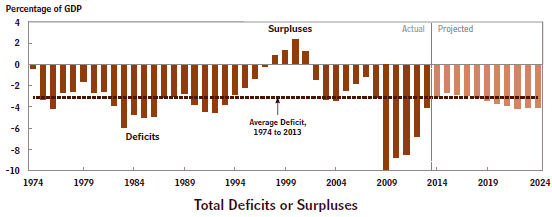
CaptureCapture1The first chart above shows a forty year history of government deficit spending.  The average deficit for this time period is 3% of GDP.  From 1982 – 1987 the deficits were worse than this and from 2009 – 2013 they were much worse.  The real problem is the accumulated deficits, i.e. the debt.  The second chart above shows the public debt (what we pay interest on) all the way back to 1940 as a percent of GDP.  As recently as 2008, the public debt was below 40% of GDP.  Now it is 73% and climbing.  This is very serious for two reasons.  Right now our public debt is almost free money because interest rates are so low.  But when interest rates return to their normal level of about 5%, interest payments will explode and be a huge drain on the economy.  In addition, these CBO predictions assume continued steady growth of the economy.  If and when we have a new recession or some other financial crisis, there will be much less flexibility available for dealing with it.
Capture2Now look at the last two charts.  The first one shows the rate of GDP growth since 2000 which has averaged about 2% since the end of the recession in June 2009 and is projected by the CBO to level off at this same rate over the next 10 years.  This is an historically low rate of growth for our economy. The final chart shows the gradual decrease of the labor force participation rate over this same time period.  These two graphs are related!  When fewer people are working, the economy simply will not grow as fast.
High debt and slow growth are big problems for an economy.  We’re falling more deeply into this perilous state of affairs all the time.  We need to take strong measures to break out of this dangerous trap!