Wealth and Taxation


As I reported in my last blog post a few days ago, wealth inequality in the United States and the rest of the developed world is growing rapidly and is likely to get much worse in the foreseeable future.   This is happening because income from wealth, i.e. the return on investment, typically grows faster than wages and GDP.  As income inequality also grows, and top wage earners have more and more money to invest, then the gap between investment income and wage income will become even wider.  There is nothing wrong with this and the more money that is reinvested in our economy, the faster it will grow and the more jobs that will be created.
At the same time that huge new wealth is being created we have an archaic tax system in the U.S. which is not only incredibly complicated and inefficient, but also discourages investment because the top individual and corporate rates are so high.  And it doesn’t collect enough tax to pay our bills.  We have huge deficits already and the CBO says that they’ll just keep getting worse.
Making government operate more efficiently with less spending is highly desirable but will only go so far.  Every government program has a constituency of supporters who complain when their own program is targeted for cuts.  And the biggest and most expensive, the entitlement programs of Social Security and Medicare, have the largest constituency of all, over 50 million retirees at the present time and growing rapidly as the baby boomers retire at the rate of 10,000 per day.
This huge crunch can only be resolved by fundamental tax reform.  Several different ways have been proposed to do this:

  • Reform the current income tax system by broadening the base, lowering rates and eliminating deductions and loopholes to pay for it.  The problem with this approach is that no one wants to give up their own deductions (for mortgage interest, charitable contributions, employer provided healthcare, state and municipal taxes, etc.)
  • Introduce a consumption tax such as the Graetz Plan which I described in my January 7, 2014 post.  It would establish a 14% Value Added Tax on consumption, supplemented by a lower but still progressive tax on incomes over $100,000.  It would avoid being regressive on low wage workers by using an Earned Income Tax Credit to offset the Payroll Tax.
  • Introduce a wealth tax.

Sorry, I’m over my (self-imposed) word limit already.  I’ll describe a possible wealth tax in my next post!

Does Tax Reform Have a Future?


My post on February 27, “A Breath of Fresh Air” praises the new tax reform proposal from the House Ways and Means Committee which both lowers and consolidates tax rates in a revenue neutral way as well as greatly simplifying the tax code.  It would be a big step in the right direction.  But the Washington Post’s Robert Samuelson makes a good case in ”Does Tax Reform Have a Future?” that the House bill does not go far enough.
CaptureMr. Samuelson argues that if we’re going to eliminate tax deductions and loopholes, and thereby alienate lots of special interest groups, in order to get lower tax rates, then we should avoid half measures and eliminate virtually all deductions in order to get the lowest possible rates.  In other words, eliminate the mortgage interest deduction rather than just limiting it, eliminate deductions for charitable contributions as well as deductions for state and local taxes.  Eliminate the deduction for employer provided healthcare (which by itself would go a long way towards reforming healthcare.)
Mr. Samuelson would retain only the Earned Income Tax Credit (which encourages low-income people to work) and also the tax preference for contributions to retirement accounts (without which most Americans wouldn’t save for retirement.)
We badly need broad based tax reform to stimulate our economy.  Douglas Holtz-Eakin, the former director of the Congressional Budget Office, has estimated “Reforming Taxes, Goosing the Economy”, that even the imperfect House tax reform proposal would raise GDP by .5% annually for 10 years and create 500,000 new jobs each year over this time period.
Full-fledged tax reform, a la Samuelson, would provide an even greater stimulus but let’s at least do something to put the millions of unemployed and underemployed people back to work and reduce our staggering budget deficits!

Where Have All the Raises Gone?


In yesterday’s New York Times an editorial asks the question “Where Have All the Raises Gone?”, pointing out that wages for college graduates have been stagnant since 2001 (see the chart below.)  A report referred to in the NYT editorial suggests that as the information technology revolution has matured, employer demand for cognitive skills has waned and so some college graduates have had to take lower paying jobs, displacing less educated lower skilled workers in the process.  This makes sense and, of course, new hiring has slowed down even more as a result of the recession.
CaptureThe question then becomes, what, if anything can government do to counteract and overcome this trend?   According to the NYT, “what’s needed to raise pay are policies like a higher minimum wage, trade pacts that foster high labor and regulatory standards, and more support for union organizing.”
Of course there is another point of view and it is expressed very well in yesterday’s Wall Street Journal by Mortimer Zuckerman, the Chairman and Editor-in-chief of U.S. News and World Report, “Fight Inequality With Better Paying Jobs”. Mr. Zuckerman declares that “income inequality isn’t so much the problem as income inadequacy.  A more robust economy, stoked by growth-oriented policies from Washington, would help produce the jobs and opportunities that millions of Americans need to climb the economic ladder.”  He suggests that what is needed is:

  • Lower corporate tax rates so that American multinational companies will bring their foreign earnings back home.
  • Get healthcare costs under control (Obama Care doesn’t do this).
  • Cut back on unnecessary regulations to encourage more business investment.
  • Train more skilled workers.  The National Federation of Independent Businesses reports that 38% of its members have job openings they can’t fill.
  • Restore H1-B visa levels to the higher levels of earlier years – 195,000 per year compared to only 65,000 today.  Skilled immigrants start many new businesses and this is the biggest source of new job creation.

In other words there are lots of things the federal government can do to boost the economy.  As Mr. Zuckerman says, “The political system is failing us.  Washington doesn’t seem to be listening as our political parties are focused more on ideological conflict than the good of the country.”

Should We Be Optimistic or Pessimistic about Our Country’s Future?

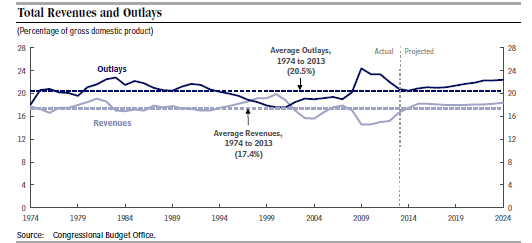
Last month the Congressional Budget Office issued the report “The Budget and Economic Outlook: 2014 to 2024”, giving an updated prediction on economic performance.  It predicts continued slow growth of GDP leveling off in the next few years at a rate of about 2.2% per year.  The public debt (on which we pay interest) will be 74% of GDP this year and increase to 79% of GDP by 2024.  Federal revenues will grow this year to 17.5% of GDP while federal spending will be 20.5% of GDP.  The problem is that the gap between revenue and spending will get worse as indicated by the chart below.
CaptureCBO estimates that interest rates on three month Treasury bills will rise from 0.1% today to 3.7% in 2018, and higher in subsequent years, which means that interest payments on our public debt will increase dramatically as shown in the chart below.  Inflation is predicted to average about 2% over this time period.  Unemployment will slowly drop to 5.8% in 2017 and not reach 5.5% until 2024.
Capture1In an article two days ago, an economics reporter for the New York Times, Floyd Norris, writes that this is “A Dire Economic Forecast Based on New Assumptions”.  Mr. Floyd argues that it is unlikely that we will continue to have both anemic growth and high interest rates at the same time.  Of course, if the economy does grow more quickly, then government revenues will also grow faster which will slow down the growth of the debt.  But CBO predicts that our recovery from the Great Recession will continue to be tortuously slow.
The problem is that when interest rates do go up, as they will sooner or later, interest payment on the national debt will rise quickly, as shown in the CBO chart.  This is going to happen and will be unpleasant to deal with.  Are we going to have slow growth in the meantime, with high unemployment along with it, and then also have expensive debt payment later?  This is indeed a pessimistic prospect!
We have a continuum of choices:

  • Do nothing until the big crunch hits in a few years (like Greece)
  • Cut spending dramatically, including for entitlements (politically infeasible)
  • Raise taxes dramatically (also politically infeasible)
  • Both cut spending and raise taxes (perhaps doable as we get closer to the big crunch)
  • Grow the economy faster which would both lower unemployment and raise revenue

I know what my choice is, how about you?

Inequality, Productivity and Compensation

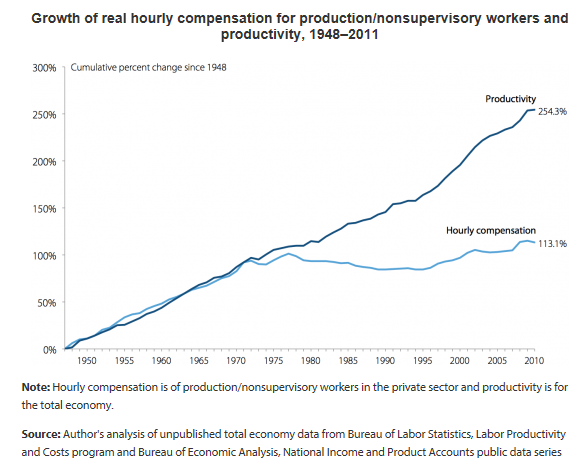
The Brookings Institution social economist, William Galston, has an interesting column in yesterday’s Wall Street Journal, “The U.S. Needs a New Social Contract”, deploring the fact that worker compensation (i.e. wages + benefits) has not kept up with gains in worker productivity since the 1970s.  Here is a chart published by the Economic Policy Institute showing the divergence between productivity and compensation for a “typical” ( i.e. in the middle) worker beginning in the 1970s:
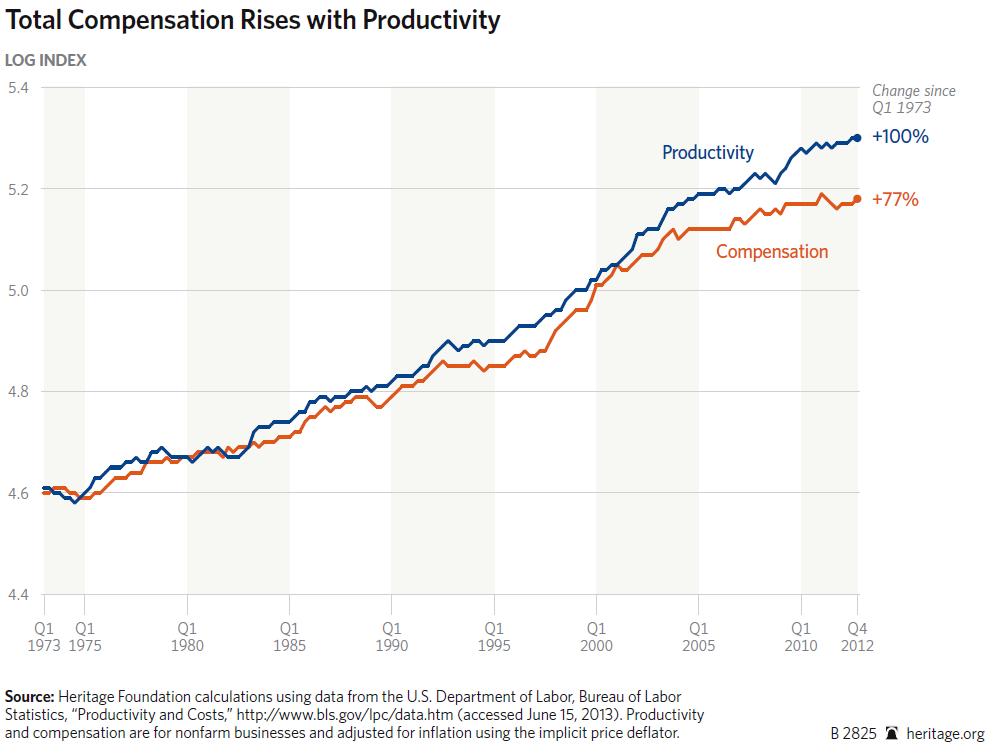
CaptureThe Heritage Foundation’s James Sherk has addressed this same question in a recent report “Productivity and Compensation: Growing Together” and shows that the “average” compensation of an American worker does track productivity very closely as shown in the chart below:
Capture1What is the explanation for this apparent discrepancy?  In fact, it is the difference between the average earnings of U.S. workers and the earnings of the median or middle worker.  The very high earnings of the top 10% and the even higher earnings of the top 1% raise average worker compensation way above the income level of the median worker.  In other words it is the result of the skewed and unequal distribution of incomes which is heavily weighted toward those at the top of the scale.  The typical or median worker is falling behind and is not benefitting from the steady rise in the overall productivity of the American economy.  This is what income inequality is all about.
The question is what to do about it.  Faster economic growth will create more opportunity by creating more jobs and better paying jobs.  Raising high school graduation rates as well as creating high quality technical training programs will also help.
Mr. Galston insists that this is not enough.  Too many workers will continue to lag farther and farther behind.  We could raise the Earned Income Tax Credit for low income workers but this would be very expensive in our currently tight fiscal situation which is likely to continue indefinitely.
Do we need a new social contract?  If so, what form will it take?  How will we pay for it?  These are indeed very difficult questions to answer!

The Economic Outlook: 2014 – 2024 II. How Can We Grow Faster?

Last week I summarized the latest economic report from the Congressional Budget Office which very clearly describes both the slow rate of growth of our economy since the end of the recession, the enormous buildup of our national debt in the past five years and also the likelihood that it will continue getting worse for the foreseeable future unless big changes are made.
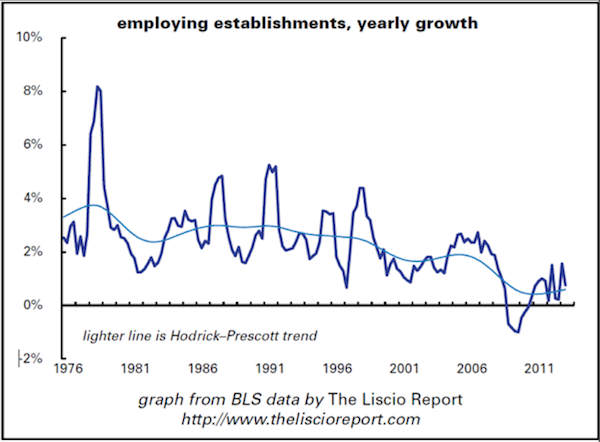
CaptureAbout a week ago the two economists Edward Prescott and Lee Ohanian had an Op Ed in the Wall Street Journal, “U.S. Productivity Growth Has Taken a Dive”, pointing out that the productivity of U.S. workers has grown at an average annual rate of only 1.1% since 2011, much lower than the average annual rate of about 2.5% since 1948 (see the above chart).  They also point out that the rate of new business creation is 28% below where it was in the 1980s (see the chart just below).  Growth of worker productivity and growth of new business formation are the two main forces which drive economic growth.
Capture1“Why is the startup rate so low?  The answer lies in Washington and the policies implemented in the wake of the 2008 financial crisis that were, ironically, intended to grow and stabilize the economy.” Mr. Prescott and Mr. Ohanian continue that it is the “explosion in federal regulation, intervention and subsidies (which) has retarded productivity growth by protecting incumbents at the expense of more efficient producers, including startups.”
It is easy to be pessimistic about the prospects for change in the government policies which are retarding economic growth.  Unfortunately, many political and social leaders have the point of view that it is income inequality which is “the defining issue of our time.”
The best response to this pervasive attitude is to shift the conversation towards equality of opportunity rather than dwelling on income inequality.  By far the best way to increase opportunity for those who desire it and are willing to work for it is to grow the economy faster in order to create more and better jobs. If we are able to do this, we’ll all be much better off.

The Economic Effect of ObamaCare

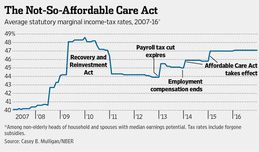
Last week’s report from the Congressional Budget Office “The Economic Outlook: 2014 – 2024” (which I discussed in my last post) caused a big stir with its prediction that ObamaCare will cause a loss of 2,000,000 mostly low wage jobs by 2017 and 2,500,000 such jobs by 2024.  The lost jobs aren’t necessarily from workers being fired or fewer workers being hired but rather the overall decreased incentive for individuals to find work.  The CBO analysis is based on the research of the economist Casey Mulligan featured in yesterday’s Wall Street Journal as “The Economist Who Exposed ObamaCare”.
CaptureThe above chart of Mr. Mulligan interprets several recent government subsidy programs as a new marginal tax rate, i.e. the “extra taxes paid and government benefits foregone as a result of earning an extra dollar of income.”  The 2009 stimulus, the Recovery and Reinvestment Act, had an effect like this but it was temporary.  The marginal tax increase of the Affordable Care Act will last as long as it remains in effect.
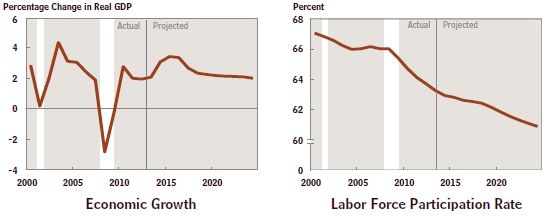
Capture1The above chart from the same CBO report, showing the steady decline in the Labor Force Participation Rate from the year 2000 onward, demonstrates the critical nature of this problem.  Lower labor force participation means lower growth in overall labor productivity which in turn means slower economic growth.  Since the Great Recession ended in June 2009, GDP growth has averaged only about 2% annually.
Slow GDP growth means, in addition to a higher unemployment rate, that America’s standard of living will not increase very rapidly if at all.  But the problem is really much worse than this.  We have an enormous debt problem which is only getting worse every year that we continue to have large deficits.  The CBO report predicts increasing growth in the size of our national debt.  By far the least painful way of shrinking our debt (relative to the size of the economy) is to grow the economy as fast as we reasonably can.  But our economy is actually slowing down, not speeding up!
This is a very serious problem which many of our national leaders are much too complacent about!

The Economic Outlook: 2014 – 2024 I. The Basic Data


The Congressional Budget Office has just issued the report ”The Budget and Economic Outlook: 2014 to 2024”, giving its usual objective and nonpartisan look at our prospects for the next ten years.  My purpose today is to give a simple interpretation of its basic data.  In my next post I will address the implications of this interpretation.
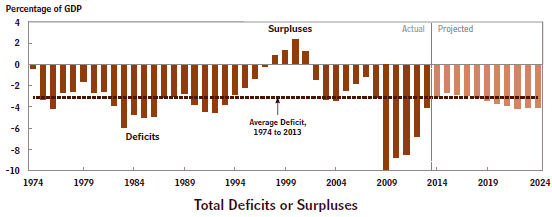
CaptureCapture1The first chart above shows a forty year history of government deficit spending.  The average deficit for this time period is 3% of GDP.  From 1982 – 1987 the deficits were worse than this and from 2009 – 2013 they were much worse.  The real problem is the accumulated deficits, i.e. the debt.  The second chart above shows the public debt (what we pay interest on) all the way back to 1940 as a percent of GDP.  As recently as 2008, the public debt was below 40% of GDP.  Now it is 73% and climbing.  This is very serious for two reasons.  Right now our public debt is almost free money because interest rates are so low.  But when interest rates return to their normal level of about 5%, interest payments will explode and be a huge drain on the economy.  In addition, these CBO predictions assume continued steady growth of the economy.  If and when we have a new recession or some other financial crisis, there will be much less flexibility available for dealing with it.
Capture2Now look at the last two charts.  The first one shows the rate of GDP growth since 2000 which has averaged about 2% since the end of the recession in June 2009 and is projected by the CBO to level off at this same rate over the next 10 years.  This is an historically low rate of growth for our economy. The final chart shows the gradual decrease of the labor force participation rate over this same time period.  These two graphs are related!  When fewer people are working, the economy simply will not grow as fast.
High debt and slow growth are big problems for an economy.  We’re falling more deeply into this perilous state of affairs all the time.  We need to take strong measures to break out of this dangerous trap!

Does Free Trade Increase Inequality?


Several days ago, David Bonior, a former Congressman from Michigan, wrote in the New York Times about “Obama’s Free-Trade Conundrum”. “The President cannot both open markets and close the wage gap.”  There is an “academic consensus that trade flows contribute to between 10 and 40 percent of inequality increases.”  This happens because “there is downward pressure on middle-class wages as manufacturing workers are forced to compete with imports made by poorly paid workers from abroad.”
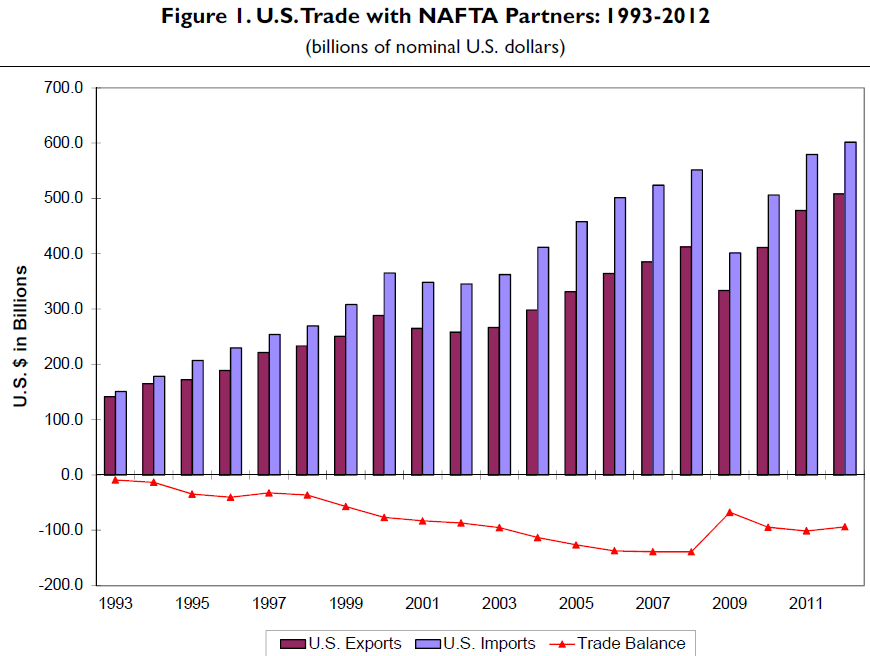
CaptureBut there is another point of view, provided, for example, by the report “NAFTA at 20: Overview and Trade Effects”, prepared by the Congressional Research Service about a year ago.  “U.S. trade with its NAFTA partners has more than tripled since the agreement took effect (in 1993).  (Canada and Mexico) accounted for 32% of U.S. exports in 2012.  40% of the content of U.S. imports from Mexico and 25% of U.S. exports from Canada are of U.S. origin.  In comparison, U.S. imports from China are said to have only 4% U.S. content.”  In other words, NAFTA at least has been a huge success.
Being able to trade with others is the foundation of private enterprise.  Foreign trade is simply an extension of domestic trade.  To limit trading opportunities with other countries would be a huge barrier to economic growth and therefore to future prosperity as well.
But at the same time we do want a more equal society as well as well as a more prosperous one.  The key to resolving this “conundrum”, as Mr. Bonior puts it, is to address “opportunity inequality” as well as “income inequality.”
It is estimated that each billion dollars in U.S. exports provides employment for about 5000 workers.  Nebraska, for example, exported $12.6 billion worth of goods and services in 2012 which translates into 63,000 jobs.
More jobs and better jobs are what create economic opportunity.  One way to create more jobs and better jobs is to promote foreign trade by removing as many trade barriers as possible.  Hopefully Congress and the President can work together to get this done!

Invested in America


The Business Roundtable, an association of chief executive officers of leading U.S. companies, has just issued a new report, “Invested in America: A Growth Agenda for the U.S. Economy”, describing four actions which policymakers can take to rejuvenate the U.S. economy.
CaptureThey are:

  • Restore Fiscal Stability: constrain federal spending in a manner that reduces long-term spending growth, making both Medicare and Social Security more progressive and less expensive.
  • Enact Comprehensive Tax Reform: adopt a competitive, pro-growth tax framework that levels the playing field for U.S. companies competing in global markets.  Several studies estimate that cutting the U.S. corporate tax rate by 10 % (e.g. from 35% to 25%) would boost GDP by 1% or more.
  • Expand U.S. Trade and Investment Opportunities: pass updated Trade Promotion Authority legislation and use TPA to complete many new trade agreements which are already pending.
  • Repair America’s Broken Immigration System: increase the number of visas for higher skilled workers and provide legal status for the millions of undocumented immigrants currently living in the U.S.

These are the same “big four” policy changes which many progressive business leaders as well as evenhanded think tank experts often recommend.  They are really just common sense ideas which reasonable people should be able to come together on.
Isn’t it obvious that we’ll soon be in big trouble if we don’t get our enormous budget deficits under control?  And that controlling entitlement spending is key to getting this done?
Isn’t it just as obviously commonsensical that even U.S. based multinational corporations will try to avoid locating business operations in countries like the United States with very high corporate tax rates?
Isn’t it likewise obvious that foreign trade is just an extension of domestic trade and that the world is better off with as much trade as possible?
Finally, the secret of a vibrant, growing economy is to encourage as much initiative and innovation as possible.  Who take more initiative than the immigrants who figure out how to get here in the first place?
We don’t have to accept a sluggish economy, high unemployment and massive debt!  But we do need to take intelligent action to extricate ourselves from the predicament we are in!