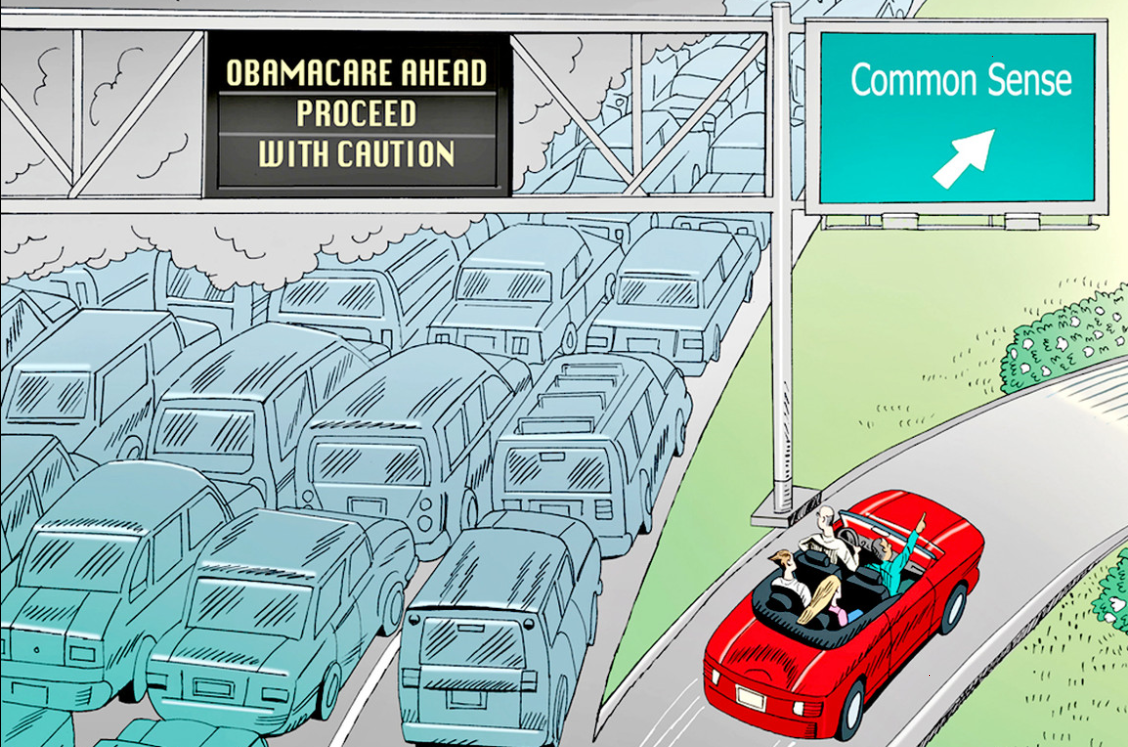
An Off-Ramp from Obama Care


The Supreme Court will soon render an opinion in King v. Burwell, challenging the implementation of the Affordable Care Act which stipulates that subsidies can only be paid “through an Exchange established by the State.”  If the plaintiffs are upheld, it will mean that anyone receiving health insurance through one of the federal exchanges operating in 33 states is not eligible to receive a subsidy.  It will be necessary for Congress to intervene to fix a problem like this.
CaptureThree committee chairs in the House of Representatives, John Kline, Paul Ryan and Fred Upton, are proposing to take such an opportunity to improve the Affordable Care Act along the following lines:

  • First of all, making health insurance more affordable by ending both the individual and employer mandates, and giving choices back to the states, individuals and families.
  • Secondly, supporting Americans in purchasing the coverage of their choosing. For example, people could save money by buying insurance across state lines.
  • Finally, many existing features of the ACA would be retained. Children could stay on their parents policies until age 26. Lifetime limits on benefits would be prohibited. People with existing conditions would be protected. Renewability would be guaranteed. Insurance would be decoupled from employment by offering equal (perhaps, age adjusted) tax credits for all.

There remains the practical problem of providing immediate assistance to the approximately 5 million people currently receiving subsidies through the federal exchanges, while larger scale changes are being worked out by Congress.  The American Enterprise Institute has proposed a simple way for Congress to do this as follows:

  • Enact a short-term extension of subsidies for current enrollees.
  • States with federal exchanges could immediately set up a state exchange if they wished.
  • People with preexisting conditions and/or continuous coverage would be protected.

Both quality control and cost control are badly needed to make the ACA sustainable for the long run.  Given the right decision in King v. Burwell, these two plans outline a possible way to accomplish this.

How Can We Achieve a Free Market in Healthcare?


My last post, “Why Is American Healthcare So Expensive?” suggests that we don’t have enough “skin in the game” because most costs are paid for by third party insurance companies.  One way to alleviate this problem is to subsidize insurance coverage only for catastrophic care with a high deductible and to encourage health savings accounts to pay for routine healthcare expenses.
CaptureBut the University of Chicago’s John Cochrane points out in “After the ACA: Freeing the market for health care” that getting to a true free market in healthcare “will be a long hard road” because “both supply and demand must be freed.”

  • Health care supply. Cost reduction only comes from new entrants into a business, not reform of old businesses. But in 36 states, for example, every new hospital or even major purchase requires a Certificate of Need issued by Hospital Equalization Boards which have explicit mandates to defend the profitability of existing hospitals.
  • Health care demand. True “need” is simply not a well-defined concept when a third party is paying the bills. The consumer must pay a lot closer to the full marginal cost of healthcare, or perhaps receiving the full financial benefits of any economies which he is willing to accept.

What are the objections to establishing a free market system?

  • The homeless and mentally ill, etc. Charity will always be needed for those who fall through the cracks. This doesn’t require a nanny state for the rest of us.
  • Adverse selection. In a free market sick people are more likely to buy insurance and healthy people to forgo it. Sick people would pay more but “health status” insurance and guaranteed renewability will mitigate this problem.
  • Shopping paternalism, i.e. people faced with serious illnesses are incapable of making cost-based decisions. These people and their families will simply have to learn to shop around. In a competitive market, a hospital which routinely overcharges cash customers will be “creamed by Yelp reviews.”

Conclusion.  There are only two ways to get health care spending under control.  A single payer system with rigid regulations and severe rationing or else a deregulated free market system where individuals have primary responsibility for their own care.  Americans are likely to prefer the second option if given a clear choice.

Why Is American Healthcare So Expensive?


The U.S. spends almost 18% of GDP on healthcare costs, double what any other developed county spends.
CaptureThere are many reasons for our excessive healthcare spending.  For example:

  • As illustrated in the above chart, many medical procedures are far more expensive here than in other countries.
  • Profit levels in the healthcare industry are often very high, for example: 16.4% for pharmaceuticals, health-care information 9.4%, home healthcare firms 8.5%, medical labs 8.2% and generic drug makers 6.5%.
  • Health insurers, on the contrary, have a very low profit margin, (2.2% in 2009), and so can hardly be blamed for the high cost of healthcare.

The Affordable Care Act greatly expands access to healthcare but does very little to control costs.  The Manhattan Institute’s Avik Roy has outlined a plan, “Transcending Obamacare: A Patient Centered Plan for Near-Universal Coverage and Permanent Solvency” which would reform Obamacare by making it more like two very successful and low cost consumer-driven plans, those in Switzerland and Singapore.
These two countries feature government sponsored health savings accounts, backed up by insurance for catastrophic care.  What happens is that out-of-pocket spending for healthcare per individual is higher in Switzerland and Singapore than it is in the U.S., as indicated in the chart below.
Capture1In other words, the real reason for our high cost of healthcare is that Americans don’t have enough “skin in the game.”  We have very little incentive to hold down the cost of our own care because it is mostly paid for by third party insurance companies.
As the cost of healthcare continues to climb, such changes are already beginning to creep into the health insurance market place.  Private companies are raising the deductibles on the insurance plans which they subsidize.  The bronze, silver, gold and platinum plans on the ACA exchanges differ largely by the level of the insurance deductible.
Avik Roy’s plan referred to above in essence speeds up the process of converting the ACA into an efficient, consumer-driven healthcare system by making it more flexible and therefore more adaptable to market forces.

What Will True Healthcare Reform Look Like?


My last post, “Progress on Medicaid Reform,” discusses innovations that several states have adopted to improve the delivery of Medicaid and to make it more cost efficient. But what we really need is a complete overhaul of American healthcare, including the Affordable Care Act, as I have also recently discussed, in order to eliminate perverse marketplace incentives as well as to achieve real cost control.
CaptureAn excellent discussion of what real healthcare reform would look like is given by John Goodman in, “Healthcare Solutions for Post-Obamacare America.” Mr. Goodman gives six principles for commonsense reform:

  • Choice. People should be free to choose a health plan that fits individual and family needs, rather than one designed by bureaucrats in Washington. This means no mandates, either for individuals or employers.
  • Fairness. Any subsidy should be in the form of a fixed sum tax deduction or credit and everyone should get it as long as they obtained credible private health insurance. The amount of the subsidy would be comparable to the cost of Medicaid enrollment.
  • Universal Coverage. Since some people will turn down the offer of a tax credit, unclaimed credits can be used to reimburse safety net healthcare institutions.
  • Portability. Portability insurance should be available to employees in case they change jobs or become self-employed.
  • Patient Power. Health Savings Accounts need to be made more available and also more flexible so that they can wrap around any third-party insurance plan, as indicated in the above chart.
  • Real Insurance. Under ACA millions of people are losing access to out-of-network providers. People should be allowed to purchase “change-of-health-status insurance” in case they develop expensive-to-treat conditions.

The ACA addresses the access problem for healthcare but has little effect on the cost problem.  American healthcare, both public and private, is way too expensive.  This is why fundamental change is still needed.

Progress on Medicaid Reform


It is widely understood that the rapid increase in spending for entitlements (Social Security, Medicare and Medicaid) is the main driver of our debt problem.  Anything that can be done to get spending for these programs under control is of great value.
The problem with Medicaid is that a fixed percentage of each state’s costs is paid for by the federal government.  The more a state spends, the more that is contributed by the federal government which is a disincentive for states to control their own spending.  From 1989 to 2013, the share of state budgets devoted to Medicaid rose from 9% to 19%.  This upward trend is a problem for both state and federal government and is clearly unsustainable.
One way to change the spending incentive is to turn Medicaid into a block-grant program whereby the federal government contributes a specific amount of money to each state each year and gives states more leeway in designing their own programs.  States would then have a much bigger incentive to hold down costs and the flexibility to be able to do it.
CaptureProgress is being made in this direction with the use of waivers:

  • Rhode Island received a waiver in 2009 to try out various cost-saving measures such as wellness programs, co-payments, etc. It has been quite successful and very well received.
  • Last year Pennsylvania agreed to expand Medicaid to an additional 500,000 people along with a waiver allowing people above the poverty line to be charged premiums of up to 2% of their household income as well as being charged an $8 copayment for use of emergency rooms.
  • Now Indiana (http://www.wsj.com/articles/indiana-governor-to-expand-medicaid-coverage-1422371729) has agreed to an expansion with a waiver under which beneficiaries above the poverty level would be charged premiums of 2% of income and would be locked out of benefits for six months if they fall behind in their payments.
  • Additional states such as Idaho, Wyoming, Utah, Tennessee, Alabama and Florida are also considering Medicaid expansions and likely will be influenced by the possibility of receiving similar waivers.

Waivers are not as cost effective as block-grant funding but they are an improvement over the existing one-size-fits-all federal rules.  If more individual states are able to show that waivers really do work to reduce costs, this will increase the likelihood of implementing a block-grant system.

America’s Best Health Care Practices


Peter G. Peterson is an 88 year old billionaire from Kearney NE.  His Peterson Foundation has just established the Peterson Center on Healthcare whose purpose is “developing a comprehensive approach to finding existing innovative solutions in healthcare that improve quality and lower costs, and accelerating their adoption on a national scale.”
Working with Stanford University’s Clinical Excellence Research Center (CERC), the Peterson team looked at 15,000 single and multi-specialty physician practices around the country and winnowed the list to those practices which were in the top 25% on quality measures and in the lowest 25% in cost.
CaptureThe second step was to identify the features of practices that help explain their exceptional performance.  This led to the identification of the 11 most exceptional physician practices (see above map) around the country.  The study found that total annual health spending was 58% lower for patients cared for by these exceptional practices compared to their national peers.  Further analysis finds that nationwide adoption of the observed features of these practices would conservatively save $300 billion per year.
These extraordinary high-performing practices shared three basic features distinguishing them from others as follows:

  • Their patient relationships are deeper: always on, conscientious observation, and complaints are gold.
  • They have wider interaction with the healthcare system: responsible in-sourcing, staying close, and closing the loop.
  • They have a team-based practice organization: upshifted staff roles, hived (highly collaborative) workstations, balanced compensation, and investment in people rather than space and equipment.

These findings debunk the myth that excellent value only exists by replicating methods used by very large health systems with an efficiency culture cultivated over many years.  For example, “an independent three physician practice in a low-income neighborhood can be among the best.”
The Peterson Center on Healthcare is in the process of showing that free enterprise health care can achieve remarkable gains in both high quality and low cost.  This is hugely important at a time when total U.S. spending on healthcare is already way too high and growing rapidly.
If private enterprise and the free market cannot figure out how to provide quality healthcare at a much lower cost, it is almost inevitable that the U.S. will eventually end up with a single-payer national healthcare system like most of the rest of the world.

Is Health Care Spending Really Under Control?


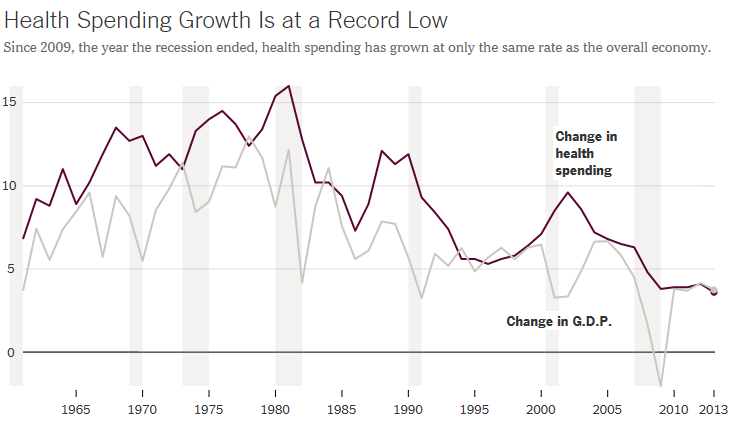
The New York Times has two recent articles about health care spending, “Good News inside the Health Spending Numbers” and “The Battle over Douglas Elmendorf – and the Inability to See Good News.”  These two articles focus on the fact, clearly evident in the chart just below, that the rate of increase in overall health care spending has slowed down since 2009.  In fact health care spending has been a constant 17.4% of GDP for the past four years, while it increased by 1.9% of GDP in the four years before that.  More precisely, health care spending rose by 3.6% in 2013, down from 4.1% in 2012.
CaptureIt is, of course, very good news that increases in health care spending have dropped dramatically since the recession in 2007-2009, but is it really surprising that this has happened in the midst of so much economic pain, with a very high rate of unemployment as well as stagnant incomes for most Americans?  In fact, even in these circumstances, health care spending is still growing at twice the rate of inflation, which has been under 2% during this same time period.
A more realistic view of health care spending has just been presented to the Health Subcommittee of the House Committee on Energy and Commerce by Marc Goldwein, from the non-partisan Committee for a Responsible Federal Budget, a Washington D.C. think tank focused on fiscal responsibility.  Mr. Goldwein makes the following points:

  • Despite the recent slowdown in health care spending, it remains incredibly important that policymakers pursue reforms to reduce future projected health care costs.
  • Policymakers should focus first and foremost on health care “benders” that would improve incentives in order to slow the overall growth of health care spending.
  • Policymakers should next look to health cost “savers” which reduce federal costs by better allocating resources within the federal health programs.
  • Given the aging of the population, health reforms will be necessary but not sufficient to put the debt on a sustainable long-term track.

Slowing down the rate of growth of health care is going to be a huge challenge for our national leaders.  I will elaborate on how to do this in forthcoming blog posts.

Why the U.S. Needs True Health Care Reform


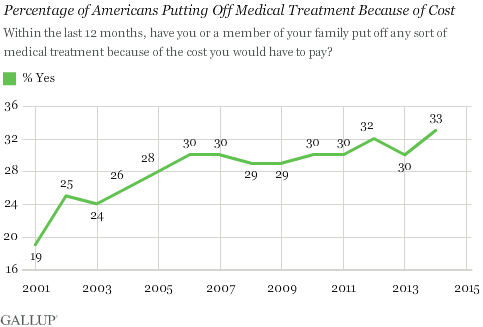
The Affordable Care Act has improved access to healthcare by already enrolling over 7 million Americans who were previously uninsured.  It is estimated that there will be a total of 20 million new enrollees by the end of this decade.
CaptureBut as the above chart from a recent Gallup survey indicates, the cost of healthcare is now a big barrier for an increasing number of people with health insurance.
The University of Chicago economist, Casey Mulligan, discusses the cost issue in a recent Wall Street Journal article “The Myth of ObamaCare’s Affordability” as well as in a new book.  He makes the following points:

  • Although the ACA helps specific populations by giving them a bigger piece of the economic pie, the law diminishes the pie itself by reducing the amount that American’s work and making their work less productive.
  • 35 million men and women currently work for employers who don’t offer health insurance. These tend to be small and midsize businesses with lower paid employees. The result of penalizing businesses for hiring and expanding will be less hiring and expanding.
  • The “29er” phenomenon is a good example of how the law harms productivity. If a business has 50 or more employees who work over 30 hours a week, it is required to offer health insurance. Many employers have thus adopted 29-hour work schedules which lessens overall productivity.
  • Mr. Mulligan estimates that the ACA’s long-term impact will include about 3% less weekly employment, 2% less GDP and 2% less labor income. He also claims that these effects will be visible and obvious in just a few years by 2017!
  • The ACA is thus weakening the economy. For the large number of people who continue to pay for their own healthcare, healthcare is now less affordable.

Conclusion: we need true healthcare reform which addresses cost as well as access and this can be achieved by fixing Obamacare.  It is not necessary to repeal it.  The Manhattan Institute’s Avik Roy has developed a plan to do this: ”Transcending Obamacare.”  Mr. Roy’s Plan would keep the exchanges, end both the individual and employer mandates, and migrate both the Medicare and Medicaid programs onto the exchanges over time.  These features will greatly reduce the cost of American healthcare.  Check it out and see for yourself!

Let’s Do Something about Corporate Welfare and Crony Capitalism!


The American Enterprise Institute is one of my favorite Washington think tanks.  It defines its mission as “research and education on issues of government, politics, economics and social welfare.”  I especially like its interest in social welfare which translates for me as being fiscally conservative with a heart.
CaptureThe AEI’s Timothy Carney has just proposed “An anti-corporate welfare, anti-cronyism agenda for the 114th Congress.” Most candidates for Congress condemn crony capitalism and corporate welfare.  This generally means any policies which tilt the playing field, picking winners and losers and rewarding well-connected insiders.  Such actions contribute to the public perception that the “game” is rigged and harm economic growth and innovation.  Here are some prime examples discussed by Mr. Carney:

  • Health Care: repeal Obamacare’s insurer bailout (the “risk corridors”) so that health insurers compete totally on price.
  • Health Care: end the individual mandate which forces people to buy a product from a private industry. An alternative incentive for individuals to remain covered would be limiting enrollment periods, for example, to a brief six-week sign-up period every two years.
  • Energy: end tax breaks and subsidies for both renewable energy (including ethanol) and oil and gas. Make all forms of energy compete in the market.
  • Taxes: make corporate taxes simpler, lower and more neutral. Besides being fairer, such changes will boost the economy.
  • Finance: Rein in Fannie Mae and Freddie Mac by treating them the same as all big banks. This means the same capital requirements, the same tax treatment and the same consumer protection regulation.
  • Finance: Kill Dodd-Frank’s too-big-to-fail designation. It acts as a moat, protecting the big guys from competition.
  • Trade: Kill the Export-Import Bank.
  • Trade: Repeal the Jones Act. It requires all shipping between U.S. ports be done on U.S. flagged vessels.
  • Agriculture: End the Sugar Program which costs consumers $3 billion per year.
  • Agriculture: Reform the Federal Crop Insurance Program by making it self-supporting.

These mostly well-known examples of corporate welfare represent just the tip-of-the-iceberg.  Nevertheless they provide a good place to start in cleaning things up!

The Reality of Today’s Healthcare: Cost Is Critical


My last two posts have been devoted to discussing the prospects for a true free-market healthcare system in the U.S.  Let’s bring this discussion down to earth with two specific examples.
CaptureIn Omaha NE, where I live, there are three major hospital systems and one of them, Catholic Health Initiatives, is 30% more expensive than the other two.  The major insurer, Blue Cross Blue Shield, has reacted by canceling its contract with CHI, making it out-of-network for Blue Cross policy holders.
As reported in today’s Omaha World Herald, “Non-CHI health clinics, hospitals handling influx,” the Nebraska Medical Center and Methodist Hospital System are seeing a large influx of Blue Cross insured patients.  This is exactly what has been expected to happen and will eventually put pressure on CHI to lower its prices in line with the other two hospital systems.
The second example, “Unable to Meet the Deductible or the Doctor” is the title of an article in yesterday’s New York Times.  The article reports that 7.3 million Americans are now enrolled in insurance coverage through the Affordable Care Act.  However the average deductible for a bronze plan on the exchange – the least expensive coverage – is $5,081 for an individual.  This compares to the average deductible of $1,217 for individual coverage in employer-sponsored plans.
Not surprisingly, relatively low-income people obtaining subsidized coverage through an exchange are likely to want a low cost policy.  But with a high deductible they will then be hard-pressed to have to pay the full price of routine care out of there possibly meager budgets.  This is going to be a larger and larger problem as more and more people obtain coverage through the exchanges.
Since all of an individual’s medical bills should go through the insurer for processing, insurance companies are in a position to, and should be expected to, help control costs by bargaining with providers to make sure that prices are not excessive.
Conclusion: here are two examples of price competition in today’s healthcare market place.  This is the reality that more and more Americans are going to have to learn to live with.  It is the only way that our excessive healthcare costs can be brought under control.