The Obama Economic Record


The readers of this blog know that I focus on what I consider to be the two biggest problems affecting our economy: 1) slow growth averaging just 2% per year since the end of the Great Recession and 2) our massive debt now equal to 75% of GDP (for the public part on which we pay interest) and predicted to keep growing steadily under current policy.
I have also made it clear that I am not pleased with the economic policies of either of the two main candidates for president, Hillary Clinton or Donald Trump.  Whichever one of them is elected, our best hope for the future is that she or he will have to work with the Republican House of Representatives which has an excellent plan, “A Better Way,”  for renewal.
capture71But, of course, the next president will take up where Barack Obama has left off.  The current issue of the Economist has an essay, “The Way Ahead,” in which Mr. Obama identifies several challenges:

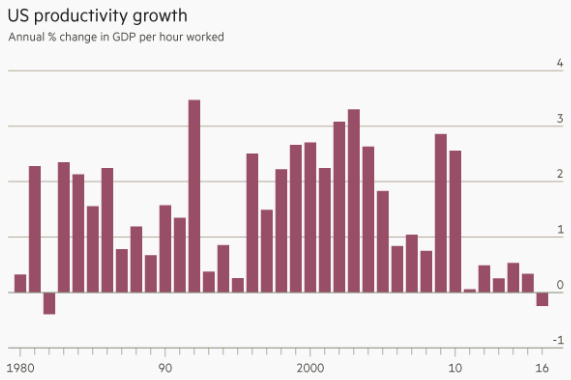
  • Boosting productivity growth. The above chart from his essay shows how much productivity growth has declined in the last ten years. He claims that the corresponding lack of investment is caused by an anti-tax ideology which rejects new funding for public projects, which in turn can be blamed on a fixation on deficits in spite of our skyrocketing debt problem. The House plan correctly identifies tax and regulatory reform as what are needed for progress.
  • Combatting rising inequality. An expanded Earned Income Tax Credit will definitely help here but mainly what is needed is overall faster economic growth.
  • Insuring that everyone who wants a job can get one. Wage insurance and better retraining programs for laid off workers are good ideas. But again, faster economic growth is what is really needed.
  • Building a resilient economy which is primed for future growth. Mr. Obama says that “America should also do more to prepare for future shocks before they occur.” This is exactly why we urgently need to start shrinking our debt now before the shock of higher interest rates leads to huge increases in interest payments on our rapidly growing debt.

Conclusion. Let’s give Mr. Obama credit for avoiding another depression after the Financial Crisis. But his poor policies are to blame for the very slow rate of recovery ever since.

Follow me on Twitter
Follow me on Facebook
 

Fiscal Irresponsibility: Our Country’s Most Fundamental Problem


As a fiscal conservative, I am worried about our nation’s future. The public debt (on which we pay interest) is now 75% of GDP, the highest level since right after WWII, and growing steadily.  Furthermore, our economy has just barely recovered from the Great Recession and is expanding too slowly to revive widespread prosperity.  Neither of the two main presidential candidates, Hillary Clinton nor Donald Trump, is talking seriously about our huge debt and neither has a credible plan to boost economic growth.

capture70
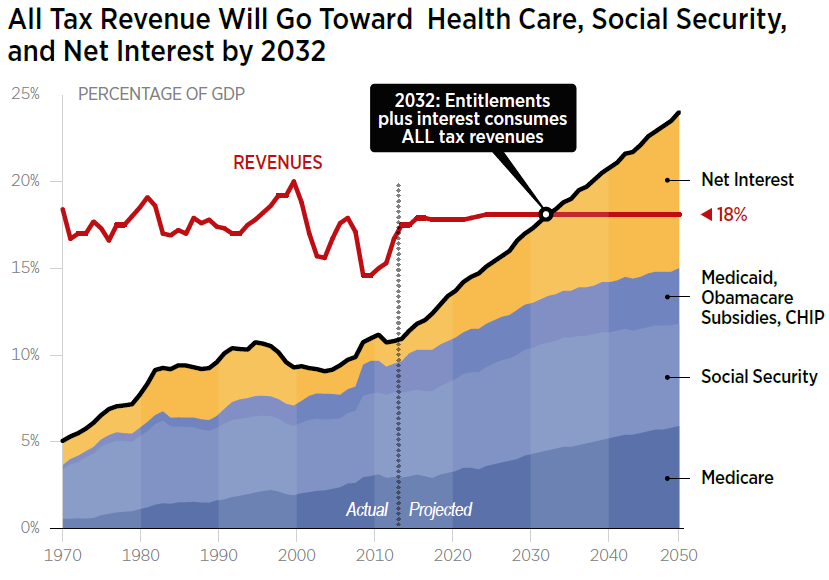
The above chart from the Heritage Foundation is a vivid way of illustrating this problem:

  • Already entitlement spending (Social Security, Medicare and Medicaid), and interest payments on our debt, use up 2/3 of all federal tax revenue. And spending on each of these entitlement programs is growing faster than the economy as a whole. Interest rates will eventually rise from their current rock bottom level. When this happens, interest payments on our growing debt will increase rapidly.
  • In 2032, just 16 years from now, spending on entitlements and interest payments is projected to consume all federal tax revenues, assuming a steady 18% of GDP level for tax revenue.

There are three possible ways to offset this bleak picture:

  • Speed up economic growth. This should, of course, be possible but it will take a major shift in thinking to accomplish.
  • Increase federal tax revenue. Suppose that federal tax revenues were raised by 1% of GDP, or $180 billion per year. This would at least temporarily put our debt on a downward path (as a percentage of GDP). But it would be very hard to accomplish politically. Mrs. Clinton, for example, has proposed raising taxes by $100 billion per year which she wants to spend entirely on new programs rather than reducing our annual deficits.
  • Reform entitlement programs. This is by far the best way to address our debt problem, and the only effective way in the long run.  But, again, it will be very hard to accomplish politically.

Conclusion. If the U.S. cannot get its debt and slow growth problems under control, it risks losing its status as the world’s major superpower. This would be a calamity for both our own national security and the peace and stability of the entire world.

Follow me on Twitter
Follow me on Facebook
Why Is U.S. Economic Growth So Slow?


In a recent post I discussed the issue of slow economic growth in the U.S. and why it is so harmful and dangerous to our nation’s future.  In short, it not only deprives many citizens of a more prosperous life and makes it more difficult to shrink our annual budget deficits, but it also endangers our national security as our chief competitor, China, grows faster than we do.
In the long run, an economy can expand only at a rate sustained by the growth of its labor force and the productivity of its workers.  I have previously pointed out  that there are far too many prime working age men who are unemployed.
capture67Today let’s talk about the rate of productivity growth (see the above chart).  In particular:

  • From 1994 – 2003, U.S. output per hour worked rose annually by an average of 2.8%.  Since then it has grown at an annual rate of 1.3%, including just 0.4% since 2011.
  • Business capital spending is down as companies are spending their profits to buy back stock rather than making new investments (see second chart).

    capture69As I have previously discussed, the U.S. is now caught in a vicious trap:

  • Slow growth keeps the under-employment level (U6) high and also means minimal raises for employed workers  The resulting economic slack leads to
  • Low Inflation. But low inflation in turn means that the Federal Reserve can maintain
  • Low Interest Rates to try to encourage borrowing. But an unfortunate side effect of low interest rates is that Congress can borrow at will and run up huge deficits without really having to worry about paying interest on this “free” money. This leads to
  • Massive Debt. But what is going to happen when inflation does eventually take off and the Fed is forced to raise interest rates? Then we will be stuck with huge interest payments on our accumulated debt. When this happens, interest payments plus ever growing entitlement spending will eat up most, if not all, of the federal budget. This will inevitably lead to a severe
  • Fiscal Crisis.

    Conclusion.
    It is absolutely imperative to speed up economic growth.
    Follow me on Twitter 
    Follow me on Facebook 

What Should A Fiscal Conservative Do?

From a reader of my blog:

“I personally believe Mr. Trump is grossly unfit to serve as President and if elected, it would be more than a huge problem. Since he lies or changes his mind on most everything, I worry when you say anything such as your comment that he won the debate. He is for the second amendment, he favors tax cuts, etc and there is nothing that sheds light on whether he even understands the complexity of these issues, let alone has any notion of how to create and implement a policy to accomplish these things. I believe many people are making comments that have the effect of normalizing his behavior and candidacy.”

I began writing this blog, It Does Not Add Up, almost four years ago, right after the presidential election of 2012.  By now I have written over 500 posts, mostly on fiscal and economic issues but occasionally branching out into important social issues as well.
As I see it, I have four choices when I vote for president this year.  I can:

  • Vote for Hillary Clinton. She is safe and predictable but the policies she promotes will do very little, if anything, for the faster economic growth which we so badly need. She wants to raise taxes on the wealthy. Fine, but this is only in order to increase spending for new programs, which is likely to lead to even bigger annual deficits and more accumulated debt.
  • Vote for Donald Trump. Like so many others, I assumed initially that his candidacy was a joke and that he would quickly fade away. But now he is a major party nominee and has some good policy ideas as well as some very bad ones! As president he would be constrained by Congress. In particular the Republican House has many excellent ideas on how to get our economy back on track.

    capture66

  • Vote for Gary Johnson. The Libertarian candidate also has good ideas on how to solve our fiscal and economic problems but has essentially no chance of being elected.
  • Refrain from voting for president.  But voting is a citizen’s first duty. 

    Conclusion. I fully agree that Donald Trump is a very risky bet for president. But the alternative is to elect Hillary Clinton and hope for a better choice in four years. What should I do? 

Follow me on Twitter
Follow me on Facebook
Why Slow Economic Growth Is So Dangerous


In my last post I said that Donald Trump won the first presidential debate, in spite of his uneven temperament, because he was more correct on the issues.
One of the biggest problems our country faces is slow economic growth, averaging only 2% per year since the end of the Great Recession in June 2009.  This compares with an average rate of growth of 3.5% from 1950 – 2000.
In fact, even the recent job growth we have seen is now leveling off.
capture65Such slow growth is very dangerous long term for many reasons:

  • Massive Debt. Our public debt, on which we pay interest, is now 75% of GDP, the highest it has been since right after WWII. CBO predicts that this percentage will keep getting steadily worse without major policy changes. Faster growth means more tax revenue and therefore smaller annual deficits. It is imperative to put our accumulating debt on a downward path.
  • The Need for More Jobs and Better Paying Jobs. The best way to achieve broad based prosperity, and minimize populist disruption, is to create a tight job market where employers have to compete for employees. This is accomplished by making the economy grow faster.
  • Keeping Ahead of China. In 2009 China’s economy was 1/3 the size of ours; now it is 60% as big. In other words, China will soon surpass us economically if we are unable to grow faster. This would risk losing our worldwide lead in such crucial areas as new technology and financial depth, as well as our superpower status.
  • Reducing Student Loan Debt. The best way we can help former students pay off their college debt is to have good jobs waiting for them when they leave school. The faster our economic growth, the better we can do this.

Conclusion. Both our own individual success in life as well as the overall status of our nation depends upon the availability of opportunity. This is why economic growth is so important and why it is dangerous to let it lag.

Follow me on Twitter
Follow me on Facebook

Who Won the First Presidential Debate?


I want to be as clear as possible that I have not yet endorsed either Hillary Clinton or Donald Trump for President and I am not doing so now. Each of them has strengths and weaknesses which I am still weighing:

  • Mrs. Clinton has extensive experience and a steady temperament but her policy prescriptions are unlikely to lead to the faster economic growth needed to boost prosperity.

    capture64

  • Mr. Trump lacks government experience and has a volatile temperament.   However many of his policy proposals make very good sense.

Pre-debate expectations were very low for Mr. Trump, based on his assumed lack of familiarity with many important issues. Nevertheless he showed that he does have a solid understanding of both national and international affairs.  On the three general debate topics:

  • Achieving Prosperity. Mr. Trump was very clear in stating what needs to be done to create more jobs and better paying jobs. He advocates individual tax reform to stimulate more business investment as well as corporate tax reform to encourage multinational companies to bring their foreign earnings back home for reinvestment.
  • America’s Direction. Mr. Trump made several references to our massive national debt of $20 trillion even though he didn’t say what he’ll do about it. He also stated very strongly that he is opposed to the Trans-Pacific Partnership and the North American Free Trade Agreement as well. Let’s hope that Mr. Trump’s bluster is just a ploy to improve his bargaining position with other countries.  Otherwise he could set off a major new recession.
  • Securing America. Mr. Trump is very clear on the need to destroy ISIS and to do so as quickly as possible. He believes that our 27 NATO allies should be contributing more towards our mutual defense. He also supports “stop and frisk” police policy as the best way to cut down on crime and violence in our inner cities.

Conclusion. Mr. Trump’s clearly stated views on these major national issues in last night’s debate were very impressive. By establishing so well his qualifications to be president, he won the debate.

Follow me on Twitter 
Follow me on Facebook 
 

College Costs and Student Debt


Student debt is a huge problem, see here and here, both for the college students and former students who have accumulated it as well as for the U.S. Government which has to carry the debt. I see this as a three-part problem which American society has to deal with:

  • As illustrated in the first chart, the cost of higher education has been rising very fast in recent years, even faster than the cost of health care, which in turn is increasing faster than the underlying rate of inflation.capture35
  • Since 1996 outstanding student loans have risen from $200 billion to $1.3 trillion.
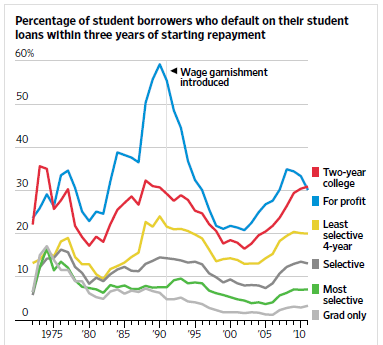
  • The highest default rates on student loans occur at community colleges (23% in 2012) and for profit colleges (18%). Worst hurt are the low-income and minority students who never graduate but still have unpaid debt (see the second chart).capture36

For the federal government to increase subsidized loan limits or to establish a broad-based free tuition program will only encourage educational institutions to keep raising their prices.
A much better approach is needed as follows:

  • Faster economic growth would help immensely. Our 2% average annual growth rate since the end of the Great Recession in 2009 is simply too slow to create more jobs and higher paying jobs (which makes it easier for students to pay back their debt).
  • At the federal level the emphasis should be on putting more money into Pell grants for the neediest students, paid for by cutting back on non-need based aid.
  • At the state level the emphasis should be on making the two-year associate degree free for all students who pursue it. Tennessee started such a program, Tennessee Promise, in 2014, Oregon in 2016. The goal here is for many more students who try postsecondary education to end up with a degree or certificate of some sort.

Conclusion. There are positive and efficient steps which can be taken to alleviate the student debt problem for the hardest hit low-income students without aggravating the overall problem of rapidly increasing college costs.

Follow me on Twitter
Follow me on Facebook


Do We Want More of the Same?


Most of the time on this blog I address what I consider to be our country’s two biggest fiscal and economic problems: 1) economic growth which, at 2% per year for the past seven years, is too slow to create enough new jobs and higher wages for middle- and lower-income workers and 2) massive and rapidly growing debt, now at 75% of GDP, the highest since the end of WWII.
But from time to time I take a broader look such as:

  • James Piereson’s contention that the New Deal liberal consensus has broken down and we are headed for America’s Fourth Revolution.
  • Yuval Levin’s argument that both progressives and conservatives are stuck with a mid-twentieth century nostalgia to which it is impossible to return.
  • Senator Mike Lee’s (R, Utah) belief that Congress is itself responsible for its shrinking powers vis-à-vis the President and the Supreme Court.

Along this line, Yuval Levin and Ramesh Ponnuru have a powerful essay in the latest issue of the National Review saying that “Mainstream liberals now advance a vision of American government that is increasingly contemptuous of our system’s democratic character and seeks to break through the restraints of the constitutional system in pursuit of their policy ends.”

capture64This vision is advanced in three key ways:

  • Executive unilateralism, for example, by President Obama with respect to status of illegal immigrants, various suspensions and waivers in the implementation of the Affordable Care Act, and net neutrality regulations.
  • The administrative state referring to the tangle of regulatory agencies that populate the executive branch. These agencies issue thousands of regulations per year which, given the vagueness of major legislation, means that the agencies legislate through their rules. Examples are the immense power of the Environmental Protection Agency and the implementation of the Dodd-Frank financial-regulatory reforms.
  • Liberal judicial philosophy understands the courts to be in the business of advancing what is properly understood as a legislative agenda. For example, two Supreme Court cases, a health-care related case (King vs Burwell) and a same-sex-marriage case (Obergefell vs Hodges) turned out this way.

Conclude Messrs. Levin and Ponnuru: “That the constitution makes the work of progressive ideologues frustrating is not an excuse for ignoring and subverting it. Arguments for doing so amount to unprincipled excuses for lawlessness.”

Follow me on Twitter
Follow me on Facebook
 

The Economy Is Improving But Not Fast Enough II. What to Do?


Our economy is doing a little better recently but not nearly as good as it could be.  In my last post, “Men without Work,” I present Nicholas Eberstadt’s data that a significant part of the problem is the very large number (9.5 million) of prime working age (25 – 54) men who are unemployed and not looking for work.
Statistically, such men are likely to be un-workers if 1) they have no more than a high school diploma, 2) are unmarried and without dependent children, 3) are not immigrants and 4) are African American.
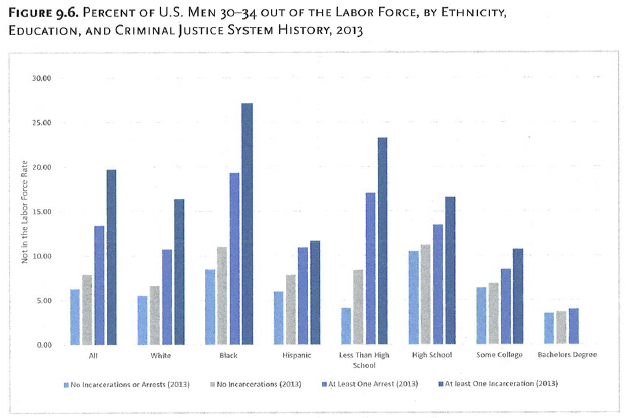
Two other relevant factors are 1) the huge increase in employment for prime working age women, from 34% in 1948 to 70% in 2015 and 2) the very high male arrest and incarceration rates for blacks and those without a high school diploma.
Obviously, it is highly detrimental to society to have such a large number of men who are idle during their prime working years.
capture63
Here are several ways to address this problem:

  • Revitalize America’s job-generating capacities. More businesses have closed than opened in each year since the 2008 financial crisis.  Furthermore, the growing regulatory burden is not a recipe for encouraging entrepreneurship.
  • Reverse the perverse disincentives against male work embedded in our social welfare systems. The Earned Income Tax Credits should be extended to single adults without dependents. Eligibility for disability income should be tightened considerably.

    capture61

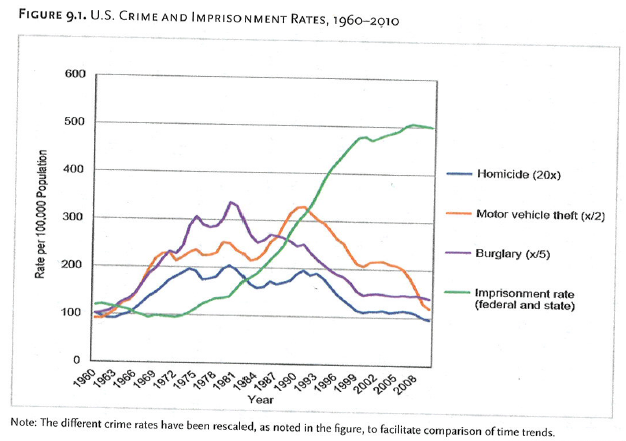
  • Come to terms with the enormous challenge of bringing convicts and felons back into our economy and society. The huge increase in incarceration rates in recent years has coincided with a dramatic drop in rates for both violent crime and property crime.

Conclusion. One good way to speed up economic growth is to put more unemployed prime working age men back to work. There are several very concrete steps which can be taken to do this.

Follow me on Twitter
Follow me on Facebook

Men without Work


As most of my readers know (but I’ll remind you anyway!), I have two major themes on this blog which are:

  • Slow U.S. Economic Growth, averaging just 2% per year since the end of the Great Recession in June 2009.
  • Massive Debt Accumulation, now 75% (for the public debt, on which we pay interest) of GDP, the highest since right after the end of WWII.

My last post, “The Economy Is Improving But Not Enough” points out that even the latest very good news, that median household incomes were up by 5.2% in 2015, doesn’t get us back to where we were before the financial crisis hit.
A new book, “Men without Work,” by Nicholas Eberstadt sheds much light on why our economy is growing so slowly.  Says Mr. Eberstadt:

  • Between 1948 and 2015, the work rate for U.S. men age twenty and older fell from 85.8% to 68.2%. Even for prime working age men, age 25 – age 54, the work rate fell from 94.1% in 1948 to 84.3% in 2015.

    capture56

  • This translates into 9.5 million prime working age men who are not in the workforce, even after correcting for the million or so of these men who are in school or training.
  • Statistically, men age 25 – 54 are more likely to be an un-worker in 2015 if 1) they had no more than a high school diploma, 2) were unmarried and without dependent children, 3) were not an immigrant and 4) were African American.
  • Looking for possible explanations for so many unemployed men, it is noteworthy that the work rate for prime working age women has increased from 34% in 1948 to 70% in 2015.

    capture58

  • One reason for so many unemployed men is the high arrest rate and incarceration rate for working age men, especially blacks and those without a high school education. In fact, Incarceration rates are way up even though violent crime is declining.

    capture62Conclusion. It seems obvious that having such a large, and growing, number of prime working age men out of the work force is a very serious problem. Besides slowing down economic growth, they are losing their best opportunity for personal fulfillment.  What should be done to turn around this deplorable situation?  Stay tuned!

Follow me on Twitter
Follow me on Facebook