A Fiscal Conservative with a Social Conscience


My last two blogs were “Why racism exists in America” and “Educare and the Academic Achievement Gap.”  I often describe myself as a fiscal conservative but it would be more accurate to say that I am a fiscal conservative with a social conscience.
Capture0By this I mean:

  • First and foremost I want to shrink our annual federal budget deficits enough so that our national debt begins to decline as a percentage of GDP. Right now the public debt (on which we pay interest) is at 74% of GDP which is the highest it has been since the end of WWII. This high level of debt is unsustainable and will inevitably lead to a new and much worse financial crisis if it is not put on a downward path.
  • Closely related to the first goal is the need to get our economy growing faster than the 2% average rate of growth since the end of the Great Recession in June 2009. This will have the twin benefits of producing more tax revenue which will make it easier to shrink our annual budget deficits as well as creating more and better paying jobs for everyone.
  • A third goal is to reduce income inequality. The best way to do this is not with more income redistribution from those with higher incomes to those with lower incomes but rather by achieving faster economic growth which will raise incomes for all. Yet another critical way of making American society more equal is to focus on:
  • Reducing social inequality. There are many different forms of social inequality  in our society but let’s focus on one of the most severe aspects: black-white racism.  America will be a more peaceful and prosperous country if we can reduce the glaring inequalities between the two races.

I am sufficiently optimistic to think it is possible to make progress on all of these fronts at the same time. It won’t be easy but momentum is slowly but surely building in this direction.
Educare and the Academic Achievement Gap


My last post, “Why Racism Exists in America,” attempts to explain not only the reason for this huge social problem, but also how to look for a solution. It turns out that the city of Omaha, Nebraska, where I live, is doing exactly this in an amazingly progressive manner.
It is well known and widely deplored that children from low-income families perform more poorly in school than children from middle class families. The Learning Community of Douglas and Sarpy Counties was created by the Nebraska Legislature in 2007 to figure out how to close this so-called academic achievement gap in metro Omaha.
The LC has recently contracted with the Buffett Early Childhood Institute at the University of Nebraska to implement the Superintendent’s Early Childhood Plan which will employ the latest national research findings to provide intensive preschool for three and four year olds at ten different Elementary School sites around the Omaha area. Capture10It turns out that Educare of Omaha has already been doing groundbreaking work in early childhood education for the past decade. A recent longitudinal study, conducted by the Munroe Meyer Institute (available upon request), has shown that children from low-income families, with two or more years of Educare training, perform well above state proficiency standards in both reading and mathematics all the way through the eighth grade (as far as has been measured to date).
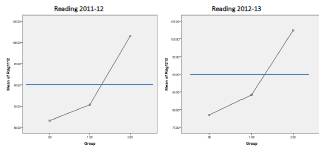
As shown in the above chart, just one year in Educare is not enough to achieve this lasting proficiency. It takes two full years to get such a large boost in achievement. This is a hugely significant finding. It shows that early childhood education, if carried out in sufficient depth and for an adequate length of time, will produce long-lasting gains in academic achievement.
It is now up to the Learning Community, working with the Buffett Institute, to implement the Superintendent’s Plan, to show that the results achieved by Educare can be scaled up to a broader and more comprehensive level.

Why Racism Exists in America


The First Unitarian Church of Omaha, to which I belong, has formed a sister church relationship with a predominantly black church in north Omaha, Clair Memorial Methodist Church. On Saturday we held a joint workshop, “Confronting Racism” at Clair. Several people said that we should “celebrate diversity, transcend race, and hope that things will be better in twenty or thirty years from now.”
I think the problem is much more fundamental and difficult than this. First of all, there are two main reasons why racism is so prevalent in America, one obvious and one perhaps less obvious:

  • The obvious reason is the very different colors of our skin.
  • The other reason, equally important, is that there are huge socio-economic differences between the two races. Whites are, by and large, better educated and more affluent than blacks. They also have a more stable family structure, with far fewer single parent families. People tend to live in homogeneous residential areas and associate with others of similar socio-economic background. All of these social factors serve to separate the races into largely non-interacting groups of people.

How do we confront and attack such deeply entrenched racism in our society? We need an approach which is more fundamental than programs like “welfare to work” or “residential integration.” Even equalizing educational opportunity is not enough. What we need is a long term effort to improve educational outcomes for blacks and other children from low-income families.
Capture9As the above chart of Nebraska data shows, children from low-income families, who thus receive free or reduced price lunch (FRL), are already behind in reading proficiency by third grade and they just keep falling further and further behind in the later grades. This means that they need major intervention before they even get to kindergarten. In fact what they need is early childhood education, beginning no later than age 3.
Conclusion: Racism is deeply embedded in American life and can only be eliminated with a long term fundamental effort to greatly improve educational outcomes for blacks.  I will discuss proof that this can be done in my next post.

Dodd-Frank Is Hurting the Recovery!


The Federal Reserve Bank plays an important role in our economy by trying to keep inflation low and stable but also by trying to make recessions less severe by increasing the money supply when the unemployment rate is high. My last post, “What the Federal Reserve Can and Can’t Do” emphasizes that, as Ben Bernanke says, “the Fed has little or no control over long term fundamentals,” such as economic growth which depends on increases in productivity which, in turn, are heavily influenced by fiscal and regulatory policy.
Capture8The American Enterprise Institute’s Peter Wallison explains very clearly in “The slow economic recovery explained,” why, for example, the Dodd-Frank Act of 2010 is having a harmful effect on economic growth:

  • Regulatory burdens imposed by Dodd-Frank have been particularly harsh for community banks, with $10 billion or less in assets; 98.5 % of U.S. banks fall into this category. Since Dodd-Frank was enacted in 2010, community banks’ share of banking assets has shrunk by 12%.
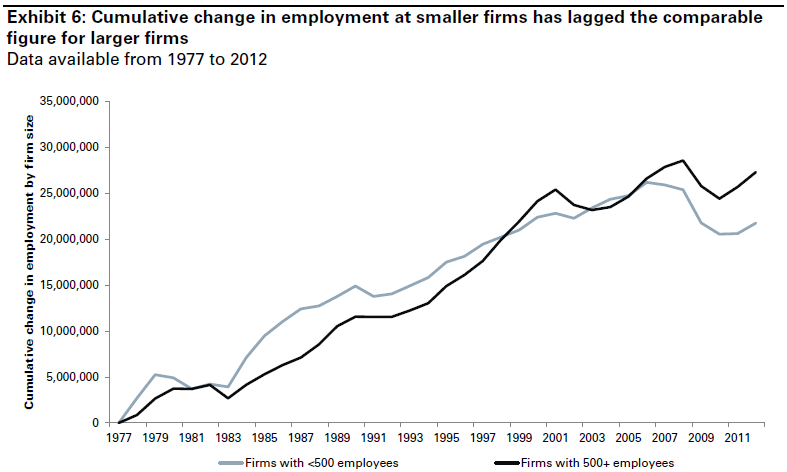
  • According to the Small Business Administration, there were approximately 23 million small businesses (with fewer than 500 employees) in 2012, compared to 18,500 firms with more than 500 employees. Large businesses have access to capital markets whereas small businesses rely on local banks for their credit needs.
  • Regulatory costs affect small banks more than large banks because the costs are fixed, independent of size of the institution. When the Consumer Financial Protection Bureau sends out voluminous regulations on mortgage lending, for example, then extensive legal fees, compliance officers and technology retooling must be paid for up front.
    Capture
  • A recent report from Goldman Sachs, “The Two-Speed Economy,” shows that large firms have grown faster than usual after 2010 while small firms have grown much slower than usual (see chart above).

Conclusion. Monetary policy alone, as conducted by the Federal Reserve, cannot return our economy to good health. This can only be accomplished by increasing productivity which is aided by smart fiscal and regulatory policy. Dodd-Frank is an example of regulatory policy which is hurting economic growth by having a harmful effect on main street banks.                                 

Why the Federal Government Fails So Often


This blog is about the major fiscal and economic problems of our country and specifically our stagnant economy (2% real growth for the past six years) and massive federal debt (the public debt, on which we pay interest, is 74% of GDP, the highest since WWII). My major sources of information are the New York Times and Wall Street Journal but I also make use of reports from various think tanks. Today’s source is the recent report, “Why the Federal Government Fails,” by the Cato Institute’s Chris Edwards.
CaptureAccording to Mr. Edwards, there are five main reasons for this:

  • Top-Down Coercion. Federal agencies impose more than 3,000 regulations each year. Total regulations now span 168,000 pages. Benefits are distributed through more than 2,300 programs. Federal policies are often based on guesswork. Failed policies are seldom weeded out because they are funded by taxes and are not contingent on performance.
  • Lack of Knowledge. Private markets operate efficiently on the basis of price information. Government subsidies and regulations throw a monkey wrench into the price mechanism.
  • Political Incentives. Congress focuses on the benefits of programs but does not consider the full costs because benefits are delivered to narrow groups while the costs are spread widely. There are too many fiscal illusions to hide costs such as: paying with debt rather than higher taxes, taxing businesses which then just raise prices, conferring benefits by regulation (e.g. requiring employers to provide healthcare) rather than direct subsidy.
  • Bureaucratic Incentives. There are too many rewards for inertia and not enough for the creation of value such as the absence of profits and losses, rigid compensation, lack of firing, red tape, agency capture, etc.
  • Hugh Size and Scope. The $4 trillion annual budget is 100 times the average state budget of $40 billion. It is simply too vast for members of Congress, and other top officials, to understand what is going on. The more programs the government has, the more likely they will work at cross-purposes.

Mr. Edwards concludes that “the most important way to improve federal performance would be to greatly cut the government’s size” and to do this by shifting federal activities back to the states. With this recommendation I heartily agree!

Social Inequality vs Income Inequality


There is today in the U.S. much concern about income inequality and I have devoted many posts to this topic recently such as “Are economics and Social Progress Related to Each Other?”,How to Expand Economic Mobility”, and “Richer and Poorer.”
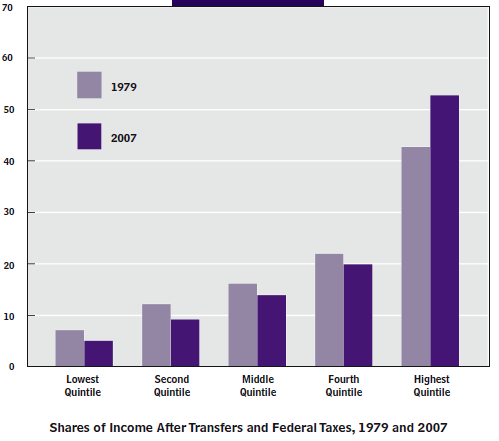
CaptureThe above CBO chart shows that income inequality has not changed much in the last 30 years once government transfers and federal taxes are taken into account. Along the same line, the Manhattan Institute’s Oren Cass makes a strong case in, “The Inequality Cycle,” that Americans should be paying at least as much attention to the social aspects of inequality as to the economic aspects.
For example:

  • As Charles Murray shows in “Coming Apart,” (http://www.amazon.com/Coming-Apart-State-America-1960-2010/dp/030745343X) the upper class has remained stable with respect to marriage rates (94% in 1960, 84% in 2010), civic involvement, and trust in society while for the lower class marriage rates (84% in 1960, 48% in 2010 and dropping), civic involvement and public trust have all declined significantly.
  • Children in the lower classes are five times more likely to face abuse, violence, addiction and the death or imprisonment of a parent.
  • By the time they reach kindergarten, 72% of middle class children know the alphabet compared with only 19% of poor children.
  • The fraction of children with a single parent is the best predictor of upward economic mobility in a particular region, whereas the level of income inequality is not a significant predictor.

Mr. Cass suggests that public policy should focus on these social problems at least as much as on income inequality. For example:

  • Education reform should be focused on both ends of the K-12 spectrum: early childhood education to ensure that all children are ready to learn when they get to school and better vocational education in high school so that graduates can find a good job if they’re not going to college.
  • Remove onerous regulations on the workplace so that employers are not pushed unnecessarily into independent contractor arrangements.
  • The federal government should be more supportive of marriage (e.g. with tax policy), and the participation of religious organizations in the delivery of public social services (to improve their quality).

Conclusion: Being poorly raised does more to cut off opportunity than being raised poor.

Donald Trump’s Tax Plan: More Bad than Good


Republican presidential candidate Donald Trump has just released his tax plan. Some of its basic features are:

  • Lowering and consolidating seven current tax brackets into three: 10%, 20% and 25%.
  • The corporate tax rate would be cut from the current level of 35% to just 15%.
  • The income tax on all businesses would be cut to 15% as well.
  • Taxing carried interest at ordinary income tax rates instead of at the lower capital gains rate.
  • Eliminating the Alternative Minimum Tax as well as the Estate Tax.
    Capture8

The nonpartisan Tax Foundation has analyzed the Trump plan and predicts the following positive long term effects:

  • 11.5% higher GDP,
  • 29% increase in capital investment,
  • 6.5% higher wages and
  • 5.3 million more full-time equivalent jobs.

The tax Foundation also performed an analysis of Jeb Bush’s tax plan and found roughly similar economic benefits except for a lesser number, 2.7 million, of new jobs created. But the Tax Foundation also predicts that the Trump plan would cut tax revenue by $11.98 trillion over ten years on a static basis or $10.14 trillion on a dynamic basis (accounting for economic growth effects of the plan). This compares with a loss of revenue of $3.6 trillion over ten years (static) or $1.6 trillion over ten years (dynamic) for the Bush plan.
In other words, for a substantially larger growth in new jobs under the Trump plan, there is an enormous cost in additional deficit spending.
Conclusion: I have previously criticized the Bush plan for increasing deficit spending and therefore adding to the debt when we should be shrinking it. The Trump plan is much, much worse in this respect, running annual deficits of over $1 trillion per year, moving in exactly the wrong direction.
The Bush tax plan, while needing changes to make it revenue neutral, is far superior to the Trump plan, which simply blows off any concern for deficits and debt.

Cutting the Federal Budget, an Example: The Highway Trust Fund


As an advocate of cutting federal spending, people sometimes ask me exactly what I would cut to save money and lower the deficit. I have two standard answers to this question:

  • Often I will respond, it is up to Congress to figure this out. The important thing is to shrink the deficit one way or another. It doesn’t matter from a fiscal point of view exactly what is cut.
  • Another answer I like to give is that with the sequester already slowing down discretionary spending, we should concentrate on finding savings in entitlement programs like Social Security, Medicare and Medicaid.

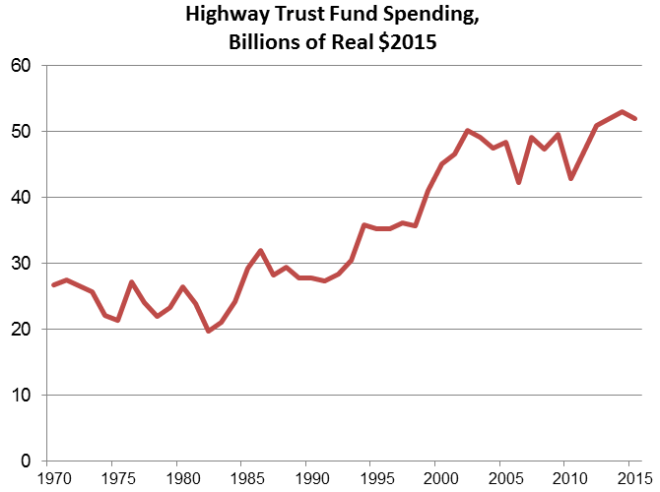
While both of these answers have validity in a general sense, nevertheless I do look for ways to cut back on discretionary spending as well. Here is a good idea from Reason magazine’s Veronique de Rugy, “Let States Build Their Own Highways.” The rationale is very simple. The federal gasoline tax of 18.4 cents/gallon brings in about $40 billion per year which goes into the Highway Trust Fund. But the HTF is spending $53 billion per year, meaning that federal gas tax revenue is being supplemented by $13 billion from general revenues. This additional $13 billion per year can be viewed as an unjustified federal expense merely adding to the deficit.
Capture2The way to address this issue is to:

  • Abolish the federal gasoline tax of 18.4 cents/gallon as of some specific date in the future, say in a year from the time such a law is enacted.
  • Turn over all responsibility for highway construction to the states.
  • States can then decide individually how much of the federal gasoline tax they wish to continue as a state gasoline tax in order to finance their own highway funding.
  • Minimal federal guidelines could be maintained if desired to insure uniform quality control by the states.

Of course, a $13 billion annual budget savings could be looked at as a drop in the bucket, not nearly large enough to make a sizable dent in the federal deficit (latest projection for fiscal year 2015: $426 billion). That would be too cynical. There are undoubtedly many other smart ways to cut back federal spending. I am constantly looking for them!

Solving the Student Debt Problem


I have devoted several posts recently, herehere, and here, to discussing the rapidly increasing costs of higher education (see chart below) and the corresponding rapid rise of student debt.
Capture7Here are the basic facts:

  • There are too few college graduates in the U.S. At least ten OECD countries have a higher percentage of college graduates than we do.
  • America is graduating inequality. College degree attainment has increased between 1970 and 2011 for all income groups; however this is happening much more quickly for higher income groups.
  • Not all college degrees are created equal. Students at private, nonprofit institutions graduate at higher rates, and with lower debt, than students from public institutions who, in turn, graduate at higher rates and with lower debt, than students from for-profit institutions.
  • The Federal Reserve Bank of New York has found a close connection between subsidized loan and Pell Grant limits and the increase in college tuition costs.
  • The Federal Reserve Bank of St. Louis has found that “white and Asian college grads do much better than their counterparts without degrees, while college-grad Hispanics and blacks do much worse proportionately.”
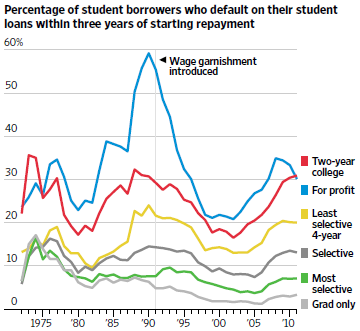
  • The percentage of student borrowers at for-profit as well as community colleges who default on their loans has greatly increased since the year 2000 (see below)
    Capture1In other words, our current federal student loan program is not only driving up college costs for everyone but is also creating a huge financial burden for the very low-income students who are most in need of financial aid to succeed in college.
    The way to respond to this is to put strict lids on the amount of subsidized loans available to both undergraduate and graduate students ($30,000 and $60,000 respectively) and, at the same time, use the savings achieved in doing this to increase the size of Pell Grants available for the lowest income students who need the most help.
    Conclusion: our high-tech society needs more college trained workers and we should especially encourage capable low-income young people to go to college. We could also do a much better job of targeting Pell grants instead of loans to this group of students.

The Pope, the United Nations and Global Poverty


This is a big week in the U.S. Pope Francis is coming here and the UN will convene a conference in NYC to endorse international development goals for the next 15 years. As I explained in a recent post, “The Dung of the Devil,” the Pope should pay more attention to the recent accomplishments of free enterprise in decreasing the amount of poverty and economic inequality around the world.
In an article just a few days ago in the Wall Street Journal, Bjorn Lomborg, the Director of the Copenhagen Consensus Center, explains that the U.N. is likely to endorse 169 targets for global investment for the next 15 years. Mr. Lomborg demonstrates with cost-benefit analysis that focusing on just 19 of these goals would accomplish far more than adopting everything on the U.N.’s much longer list.
Capture1Here are a few of Mr. Lomborg’s items:

  • Completing the World Trade Organization’s Doha agreement would return $2000 for every dollar spent to retrain and compensate displaced workers.
  • The elimination of fossil fuel subsidies would be worth $15 for every dollar spent in direct support of the very poor who are unable to afford higher fuel prices. By contrast, trying to drastically increase the production of renewable energy would return less than a dollar for every dollar spent because renewable forms of energy remain so expensive.
  • Tripling access to preschool in sub-Saharan Africa would have benefits worth more than $30 for every dollar spent because of improved future earnings. On the other hand, efforts to improve exams and teacher accountability are much harder to achieve and the benefits would only amount to $5 for every dollar spent.
  • Other actions: boosting agricultural yields, cutting indoor air pollution with clean cook stoves, increasing access to family planning, fighting malaria and combatting malnutrition are other examples where investment would lead to big dollar returns.

Conclusion: Free enterprise economics has done much in recent years to eliminate poverty and inequality around the world. Additional public and private investment, focusing on just a relatively few major goals, can accomplish even more.