Why Is U.S. Productivity Growth Declining?


The economist Alan Blinder has just reported, “The Mystery of Declining Productivity Growth” that U.S. productivity growth has fallen dramatically in the last few years.  “The healthy 2.6% a year from 1995-2010 has since been an anemic 0.4%.  What’s scary is that we don’t know why.”
CaptureThe economists Edward Prescott and Lee Ohanian believe the productivity slowdown is caused by a corresponding slowdown in new startups (as illustrated by the above chart).  They point out, for example, that:

  • The creation rate of new businesses in 2011 was 30% lower than the average rate of the 1980s.
  • New startups are critical for growth since many of today’s heavyweights will decline as new businesses take their place. For example, only half of the Fortune 500 firms in 1995 remained on that list in 2010.
  • Startups in high technology have also declined since 2000 even though there is no slowdown in the development of new technology.

Consistent with the recommendations of James Bessen in a recent post of mine, “Learning by Doing,” Messrs. Prescott and Ohanian recommend policy changes such as:

  • Better training, plus immigration reform, to produce more skilled workers.
  • Streamlining regulations that raise cost, especially for small businesses.
  • Tax reform to reduce marginal tax rates.
  • Reforming Dodd-Frank to make it easier for small businesses to obtain loans from main street banks.

In today’s New York Times, the economist Tyler Cowen wonders whether our economy is in the midst of a “Great Reset.”  “Perhaps the most crucial issue is whether economies will return to normal conditions of steady growth, or whether we are witnessing a fundamental transformation” to a less productive economy.
Here’s another way to put it: shall we attempt to adopt better pro-growth policies or shall we just give in to the status quo and accept that we can’t do any better?  Are we optimists or are we pessimists?

Learning By Doing III. Limiting the Influence of Lobbyists


The eclectic entrepreneur/economist/law professor, James Bessen, suggests how to boost our stagnant economy in a new book, “Learning by Doing: the real connection between innovation, wages and wealth.” The idea is to make fuller use of new technology by putting more emphasis on practical vocational training, ending government favoritism for established businesses, and by removing regulatory roadblocks to job mobility and entrepreneurship.  He also thinks that the greatest hindrance to progress on these fronts is the influence of lobbyists and, more generally, “the growing role of money in politics.”
CaptureHow do we limit the ability of lobbyists, with their huge financial resources, to slow down the opening up of new technology to the broadest possible group of participants?  Some people would say this can only be done by curtailing the use of money in politics.  But this is virtually impossible.  Spending money to get your message out is really just a form of speech and the First Amendment to the Constitution says that “Congress shall make no law abridging the freedom of speech.”
Rather than trying to restrict the ways in which lobbyists can spend their money, we could alternatively try to immunize our elected representatives from its effect, in one or both of these two different ways:

  • Pass a Balanced Budget Amendment to the Constitution. Such an amendment would likely create the discipline needed for Congress to be able to set priorities and decide what is more or less important with regard to the overall economy. Spending programs, tax revenue, and the effects of regulation would all have to be considered together to maximize economic efficiency. Lobbyists would have far less power to push one particular program independently of how it relates to everything else.
  • Term Limits for national office. Knowing that one’s time in office is limited would help provide the strength to make the difficult tradeoffs necessary for good legislation and make officeholders more immune to special interest influence.

Conclusion:  Rather than making a likely futile attempt to reduce the amount of money in the political process, change the process sufficiently so that money doesn’t have as much influence!

Learning By Doing II. The negative influence of lobbyists


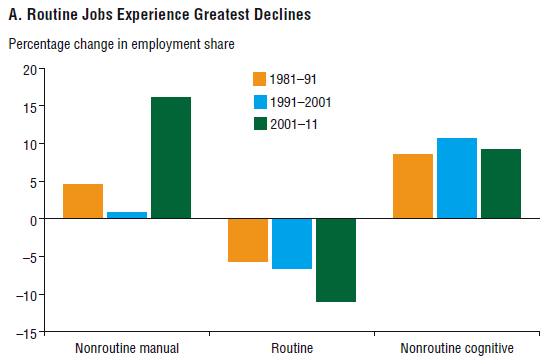
My last post reported on a new book by James Bessen, “Learning by Doing: the real connection between innovation, wages and wealth.”  It makes several recommendations for how the U.S. can better meet the challenges posed by the hollowing out of the middle class, as illustrated in the chart just below from the Dallas Federal Reserve.
Capture Mr. Bessen blames one primary culprit for this problem: the growing role of money in politics.  For example:

  • The dramatic growth in occupational licensure from 70 occupations covering 5% of the workforce in the 1950s to over 800 occupations covering over 29% of the workforce in 2008. Such a major change can only be understood as the outcome of massive lobbying.
  • Defense procurement. For example, in 2012 the defense industry spent $132 million on over 900 lobbyists. It is hardly surprising that defense procurement rules have favored established defense contractors at the expense of start-up technology firms.
  • The best patent law money can buy. Patent trolls have continued to file more lawsuits, despite the America Invents Act of 2011. A new legislative effort for patent reform in 2013 passed the House by a margin by a margin of 325 to 91 but then was killed by the Senate in May 2014.
  • Changes in trade secret law. The problem is that more uniform trade law, which sounds desirable, also broadens its scope which then limits employee mobility and the creation of spin-offs.
  • Strong enforcement of non-compete agreements in Massachusetts protects established firms but hurts startups. This has given Silicon Valley companies a big advantage over the companies on Route 128 outside of Boston.

Mr. Bessen makes a very strong case for the harmful effects of lobbyists and their money in retarding economic growth.  But how can we possibly curtail the influence of lobbyists without limiting their freedom of speech?  Stay tuned for the next post!

Learning By Doing


The two biggest problems facing our country today are a stagnant economy and an exploding national debt.  Faster economic growth would help pay our bills by bringing in more tax revenue.  It would also create more jobs and give a boost to stagnant wages.  One of the causes of this stagnation is that our economy has become less entrepreneurial over time as shown by this often cited chart from the Brookings Institution.
CaptureA very interesting new book by James Bessen, “Learning by Doing: the real connection between innovation, wages and wealth.” looks at both our economic history and our current economy to understand how society can best meet the challenges posed by new technology.  Mr. Bessen  identifies the basic problems as follows:

  • Funds have been shifted away from vocational education and community colleges at a time when large numbers of workers could acquire valuable skills at these institutions.
  • The rapid growth of occupational licensing restricts training and jobs open to mid-skill workers and, in many cases, limits their use of technology.
  • Military procurement favors large defense contractors over start-up firms, while heightened secrecy requirements limit the development of open standards and the broad sharing of knowledge.
  • Job mobility has declined, limiting knowledge sharing and weakening labor markets.
  • Abusive patent litigation has exploded, making it harder for startups and small firms to develop new technology.

Mr. Bessen concludes:“The practical skills of ordinary people have been a wellspring of widely shared wealth for 200 years, and the economic power of mighty nations rests on the technical knowledge of the humble.  Provide the means for ordinary workers to acquire the skills and knowledge to implement new technology today and the economic bounty will not only grow, it will be widely shared.”
What are the roadblocks to implementing Mr. Bessen’s recommendations?  I will return to this question later.

Why Inequality Is Harmful and What to Do About It


I describe this blog as addressing our fiscal and economic problems, meaning deficits and debt on the one hand and slow economic growth on the other.  But these topics, while being of critical importance to our national welfare, are also somewhat on the dry side.  The subject of economic inequality stirs up lots more interest and response. In the Fall of 2012 The Economist declared that “a new form of radical centrist politics is needed to tackle inequality without hurting economic growth.”
CaptureSays The Economist:

  • There’s too much cronyism in the rich world. Banks which are “too big to fail” have an implicit subsidy. From doctors to lawyers, many high paying professions are full of unnecessarily restrictive practices. Social spending often helps the rich more than the poor. For example housing subsidies for the top 20% (mortgage-interest deductions) are four times the amount spent on public housing for the poorest 20%.
  • If income gaps become too wide, they can lead to less equality of opportunity, especially in education. The gap in test scores between rich and poor American children is 30 – 40% wider than it was 25 years ago.
  • If those on the top of the heap resist equalizing changes, it could lead to political pressure which serves nobody’s best interests.

Here are The Economist’s proposals for a True Progressive Agenda to attack inequality:

  • Compete.   A Rooseveltian attack on monopolies and vested interests is needed. School reform is crucial: no Wall Street financier has done as much damage to social mobility as the teacher’s unions have.
  • Target. Government spending need to be focused on the poor and the young. Governments can’t hope to spend less on the elderly but they can reduce the pace of increase.
  • Reform. Eliminate tax deductions which primarily benefit the wealthy such as for mortgage-interest; narrow the gap between tax rates on wages and capital income.

“The right is still not convinced that inequality matters.  The left’s default position is to raise income tax rates for the wealthy and to increase spending still further – unwise when sluggish economies need to attract entrepreneurs and when governments are overburdened with promises of future spending.”
Surely there is a better way!

Baltimore Is About Economics, Not Racism


The death of another black man at the hands of the police, this time Freddie Gray of Baltimore, has again set off a national debate about poverty, inequality and racial injustice.
CaptureThe Washington Post journalist Marc Thiessen wrote about this several days ago in, “The Baltimore Democrats Built,” saying that:

  • Although 63% of Baltimore residents are black, so are 40% of police officers.
  • City officials injected $130 million into the Sandtown-Winchester community (where the riots took place) in a failed effort to transform it.
  • The poverty rate in Baltimore is 24% compared with 14.5% nationally.
  • The unemployment rate for black men in Baltimore between the ages of 20 – 24 is 37%.
  • Among the nation’s 100 largest counties, the one where children face the worst odds of escaping poverty is the city of Baltimore.
  • In 2014, Baltimore public schools ranked third in the country in per-pupil spending, yet 55% of Baltimore fourth graders scored below basic in reading.
  • In the Sandtown-Winchester community, nearly half of all high school students missed at least 20 days of school in 2011.
  • This community’s murder rate is double the average for Baltimore, which in turn had the fifth highest murder rate last year among major U.S. cities.

In other words, Baltimore’s problems cannot be blamed on racial prejudice or on a lack of resources to combat poverty and low educational performance.  Clearly needed are better schools and more employment opportunities.  Better state and local leadership would help in this respect. But what is most needed is faster economic growth for the whole country.  There are many things which could be done to accomplish this.  It’s a shame that our current political system is too fractured to allow this to happen.

Will Wage Stagnation Continue Indefinitely?


It is widely deplored that wages for both middle- and lower-income workers are stagnant and have not even recovered from where they were before the beginning of the Great Recession.  The latest issue of The Economist explores this problem, “When what comes down doesn’t go up.”
CaptureThe Economist sees several factors at work:

  • As the unemployment rate continues to drop, many new jobs are paying less than the old jobs that were lost.
  • In Germany “mini jobs,” paying under $440 per month, are skyrocketing. In Britain “zero hours” contracts, with no commitment to a fixed number of hours, are becoming more common.
  • In 2013 Kelly Services, which provides temporary workers, was the second largest employer in the U.S. with a staff of 750,000. 2.9 million temps account for 2% of all jobs in the U.S.

As The Economist points out, if low pay does in fact lock in, inflation will stay low even as the unemployment rate continues to fall.  The Federal Reserve will then be likely to keep interest rates low indefinitely as well.  But this means there will be far less incentive for Congress and the President to cut back on huge deficit spending because debt is almost “free money” when interest rates are low.  Long term, massive debt, is a huge threat to our security and prosperity.
Breaking out of this pernicious low wage trap will require a bold effort by Congress and the President to boost economic growth.  By far the best way to do this is with broad-based tax reform at both the individual and corporate levels.  As I have discussed in previous posts, what is needed is lower tax rates paid for by closing loopholes and deductions.  Hopefully, the new Congress is headed in this direction!

The Social Effects of Income Inequality


It is well understood that income inequality is increasing in the U.S. for a number of reasons: economic globalization, the rapid development of new technology and the slow recovery from the Great Recession of 2007 – 2009.
CaptureThe New York Times’ economics journalist, Eduardo Porter, discusses the social effects of this ominous trend in the article “Income Inequality Is Costing the U.S. on Social Issues.” For example:

  • The U.S. has the highest teenage birthrate in the developed world – seven times the rate in France, for example.
  • More than one out of four U.S. children lives with one parent, the largest percentage by far amongst industrialized nations.
  • More than a fifth of U.S. kids live in poverty, sixth from the bottom among the OECD.
  • Among adults, seven out of every 1000 are in prison, five times the rate for other rich democracies and three times the U.S. rate from four decades ago.
  • In 1980 the infant mortality rate in the U.S. was about the same as in Germany. Today it is almost twice the rate as for German babies.
  • American babies born to white, college educated, married women survive as often as those born to advantaged women in Europe. It is the babies born to nonwhite, non-married, non-prosperous women who die so young.

In other words, there is huge social disparity between the well-off and the poor in the U.S. and, furthermore, the resulting social breakdown is getting worse. Why has this been happening?
Conservatives say that it is the fault of a growing welfare state which has sapped Americans’ industriousness and sense of self-responsibility.  Liberals say that welfare programs arn’t extensive enough to withstand the strict demands of globalization and technological development.
Mr. Porter concludes that, “the challenge America faces is not simply a matter of equity.  The bloated incarceration rates, rock-bottom life expectancy, unraveling families and stagnant college graduation rates amount to an existential threat to the nation’s future.”
I tend to agree.  Is our democratic political process capable of responding in a satisfactory manner?  I will return to this theme often in the coming months!

Globalization Is a Messy Process


Globalization is having a dramatic effect on income distribution around the world as I discussed in a previous post. Middle incomes in the developed world are stagnating while at the same time they are growing rapidly throughout much of the rest of the world.
At the same time as western world economies are stagnating, turmoil and instability are breaking out elsewhere, especially in eastern Europe, the Middle East and northern Africa.  Fortunately the U.S. and its allies are stepping in with military force to help maintain local order in many parts of the world where it is breaking down.
In short, at the same time, whether connected or not, the postwar geopolitical system is breaking down and the economic stability of the Great Moderation has given way to the Great Recession and its aftermath of macroeconomic volatility.
An interesting article by Chrystia Freeland in the latest issue of The Atlantic, “Globalization Bites Back” addresses both of these issues together.  She says “I believe that capitalist democracy has proved itself to be the only compelling, universalist vision of how to live the good life.  But the stable world order many of us assumed this thesis foretold has not come to pass.”
CaptureAs the above chart shows, one very positive result of this messy process is likely to occur.  The middle class worldwide is predicted to grow from 1.8 billion in 2009 to 4.9 billion in 2030.  All of this enormous growth in the size of the middle class will occur outside of North America and Europe.
The implications for the continued prosperity and world leadership of the U.S. are clear.  We need to get our own economy back on track, growing at a faster rate.  We also need to get our fiscal house in order so that the dollar will continue to be the international currency of choice.
Our dominant role in world affairs is beneficial to all but it is by no means assured without much effort on our part.

How Can We Achieve a Free Market in Healthcare?


My last post, “Why Is American Healthcare So Expensive?” suggests that we don’t have enough “skin in the game” because most costs are paid for by third party insurance companies.  One way to alleviate this problem is to subsidize insurance coverage only for catastrophic care with a high deductible and to encourage health savings accounts to pay for routine healthcare expenses.
CaptureBut the University of Chicago’s John Cochrane points out in “After the ACA: Freeing the market for health care” that getting to a true free market in healthcare “will be a long hard road” because “both supply and demand must be freed.”

  • Health care supply. Cost reduction only comes from new entrants into a business, not reform of old businesses. But in 36 states, for example, every new hospital or even major purchase requires a Certificate of Need issued by Hospital Equalization Boards which have explicit mandates to defend the profitability of existing hospitals.
  • Health care demand. True “need” is simply not a well-defined concept when a third party is paying the bills. The consumer must pay a lot closer to the full marginal cost of healthcare, or perhaps receiving the full financial benefits of any economies which he is willing to accept.

What are the objections to establishing a free market system?

  • The homeless and mentally ill, etc. Charity will always be needed for those who fall through the cracks. This doesn’t require a nanny state for the rest of us.
  • Adverse selection. In a free market sick people are more likely to buy insurance and healthy people to forgo it. Sick people would pay more but “health status” insurance and guaranteed renewability will mitigate this problem.
  • Shopping paternalism, i.e. people faced with serious illnesses are incapable of making cost-based decisions. These people and their families will simply have to learn to shop around. In a competitive market, a hospital which routinely overcharges cash customers will be “creamed by Yelp reviews.”

Conclusion.  There are only two ways to get health care spending under control.  A single payer system with rigid regulations and severe rationing or else a deregulated free market system where individuals have primary responsibility for their own care.  Americans are likely to prefer the second option if given a clear choice.