Fix the Debt II. The National Debt and You


As I reported earlier, I am a volunteer for Fix the Debt, the outreach arm for the Washington DC think tank, Committee for a Responsible Federal Budget. I recently attended a workshop in D.C. put on by Fix the Debt and, in return, I have agreed to make presentations about our debt problem to local organizations during the coming year.  Today I gave my first such talk to a local Kiwanis Club.
CaptureThe message is that a large debt means:

  • Lower Wages and Fewer Job Opportunities. The growing debt “crowds out” productive investments in people, machinery, technology and new ventures. For example, the Congressional Budget Office estimates that the average wage in 25 years will be $7000 lower if debt is on an upward path compared to a downward path (see above chart).
  • Increased Costs of Home, Auto, Student and Credit Card Loans. Although interest rates are currently low, they will almost certainly rise as the economy recovers, and they will rise much higher if debt continues to grow.
  • Less Room for Investment in Infrastructure, Research, and the Next Generation. The CBO projects that interest costs will nearly quadruple from $220 billion in 2013 to $800 billion in 2025. By 2030, 100% of all revenue will go towards interest payments and mandatory spending.
  • A Threatened Social Security Net. Both Social Security and Medicare are on a road to insolvency. By 2033 both Medicare’s hospital insurance trust fund and the Social Security trust fund will run out of money.
  • An Increased Likelihood of a New Fiscal Crisis. If investors lose confidence in our ability to service debt, there will be tanking markets, sharply rising interest rates, mass unemployment and rapid inflation.
  • A Missed Opportunity to Grow the Economy. Debt reduction, tax reform and modest entitlement reforms have the potential to increase economic growth by 9.5% by 2035. Think of all the new jobs this would create!

Do you belong to a club or other civic organization in metro Omaha which brings in outside speakers?  If so I’d be happy to bring Fix the Debt’s message to your group.  Shoot me an email at jackheidel@yahoo.com!

“Manana Is Not a Credible Fiscal Plan”


Thus spoke George Osborne, Great Britain’s Chancellor of the Exchequer, in a recent speech to the Economic Club of New York.  “By applying a consistent and long-term economic plan, we can ensure that our best days lie ahead.  If we reduce our high debt so we can weather new shocks, and take the difficult decisions to make our economies more productive, we can provide rising living standards for our citizens.”
CaptureAccording to Mr. Osborne, any long term economic plan needs to include three elements:

  • An activist monetary policy to do whatever it takes to sustain sufficient demand in the economy.
  • A credible commitment to sustainable fiscal policy. Some have argued that fiscal consolidation is incompatible with economic recovery. But recent experience, e.g. sequestration in the U.S. and a balanced budget in the U.K., has shown the reverse.
  • An ambitious program of supply-side reform. The U.S. has a booming technology sector and the fracking revolution. The U.K. has cut its corporate tax rate to 20%, welcomes disruptive innovation and is pushing ahead on shale gas.

In the U.S. things are moving in the right direction and so the focus needs to be on keeping the momentum going.  Monetary stimulus has accomplished much but now a sound exit policy is needed.  Sequestration has slowed down the growth of government debt but has not ended it.  Further progress will require entitlement reform, especially for Medicare and Medicaid.  But first, the Affordable Care Act needs to be improved to do a better job of controlling the overall cost of healthcare.  Infrastructure improvement, tax reform and expanding trade are the supply side keys to increasing productivity and shared prosperity.
Activist monetary policy, credible fiscal policy, and ambitious supply side reform: these are the policies which will lead to future progress!

America’s Best Health Care Practices


Peter G. Peterson is an 88 year old billionaire from Kearney NE.  His Peterson Foundation has just established the Peterson Center on Healthcare whose purpose is “developing a comprehensive approach to finding existing innovative solutions in healthcare that improve quality and lower costs, and accelerating their adoption on a national scale.”
Working with Stanford University’s Clinical Excellence Research Center (CERC), the Peterson team looked at 15,000 single and multi-specialty physician practices around the country and winnowed the list to those practices which were in the top 25% on quality measures and in the lowest 25% in cost.
CaptureThe second step was to identify the features of practices that help explain their exceptional performance.  This led to the identification of the 11 most exceptional physician practices (see above map) around the country.  The study found that total annual health spending was 58% lower for patients cared for by these exceptional practices compared to their national peers.  Further analysis finds that nationwide adoption of the observed features of these practices would conservatively save $300 billion per year.
These extraordinary high-performing practices shared three basic features distinguishing them from others as follows:

  • Their patient relationships are deeper: always on, conscientious observation, and complaints are gold.
  • They have wider interaction with the healthcare system: responsible in-sourcing, staying close, and closing the loop.
  • They have a team-based practice organization: upshifted staff roles, hived (highly collaborative) workstations, balanced compensation, and investment in people rather than space and equipment.

These findings debunk the myth that excellent value only exists by replicating methods used by very large health systems with an efficiency culture cultivated over many years.  For example, “an independent three physician practice in a low-income neighborhood can be among the best.”
The Peterson Center on Healthcare is in the process of showing that free enterprise health care can achieve remarkable gains in both high quality and low cost.  This is hugely important at a time when total U.S. spending on healthcare is already way too high and growing rapidly.
If private enterprise and the free market cannot figure out how to provide quality healthcare at a much lower cost, it is almost inevitable that the U.S. will eventually end up with a single-payer national healthcare system like most of the rest of the world.

The American People Are Amazingly Upbeat!


I think of myself as a political moderate, conservative on fiscal matters and somewhat liberal on social issues.  My blog posts are usually based on a recent newspaper article or think tank study presenting one side or the other of an important issue in an intelligent way.  In other words, I seldom bother to refute what I consider to be dumb ideas.  I assume that they will eventually die of their own dead weight.  My favorite approach is to respond to an attractive article with which I may have a somewhat different point of view.
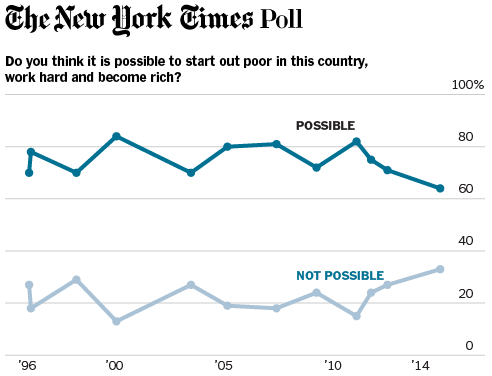
CaptureToday’s New York Times has such an article, “Many Feel American Dream is Out of Reach, Poll Shows,” pointing out that 64% of a NYT Poll respondents think that it is possible to start out poor and become rich (see above chart), which opinion has dropped from 72% in 2009.  The Poll also reports that:

  • 81% of Americans have confidence in their own local banks whereas only 41% have confidence in Wall Street bankers and brokers.
  • 52% think the economic system in the U.S. is basically fair, since all Americans have a chance to succeed, whereas 45% think it is unfair.
  • 54% of Americans think that over-regulation of the economy, which interferes with economic growth, is a bigger problem than under-regulation, which may create an unequal distribution of wealth.

For almost two-thirds of Americans to be upbeat about the American Dream, after six or seven years of recession and slow recovery is to me a very positive sign.  After a severe financial crisis, it is not at all surprising that “main street” bankers have a much higher favorability rating than “Wall Street” bankers.
Several months ago I reported on a survey taken by the progressive Global Strategy Group showing that 80% of voters consider economic growth more important than income inequality.
Both today’s NYT Poll and the previous GSG Survey are saying loud and clear that Americans put a high premium on economic growth and this is where our national leaders should be concentrating their time and energy.  The new Republican majority in Congress has an almost historic opportunity to get this right.  Let’s hope they don’t blow it!

Is Health Care Spending Really Under Control?


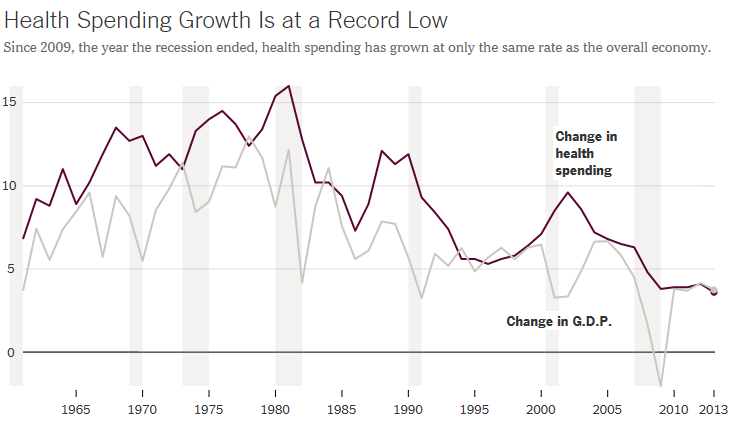
The New York Times has two recent articles about health care spending, “Good News inside the Health Spending Numbers” and “The Battle over Douglas Elmendorf – and the Inability to See Good News.”  These two articles focus on the fact, clearly evident in the chart just below, that the rate of increase in overall health care spending has slowed down since 2009.  In fact health care spending has been a constant 17.4% of GDP for the past four years, while it increased by 1.9% of GDP in the four years before that.  More precisely, health care spending rose by 3.6% in 2013, down from 4.1% in 2012.
CaptureIt is, of course, very good news that increases in health care spending have dropped dramatically since the recession in 2007-2009, but is it really surprising that this has happened in the midst of so much economic pain, with a very high rate of unemployment as well as stagnant incomes for most Americans?  In fact, even in these circumstances, health care spending is still growing at twice the rate of inflation, which has been under 2% during this same time period.
A more realistic view of health care spending has just been presented to the Health Subcommittee of the House Committee on Energy and Commerce by Marc Goldwein, from the non-partisan Committee for a Responsible Federal Budget, a Washington D.C. think tank focused on fiscal responsibility.  Mr. Goldwein makes the following points:

  • Despite the recent slowdown in health care spending, it remains incredibly important that policymakers pursue reforms to reduce future projected health care costs.
  • Policymakers should focus first and foremost on health care “benders” that would improve incentives in order to slow the overall growth of health care spending.
  • Policymakers should next look to health cost “savers” which reduce federal costs by better allocating resources within the federal health programs.
  • Given the aging of the population, health reforms will be necessary but not sufficient to put the debt on a sustainable long-term track.

Slowing down the rate of growth of health care is going to be a huge challenge for our national leaders.  I will elaborate on how to do this in forthcoming blog posts.

Let’s Keep the Economic Momentum Going


There has been lots of good economic news lately:

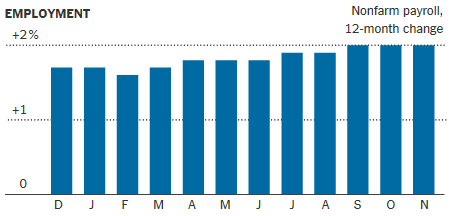
  • The economy added 321,000 jobs in November, the most in one month since January 2012.
  • The unemployment rate of 5.8% remains steady and is down from 7% in November 2013.
  • The average hourly earnings for workers is up by 2.1% from a year earlier.
  • Economic growth for the third quarter is up 3.9% from the previous quarter.
  • The deficit for the 2014-2015 fiscal year was “only” 2.8% of GDP and is predicted by the Congressional Budget Office to drop to 2.6% for the current year.
  • The price of a gallon of gasoline has dropped to $2.71 on average, its lowest level since 2010 and is still dropping.

CaptureThe New York Times predicts that the “Brighter Economy Raises Odds of Action in Congress.”  Jason Furman, Chairman of the White House Council of Economic Advisors, is quoted as saying that “At least there will be less of a philosophical debate on infrastructure, tax reforms and expanding exports.  You can have that agenda because the economy is not in free fall.” These three items would make a great agenda for the 114th Congress in the following way:

  • Infrastructure. The continuing drop in the price of gasoline offers the opportunity to replenish the inadequately funded Highway Trust Fund in a fiscally responsible manner. Congress should raise the federal gasoline tax above its current 18 cents per gallon to a level which is sufficient to fund the entire federal share of highway construction and repair.
  • Tax reform. Individual and corporate tax reform will give the economy a huge boost. The idea here is to lower tax rates in a revenue neutral way by closing loopholes and deductions.
  • Expanding Exports. What’s needed here is to give the President fast track negotiating authority so that Congress has to vote any trade agreement up or down without modification. This is the only way to get other countries to make concessions.


Of course there are many other issues which need to be seriously addressed by the new Congress.  But relatively quick action on just these three less controversial items would be a great start!

Why Nebraska Needs a Learning Community III. High Black Unemployment


Omaha’s Metropolitan Area Planning Agency has just released a comprehensive report, “Equitable Growth Profile of the Omaha-Council Bluffs Region,” describing the challenges facing the Omaha area economy in the next 25 years.
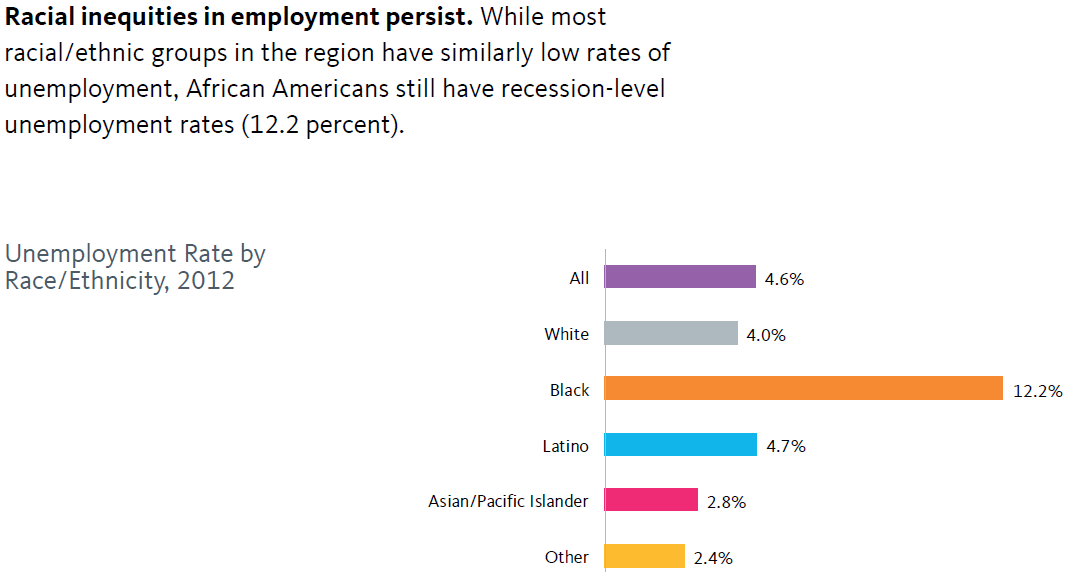
CaptureAs also reported in the Omaha World Herald  MAPA says that:

  • Racial minorities currently make up 21% of the area’s population, up from 9% in 1980. Under current trends minorities will comprise 39% of the population by 2040.
  • Minorities are less likely than whites to have high school degrees, associate degrees, or four-year college degrees.
  • The education gap contributes to a skills gap which in turn contributes to a jobs and income gap. As shown above, black unemployment at 12.2% (in March 2014) is much higher than the unemployment rate for any other racial group.

MAPA has several suggestions for improving job prospects for blacks such as more and better job training, better public transit, and helping minority owned businesses.  It also suggests building “cradle to career” pipelines for underprivileged youths.
This last suggestion is precisely what the Omaha area Learning Community is focused on.  As I reported  several months ago, the superintendents of the 11 school districts in the Learning Community have approved a comprehensive plan for Early Childhood Education whose purpose is to make sure that children from low-income families are well prepared to succeed in school.  It will be funded by a ½ cent levy approved by the Learning Community Coordinating Council.
These same 11 superintendents are highly supportive of the overall mission of the LC to close the academic achievement gap between low-income students and middle class students.  They have recently submitted a report to the Education Committee of the Nebraska Legislature suggesting ways to make the LC even more effective than it is already.
Achieving improved educational outcomes for minorities has been called America’s big new civil rights challenge of the 21st century.  Omaha is making significant strides in addressing this problem thanks to a huge communitywide effort by many different organizations including the Learning Community.

Why the U.S. Needs True Health Care Reform


The Affordable Care Act has improved access to healthcare by already enrolling over 7 million Americans who were previously uninsured.  It is estimated that there will be a total of 20 million new enrollees by the end of this decade.
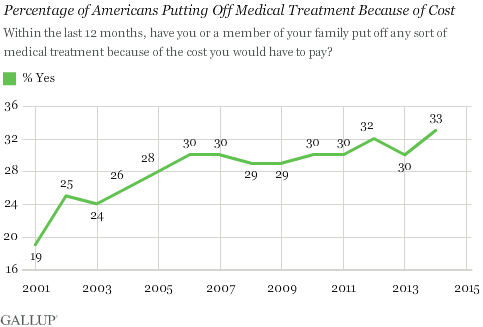
CaptureBut as the above chart from a recent Gallup survey indicates, the cost of healthcare is now a big barrier for an increasing number of people with health insurance.
The University of Chicago economist, Casey Mulligan, discusses the cost issue in a recent Wall Street Journal article “The Myth of ObamaCare’s Affordability” as well as in a new book.  He makes the following points:

  • Although the ACA helps specific populations by giving them a bigger piece of the economic pie, the law diminishes the pie itself by reducing the amount that American’s work and making their work less productive.
  • 35 million men and women currently work for employers who don’t offer health insurance. These tend to be small and midsize businesses with lower paid employees. The result of penalizing businesses for hiring and expanding will be less hiring and expanding.
  • The “29er” phenomenon is a good example of how the law harms productivity. If a business has 50 or more employees who work over 30 hours a week, it is required to offer health insurance. Many employers have thus adopted 29-hour work schedules which lessens overall productivity.
  • Mr. Mulligan estimates that the ACA’s long-term impact will include about 3% less weekly employment, 2% less GDP and 2% less labor income. He also claims that these effects will be visible and obvious in just a few years by 2017!
  • The ACA is thus weakening the economy. For the large number of people who continue to pay for their own healthcare, healthcare is now less affordable.

Conclusion: we need true healthcare reform which addresses cost as well as access and this can be achieved by fixing Obamacare.  It is not necessary to repeal it.  The Manhattan Institute’s Avik Roy has developed a plan to do this: ”Transcending Obamacare.”  Mr. Roy’s Plan would keep the exchanges, end both the individual and employer mandates, and migrate both the Medicare and Medicaid programs onto the exchanges over time.  These features will greatly reduce the cost of American healthcare.  Check it out and see for yourself!

Nebraska Will Benefit From Immigration Reform


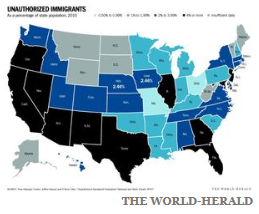
Several months ago the Omaha World Herald reported that Nebraska has approximately 45,000 illegal immigrants, or about 2.5% of the state’s population.  Nebraska’s unemployment rate has now dropped to 3.4%, the third lowest in the nation behind only North Dakota and South Dakota.  Such a low unemployment rate represents a labor shortage.  There simply aren’t enough Nebraskans to perform all of the physically demanding, low skill work needed in the agriculture, meatpacking and construction industries.  It is this labor shortage which is attracting such a large number of illegal immigrants to Nebraska.
CaptureAccording to the New York Times, the Tea Party has recently changed its focus from “curtailing the reach of the federal government, cutting the deficit and countering the Wall Street wing of the Republican Party to becoming largely an anti-immigration overhaul movement.”  This is a very unfortunate development.
Why would it be so difficult to solve our illegal immigration problem in the following manner:

  • Give all businesses a limited period of time, perhaps six months, to present a list of current employees who are illegal. Everyone on this list without a criminal record would receive a guest worker visa.
  • Going forward, businesses would be authorized to hire additional foreign workers as needed with guest worker visas issued in their home country. This would eliminate the need for illegal entry into the U.S.
  • As of a certain date in the near future, all businesses would be required to periodically demonstrate the legal status of all workers on their payroll.
  • Guest workers would be eligible to apply for citizenship after a lengthy period of time, perhaps ten years.

Once an adequate guest worker visa program has been set up and is operating efficiently, security on our southern border with Mexico would hardly be more of a problem than is security on our northern border with Canada. Illegal immigration should be considered as an economic problem, not a law-enforcement problem.
If it were handled correctly in this way, the problem would disappear in short order!

Let’s Do Something about Corporate Welfare and Crony Capitalism!


The American Enterprise Institute is one of my favorite Washington think tanks.  It defines its mission as “research and education on issues of government, politics, economics and social welfare.”  I especially like its interest in social welfare which translates for me as being fiscally conservative with a heart.
CaptureThe AEI’s Timothy Carney has just proposed “An anti-corporate welfare, anti-cronyism agenda for the 114th Congress.” Most candidates for Congress condemn crony capitalism and corporate welfare.  This generally means any policies which tilt the playing field, picking winners and losers and rewarding well-connected insiders.  Such actions contribute to the public perception that the “game” is rigged and harm economic growth and innovation.  Here are some prime examples discussed by Mr. Carney:

  • Health Care: repeal Obamacare’s insurer bailout (the “risk corridors”) so that health insurers compete totally on price.
  • Health Care: end the individual mandate which forces people to buy a product from a private industry. An alternative incentive for individuals to remain covered would be limiting enrollment periods, for example, to a brief six-week sign-up period every two years.
  • Energy: end tax breaks and subsidies for both renewable energy (including ethanol) and oil and gas. Make all forms of energy compete in the market.
  • Taxes: make corporate taxes simpler, lower and more neutral. Besides being fairer, such changes will boost the economy.
  • Finance: Rein in Fannie Mae and Freddie Mac by treating them the same as all big banks. This means the same capital requirements, the same tax treatment and the same consumer protection regulation.
  • Finance: Kill Dodd-Frank’s too-big-to-fail designation. It acts as a moat, protecting the big guys from competition.
  • Trade: Kill the Export-Import Bank.
  • Trade: Repeal the Jones Act. It requires all shipping between U.S. ports be done on U.S. flagged vessels.
  • Agriculture: End the Sugar Program which costs consumers $3 billion per year.
  • Agriculture: Reform the Federal Crop Insurance Program by making it self-supporting.

These mostly well-known examples of corporate welfare represent just the tip-of-the-iceberg.  Nevertheless they provide a good place to start in cleaning things up!