Should We Be Optimistic or Pessimistic about Our Country’s Future?

Last month the Congressional Budget Office issued the report “The Budget and Economic Outlook: 2014 to 2024”, giving an updated prediction on economic performance.  It predicts continued slow growth of GDP leveling off in the next few years at a rate of about 2.2% per year.  The public debt (on which we pay interest) will be 74% of GDP this year and increase to 79% of GDP by 2024.  Federal revenues will grow this year to 17.5% of GDP while federal spending will be 20.5% of GDP.  The problem is that the gap between revenue and spending will get worse as indicated by the chart below.
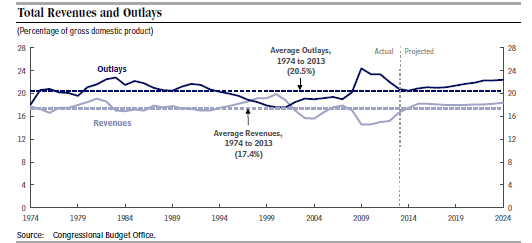
CaptureCBO estimates that interest rates on three month Treasury bills will rise from 0.1% today to 3.7% in 2018, and higher in subsequent years, which means that interest payments on our public debt will increase dramatically as shown in the chart below.  Inflation is predicted to average about 2% over this time period.  Unemployment will slowly drop to 5.8% in 2017 and not reach 5.5% until 2024.
Capture1In an article two days ago, an economics reporter for the New York Times, Floyd Norris, writes that this is “A Dire Economic Forecast Based on New Assumptions”.  Mr. Floyd argues that it is unlikely that we will continue to have both anemic growth and high interest rates at the same time.  Of course, if the economy does grow more quickly, then government revenues will also grow faster which will slow down the growth of the debt.  But CBO predicts that our recovery from the Great Recession will continue to be tortuously slow.
The problem is that when interest rates do go up, as they will sooner or later, interest payment on the national debt will rise quickly, as shown in the CBO chart.  This is going to happen and will be unpleasant to deal with.  Are we going to have slow growth in the meantime, with high unemployment along with it, and then also have expensive debt payment later?  This is indeed a pessimistic prospect!
We have a continuum of choices:

  • Do nothing until the big crunch hits in a few years (like Greece)
  • Cut spending dramatically, including for entitlements (politically infeasible)
  • Raise taxes dramatically (also politically infeasible)
  • Both cut spending and raise taxes (perhaps doable as we get closer to the big crunch)
  • Grow the economy faster which would both lower unemployment and raise revenue

I know what my choice is, how about you?
Let’s Devolve Federal Programs Back to the States!


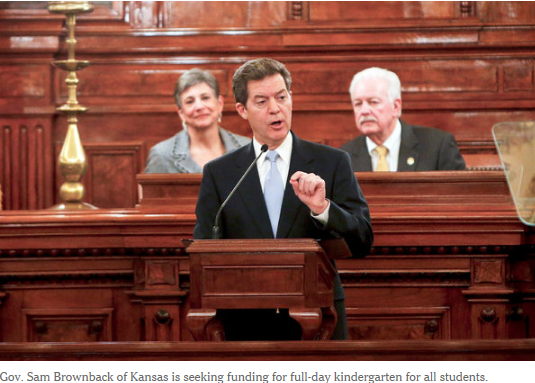
Yesterday’s New York Times has an article “Battles Looming Over Surpluses in Many States”, pointing out that “unexpectedly robust revenues from taxes and other sources are filling most state coffers, creating surpluses not seen in years and prompting statehouse battles over what to do with the money.”  For example, in Kansas, Governor Sam Brownback is calling for full day kindergarten for all students.
CaptureThis raises a larger issue.  The states are recovering from the Great Recession and have lots of money.  We know that states spend money far more efficiently than the federal government, because states have constitutional requirements to balance their budgets.  On the other hand, the federal government is hemorrhaging red ink at a frightening rate which will just keep getting worse indefinitely until strong measures are taken.  It has taken on far too many responsibilities and spends money very inefficiently.
All of this suggests an obvious course of action to turn around a very bad situation.  We should devolve as many federal programs as possible back to the states.  Here are three good ones to start with:

  • Medicaid costs the federal government about $250 billion per year with another $150 billion being paid for by the states.  The problem is that federal support is a fixed percentage of what the states spend.  This makes Medicaid a very expensive program with no limit on the cost to the federal government.  A good way to solve this problem is to “block grant” Medicaid to the states and let each state figure out the best way to spend its own federal allotment.  Annual increases in the size of federal block grants could be tied to the rate of inflation in order to limit their growth.
  • Education spending at the federal level is a $100 billion per year (not counting student loans) item.  Just at the K-12 level alone there are over 100 individual programs to which states and school districts have to apply for funds separately.  Wouldn’t it make far more sense to “block grant” education funds back to the states so that this large sum of money can be spent more effectively and efficiently by targeting it at the biggest needs in each state?
  • Job-Training costs the federal government $18 billion per year for 47 different programs.  Again it would be so much more sensible to block-grant job training funds to the states and measure effectiveness by the number of workers hired.

There really are relatively simple ways for the federal government to operate more effectively and at much lower cost.  We need national leaders who are committed to getting this done.

What Is the State of the U.S. Economy?


On the eve of the President’s State of the Union address, the New York Times gives an answer to this question in today’s paper, “Obama’s Puzzle: Economy Rarely Better, Approval Rarely Worse”.  The charts below do show the basic trends all moving in the right direction.  But is this good enough?
CaptureThe unemployment rate is moving steadily downward but it is still a high 6.7% almost five years after the recession ended in June 2009.  And this is with a labor participation rate of only 58.6%, which is historically very low.
The budget deficit is dropping but is still unsustainably high.  In the five years, 2009 – 2013, deficits have totaled $6 trillion dollars.  As soon as interest rates return to their historical average of 5%, interest on this $6 trillion in new debt alone will total $300 billion per year, forever!  Furthermore, the Congressional Budget Office, the most credible source of budget information, predicts that the deficit is likely to resume an inexorable climb within a few years as baby boomers retire in ever greater numbers, rapidly driving up entitlement costs.
Economic growth was stronger than expected in the last quarter of 2013 and this is a good sign.  But it has averaged only about 2% since the recession ended which is very low by historical standards, in a post recessionary period.
The point is, do we really need to settle for such mediocre performance: a stagnant economy, high unemployment and massively accumulating debt?  Should we just declare that in a highly competitive global economy with an ever higher premium on information and technology, that we just can’t do any better than we already are?  Isn’t there some way to make our economy grow faster in order to provide more and higher paying jobs?
I think that the answer to this last question is an emphatic yes!  In fact, this is what my blog is all about.  Just read some of the other recent posts and let me know if you disagree with what I am saying!

A Global Perspective on Income Inequality II. Where Are the Jobs?


My last post on January 23 shows vividly what the challenges are in restoring the American middle class to the prosperity which existed up until the Great Recession hit in late 2007.  The problem, of course, is the gale strength force of globalization which is lifting up low wage workers all over the developing world and creating huge competition for the many low-skilled workers in the United States.
In today’s New York Times, the former Obama Administration car czar, Steven Rattner, writes about “The Myth of Industrial Rebound” in the United States, explaining why manufacturing jobs are coming back much more slowly than other jobs.  “Manufacturing would benefit from the same reforms that would help the broader economy: restructuring of our loophole-ridden corporate tax code, new policies to bring in skilled immigrants, added spending on infrastructure and, yes, more trade agreements to encourage foreign direct investment.”
CaptureThe above chart shows the huge decline in manufacturing jobs relative to other parts of the economy such as the education and health sector as well as the professional and business sector.  Of course, these more rapidly growing service sectors are the ones benefitting from the information technology revolution.  In manufacturing, on the other hand, the low skill jobs are going overseas while the high skill jobs, using technology such as robots, are much fewer in number.
Conclusion: in order to increase manufacturing jobs in the U.S., we better government policies, as outlined above by Mr. Rattner.  But we also need to recognize that there aren’t going to be as many high skilled manufacturing jobs in the future.  We are going to need much better K-12 and post-secondary educational outcomes to prepare the middle class for the high skilled service jobs which will predominate in the future.

Should Government Address Inequality Directly?


Wall Street Journal columnist William Galston suggests in “Where Right and Left Agree on Inequality”, that both sides of the political spectrum agree that economic inequality is increasing in America and that government needs to address this problem.  “Poverty is part of the explanation, as liberals insist.  But so are parenting and family structure, as conservatives believe.”
CaptureIt so happens that we have a broadly supported federal program which simultaneously addresses both poverty and family structure.  It is the Earned Income Tax Credit program.  It provides $3,305 a year to low-income working families with one child and up to $6,143 for families with three or more children.  The U.S. spends $61 billion a year on this program and it has proven to be very successful in encouraging low-income people to find and keep jobs.  In fact, the economist, Gregory Mankiw, recommends the EITC over a higher minimum wage as a better way to increase the earnings of the working poor.
The New York Times’ Eduardo Porter reports in “Seeking Ways to Help the Poor and Childless”, that New York City is conducting an experiment to see if a locally run program similar to the EITC  will have the same positive effect in increasing employment of childless adults.  It is understood that many of the jobs being created in today’s economy are low paying service jobs.  As Mr. Porter says, “for the American market economy to remain viable, being employed must, one way or another, provide for workers’ needs.”
Conclusion:  as important as it is for Congress and the President to adopt measures to increase economic growth (e.g. tax reform, fiscal stability, expanded foreign trade, immigration reform), in order to create more and better paying jobs, government also has a responsibility to provide direct help to the needy who are trying to help themselves.  The EITC program is an excellent way to do this!

Why a High Corporate Income Tax Is So Damaging to Our Economy


My previous post, “Fundamental Tax Reform Is the Key to Solving Our Economic and Fiscal Problems II.  The Graetz Plan”, describes a tax reform plan which establishes a 14% national consumption (VAT) tax, exempts families earning under $100,000 from paying any income tax and also reduces the Corporate Income Tax to 15%.  All of this is done in a revenue neutral manner while also preserving all of the progressivity of our current income tax system.
CaptureA recent Op Ed column in the New York Times, by the economist Lawrence Kotlikoff, “Abolish the Corporate Income Tax”, makes the case that such a proposal “might sound like a gift to the rich, but it would actually help workers. … Apple’s tax return says it all:  The company, according to one calculation, paid only 8% of its worldwide profits in United States corporate income taxes, thanks to piling up most of its profits and locating far too many of its operations overseas.”
Our corporate income tax rate, at 35%, is one of the highest in the world and this is what encourages American multinational companies to move their business to other countries.  Whether we abolish the corporate income tax entirely, or just reduce it to 15%, is less important than recognizing the need to overcome popular prejudice about big business and make fundamental changes in our tax structure.
Solving our country’s many problems, from rising inequality at home to projecting adequate strength around the world, requires that the U.S. have a strong economy.  An annual growth rate of 2% of GDP is not nearly good enough to end our current economic stagnation.  To accomplish this will require overcoming the strong headwinds of increasing global competition and the replacement of people with machines.  We will need innovative thinking and initiative to break out of the old ways of doing things which are holding us back.
Are the American people “exceptional” enough to accomplish this challenging task?

Inequality III: Is the Game Rigged?


The economist Joseph Stiglitz has an Op Ed column in today’s New York Times, “In No One We Trust”, blaming the financial crisis on the banking industry.  “In the years leading up to the crisis our traditional bankers changed drastically, aggressively branching out into other activities, including those historically associated with investment banking.  Trust went out the window. … When 1 percent of the population takes home more than 22 percent of the country’s income – and 95 percent of the increase in income in the post-crisis recovery – some pretty basic things are at stake. … Reasonable people can look at this absurd distribution and be pretty certain that the game is rigged. … I suspect that there is only one way to really get trust back.  We need to pass strong regulations, embodying norms of good behavior, and appoint bold regulators to enforce them.”  
CaptureMr. Stiglitz is partially correct.  Although the housing bubble, caused by poor government policy – loose money, subprime mortgages, and lax regulation – was the primary cause of the financial crisis, nevertheless, poorly regulated banking practices made the crisis much worse.  But this is all being fixed with Dodd-Frank, a just recently implemented Volker Rule, and a soon coming wind-down of Fannie Mae and Freddie Mac. 
Mr. Stiglitz concludes, “Without trust, there can be no harmony, nor can there be a strong economy.  Inequality is degrading our trust.  For our own sake, and for the sake of future generations, it is time to start rebuilding it. 
But how do we reduce the inequality in order to restore the trust which is necessary for a strong economy?  Mr. Stiglitz doesn’t say!
What we need is faster economic growth in order to create more new jobs.  The last four years have demonstrated that the Federal Reserve can’t accomplish this with quantitative easing.  It needs to be done by private business and entrepreneurship.  Tax reform and the easing of regulations on new businesses is what we need.  It’s too bad that ideological blinders prevent so many people from understanding this basic truth!    
    

How Do We Fight Economic Inequality? By Restoring Growth!

The liberal economist Paul Krugman returns to one of his favorite topics in yesterday’s New York Times, “Why Inequality Matters”.  “On average, Americans remain a lot poorer today than they were before the economic crisis.  For the bottom 90 percent of families, this impoverishment reflects both a shrinking economic pie and a declining share of that pie.”  The problem with Mr. Krugman’s analysis is that he offers no solution beyond more fiscal stimulus: “the premature return to fiscal austerity has done more than anything to hobble the recovery.”
CaptureBut there is another route to recovery and it is propounded in today’s Wall Street Journal by George Osborne, the United Kingdom’s Chancellor of the Exchequer, “How Britain Returned to Growth”. “We cut spending and top tax rates, and now deficits are down and jobs are being created at a healthy clip … at the rate of 60,000 per month, roughly equivalent to 300,000 in the U.S. … The corporate tax rate is being cut to 20% from 28%. … As a result, more international firms are moving their headquarters to Britain and investment is flowing into our country.”
Yes, as Mr. Krugman says, economic inequality in the U.S. is bad and getting worse.  The question is what to do about it.  Shall we try to improve the situation with artificial stimulation, increasing government debt, already very high, for future generations?  Or shall we address this inequality by encouraging businesses to grow and expand and thereby raise wages and hire more people.
The good news is that America is the success story of the 20th century.  The bad news is that everyone else in the world has figured this out and is now copying our own best methods.  Either we can compete, innovate, stay on top and thrive, or else we can get lazy, stagnate and sink down in the pack.
Will it be more inequality or more growth?  The choice is up to us!

How to Get the Economy Back on Track


Harvard Economist, Martin Feldstein, has an Op Ed column in yesterday’s New York Times, “Saving The Fed From Itself”, which gets our current economic situation half right.  First of all, Mr. Feldstein says that the Fed’s quantitative easing policy is inadequate because “the magnitude of the effect has been too small to raise economic growth to a healthy rate.  … The net result is that the economy has been growing at an annual rate of less than 2 percent.  … Weak growth has also meant weak employment gains.  … Total private sector employment is actually less than it was six years ago.  … While doing little to stimulate the economy, the Fed’s policy of low long-term interest rates has caused individuals and institutions to take excessive risks that could destabilize the economy just as it did before the 2007-2009 recession.”  So far he’s right on the button!
But then he goes on to say, “To get the economy back on track,” Congress should enact a five year plan to spend a trillion dollars or more on infrastructure improvement and that this would “move the growth of gross domestic product to above three percent a year.”  An artificial stimulus like this might work temporarily but then it ends and we’re back where we started.  We need a self-generating stimulus that will keep going indefinitely on its own.  How do we accomplish this?
The answer should be obvious.  We do it by stimulating the private sector to take more risk in order to generate more profits. In the process they will hire more employees and boost the economy.
How do we motivate the private sector?  By lowering tax rates and loosening the regulations which stifle growth.  Closing tax loopholes and lowering deductions (which will raise revenue to offset the lower tax rates) has the added benefit of attacking the corporate cronyism which everyone deplores.
We really do need to put first things first.  If we can jump start the economy by motivating the private sector to invest and grow, we will have more tax revenue to spend on new and expanded government programs as well as shrinking the federal deficit.
Why is this so hard for so many people to understand?

Global Warming Is For Real. What Should We Do About It?

Although the threat of global warming is vastly overhyped, it is happening nonetheless.  Perhaps the best single indication of this is the shrinking of the north-pole ice cap.  The New York Times reported just a few days ago, “Large Companies Prepared to Pay Price on Carbon”, that at least 29 major companies “are incorporating a price on carbon into their long-range financial plans.”  This includes five big oil companies ExxonMobil, ConocoPhillips, Chevron, BP and Shell.  Specifically, these major companies have all come to accept the reality of global warming and are preparing for a carbon tax to be levied before long.
The Congressional Budget Office has recently released a report “Effects of a Carbon Tax on the Economy and the Environment”, which concludes that a tax of $20 to emit a ton of CO2 would raise a total of $1.2 trillion over a decade.  Such a tax would, for example, raise the price of gasoline by 10 to 15 cents per gallon.
Once we admit that global warming is for real, and that we need to address it in a serious way, a carbon tax is almost certainly the most efficient, and least economically harmful, way to do it.  A tax on carbon output would do many things.  It would give a big boost to renewable energy (solar and wind) with, or without, special subsidies for renewables.  It would speed up the transformation from the use of coal to natural gas, since natural gas only contains half as much carbon as coal does.  And it would create an economic incentive to speed up the development of carbon capture in order to make the burning of coal more cost competitive.
Of course, a new $120 billion per year carbon tax will affect the economy.  But it will do the least damage if the proceeds are used entirely for deficit reduction.  So we can address a serious environmental problem which effects life on earth and can do so in a way which also addresses a very serious fiscal problem.
I believe that the American people are up to making a sacrifice like this if the consequences of inaction are clearly explained to them.