How Not to Help Black Americans


“It is important and right that all privileges of the law be ours, but it is vastly more important that we be prepared for the exercise of these privileges.”                                                                  Booker T. Washington, 1856 – 1915

How do we lift up the black underclass, the school dropouts, gang members, and drug dealers who become criminals and spend their lives as a drag on society?  The Wall Street Journal’s (black) editorial writer, Jason Riley, addresses this question in today’s paper, “How Not to Help Black Americans”.  As he says “Upward mobility depends on work and family.  Government policies which undermine the work ethic – open-ended welfare benefits, for example – help keep poor people poor.  Why study hard in school if you will be held to a lower academic standard?  Why change antisocial behavior when people are willing to reward it or make excuses for it?”
A few days ago, Robert Balfanz, the Director of the Everyone Graduates Center at John Hopkins University in Baltimore, wrote in the New York Times, “Stop Holding Us Back”, that even though 80% of Americans now graduate from high school, 33% of the nation’s African-American and Latino young men will not graduate.  Half of these non-graduates go to a total of just 660 high schools out of a total of 12,600 high schools in the country.  He suggests the following:

  • Refocus such high-poverty high schools in order to identify by the middle of ninth grade the students most likely to drop out.
  • Set up early warning systems so that adults can step in at the first sign that a student is in trouble.
  • Employ additional adults to support students who need daily nagging to succeed, especially during the key transitional years in sixth and ninth grade.

Capture Such a plan has been instituted in the Chicago Public Schools as described in “Preventable Failure”.  As the above chart shows, it has led to dramatic improvement in the on-track rate of at-risk ninth graders in CPS.
These two school programs, in Baltimore and Chicago, represent what we should be doing to help all minorities, especially blacks, succeed in life.  Resources provided for such programs will do much more to eliminate poverty than expanding conventional welfare.

Escaping the Student Debt Trap


Student debt in the U.S. now tops $1.2 trillion with 37 million borrows, 5.4 million of whom have already defaulted.  President Obama has proposed to expand a program which allows students to repay debt based on what they earn, eventually forgiving the balance.  Massachusetts Senator Warren has proposed taxing millionaires to pay for student loan refinancing.  Small scale free market proposals abound.  What is badly needed is a sensible broad-based public program approved by Congress.
CaptureThe Brookings Institution has recently proposed just such a model for student loan repayment “Loans for Educational Opportunity: Making Borrowing Work for Today’s Students”.  It is based on four observations:

  • Moderate debt for the typical student borrower. 69% of students have borrowed $10,000 or less.
  • The high payoff of a college education. Over a lifetime the holder of a bachelor’s degree earns several hundred thousand dollars more than a high school graduate. Even those who attend college but do not graduate will experience an income gain of about $100,000.  Postsecondary education should be encouraged as widely as possible.
  • The highest rates of default are on typical loan balances. The average loan balance in default is $14,000 while the average loan balance in good standing is $22,000.
  • The highest rates of default are among young borrowers. For borrowers under age 21, 28% have defaulted, for borrowers between ages 30 and 44, 18% have defaulted and it is 12% for borrowers aged 45 and older.

The Brookings’ authors propose that student loan payments be deducted from pay by the employer, in the same way as for income taxes and Social Security.  The payment rate would be only 3% of the first $10,000 in annual earnings and would rise with higher earnings topping out at 10%.  Loan payments will stop when the loan is repaid or after 25 years, whichever comes first.  Various measures can be adopted to protect against deadbeats.  See the Brookings report for details.
The fairest system would be for all students, past and present, to be put into a program like this.  Nobody would be expected to pay during periods of unemployment. Interest rates could be adjusted from year to year to make the program self-supporting. Something along these lines is badly needed!

Raising America’s Pay II. How Can We Do It?


My last post “Raising America’s Pay” addresses a new report from the Economic Policy Institute, “Raising America’s Pay: Why It’s Our Central Economic Policy Challenge”.  Its starting point is the now generally accepted view that wages for the typical American worker have been flat ever since the early 1970s even though labor productivity has continued to rise steadily.
The EPI authors recognize that globalization and the growth of technology have contributed to wage stagnation even though they blame malign policy decisions as well.  I do agree with them that the resulting increase in economic inequality is detrimental to America.  I also agree with them that the way to address inequality is for wages to go up. The best way to accomplish this is to lower unemployment by increasing economic growth.  This will happen when large numbers of consumers start spending more money, thereby increasing demand.  Does this sound like a vicious circle?  It need not be!
CaptureThe above chart from the Wall Street Journal shows that the net worth of U.S. households has now more than recovered from the Great Recession.  The problem is that most of this new wealth has gone to the people with the highest incomes who are more likely to save it.  What we need to do is “redistribute” (gasp!) some of this vast sum of new wealth back to middle and lower income people who would be much more likely to spend it.
There is a straightforward way to do this.  Broad based tax reform!  Lower everyone’s tax rates paid for by closing loopholes and shrinking deductions which primarily benefit the wealthy.  This will be a pure gain in income for the two thirds of Americans, about 80 million, who pay income taxes but do not itemize deductions, most of whom are in the lower and middle income brackets.  These people are likely to spend most of their new income, thus giving the economy the big boost that it needs!
Our leaders in Washington should be able to figure this out!

A Strong Country Requires a Strong Economy


“Ukraine is a wake-up call for what a post-American world would look like” declares the foreign affairs expert Walter Russell Mead in an article “Putin Did Americans a Favor” (http://online.wsj.com/articles/walter-russell-mead-putin-did-americans-a-favor-1401662270) in yesterday’s Wall Street Journal.
“For those willing to see, the signs of what a post-American world would look like are easy to discern.  We can look at Bashar Assad’s murderous campaign in Syria to see how Iran thinks power should be used.  To see what Saudi Arabia thinks about human rights and liberal values, follow events in Egypt and Pakistan.  China would become more aggressive in a post American world, and the chances of Sino-Japanese conflict would increase. … In Europe, only power keeps or can keep Russia from rebuilding its old empire.”
“Those who think American decline is inevitable must face a tragic truth: The eclipse of American power will be a disaster for our economic interests, for the values we cherish and, in the end, for our security at home.  What stability, peace and legality now exist in the international system are there because the U.S., with important help from allies and partners, made great sacrifices to build and secure them.”
Capture2America’s decline is not inevitable but neither is our continued success.  As much as anything else, it depends on the strength of our economic system.  We need to give much more attention to making our economy grow faster.  This will create more jobs and better jobs and thereby boost national morale.  It will bring in more tax revenue for paying our bills.  In addition, projecting national power is very expensive.  We can and should continue to insist that our defense budget be lean and efficient.  But there is a limit as to how far we can go in this direction.  Ultimately defense spending will have to increase as a percentage of GNP.  This can only be accomplished with a robust economy.
As I have repeated many times in my blog posts, the best strategy for making the economy grow faster is to encourage more consumer spending by lowering individual tax rates and to encourage more entrepreneurial activity by reducing tax rates on small business.  Such tax changes can easily be paid for by closing loopholes and shrinking tax deductions for the wealthy.  But there has to be a political will to do this.
Can this be accomplished?  I don’t know but our future as a free and prosperous nation depends on it!

An Inequality Culprit: Single-Parent Families


It is generally agreed that income inequality in the U.S. is bad and getting worse.  Before we can address it effectively, we have to understand what is causing it.  In this regard the Wall Street Journal had an article recently, “Ignoring an Inequality Culprit: Single-Parent Families”, by two scholars, Robert Maranto and Michael Crouch, from the Department of Education Reform at the University of Arkansas.
CaptureMr. Maranto and Mr. Crouch call attention to what they call “the strongest statistical correlate of inequality in the United States: the rise of single parent families during the past half century. … In 1960, more than 76% of African-Americans and nearly 97% of whites were born to married couples.  Today the percentage is 30% for blacks and 70% for whites. … This trend, coupled with high divorce rates, means that roughly 25% of American children now live in single-parent homes, twice the percentage in Europe (12%).  Roughly a third of American children live apart from their fathers.” In addition, “more than 20% of children in single-parent families live in poverty long-term, compared with 2% of those raised in two parent families.”  It is estimated “that 41% of the economic inequality created between 1976-2000 was the result of changed family structure.”
The authors wonder why there is not more public attention given to this depressing state of affairs and conclude that

  • Intellectual and cultural elites lean to the left and it is primarily social conservatives who promote traditional family structure.
  • Family breakup has hit minority communities the hardest. Therefore public discussion can be characterized as being racist.
  • This is a very hard problem to solve. Marriage and childrearing involve highly personal choices which cannot be dictated by society.

In this regard, my March 11, 2014 post “A balanced and Sensible Antipoverty Program”, emphasizes the need to at least remove marriage penalties from government welfare policy.
As the authors conclude, “The first step is to acknowledge the problem.”

The Growth Deficit


I am a fiscal conservative, as well as a social moderate, which means that I don’t fit very easily into a standard mold.  I am non-doctrinaire, non-ideological and mostly nonpartisan.  I vote for candidates from both major parties as well as independents.  I prefer a balanced government with neither party in complete control.
My most direct sources of information on fiscal and economic issues are the Wall Street Journal and the New York Times, both of which I read assiduously on a daily basis.  When these two newspapers disagree on a particular issue, then I usually decide that the truth lies somewhere in between.
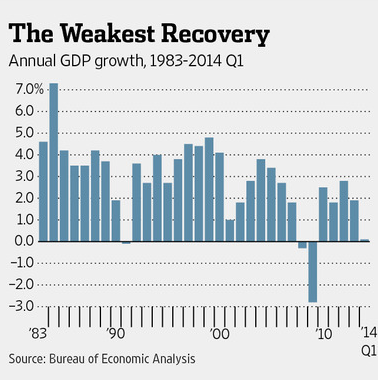
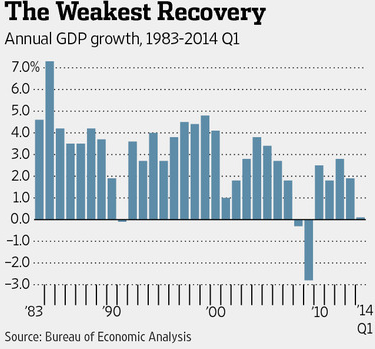
CaptureOur biggest national problem right now, in my opinion, is the stagnant economy.  In today’s WSJ, the lead editorial, “The Growth Deficit”, clearly describes how bad the situation is.  Since the Great Recession ended in June 2009, our rate of GDP growth has averaged 2.2% per year.  This compares with a 4.1% annual rate of growth for all post-1960 recovery periods.
Such a slow rate of growth causes all sorts of problems.  First of all, it explains why our unemployment rate is still so high at 6.7% after five years of recovery.  This means that between 15 and 20 million people are still unemployed or underemployed.  Such a large human toll means a huge increase in government welfare expenses for food stamps, unemployment insurance, etc.  Higher unemployment also means less tax revenue collected by the federal government.  This translates into much larger deficit spending, adding to the already massive national debt.
There are lots of things which can be done to increase growth, for example:

  • Lowering tax rates on individuals to put more money in the hands of the 2/3 of Americans who do not itemize deductions on their tax returns. They’ll spend this extra income and create more demand! Pay for this by closing loopholes and deductions, which are used primarily by the wealthy. Besides stimulating the economy, this will simultaneously address increasing income inequality.
  • Lowering tax rates on corporations to encourage multinationals to bring their foreign profits back home for reinvestment or paying dividends. Again, balanced by eliminating deductions enjoyed by privileged corporations.
  • Relax regulatory burdens on small businesses where most new jobs are created.
  • Reform immigration procedures by boosting the number of H1-B visas to attract more highly skilled, and entrepreneurial, foreign workers.
  • Grant trade promotion authority to the President to speed up new trade agreements.

We should be clamoring for our national leaders to be acting on these fronts.  A strong economy is the very backbone of our success as a nation!

The Resurrection of Karl Marx II. Let’s React But Not Overreact!


This morning’s Wall Street Journal has a book review by the New York fund manager, Daniel Shuchman, “Thomas Piketty Revives Karl Marx for the 21st Century” of Thomas Piketty’s new book “Capitalism in the Twenty-First Century.” As I recently discussed, Piketty makes the simple observation that income from wealth, i.e. investment income, grows faster than income from wages or GDP.
CaptureHe then provides a large quantity of data showing how this has played out since the end of WWII.  He plausibly predicts that the value of private capital as a percentage of national income will continue to grow indefinitely into the future.
CaptureThis much is straightforward.  The question is how we should react to a steadily increasing and very large concentration of wealth in the hands of a small percentage of people.  Mr. Piketty’s own idea is, for example, to establish an 80% tax rate on incomes starting at “$500,000 or $1,000,000” in order “to put an end to such incomes.”  Mr. Shuchman attempts to discredit Mr. Piketty by focusing in on such socialistic views for dealing with the problem rather than discussing the intrinsic merit of Piketty’s basic thesis about the buildup of great wealth in the first place.
My own view is that Mr. Piketty has clearly identified a weakness of capitalism and that it behooves supporters of free markets and private initiative to address this problem in a constructive way, for example, as follows.
We need fundamental broad-based tax reform, i.e. lower tax rates in exchange for closing loop-holes and lowering deductions, in order to boost the economy and create more jobs.  As part of a major tax overhaul, we could also establish a relatively small wealth tax, of about 1% or 2%, on assets over $10,000,000, which would raise as much as $200 billion per year.  This much money could be used to begin a large scale program of infrastructure renewal as well as leaving a lot left over to make significant payments on reducing our annual deficit.
Such an overall plan would address both income inequality and wealth inequality in a highly visible manner while simultaneously helping our economy.

Soaring Profits, Too Few Jobs and Low Interest Rates


“Low interest rates aren’t working, but we need a debate about what will,” declares The Wall Street Journal’s William Galston yesterday in “Soaring Profits but Too Few Jobs”. “Corporate profits after taxes in the fourth quarter of 2013 rose to an annual level of $1.9 trillion – 11.1% of GDP, a postwar high. Meanwhile, total compensation – wages and benefits – fell to their lowest level of GDP in at least 50 years.”
Capture“Businesses are sitting on tons of cash . . . and they’re choosing to invest their capital in hardware, rather than hiring. The reason: they believe that investing in technology is likely to have a better effect on sales than hiring more people.” Furthermore, “today’s (low) interest- rate regime lowers the cost of capital – and therefore of capital investment relative to labor.”
Meanwhile,” Republicans are banging away at the Affordable Care Act while Democrats are busy scheduling votes on a grab bag of subjects designed to boost turnout from the party’s base in the fall elections. The economic problems we face are getting lost in the partisan din.”
We are in a very tough situation. Raising interest rates might give a marginal boost to hiring more workers over capital investment but it will also greatly increase interest payments on our massive and rapidly increasing national debt. And meanwhile we have a stagnant economy with millions of people either unemployed or underemployed. What should we do?  How about

  • Boosting the economy with lower individual and corporate tax rates, paid for by cutting back on tax preferences. This will especially help small businesses grow and hire more employees. It will also encourage multinational corporations to bring their foreign profits back home for reinvestment.
  • Addressing rising income and wealth inequality by establishing an annual 1% wealth tax on individual assets in excess of $10 million. This will raise about $200 billion per year and could be used to set up a huge infrastructure improvement program to put millions of people back to work.

Interest rates will eventually return to normal levels of 5% or so and this will create a big squeeze on the federal budget. So we also need to get federal spending under control as soon as possible. But this is a separate issue.
Just boosting the economy and putting people back to work while addressing inequality in a very visible way will get us started on a path to recovery.

Considering a Wealth Tax for the U.S.


What should a country do when it has

  • Massive accumulated debt and annual deficits predicted to grow indefinitely.
  • A rapidly growing population of retirees heavily dependent on expensive entitlement programs such as Social Security and Medicare.
  • A national Congress which is unwilling to make significant spending cuts for fear of offending powerful constituent groups.
  • Growing income inequality and wealth inequality.
  • A stagnant economy and high unemployment which makes inequality worse.
  • An inefficient income tax system which does not take in enough tax revenue to pay the bills.

The best response by far is to implement broad-based, pro-growth, tax reform.  I have often discussed how to make major changes to our current income tax system.  I have also described an attractive way to introduce a consumption tax, the so-called Graetz Plan.
CaptureAnother way to reform taxes is to introduce a wealth tax.  The economist Ronald McKinnon has described a way to do this in a Wall Street Journal column, “The Conservative Case for a Wealth Tax”.  His plan is to implement a federal wealth tax in addition to the federal income tax.  It would consist of a flat tax of about 3% imposed on household wealth in excess of a $3 million exemption which would exclude 95% of the population.  In addition to bringing in a significant amount of new revenue each year, which is its principal objective, it would serve the purpose of making a flatter, pro-growth, income-tax system more palatable to people who are concerned about inequality, and therefore to a much wider audience.
The economics journalist, Daniel Altman, recently reported in the New York Times, “To Reduce Inequality, Tax Wealth, not Income” that American household wealth totaled more than $58 trillion in 2010.  The most recent issue of Forbes Magazine reports that there are now 492 billionaires in the U.S. with a total wealth of $2.3 trillion.  A 2% tax on the wealth of just these billionaires alone would raise $46 billion.  A 0.5% tax on the wealth of all Americans would raise $290 billion annually.  These examples show that a “moderate” wealth tax could bring in a significant amount of new tax revenue which would make a big dent in shrinking our annual deficit.
We have to do something and do it quickly.  The problem will occur when interest rates return to their normal level as they surely will before long.  When this happens, interest payments on our national debt will sky rocket.  It’s going to be painful regardless, but let’s try to head for the softest landing we can manage!

Does Tax Reform Have a Future?


My post on February 27, “A Breath of Fresh Air” praises the new tax reform proposal from the House Ways and Means Committee which both lowers and consolidates tax rates in a revenue neutral way as well as greatly simplifying the tax code.  It would be a big step in the right direction.  But the Washington Post’s Robert Samuelson makes a good case in ”Does Tax Reform Have a Future?” that the House bill does not go far enough.
CaptureMr. Samuelson argues that if we’re going to eliminate tax deductions and loopholes, and thereby alienate lots of special interest groups, in order to get lower tax rates, then we should avoid half measures and eliminate virtually all deductions in order to get the lowest possible rates.  In other words, eliminate the mortgage interest deduction rather than just limiting it, eliminate deductions for charitable contributions as well as deductions for state and local taxes.  Eliminate the deduction for employer provided healthcare (which by itself would go a long way towards reforming healthcare.)
Mr. Samuelson would retain only the Earned Income Tax Credit (which encourages low-income people to work) and also the tax preference for contributions to retirement accounts (without which most Americans wouldn’t save for retirement.)
We badly need broad based tax reform to stimulate our economy.  Douglas Holtz-Eakin, the former director of the Congressional Budget Office, has estimated “Reforming Taxes, Goosing the Economy”, that even the imperfect House tax reform proposal would raise GDP by .5% annually for 10 years and create 500,000 new jobs each year over this time period.
Full-fledged tax reform, a la Samuelson, would provide an even greater stimulus but let’s at least do something to put the millions of unemployed and underemployed people back to work and reduce our staggering budget deficits!