How to Confront Vladimir Putin


My last post expressed my biggest worry about Donald Trump: that he won’t be sufficiently firm with Vladimir Putin to persuade him to stop his aggression in Eastern Europe. The American Enterprise Institute’s Leon Aron has an excellent analysis of the Putin problem, “Changing Putin’s Mind.”  Says Mr. Aron:

  • Vladimir Putin has called the demise of the Soviet Union “the greatest geopolitical tragedy of the 20th century.” The overarching objective of Putin’s policies, both domestic and external, is to recover and repossess the political, economic and geostrategic assets lost by the Soviet state when it fell apart in the 1990s.
  • In Putin’s first two terms as Russian President, from 2000 – 2008, he focused on restoring the economy. But by 2012, when Putin returned to power, the domestic investment climate had slowed to a crawl with low oil prices causing a severe recession. Putin shifted the foundation of his regime’s legitimacy from economic expansion to patriotic mobilization.

    capture91

  • The reason for the annexation of Crimea, war on Ukraine and intervention in Syria is that restoring Russia’s superpower pride is essential to his regime’s legitimacy. This is the point of a classic Soviet poster (attached) with a Russian soldier admonishing Uncle Sam, “Don’t you fool around!”
  • In Syria, Putin’s goal is to help Bashar al Assad, not defeat ISIS, and so Assad must not be restored. This could be accomplished by grounding the Syrian air force, enforcing no-fly zones, etc. and forcing Putin to distance himself from Damascus.
  • In Ukraine, Putin will not stop unless battlefield dynamics begin to change by, for example, sending Ukraine defensive anti-tank and anti-aircraft weapons, radars to pinpoint Russian positions, etc. Putin must be forced to make a choice between increasing Russian deployment and thus casualties or seeking a genuine peace agreement.
Conclusion.  The choice is between two admittedly risky and unpleasant options: confronting Putin now or see him emboldened to the point where he attempts to destabilize a member state on NATO’s eastern flank.

Follow me on Twitter
Follow me on Facebook

Getting American Health Care Straightened Out II. Medicare


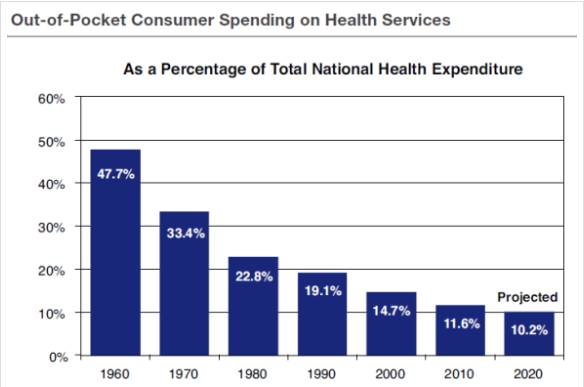
One of the major problems facing the United States today is the high cost of healthcare. We spend almost 18% of GDP on healthcare, both public and private, almost twice as much as any other developed country.  A big reason for the high cost is the low out-of-pocket consumer spending on health services in the U.S. 
My last post discusses a general plan, involving catastrophic health insurance and health savings accounts, for getting the overall cost of healthcare under control.

capture82Once we have a handle on the overall problem, we then need to focus on the cost of the Medicare entitlement program for retirees.  The problem here is easy to understand.  In just 15 years enrollment in Medicare will increase to over 80 million beneficiaries from 57 million today.  Likewise there are 3.1 workers per beneficiary today and there will be only 2.4 in 2030 (see above chart).

capture4
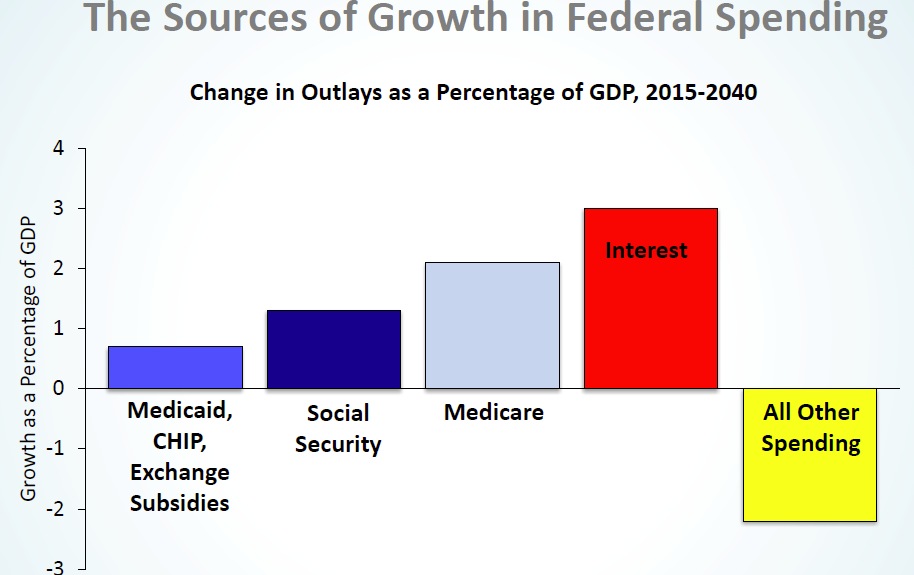
The second chart demonstrates that Medicare will be the major component of increases in federal spending in the coming years (with the other entitlements of Social Security and Medicaid following right behind).
So the question is: how do we control Medicare spending within the context of overall health-care reform?  Here is a proposal from James Capretta of the American Enterprise Institute:

  • Medicare recipients would receive fixed payments toward the coverage option of their choice, based on their age, income and health status. The traditional Medicare program would be one of the choices. Enrollees choosing less costly coverage options would see a reduction in their premiums.
  • Premium payments would be comparable to subsidies and tax credits received from the reformed Affordable Care Act.
  • Privately run managed care plans provide benefits at far less cost than traditional Medicare. Beneficiaries would share in the savings.

Conclusion. It needs to be emphasized as strongly as possible that the point of Medicare reform is to lower costs to both individuals and the government, sa that Medicare can be preserved indefinitely into the future.

Follow me on Twitter
Follow me on Facebook

Getting American Health Care Straightened Out


Donald Trump was elected to be our next president because of the huge desire for change amongst the American electorate. Many things need changing, but among the most important is our healthcare system.  The problem is that we are spending 18% of our GDP on healthcare, twice as much as any other developed country.  The Affordable Care Act has increased access to healthcare but does very little to hold down costs.  This is one reason why it is so unpopular and needs to be substantially modified.
capture10President-elect Trump has nominated Representative Tom Price (R, Ga) to head up Health and Human Services in his cabinet.  Rep. Price is an expert on healthcare and is a leading advocate for replacing the ACA with something more workable.  He will soon be in position to lead the charge for healthcare reform.
The two American Enterprise Institute scholars, James Capretta and Scott Gottlieb,  have some good ideas for what needs to be done.

  • Provide a path to catastrophic health insurance for all Americans. The idea is that all Americans who do not get health insurance through employers, or Medicare or Medicaid, should be eligible for a refundable tax credit sufficient to pay for a basic level of catastrophic (i.e. with a high deductible) insurance coverage.
  • Accommodating people with pre-existing health conditions. Everyone who maintains continuous (catastrophic, as above) coverage would be allowed to move from employer coverage to the individual market without facing exclusions or higher premiums based on health status.
  • Allow broad access to health-savings accounts. There would be a one-time federal tax credit to encourage all Americans to open an HSA to pay routine medical bills. Families typically spend up to 22% less on healthcare after switching to an HSA.
  • Deregulate the market for medical services. Providers need freedom from regulation to provide packages of services better tailored to people’s needs. Such provider flexibility will further reduce costs through additional marketplace competition.

Conclusion. The major reason why our healthcare is so expensive is because we, as individuals, don’t have enough “skin in the game,” in the sense of paying for routine medical expenses directly out of our own pockets. The reforms outlines above would correct this very problem.

Follow me on Twitter
Follow me on Facebook

Fiscal Policy after the Election


As the presidential election tightens and the likely margin of victory for either candidate continues to shrink, it becomes ever more apparent that we need a bipartisan approach to solving our most basic problems.  My last post discusses the need for fundamental tax reform to get our economy growing faster to create more and better paying jobs.  Today I remind my readers of the need for better fiscal policies as well to address our massive and steadily deteriorating debt problem.
As the American Enterprise Institute,  among many other think tanks, makes abundantly clear, we are spending more and more of our federal budget on entitlements  as opposed to all of the many other federal responsibilities which are lumped together as discretionary spending.  In other words, the only way to fix our deficit and debt problems is to achieve better control over entitlement spending.

capture78
AEI has some excellent ideas on how to do this:

  • Social Security should move towards providing a universal flat benefit, set at the federal poverty level, for all U.S. residents aged 65 and older. Social Security would then become a guarantee against poverty in old age rather than a scheme for partially replacing pre-retirement earnings for middle and higher earning households.
  • Health Care. The Affordable Care Act should be replaced with a less regulated system (i.e. no mandates). The federal tax preference on employer plans could be limited to the cost of catastrophic (high deductible) insurance plus a contribution to health savings accounts. Households without employer coverage would receive a comparable tax credit.
  • Medicare would be converted into a premium support system with a fixed level of support comparable to that provided by employers.
  • Medicaid would be converted into a block grant program for the states based on the fixed, per capita costs for enrolled populations.
  • Other Safety-Net Programs should emphasize work as the key to improved economic prospects plus greater state control over resources in order to encourage innovation.

Conclusion. It should be emphasized as strongly as possible that the purpose of entitlement reform is to preserve and strengthen entitlements, not to weaken or destroy them.  Without such action we are headed for a much worse financial crisis than the one we had in 2008-2009 which will put all government social programs at risk.

Follow me on Twitter
Follow me on Facebook


How to Get Our Economy Back on Track III. Tax Reform


Both political parties, both presidential candidates, most prominent economists and economics journalists, in other words, most opinion makers, favor faster economic growth. I have had several recent posts on this topic, here and here, pointing out especially the need to increase the rate of growth of worker productivity which in turn is heavily influenced by the rate of new business investment.
One of the most valuable policy changes in this respect is tax reform, with lower marginal rates paid for by closing loopholes and shrinking deductions. The Republican House of Representatives has developed an excellent plan, “A Better Way,” which includes such extensive tax reform.

capture77
The American Enterprise Institute has recently analyzed the House plan and describes the positive impact it would have on our economy:

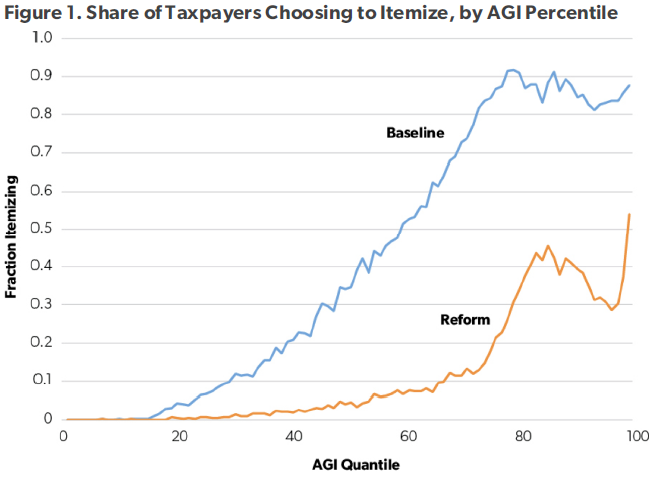
  • Simplification. The seven current individual tax rates would be reduced to just three: 12%, 25% and 33%. All deductions would be eliminated except for mortgage interest and charitable contributions. The standard deduction would be almost doubled. A 50% exclusion for capital gains, dividends and interest income would lower those tax rates in half.
  • Business taxes. The corporate tax rate would be cut from 35% to 20%, again by eliminating most deductions, and a territorial system adopted whereby taxes are only paid in the country where business is conducted. Immediate expensing for new investment would replace multiyear depreciation.
  • Effects. Base broadening by eliminating deductions will add 6.5 million new taxpayers. The number of taxpayers taking the standard deduction will increase by 37 million (from 70% to 95%). Total tax revenue will decrease by $227 billion over ten years. The effective marginal tax rate is slightly lower for most income groups.

Conclusion. The overall lower tax rates will boost economic growth. The ten year loss of tax revenue, while relatively small, is still a detriment and should be eliminated by shrinking the remaining mortgage interest deduction (which primarily benefits the wealthy).

Follow me on Twitter
Follow me on Facebook

The Economy Is Improving But Not Fast Enough II. What to Do?


Our economy is doing a little better recently but not nearly as good as it could be.  In my last post, “Men without Work,” I present Nicholas Eberstadt’s data that a significant part of the problem is the very large number (9.5 million) of prime working age (25 – 54) men who are unemployed and not looking for work.
Statistically, such men are likely to be un-workers if 1) they have no more than a high school diploma, 2) are unmarried and without dependent children, 3) are not immigrants and 4) are African American.
Two other relevant factors are 1) the huge increase in employment for prime working age women, from 34% in 1948 to 70% in 2015 and 2) the very high male arrest and incarceration rates for blacks and those without a high school diploma.
Obviously, it is highly detrimental to society to have such a large number of men who are idle during their prime working years.
capture63
Here are several ways to address this problem:

  • Revitalize America’s job-generating capacities. More businesses have closed than opened in each year since the 2008 financial crisis.  Furthermore, the growing regulatory burden is not a recipe for encouraging entrepreneurship.
  • Reverse the perverse disincentives against male work embedded in our social welfare systems. The Earned Income Tax Credits should be extended to single adults without dependents. Eligibility for disability income should be tightened considerably.

    capture61

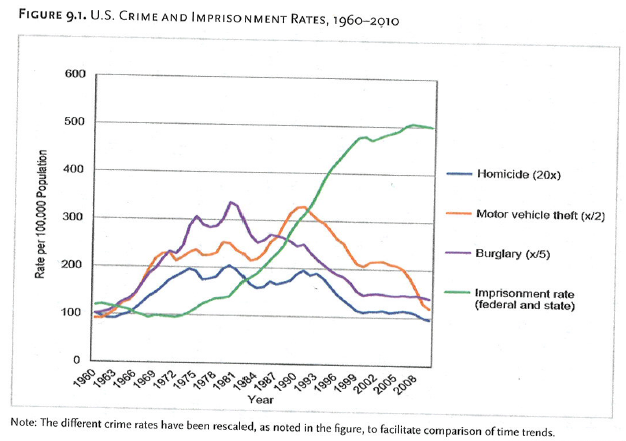
  • Come to terms with the enormous challenge of bringing convicts and felons back into our economy and society. The huge increase in incarceration rates in recent years has coincided with a dramatic drop in rates for both violent crime and property crime.

Conclusion. One good way to speed up economic growth is to put more unemployed prime working age men back to work. There are several very concrete steps which can be taken to do this.

Follow me on Twitter
Follow me on Facebook

Donald Trump Needs a More Positive Message


As regular readers of my blog posts know, I am not enthusiastic about either of our two main presidential candidates because neither of them has a good grasp of our two biggest economic problems which are:

  • Slow economic growth, averaging just 2% per year since the end of the Great Recession in June 2009. Faster growth would solve or alleviate many other problems, especially by creating more new jobs as well as delivering faster wage growth for all middle- and lower-income workers.
  • Massive debt now at 75% of GDP, the highest it has been since right after WWII, and projected by the Congressional Budget Office to get steadily worse unless big changes are made in spending and tax policies. Such major changes are difficult to make without presidential leadership.

Hillary Clinton promises “equitable” growth but her policy proposals will lead to a big increase in spending (bad idea) on projects of dubious value in speeding up economic growth. Donald Trump would hurt the economy with immigration controls and trade restrictions.  His proposal for lower tax rates (good idea) needs much improvement to avoid increasing annual deficits.
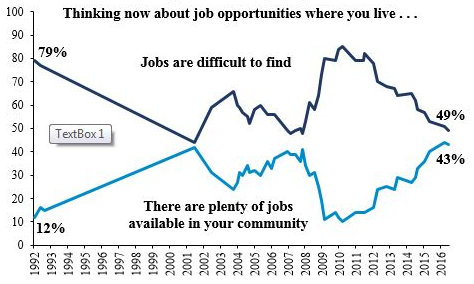
capture40Mr. Trump’s biggest problem, however, is his negative message about life in America today. Yes, we need stronger border security but we don’t need a Fortress America.  As the American Enterprise Institute has just reported, worker satisfaction is greatly improved since 2009 and workers are now much less anxious about job security than just a few years ago.
There is a really good way for Mr. Trump to sound a more positive note.  He could very easily take up the major themes of the Republican House Plan, “A Better Way” for solving America’s major economic problems.
Conclusion. There is an overwhelming desire for change in America, for new leadership which breaks out of the corruption, cronyism and elitism so rampant in Washington DC today.  But Americans are natural optimists and want a leader who can look forward to a bright future for our country.

Follow me on Twitter
Follow me on Facebook

Can U.S. Economic Growth Be Speeded Up?


It is widely recognized and deplored, see here and here, that economic growth in the U.S. has been very slow, averaging only 2% per year, since the end of the Great Recession in June 2009.
The Federal Reserve has taken unprecedented steps to limit the severity of the recession by holding down both short term and long term interest rates.  But these efforts are only partially working and are, unfortunately, having a number of negative effects as well.
It also has been made quite clear that the problem is supply side and not demand side.  This is because, on the one hand, wages are beginning to rise more quickly and consumers are spending more money but, on the other hand, business investment is shrinking which is leading to slow productivity growth.
Capture38The American Enterprise Institute’s James Pethoukoukis has just provided new data  on the current weakness of business investment as illustrated in the above chart. Furthermore he quotes the economist, Robert Gordon, who has clearly described the many headwinds holding back the U.S. economy to the effect that:

“The American tax code exerts a downward pressure on capital formation and therefore on economic growth. It is now 30 years since the passage of comprehensive federal tax reform in the U.S.  In the intervening years, nearly every developed country has reformed its tax codes to make them more competitive than that of America.  Meanwhile the U.S. has allowed its tax code to atrophy.”

Conclusion. Yes, economic growth can be speeded up. But monetary policy won’t do the trick.  Congress must intervene with the right changes to fiscal policy, i.e. lowering tax rates for both individuals and corporations, paid for by closing loopholes and shrinking deductions.

Follow me on Twitter
Follow me on Facebook

How to Improve Obamacare and Lower It’s Costs


I have been making the case for some time now that the rapidly increasing costs of U.S. health care, especially for the entitlement programs of Medicare and Medicaid, is the fundamental cause of our exploding national debt, and therefore these costs must be curtailed.  The only way to fix this problem is for Americans to have more “skin in the game” regarding these costs.
Capture10My last post, “The Inherent Instability of Obamacare,” discusses the separate but related problem that the Affordable Care Act is actuarially unsound because it misprices the basic risks involved in health insurance.  This is why costs on the exchanges are going up so fast which, in turn, leads to fewer enrollees.
A good way to address this double whammy of problems is to use a plan developed (mostly) by the American Enterprise Institute in December, 2015.  The main features are:

  • ACA Mandates, for both individuals and employers, would be abolished.
  • Retain tax preferences for employer-paid premiums, with an upper limit comparable to the cost of catastrophic health insurance.
  • Provide refundable tax credits to households without access to employer coverage, gradually replacing subsidies provided by ACA exchanges.
  • Persons with pre-existing conditions would have continuous coverage protection.
  • Medicare would migrate to a defined contribution, refundable tax credit model as above, with eligibility gradually rising to age 67.
  • Medicaid would be financed with block grants to the states and would supplement the refundable tax credit model.
  • Health Savings Accounts, to accompany high deductible plans, would be encouraged with a one-time federal tax credit matching enrollee contributions.
  • Health Care for Veterans would be integrated into mainstream care.

Summary. Abolishing the mandates means that coverage levels and price would be actuarially determined in the market place. Equal tax credits for insurance and help in setting up health savings accounts ensure fairness and widespread accessibility.  The overall free market model will guarantee both low cost and the greatest possible degree of flexibility, innovation and quality of care.

Follow me on Twitter
Follow me on Facebook


Can the U.S. Economy Do Better? V. Entitlement Reform


My last several posts, e.g. here, have discussed the question as to whether or not the U.S. economy can grow faster. Even though there are many headwinds to faster growth, there are still various measures to take which will help significantly. Beyond specific policy directions, such as aiding small business and cleaning up and simplifying our tax code, another very important step is to get our fiscal problems, i.e. massive debt, under much better control.
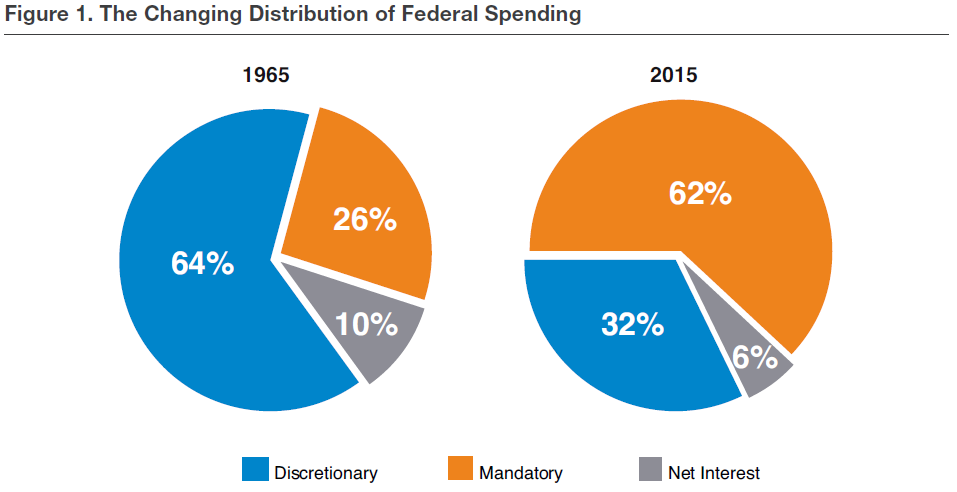
Capture7As made clear in the above chart, there is really only one way to do this.  It is entitlement reform.  In the last 50 years, from 1965 – 2015, mandatory, i.e. entitlement, spending has grown from 26% of the federal budget to 62% and this percentage will just keep growing until something is done to stop it. Along this line, an excellent new report from the American Enterprise Institute, “Increasing the Effectiveness and Sustainability of the Nation’s Entitlement Programs” lays out some basic principles for entitlement reform. They are:

  • Personal Responsibility for Retirement Savings. The idea is to move toward turning Social Security into a universal flat benefit for all U.S. residents age 65 and older. Anyone could supplement this basic income with additional private savings.
  • Market Discipline in Health Care. The idea here is to keep the ACA exchanges with subsidies for low-income households. Employer provided care would have no mandates and a rational and equal tax credit for all. Health Savings Accounts would be liberalized to encourage widespread participation. Both Medicare and Medicaid would provide premium support for basic care. The point is to bolster the consumer’s role in the marketplace in order to slow down the rising cost of healthcare.
  • Promotion of Work for Safety-Net Programs. The federal government spends about $400 billion annually to fight poverty (not counting healthcare programs) with much overlap of federal and state programs. Reform efforts should emphasize work as the key to improved economic prospects as well as greater state control over resources to allow for better coordination of efforts. Two major reform concepts, block grants to states as well as wage subsidies, should be implemented.


We have to get our fiscal house in order, so entitlement reform is not optional. Delay, moreover, could be catastrophic.  If we wait until another crisis hits, then it will no longer be possible to design reforms with gradual adjustments. Now is the time to act!

Follow me on Twitter
Follow me on Facebook