Bush Failures Led to Obama and Obama Failures Led to Trump


As I have previously stated, I voted for Hillary Clinton because Donald Trump is so crude and sleazy even though our country will now greatly benefit from the change which Mr. Trump represents.  This is the way the political process often works.

capture79 Consider that after eight years of George Bush we had:

  • Ongoing war in Iraq and Afghanistan, of which the Iraq war was an unnecessary mistake.
  • $2.5 trillion of additional debt, even after Mr. Bush started out with a budget surplus, compliments of Bill Clinton.
  • An expensive new Medicare Part D prescription drug plan which just makes overall Medicare even less affordable than it already is.
  • The Financial Crisis of 2007-2008 which the Bush Administration could have seen coming if they had been more vigilant.


Under such political circumstances, the 2008 election of the Democratic nominee, Barack Obama, over the Republican nominee, John McCain, was almost inevitable. But then in the next eight years we have experienced:

  • Slow economic growth averaging only 2% per year, ever since the end of the Great Recession in June 2009. The unemployment rate has fallen to 4.9% but there is still a lot of slack in the labor market which holds wages down. This is the main reason for the huge support Mr. Trump had from white blue-collar workers in the election.
  • Massive debt, now 76% of GDP (for the public debt on which we pay interest), the highest since right after WWII and double the debt in January 2009 when Mr. Obama entered office. Such a high debt level means greatly increased interest payments as soon as interest rates go up which they are likely to do anytime. The high annual deficits contributing to the debt mean little budget flexibility for new programs.

Conclusion. Democrats like to say that slow economic growth is “the new normal” which can only be overturned with budget busting new fiscal stimulus. This is a pessimistic point of view which refuses to consider other alternatives.  This is what led to Ms. Clinton’s defeat on November 8.

Follow me on Twitter
Follow me on Facebook

We Need Fundamental Change and Now We’re going to Get It!


I want to emphasize that I voted for Hillary Clinton on Tuesday because Donald Trump has such a sleazy and mercurial personality. But Mr. Trump was clearly the change candidate and we need change big time.  His strongest base of support is the white working class which has not really recovered from the Great Recession of 2008-2009 and he will surely try to help out these people.

capture79
Here are the changes we need in order of importance:

  • Grow the economy faster. Tax reform, individual and corporate, and regulatory reform are what are most needed. Mr. Trump and the House Republicans are in rough agreement on both of these major initiatives and hopefully the new Republican led Senate will go along. The best kind of tax reform means to lower tax rates and shrink deductions enough to avoid losing tax revenue. This can be accomplished if a real effort is made to do it this way.
  • Begin to shrink our massive debt. This can only be done by major entitlement reform, meaning to control the costs of Social Security, Medicare and Medicaid. Medicare should be transitioned over from a single payer system to a premium support system, consistent with a reformed Affordable Care Act. Healthcare costs can only be contained by giving consumers more skin in the game, meaning higher deductibles supplemented with health savings accounts.
  • More assertive foreign policy. Worldwide peace and stability depend on our own economic and military strength. Right now China, Russia and Iran think they can push us around. President Trump will not let this happen.
  • Trade and immigration policy. Most knowledgeable people agree that international trade is generally beneficial. We simply have to do a better job of retraining American workers who lose their jobs to foreign competition. The key to immigration reform is tougher border security plus an effective guest worker visa program.

Conclusion. The Republican House of Representatives has an excellent plan, “A Better Way,” for American economic, fiscal and social renewal and Mr. Trump is largely supportive of it. This augers well for fundamental progress in the next four years.

Follow me on Twitter
Follow me on Facebook

Election Day 2016: The Fourth Anniversary of this Blog


I have now been writing this blog for four years, beginning right after the presidential election of 2012. I was a candidate in the May 2012 Republican Primary for the 2nd Congressional District of Nebraska.  I campaigned on the platform to “eliminate the deficit.”  I lost to the incumbent Lee Terry who was in turn replaced in office by the Democrat Brad Ashford in 2014.

capture79
The overriding theme of my blog is “how to restore fiscal responsibility to our national government.”   I discuss two fundamental and related issues:

  • Massive Debt now 75% of GDP, the highest level since right after WWII, and predicted by the Congressional Budget Office to keep rising steadily under current policies.
  • Slow Economic Growth averaging just barely 2% per year since the end of the Great Recession in June 2009. Although the unemployment rate is down to a respectable 4.9%, the labor participation rate is also lower than usual. Faster growth would mean more jobs and better paying jobs. It would also mean more tax revenue to shrink our annual deficits.

How should these problems be addressed?  In briefest outline:

  • Balanced Budget Amendment to the Constitution. This is a drastic measure but I see no other way to get the job done. The pressure on Congress is always to create new programs and spend more money, not less. A BBA could be designed in a flexible manner to allow emergency overrides. It could also be phased in by, for example, having an effective date three years after ratification. It so happens that 28 states (out of 34 needed) have now called for a Constitutional Convention to propose such an amendment. (http://bba4usa.org/)
  • Tax Reform, lowering rates for individuals and corporations, paid for by shrinking deductions, would do wonders for encouraging business investment and entrepreneurship, as well as encouraging American multinational companies to bring their foreign earnings back home for reinvestment.

Conclusion. Much more can be done but this would be a very good start.

Follow me on Twitter
Follow me on Facebook

How Will Hillary Clinton Do on the Economy?


With Donald Trump dropping in the polls, whirling out of control and unwilling to withdraw from the race, my attention now turns to Hillary Clinton and what she is likely to do as President. I divide this discussion into good news and bad news.

capture73
First the good news:

  • A leading democratic economist, Larry Summers, is on record as strongly supporting faster economic growth.  However, he seems to think that public investment (i.e. more public spending) is the best way to achieve this.
  • The House of Representatives is likely to remain in Republican hands after the 2016 election, even if the margin of control is reduced. The Republican House has an excellent plan to boost economic growth and presumably will be able to bargain for pro-growth policies.

Unfortunately, the current Clinton tax plan is anti-growth. As analyzed by the Tax Foundation, her plan would:

  • Give individuals with an AGI over $5 million a 4% tax surcharge. Taxpayers with an AGI of $1 million or more would pay a 30% minimum tax (Buffett Rule). Carried Interest would be taxed at ordinary income rates. Short term capital gains would be taxed at higher rates up to 39.6%. Most itemized deductions would be capped at a tax rate of 28%. Taxes on small businesses and startups would be reduced.
  • Lead to a 2.6% overall lower level of GDP which would lead to lower levels of wages and jobs.
  • Raise $1.4 trillion in new revenue over the next decade on a static basis which would only really produce $663 billion because of slower growth.
  • Devote all of the new revenue to new spending programs and therefore achieve no deficit reduction and more likely an increase in annual deficits.

Conclusion. The Clinton tax plan has some attractive features such as reducing taxes on small business. But overall it would slow economic growth in the name of reducing income inequality.  A Republican House in the new Congress would likely be able to bargain for a much better plan.

Follow me on Twitter
Follow me on Facebook

The Obama Economic Record


The readers of this blog know that I focus on what I consider to be the two biggest problems affecting our economy: 1) slow growth averaging just 2% per year since the end of the Great Recession and 2) our massive debt now equal to 75% of GDP (for the public part on which we pay interest) and predicted to keep growing steadily under current policy.
I have also made it clear that I am not pleased with the economic policies of either of the two main candidates for president, Hillary Clinton or Donald Trump.  Whichever one of them is elected, our best hope for the future is that she or he will have to work with the Republican House of Representatives which has an excellent plan, “A Better Way,”  for renewal.
capture71But, of course, the next president will take up where Barack Obama has left off.  The current issue of the Economist has an essay, “The Way Ahead,” in which Mr. Obama identifies several challenges:

  • Boosting productivity growth. The above chart from his essay shows how much productivity growth has declined in the last ten years. He claims that the corresponding lack of investment is caused by an anti-tax ideology which rejects new funding for public projects, which in turn can be blamed on a fixation on deficits in spite of our skyrocketing debt problem. The House plan correctly identifies tax and regulatory reform as what are needed for progress.
  • Combatting rising inequality. An expanded Earned Income Tax Credit will definitely help here but mainly what is needed is overall faster economic growth.
  • Insuring that everyone who wants a job can get one. Wage insurance and better retraining programs for laid off workers are good ideas. But again, faster economic growth is what is really needed.
  • Building a resilient economy which is primed for future growth. Mr. Obama says that “America should also do more to prepare for future shocks before they occur.” This is exactly why we urgently need to start shrinking our debt now before the shock of higher interest rates leads to huge increases in interest payments on our rapidly growing debt.

Conclusion. Let’s give Mr. Obama credit for avoiding another depression after the Financial Crisis. But his poor policies are to blame for the very slow rate of recovery ever since.

Follow me on Twitter
Follow me on Facebook


Why Slow Economic Growth Is So Dangerous


In my last post I said that Donald Trump won the first presidential debate, in spite of his uneven temperament, because he was more correct on the issues.
One of the biggest problems our country faces is slow economic growth, averaging only 2% per year since the end of the Great Recession in June 2009.  This compares with an average rate of growth of 3.5% from 1950 – 2000.
In fact, even the recent job growth we have seen is now leveling off.
capture65Such slow growth is very dangerous long term for many reasons:

  • Massive Debt. Our public debt, on which we pay interest, is now 75% of GDP, the highest it has been since right after WWII. CBO predicts that this percentage will keep getting steadily worse without major policy changes. Faster growth means more tax revenue and therefore smaller annual deficits. It is imperative to put our accumulating debt on a downward path.
  • The Need for More Jobs and Better Paying Jobs. The best way to achieve broad based prosperity, and minimize populist disruption, is to create a tight job market where employers have to compete for employees. This is accomplished by making the economy grow faster.
  • Keeping Ahead of China. In 2009 China’s economy was 1/3 the size of ours; now it is 60% as big. In other words, China will soon surpass us economically if we are unable to grow faster. This would risk losing our worldwide lead in such crucial areas as new technology and financial depth, as well as our superpower status.
  • Reducing Student Loan Debt. The best way we can help former students pay off their college debt is to have good jobs waiting for them when they leave school. The faster our economic growth, the better we can do this.

Conclusion. Both our own individual success in life as well as the overall status of our nation depends upon the availability of opportunity. This is why economic growth is so important and why it is dangerous to let it lag.

Follow me on Twitter
Follow me on Facebook

Why Medicaid Needs to Be Reformed


One of the very most serious problems facing our nation is our massive federal debt, now over $13 trillion (the public debt on which we pay interest), or 75% of GDP, the highest since right after WWII, and predicted by the CBO to keep getting worse unless major policy changes are made.
The main contributors to this rising debt are the big three entitlement programs of Social Security, Medicare and Medicaid. All three need substantial reforms in order to rein in spending.
Today I will discuss Medicaid, based on an excellent analysis performed by the Manhattan Institute’s Oren Cass, “Over-Medicaid-Ed: how Medicaid distorts and dilutes America’s Safety net.”
capture41Consider these pertinent points:

  • Badly designed incentives for Medicaid expansion. Each state sets the size of its Medicaid program and receives matching federal dollars, from $1 to $4, for every dollar spent. States thus have a strong incentive to overinvest in Medicaid, expanding their programs far beyond the point where a marginal dollar of their own spending produces a dollar of value.
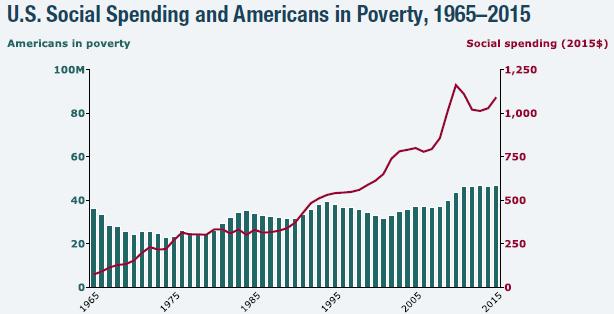
  • Health care dominates safety-net spending. During 1975 – 2015, government social spending per person in poverty more than doubled (in constant 2015 dollars) from $11,600 to $23,400. Rising health care expenditures accounted for more than 90% of that increase.

    capture42

  • Medicaid spending in 2012 was 39% higher than if it had remained a constant share of state budgets since 2000. State spending on education and welfare was 9% and 54% lower, respectively.
  • This allocation is an ineffective poverty-fighting strategy. While the majority of government social spending goes to health care, low-income households not enrolled in Medicaid allocate less than 10% of their spending to health care. Studies consistently show little or no positive impact on health outcomes from Medicaid enrollment.
  • How to strengthen America’s safety net. The federal government should consolidate all antipoverty funding streams, including Medicaid, and allow states to design programs and allocate funding to such programs as states see fit.

Conclusion. The above program outlines a way to both improve the effectiveness of social welfare spending and curtail its costs to both states and the federal government. Let’s do it!

Follow me on Twitter
Follow me on Facebook


Donald Trump Needs a More Positive Message


As regular readers of my blog posts know, I am not enthusiastic about either of our two main presidential candidates because neither of them has a good grasp of our two biggest economic problems which are:

  • Slow economic growth, averaging just 2% per year since the end of the Great Recession in June 2009. Faster growth would solve or alleviate many other problems, especially by creating more new jobs as well as delivering faster wage growth for all middle- and lower-income workers.
  • Massive debt now at 75% of GDP, the highest it has been since right after WWII, and projected by the Congressional Budget Office to get steadily worse unless big changes are made in spending and tax policies. Such major changes are difficult to make without presidential leadership.

Hillary Clinton promises “equitable” growth but her policy proposals will lead to a big increase in spending (bad idea) on projects of dubious value in speeding up economic growth. Donald Trump would hurt the economy with immigration controls and trade restrictions.  His proposal for lower tax rates (good idea) needs much improvement to avoid increasing annual deficits.
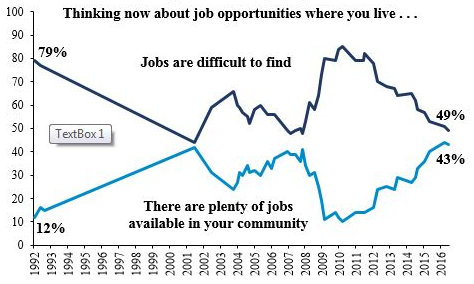
capture40Mr. Trump’s biggest problem, however, is his negative message about life in America today. Yes, we need stronger border security but we don’t need a Fortress America.  As the American Enterprise Institute has just reported, worker satisfaction is greatly improved since 2009 and workers are now much less anxious about job security than just a few years ago.
There is a really good way for Mr. Trump to sound a more positive note.  He could very easily take up the major themes of the Republican House Plan, “A Better Way” for solving America’s major economic problems.
Conclusion. There is an overwhelming desire for change in America, for new leadership which breaks out of the corruption, cronyism and elitism so rampant in Washington DC today.  But Americans are natural optimists and want a leader who can look forward to a bright future for our country.

Follow me on Twitter
Follow me on Facebook

Why We Should Be Deeply Worried about Our National Debt


My last post is highly critical of the economist and New York Times columnist, Paul Krugman, for encouraging massive new deficit spending to stimulate our under-performing economy.
Debt and the slow growth of our economy are the two main topics of this blog which I have now been writing for almost four years.  How to speed up growth is a complicated and highly charged political issue about which reasonable and well informed people can differ.  However avoiding excessive debt is to me a moral issue whose resolution should not be that difficult, at least in a conceptual sense.
Capture2 I have often used the above chart from the Congressional Budget Office to illustrate our debt problem because it clarifies the problem so vividly.  Here are its main features:

  • Our public debt (on which we pay interest), now about $13 trillion, is 75% of GDP, the highest since right after the end of WWII. And it is projected to keep getting steadily worse under current policy.
  • Note the decline in the debt from the end of WWII until about 1980. This doesn’t mean that the debt was actually paid off but rather that it shrank as a percentage of GDP as the economy grew fairly rapidly during this time period.
  • From 1980 – 2008 the debt level fluctuated and increased somewhat but did not get badly out of control.
  • Debt shot up rapidly with the Great Recession and has been continuing to grow ever since.
  • The current GDP of our economy is about $19 trillion. At a current growth rate of 2.1%, this adds $400 billion of GDP per year. This means that a $400 billion deficit for 2016 would stabilize the public debt at 75% of GDP. But our 2016-2017 deficit is projected to be almost $600 billion (and rising). This is not good enough!

Conclusion. In order to begin to shrink the size of the public debt, it is imperative that annual spending deficits be reduced to well below $400 billion per year. This will be difficult for our political process to achieve but it is the only way to avoid a new and much worse financial crisis in the relatively near future.

Follow me on Twitter
Follow me on Facebook

Paul Krugman’s Great Crime: Stealing from Our Nation’s Future


New York Times columnist Paul Krugman is perhaps the most ardent Keynesian economist in the U.S. today. Let’s agree that Mr. Krugman is a very intelligent and articulate fellow.  He is a Nobel Prize winner and undoubtedly has made important contributions to economics. But he has the absolutely nutty idea that extreme deficit spending not only doesn’t hurt our economy but can actually be beneficial.  His column, “Time To Borrow”  in yesterday’s NYT is a perfect example of this dangerous idea.
Capture31Here is the essence of his thinking:

  • Our national debt of $19 trillion is just a big scary number. Actually just our public debt alone of $13 trillion (on which we pay interest) is 75% of GDP, the highest since the end of WWII, and is projected (by the CBO) to steadily become much worse.  
  • Federal interest payments are only 1.3% of GDP, low by historical standards. Just lock in repayment with 30-year inflation protected bonds, yielding .64% interest. Okay, suppose we can lock in very low interest payments on our current debt and therefore just borrow away oblivious to total debt for the next 30 years. In 2046 I expect to be gone but my children and grandchildren will still be around. Why should they be stuck with paying off or refinancing our own extravagant debt at likely much higher interest rates?
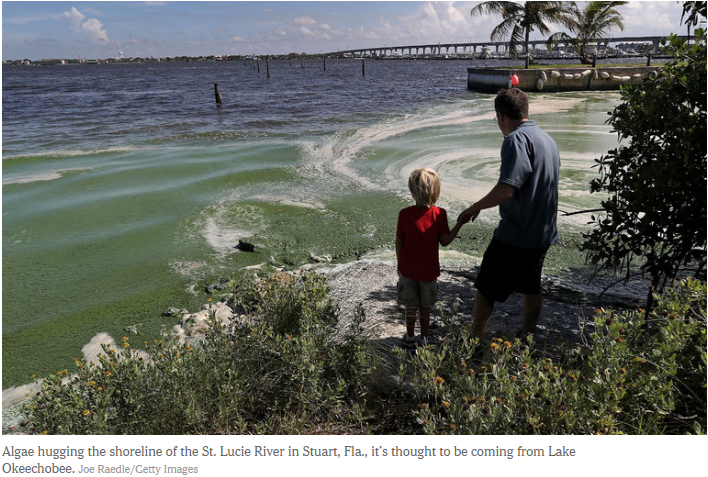
  • There are pressing infrastructure problems all over the country which need fixing now. For example, in Florida, green slime infests beaches because of failure to upgrade an 80 year old dike. The answer is to let Florida voters decide if they want to issue bonds for this project and pay them off with state tax revenue. Nebraska, for example, has decided to raise its state gas tax by 6 cents/gallon in order to pay for infrastructure upgrades.


Conclusion. The U.S. is currently in a huge fiscal bind with massive debt and continuing large annual deficits. It is extremely reckless to continue even current deficit spending, let alone increasing it, for anything less than a true national emergency.  Infrastructure repair, for example, is an important but routine need which should be paid for out of current tax revenue.

Follow me on Twitter
Follow me on Facebook