Is Capitalism in Crisis?


The economist and public lecturer, Richard Wolff, gave an address in Omaha NE last night, entitled “Capitalism in Crisis: How Lopsided Wealth Distribution Threatens Our Democracy”.  His thesis is that after 150 years, from 1820 – 1970, of steadily increasing worker productivity and matching wage gains, a structural change has taken place in our economy.  Since 1970 worker productivity has continued to increase at the same historical rate while the median wage level has been flat with no appreciable increase. This wage stagnation has been caused by an imbalance of supply and demand as follows:

Capture

  • Technology has eliminated lots of low skill and medium skill jobs in the U.S.
  • Globalization has made it less expensive for low skill jobs to be performed in the developing world at lower cost than in the U.S.
  • At the same time as jobs were being replaced by technology and disappearing overseas, millions of women entered the labor force.
  • A new wave of Hispanic immigration has caused even more competition for low skilled jobs.

In addition, stagnant wages for the low skilled and medium skilled worker have been accompanied by an increase in private debt through the advent of credit cards and subprime mortgage borrowing.  This enormous increase of consumer debt led to the housing bubble, its bursting in 2007-2008, and the resulting Great Recession.
Five years after the end of the recession in June 2009, we still have an enormous mess on our hands: a stagnant economy, high unemployment, massive and increasing debt and a fractious political process.  How in the world are we going to come together to address our perilous situation in a rational and timely manner?
Mr. Wolff believes that capitalism’s faults are too severe to be fixed with regulatory tweaks.  He also agrees that socialism has proven to be unsuccessful where it has been tried.  He proposes a new economic system of “Workers’ Self-Directed Enterprises” as an alternative.
I agree with Mr. Wolff that capitalism is in a crisis but I think that it can be repaired from within.  The challenge is to simultaneously give our economy a sufficient boost to put millions of people back to work and to do this while dramatically shrinking our annual deficits in order to get our massive debt on a downward trajectory as a percent of GDP. How to do this is the main focus of my blog, day in and day out!

Wealth Inequality vs Income Inequality


The Yale Economist and Nobel Prize winner, Robert Shiller, has an article in today’s New York Times, “Better Insurance Against Inequality”, proposing that “taxes should be indexed to income inequality so that they automatically become more progressive – meaning that the marginal tax rate for the highest income people will rise – if income equality becomes much worse.”
CaptureWe do know, of course, that income inequality is steadily increasing in the U.S. It is in fact essentially folklore that the top 1% of Americans is collecting a larger and larger share of the national income. Furthermore the French economist, Thomas Piketty, has recently shown that there is also “a relentless widening of disparity in wealth”.
Our democratic political system will surely respond in some way to this increasing gap between the rich and the poor. It is important to our future wellbeing to respond in a constructive manner. Today’s top tax rate of 39.6% is already very high and Mr. Shiller admits that the top rate would have to rise well over 75% in his plan.
Our biggest economic problem today is a stagnant economy. We badly need faster economic growth, in order to put people back to work and to bring in more revenue to shrink the deficit. Today what we need is lower tax rates, to put more money in the hands of people who will spend it, including potential entrepreneurs who will invest it in new businesses. Raising tax rates to address rising income inequality is therefore self-defeating as an economic strategy.
Rather let’s tax people’s financial assets after they have earned their money. A 1% wealth tax with a relatively high $10,000,000 personal exemption would bring in approximately $200 billion per year.  $200 billion per year would enable us to pay down our deficit at a much faster rate as well as having a lot left over to begin an extensive infrastructure renewal program (for example)!

How Do We Break Out of Our Economic Rut?


The U.S. economy is in a rut. On the one hand, growth is stagnant, unemployment is high and huge deficits are leading to massive debt. On the other hand our population has an increasing number of retirees and also an increasing number of low income (often immigrant and minority) service workers. These groups demand more services in the form of entitlements and social welfare programs. In a democracy these needs are hard to deny. Is it possible to better stimulate the economy, alleviate inequality and shrink deficit spending at the same time?   I believe it is!
Capture 

  • Stimulating the economy. The best way to do this is to lower both individual and corporate tax rates in a revenue neutral way by eliminating, or at least greatly reducing, tax preferences. Faster growth of GDP will both reduce unemployment and bring in more tax revenue and thereby lower the deficit.
  • Reducing inequality. I join many others to propose a large scale, government funded, infrastructure development program, badly needed for its own sake, but also as a way of putting hundreds of thousands, if not millions, of people back to work. However, and this is essential, it has to be paid for by a major new source of revenue. My own preference is to establish a new tax, on the assets of very wealthy people, say with a net worth of $10,000,000 or more. An asset tax of between one and two percent per year would bring in several hundred billion dollars and also represents a highly visible way of reducing inequality without adversely affecting the economy.
  • Shrinking the Deficit. One of the biggest problems with many federal programs is that there is neither built in quality control nor cost control. There is little incentive for either Congress or federal bureaucrats to set priorities and control costs. A good way to change this system is to devolve many federal programs back to the states where such controls do exist. I will have more to say about this in future posts.

Big changes are needed at the federal level to get our economy back on track and put people back to work. There are ways to do this and we simply need leaders with enough vision and determination to get the job done!

Do We Need a New School of Economics?


“Consider the following scenario. You are an airline pilot charged with flying a planeload of passengers across the Atlantic. You are offered the choice of two different aircraft. The first aircraft has been prepared by chief engineer Keynes and the second by chief engineer Hayek.
You have to choose which plane to use, so naturally you ask the advice of the two engineers. Keynes urges you to use his aircraft, offering a convincing explanation of why Hayek’s plane will crash on take-off. Hayek urges you to use his aircraft, offering an equally convincing explanation of why Keynes’s plane will crash on landing.

At loss as to which plane to choose, you seek the advice of two leading independent experts – Karl Marx and Adam Smith. Marx assures you that it does not matter which aircraft you choose as both will inevitably suffer catastrophic failure. Similarly, Smith also reassures you that it does not matter which aircraft you choose, as long as you allow your chosen craft to fly itself.”
Thus begins a fascinating new book, “Money, Blood and Revolution: How Darwin and the doctor of King Charles I could turn economics into a true science,” by the fund manager and economist, George Cooper.
CaptureMr. Cooper sets up a circulatory model of democratic capitalism whereby rent, interest payments and profits flow from low income people at the bottom of the pyramid to the wealthy at the top. And then tax revenue (collected mostly from the wealthy) is redistributed downward in the form of government programs.
According to Mr. Cooper, the financial crisis was caused by a combination of lax regulation and excessive credit and monetary stimulus. The question is what to do about it. Mr. Cooper says:

  • Stop adding to the problem. High student debt and high mortgage debt are still being supported by government programs.
  • Change the course of the monetary river. Quantitative easing does not work because it just puts money into the hands of the wealthy and they have no incentive to spend it.
  • Change the course of the fiscal river. Instead put money into the hands of the people at the bottom of the pyramid with expanded government spending on infrastructure (paid for by taxing the wealthy).

Without endorsing all of Mr. Cooper’s suggestions, he nevertheless has many good ones and expresses them in a highly entertaining style!

Do We Really Need a Wealth Tax?


Our dire fiscal and economic problems are crying out for a bold solution.  We need to simultaneously stimulate our economy to grow faster and create more jobs, raise sufficient tax revenue to pay for our growing spending commitments, and address a widening inequality gap which threatens to undermine the basic principles of a free and just society.  How are we going to accomplish all of these tasks at the same time?
It seems to me that the best way is to thoroughly reform our income tax system based on the following principles:

  • Lower tax rates on marginal income to encourage more investment and entrepreneurship.  Such changes can be made revenue neutral by eliminating deductions, loopholes and other tax preferences.  This would apply to corporations as well as individuals.
  • Establish a new low percentage (1% – 2%) wealth tax with a relatively high personal exemption ($5 million – $10 million).  This would bring in approximately $200 billion per year to be used for reducing the deficit.  Equally as important it would be a visible sign that the wealthy are making a significant contribution towards solving our fiscal problem.  This will make it more acceptable to lower marginal tax rates on income in order to boost economic growth.

Fiscal conservatives often oppose any increase in tax revenue because, they think, it is likely to be used for new spending rather than for lowering the deficit.  One way to overcome this concern is to pass a Balanced Budget Amendment to the Constitution. This would make it much harder to increase spending.  The problem is that it will be very hard for Congress to pass such an amendment and have it ratified by ¾ of the states.
But something has to be done.  The longer we wait and the more debt we build up, the more painful it will be to extract ourselves when the next crisis occurs as it surely will.

Truth and Myth about Inequality


Two of my favorite columnists are the Brooking Institution’s William Galston, a social economist who has a weekly column in the Wall Street Journal and the economics journalist Robert Samuelson who writes for the Washington Post.  
Most people agree that income inequality in the U.S. is steadily getting worse.  Mr. Galston make a good case (see my last post) that it is primarily caused by the large gap between the rising productivity of American workers and the stagnant level of their pay which has developed since 1973.  He thinks that we need a fundamentally new social contract which links worker compensation to productivity.  This, of course, is a tall order and it is not at all clear how such a new order would be achieved.
CaptureMr. Samuelson has a different perspective: “Myth-making about Economic Inequality”.  For example:

  • The poor are not poor because the rich are rich
  • Most of the poor will not benefit from an increase in the minimum wage because only 6% of the 46 million poor people have full time jobs
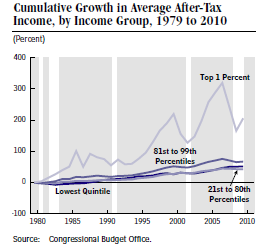
  • All income groups have gained in the past three decades, even though the top 1% has gained the most (see the above chart from the CBO, December 2013)
  • Widening economic inequality did not cause the Great Recession

These two perspectives on inequality are quite different but not contradictory.  Basically what Mr. Samuelson is saying is that we have to be careful in how we address this problem or we’ll just make it worse.  Raising taxes on the rich is unlikely to help and might hurt if it slows down the economy.  Raising the minimum wage will only raise a fairly small number of people out of poverty and may cause a lot of unemployment along the way.
My solution: focus on boosting the economy to create more jobs in the short run (tax reform, immigration reform, trade expansion) and improved educational outcomes for the long run (early childhood education, increasing high school graduation rates, better career education).
But I agree with Mr. Galston that it is imperative to lessen income inequality, one way or another.  Otherwise as a society we’ll have big trouble on our hands.

Inequality, Productivity and Compensation

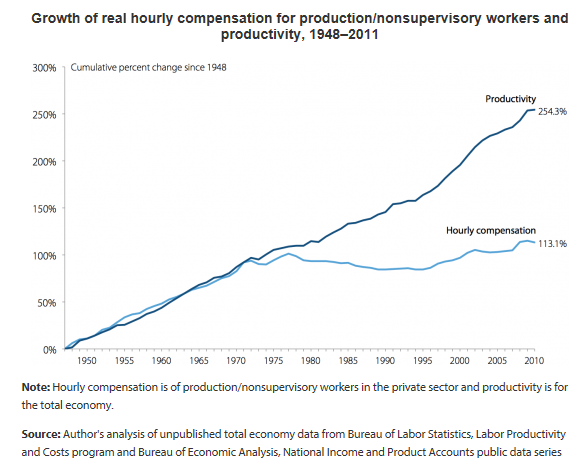
The Brookings Institution social economist, William Galston, has an interesting column in yesterday’s Wall Street Journal, “The U.S. Needs a New Social Contract”, deploring the fact that worker compensation (i.e. wages + benefits) has not kept up with gains in worker productivity since the 1970s.  Here is a chart published by the Economic Policy Institute showing the divergence between productivity and compensation for a “typical” ( i.e. in the middle) worker beginning in the 1970s:
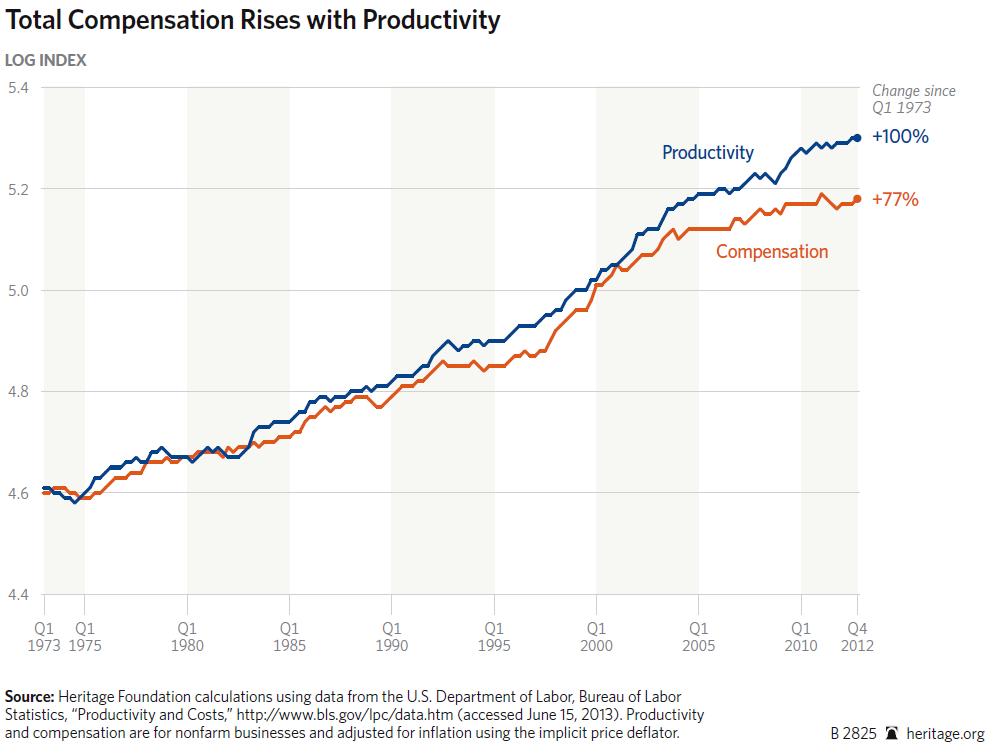
CaptureThe Heritage Foundation’s James Sherk has addressed this same question in a recent report “Productivity and Compensation: Growing Together” and shows that the “average” compensation of an American worker does track productivity very closely as shown in the chart below:
Capture1What is the explanation for this apparent discrepancy?  In fact, it is the difference between the average earnings of U.S. workers and the earnings of the median or middle worker.  The very high earnings of the top 10% and the even higher earnings of the top 1% raise average worker compensation way above the income level of the median worker.  In other words it is the result of the skewed and unequal distribution of incomes which is heavily weighted toward those at the top of the scale.  The typical or median worker is falling behind and is not benefitting from the steady rise in the overall productivity of the American economy.  This is what income inequality is all about.
The question is what to do about it.  Faster economic growth will create more opportunity by creating more jobs and better paying jobs.  Raising high school graduation rates as well as creating high quality technical training programs will also help.
Mr. Galston insists that this is not enough.  Too many workers will continue to lag farther and farther behind.  We could raise the Earned Income Tax Credit for low income workers but this would be very expensive in our currently tight fiscal situation which is likely to continue indefinitely.
Do we need a new social contract?  If so, what form will it take?  How will we pay for it?  These are indeed very difficult questions to answer!

A Global Perspective on Income Inequality II. Where Are the Jobs?


My last post on January 23 shows vividly what the challenges are in restoring the American middle class to the prosperity which existed up until the Great Recession hit in late 2007.  The problem, of course, is the gale strength force of globalization which is lifting up low wage workers all over the developing world and creating huge competition for the many low-skilled workers in the United States.
In today’s New York Times, the former Obama Administration car czar, Steven Rattner, writes about “The Myth of Industrial Rebound” in the United States, explaining why manufacturing jobs are coming back much more slowly than other jobs.  “Manufacturing would benefit from the same reforms that would help the broader economy: restructuring of our loophole-ridden corporate tax code, new policies to bring in skilled immigrants, added spending on infrastructure and, yes, more trade agreements to encourage foreign direct investment.”
CaptureThe above chart shows the huge decline in manufacturing jobs relative to other parts of the economy such as the education and health sector as well as the professional and business sector.  Of course, these more rapidly growing service sectors are the ones benefitting from the information technology revolution.  In manufacturing, on the other hand, the low skill jobs are going overseas while the high skill jobs, using technology such as robots, are much fewer in number.
Conclusion: in order to increase manufacturing jobs in the U.S., we better government policies, as outlined above by Mr. Rattner.  But we also need to recognize that there aren’t going to be as many high skilled manufacturing jobs in the future.  We are going to need much better K-12 and post-secondary educational outcomes to prepare the middle class for the high skilled service jobs which will predominate in the future.

A Global Perspective on Income Inequality


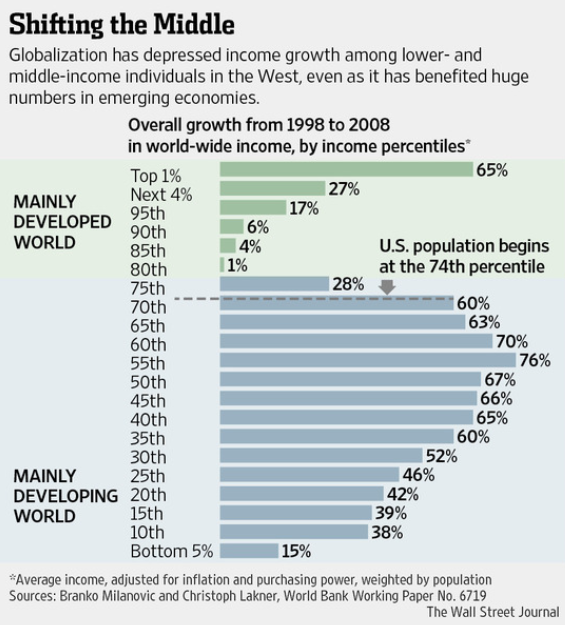
In connection with the annual World Economic Forum in Davos Switzerland, the World Bank has published a breakdown of income growth around the world, as reported yesterday by the Wall Street Journal in the article “Two-Track Future Imperils Global Growth”.  The key finding, as shown in the chart below, is that it is precisely the middle class in the developed nations which saw the slowest income growth in the years from 1998-2008.
CaptureIt is clear from this chart what is going on around the world.  The top 1% makes its money from capital investments and historically the return on capital exceeds economic growth.  The next 9% are both the skilled workers and the educated professionals who are benefitting from the growth of  knowledge industry.  The medium skilled middle class in the developed world, from the 75th percentile through the 90th percentiles, are the ones who are seeing the smallest income gains.  Their jobs are being eliminated by the force of globalization which is shifting lower skilled work to lower paid workers in the developing world.
The article points out, consistent with the above chart, that the income, including benefits, of the poorest 50% in the U.S. grew 23% in this same time period.  So it really is the middle class which is hurting the most in the U.S.  There are three basic ways of addressing this problem:

  • The federal government can help by taking much stronger measures to boost the economy thereby creating more jobs as well as higher paying jobs.  Tax reform, trade expansion, immigration reform and fiscal stability are what is needed to get this job done.
  • The states can help by improving our K-12 education system to make sure that everyone acquires the basic academic skills, such as reading and math, which they will need to achieve their highest potential in life.
  • All concerned and aware individuals (such as ourselves!) must constantly beat the drums to encourage young people to stay in school and take learning seriously.

America is “exceptional” because it is the strongest, freest, and wealthiest country the world has ever known.  But our future success is by no means guaranteed.  We have to constantly work for it and earn it!

Who Are the Enemies of the Poor?


In his usual provocative fashion, New York Times columnist Paul Krugman says that Republicans are “Enemies of the Poor” because “they’re deeply committed to the view that efforts to aid the poor are actually perpetuating poverty, by reducing incentives to work.”
CaptureBut the Heritage Foundation’s Robert Rector has recently pointed out in the Wall Street Journal, “How the War on Poverty Was Lost”, that “the typical American living below the poverty line in 2013 lives in a house or apartment that is in good repair, equipped with air conditioning and cable TV.  He has a car, multiple color TVs and a DVD player.  The overwhelming majority of poor Americans are not undernourished and did not suffer from hunger for even one day of the previous year.”  In fact we are now spending $600 billion a year of our $3.4 trillion federal budget and another $230 billion by the states to fight poverty.  The poverty rate was 19% in 1964 and is 16% today (when government benefits are included).
Mr. Rector reminds us that “LBJ’s original aim (in initiating his antipoverty program) was to give poor Americans ‘opportunities, not doles’.  It would attack not just the symptoms of poverty but, more important, remove the causes.  By that standard, the war on poverty has been a catastrophe.  The root ‘causes’ of poverty have not shrunk but expanded as family structure disintegrated and labor force participation among men dropped.”
So what should our poverty agenda look like going forward?  We are already providing the basic necessities of life.  Our future efforts should therefore be focused on improving the quality of life for the poor.  This means more effective education and job training.  It means more effort to keep families together by reducing marriage penalties.  But most of all it means providing more opportunities for employment and job advancement.  This requires faster economic growth.  There are many ways to accomplish this.  Back to square one!
The true enemies of the poor are those who refuse to accept the progress which has been made in the War on Poverty and the need to change our approach in order to make further progress.