
The Economic Outlook: 2014 – 2024 I. The Basic Data


The Congressional Budget Office has just issued the report ”The Budget and Economic Outlook: 2014 to 2024”, giving its usual objective and nonpartisan look at our prospects for the next ten years.  My purpose today is to give a simple interpretation of its basic data.  In my next post I will address the implications of this interpretation.
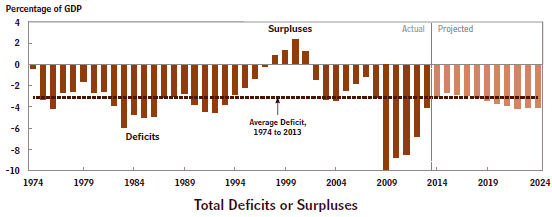
CaptureCapture1The first chart above shows a forty year history of government deficit spending.  The average deficit for this time period is 3% of GDP.  From 1982 – 1987 the deficits were worse than this and from 2009 – 2013 they were much worse.  The real problem is the accumulated deficits, i.e. the debt.  The second chart above shows the public debt (what we pay interest on) all the way back to 1940 as a percent of GDP.  As recently as 2008, the public debt was below 40% of GDP.  Now it is 73% and climbing.  This is very serious for two reasons.  Right now our public debt is almost free money because interest rates are so low.  But when interest rates return to their normal level of about 5%, interest payments will explode and be a huge drain on the economy.  In addition, these CBO predictions assume continued steady growth of the economy.  If and when we have a new recession or some other financial crisis, there will be much less flexibility available for dealing with it.
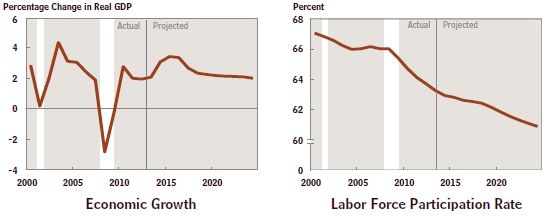
Capture2Now look at the last two charts.  The first one shows the rate of GDP growth since 2000 which has averaged about 2% since the end of the recession in June 2009 and is projected by the CBO to level off at this same rate over the next 10 years.  This is an historically low rate of growth for our economy. The final chart shows the gradual decrease of the labor force participation rate over this same time period.  These two graphs are related!  When fewer people are working, the economy simply will not grow as fast.
High debt and slow growth are big problems for an economy.  We’re falling more deeply into this perilous state of affairs all the time.  We need to take strong measures to break out of this dangerous trap!

What Is the State of the U.S. Economy?


On the eve of the President’s State of the Union address, the New York Times gives an answer to this question in today’s paper, “Obama’s Puzzle: Economy Rarely Better, Approval Rarely Worse”.  The charts below do show the basic trends all moving in the right direction.  But is this good enough?
CaptureThe unemployment rate is moving steadily downward but it is still a high 6.7% almost five years after the recession ended in June 2009.  And this is with a labor participation rate of only 58.6%, which is historically very low.
The budget deficit is dropping but is still unsustainably high.  In the five years, 2009 – 2013, deficits have totaled $6 trillion dollars.  As soon as interest rates return to their historical average of 5%, interest on this $6 trillion in new debt alone will total $300 billion per year, forever!  Furthermore, the Congressional Budget Office, the most credible source of budget information, predicts that the deficit is likely to resume an inexorable climb within a few years as baby boomers retire in ever greater numbers, rapidly driving up entitlement costs.
Economic growth was stronger than expected in the last quarter of 2013 and this is a good sign.  But it has averaged only about 2% since the recession ended which is very low by historical standards, in a post recessionary period.
The point is, do we really need to settle for such mediocre performance: a stagnant economy, high unemployment and massively accumulating debt?  Should we just declare that in a highly competitive global economy with an ever higher premium on information and technology, that we just can’t do any better than we already are?  Isn’t there some way to make our economy grow faster in order to provide more and higher paying jobs?
I think that the answer to this last question is an emphatic yes!  In fact, this is what my blog is all about.  Just read some of the other recent posts and let me know if you disagree with what I am saying!

How to Get the Economy Back on Track


Harvard Economist, Martin Feldstein, has an Op Ed column in yesterday’s New York Times, “Saving The Fed From Itself”, which gets our current economic situation half right.  First of all, Mr. Feldstein says that the Fed’s quantitative easing policy is inadequate because “the magnitude of the effect has been too small to raise economic growth to a healthy rate.  … The net result is that the economy has been growing at an annual rate of less than 2 percent.  … Weak growth has also meant weak employment gains.  … Total private sector employment is actually less than it was six years ago.  … While doing little to stimulate the economy, the Fed’s policy of low long-term interest rates has caused individuals and institutions to take excessive risks that could destabilize the economy just as it did before the 2007-2009 recession.”  So far he’s right on the button!
But then he goes on to say, “To get the economy back on track,” Congress should enact a five year plan to spend a trillion dollars or more on infrastructure improvement and that this would “move the growth of gross domestic product to above three percent a year.”  An artificial stimulus like this might work temporarily but then it ends and we’re back where we started.  We need a self-generating stimulus that will keep going indefinitely on its own.  How do we accomplish this?
The answer should be obvious.  We do it by stimulating the private sector to take more risk in order to generate more profits. In the process they will hire more employees and boost the economy.
How do we motivate the private sector?  By lowering tax rates and loosening the regulations which stifle growth.  Closing tax loopholes and lowering deductions (which will raise revenue to offset the lower tax rates) has the added benefit of attacking the corporate cronyism which everyone deplores.
We really do need to put first things first.  If we can jump start the economy by motivating the private sector to invest and grow, we will have more tax revenue to spend on new and expanded government programs as well as shrinking the federal deficit.
Why is this so hard for so many people to understand?

The Mess in Detroit: A Stern Warning for the Whole Country


An article in yesterday’s New York Times, “Detroit Ruling Lifts a Shield on Pensions”, reports a ruling by bankruptcy judge Steven W. Rhodes that Detroit “could formally enter bankruptcy and that Detroit’s obligations to pay pensions in full is not inviolable.”
The article goes on to say “that most here agree that the city’s situation is dire:  annual operating deficits since 2008, a pattern of new borrowing to pay for old borrowing, miserably diminished city services, and the earmarking of about 38 percent of tax revenues for debt service.  A city that was once the nation’s fourth largest has dropped to 18th, losing more than half of its population since 1950.  The city was once home to 1.8 million people but now has closer to 700,000.”
The parallels and analogies between what has happened in Detroit and what is now happening in the U.S. are striking.  The U.S. has had huge annual deficits for five years in a row and the accumulated debt is enormous, the Federal Reserve is holding interest rates down to make borrowing cheaper, and our country’s infrastructure is deteriorating much faster than it is being repaired.
Right now interest on the national debt is small ($223 billion in 2013, or 8% of federal revenues).  But interest rates will inevitably return before long to their average historical rate of about 5%.  Right now the public debt (on which we pay interest) is just over $12 trillion.  This means that in the near future interest on the national debt will be at least $600 billion per year and probably much larger because the debt is still growing so rapidly.  This will take a huge bite out of revenue and leave far less of it for other purposes.
This problem will continue to exist even if the budget were to be miraculously balanced from now on but it would at least lessen over time as the economy continues to grow.  Without budget restraint the problem will never go away and will be a perpetual drag on our national welfare.
This is, of course, exactly the condition in which Detroit finds itself at the present time.  Detroit has the option to declare bankruptcy and make its creditors and pensioners take big losses.  Once it does this it can make a fresh start and perhaps recover its former status.
But are we prepared to let the whole country suffer a similar fate?  The consequences would be enormous.  If the U.S. goes down, the whole western world could come down with it.  Democracy and human progress would be severely threatened.  This is really too terrible a tragedy to even contemplate.  Let’s turn things around before they get any worse!

Who Won and Who Lost in the Fiscal Stalemate?

The mainstream media are uniformly agreed that the Democrats and President Obama “won” the latest debt ceiling and shutdown standoff and that the Republicans “lost”.  For example, New York Times, reporter Jeremy Peters gives the GOP a rebuke in “Losing a Lot to Get Little”. “For the Republicans who despise President Obama’s health care law, the last few weeks should have been a singular moment to turn its botched rollout into an argument against it.  Instead, in a futile campaign to strip the law of federal money, the party focused harsh scrutiny on its own divisions, hurt its national standing, and undermined its ability to win concessions from Democrats.”
This is all true and, in addition, the twenty or twenty-five Tea Party stalwarts made fools of themselves by being so intransigent.  And 145 House Republicans ran away by voting against the final deal.
But look at the broader picture.  The federal government has been reopened for just three months, until January 15, 2014, and at current funding levels which include the 2013 sequester spending cuts.  On January 1, the more stringent 2014 sequester cuts take effect.  In other words the pressure is growing on the big spenders in Congress to deal seriously with our ongoing debt and deficit crises.
The big spenders have two options.  They can continue to kick the can down the road (i.e. refuse to bargain and force additional continuing resolutions to keep the government open) as discretionary spending continues to shrink more each year.  Or they can agree to make significant adjustments to entitlements to slow down their rate of growth, in return for easing the sequester cuts.
In a more rational world, the big spenders would understand that cutbacks must be made and the two sides would bargain in good faith and reach agreement.  But fiscal conservatives continue to have the necessary leverage to force compromise, and are unlikely to give it up.
Conclusion: the Tea Party “lost” and fiscal conservatives broke even.  The big spenders didn’t “win” but they got a temporary pass because the Tea Party overreacted and was shot down.

A Pessimistic View of America’s Future V. When Wealth Disappears


Several of my recent posts have been pretty gloomy.  “Average is Over,” “What, Me Worry?” and “The Age of Oversupply,” for example.  Here’s another gloomy one.  The British economist, Stephen King, has an Op Ed column in last Monday’s New York Times, “When Wealth Disappears.”, based on his new book, “When the Money Runs Out.”
Our GDP grew at 3.4% per year in the 1980s and 1990s, then dropped to a growth rate of 2.4% from 2000 – 2007.  Since the Great Recession ended it has averaged barely 2% per year.  The Democrats say we just need more fiscal stimulus and monetary easing to boost the growth rate.  The Republicans say deficit reduction including entitlement reform, slashing regulations and tax reform is what is needed to revive the economy.
“Both sides are wrong,” says Mr. King.  “The underlying reason for the stagnation is that a half-century of one-off developments in the industrialized world will not be repeated.”  These one-off developments are: the unleashing of global trade after World War II, financial innovation such as consumer credit, expansion of social safety nets which reduces the need for household savings, reduced discrimination which has flooded the labor market with women and, finally, the great increase in the number of educated citizens.
What Mr. King recommends is “economic honesty, to recognize that promises made during good times can no longer be easily kept.  What this means is a higher retirement age, more immigration to increase the working age population, less borrowing from abroad (by holding down deficit spending), less reliance on monetary policy that creates unsustainable financial bubbles, a new social compact which doesn’t cannibalize the young to feed the boomers, and a further opening of world trade.”
“Policy makers simply pray for a strong recovery.  They opt for the illusion because the reality is too bleak to bear.  But as the current fiscal crisis demonstrates, facing the pain will not be easy.  And the waking up from our collective illusions has just begun.”
It is obviously time to bite the bullet, lower our expectations, and start doing the hard work needed for even incremental economic progress.

Can We Solve Our Fiscal Problems by Taxing the Rich? II. Robert Reich’s View


One of America’s foremost liberal writers, Robert Reich, a Professor of Public Policy at UC Berkeley, argues in his latest book, “Beyond Outrage”, that “America’s economy and democracy are working for the benefit of ever-fewer privileged and powerful people.”  He presents “a plan for action for everyone who cares about the future of America.”  Mr. Reich’s tax policy:

  • Raise the tax rate on the rich to what it was before 1981

“Sixty years ago Americans earning over $1 million in today’s dollars paid 55.2 percent of it in income taxes, after taking all deductions and credits.  If they were taxed at that rate now, they’d be paying at least $80 billion more annually.”

  • Put a two percent surtax on the wealth of the richest one-half of one percent

“The richest on-half of one percent of Americans, each with over $7.2 million of assets, own 28 percent of the nation’s total wealth.  Given this almost unprecedented concentration, and considering what the nation needs to do to rebuild our schools and infrastructure, as well as tame the budget deficit, a surtax is warranted.  It would generate another $70 billion a year.”

  • Put a one-half of one percent tax on all financial transactions

“This would bring in more than $25 billion per year.”

These new tax provisions would together raise tax revenue by $175 billion per year.  But our deficit this fiscal year, ending September 30, 2013, is about $700 billion.  In a few years, without significant changes in either discretionary or entitlement spending, annual deficits will be back up over a trillion dollars per year and climbing.  Mr. Reich’s steep taxes on wealth and wealth creation are not enough to seriously tame deficit spending, let alone end it.
Let’s be honest and admit that some new tax revenue is probably going to be necessary in the future if we are ever going to be able to eliminate the deficit.  But it makes no sense to start out with a tax increase which will be strongly opposed anyway.  It is far more sensible to first wring out the hundreds of billions of dollars in wasteful federal spending which now exists.  After this is done there likely will still be a big deficit.  Then, and only then, would it be appropriate to generate significant new revenue by raising taxes.

What Should the Republicans Do Now?


An editorial in yesterday’s Wall Street Journal, “A GOP Shutdown Strategy”, offers good advice to the House Republicans for how to proceed in the shutdown stalemate.  “ …the best chance to move Democrats is Louisiana Senator David Vitter’s amendment that would annul the exemption from Obama-Care that the White House carved out for Congressmen and their staff.  These professionals will receive special subsidies unavailable to everybody else on the insurance exchanges, and preserving this deeply unpopular privilege would be a brutal vote for Democrats.”
The House Republican Caucus should attempt to line up 218 votes to attach this provision to a continuing resolution to fund the government for all or part of the new fiscal year at the current level.  If 218 votes to support this approach cannot be found, then the House should pass a clean funding resolution.  Nothing else has a chance of succeeding (the idea of trying to defund Obama-Care for even one year is absurd) and the American people will grow increasingly impatient. 
The bigger issue by far is the need to raise the debt limit by October 17th at the latest.  Here the Republicans have major leverage, namely the sequester, which takes a bigger bite out of discretionary spending each year for nine more years.  The Republican House can give the Democratic Senate a choice:  either agree to a sensible long range plan for spending restraint (including entitlements), or else we’ll agree to raise the debt limit for six months or so, into early 2014, and then revisit the debt limit issue after the 2014 tighter sequester limits take effect. 
This is what I suggest.  Now we’ll wait and see what happens!

Our Dire Fiscal Situation II A Promising Solution


As I discussed in my last post, the Congressional Budget Office has shown very clearly that the U.S. is on an unsustainable fiscal path which must be reversed in order to avoid calamity.  We are spending too much money and not taking in enough tax revenue.  In a recent Wall Street Journal Op Ed column, the economist Martin Feldstein describes “How to Create a Real Economic Stimulus”.  “A successful growth and employment strategy would combine substantial reductions in the relative size of the future national debt with immediate permanent tax rate cuts and a multiyear program of infrastructure spending…….The only way to reduce future deficits without weakening incentives and growth is by cutting future government spending.”
Mr. Feldstein proposes slowing the growth of benefits of middleclass retirees by gradually raising the full benefit retirement age for Social Security from 67 to 70 and also raising the age of Medicare eligibility to the same level.  This would create a budget savings of 1% of GDP, or $200 billion, by 2020.   Rather than eliminating such popular tax deductions as the one for mortgage interest or the exclusion of employer payments for health insurance, he recommends limiting the amount by which individuals can reduce their tax liabilities to 2% of adjusted gross income.  This single change to the tax code would, for example, reduce the 2013 deficit by $140 billion.
In addition to lowering tax rates for individuals, corporate tax rates should be cut from 35% to about 25% in order to be competitive with other industrial countries.  We should also adopt the internationally common “territorial” system which doesn’t tax foreign earnings brought back home.
In short, we decrease spending and raise revenue with entitlement reforms and a limit on tax expenditures thereby creating a framework for tax rate reductions and infrastructure spending.  These are the sorts of bold measures needed to produce a real stimulus and thereby get our economy back on track!

Private Health Care Reform is Getting Started!


Yesterday’s Wall Street Journal has a very interesting article, “More Employers Overhaul Health Benefits”, which describes a movement just getting started whereby employers give their employees a fixed sum of money and let them choose their own plan from an online market place.  The idea is that employers will be better able to predict and control their healthcare expenses for employees.  Furthermore, employees will be able to get better value for dollars spent by selecting their own coverage options, deductible amounts, copays, etc.
In fact, in an exchange run by Liazon Corp., which has 60,000 people enrolled, 75% of workers have chosen less expensive plans than they had before, by accepting bigger deductibles and copays, as well as smaller choices of healthcare providers and restrictions such as primary-care gatekeepers.
This is such an appealing approach to private healthcare cost control that the Accenture Management Consulting Company estimates just five years from now there will be 40,000,000 business employees receiving their healthcare benefits in this manner.  This would be a phenomenal development!
The United States spends 18% of GDP on healthcare altogether, both public and private, which is double the amount spent by any other country.  This enormous expense is a major reason why wage growth is stagnant in our country as well as why the costs of public programs like Medicare and Medicaid are so high and contributing to so much government debt.  It is critical for our country to get the rapid increase of healthcare costs under much better control.  That’s why this new movement of employers and employees working together on this critical problem is such a big step in the right direction.
If the estimate by Accenture is anywhere nearly accurate about how fast this new private healthcare selection method will grow, then there will soon be an excellent opportunity for Congress to expand its benefits to the control of Medicare and Medicaid costs as well.  This is very exciting indeed!