Stopping Corporate Tax Dodgers

Several large U.S. companies have recently announced that they are planning to merge with foreign companies and move their corporate headquarters to a low tax country such as Ireland or Great Britain.  The Obama Administration proposes to disallow such “tax inversions” by requiring that after such a merger at least 50% of the stock of the new company would have to be foreign owned.  Otherwise the firm would still be considered American for tax purposes.  Such a technical fix is unlikely to solve a much more fundamental problem.
As the latest issue of the Economist, “How to stop the inversion perversion,” makes clear, “America’s corporate tax has two horrible flaws.  The first is the tax rate, which at 35% is the highest among the 34 mostly rich-country members of the OECD. … The second flaw is that America levies tax on a company’s income no matter where in the world it is earned.  In contrast, every other large rich country taxes only income earned within its borders (a so-called ‘territorial system’).  Here, too, America’s system is absurdly ineffective at collecting money.  Firms do not have to pay tax on foreign profits until they bring them back home.  Not surprisingly, many do not: American multinationals have some $2 trillion sitting on their foreign units’ balance sheets.”
CaptureA relatively simple solution to this glaring problem would be to lower the corporate tax rate to 25%, the OECD average, and shift to a territorial system.  Revenue losses would be offset by closing loopholes and deductions.
A better, but likely more controversial, solution would be to completely eliminate the corporate income tax and then tax dividends and capital gains at the same rate as earned income.  This would avoid the double taxation problem whereby profits are taxed first at the corporate level and then again for individuals as dividends and capital gains.
The overall goal in this entire endeavor should be to boost the economy, thereby creating more jobs, and additionally to raise the tax revenue needed to pay our bills.  Fairness is important but growth is even more important!

How to Control Federal Spending: The Highway Trust Fund


The federal Highway Trust Fund is almost out of money.  It takes in $35 billion per year from the 18.4 cents per gallon federal gas tax, which has not been raised since 1993.  Sometime this summer the government will have to cut back on payments to state highway departments unless Congress acts.
CaptureAs the above chart from the Economist  shows, the U.S. spends much less of GDP on roads than many other developed nations.  Something clearly needs to be done because we need many improvements in infrastructure.  But there are better ways and poorer ways to solve this problem.  Here are two good ways as described by Thomas Donlan in a recent issue of Barron’s:

  • A bill to raise the gas tax by 12 cents per gallon over two years has been introduced in the Senate by Bob Corker (R, Tenn.) and Chris Murphy (D, Conn.). Each penny added to the federal gas tax rate will raise $1.3 billion and this would solve the problem.
  • Repeal the federal gas tax and turn federal highway construction entirely over to the states. Each state could then increase its own gas tax and/or pay for construction with tolls on bridges and roads.

Here are two examples of poor ways to replenish the Highway Trust Fund:

  • Continue adding to the Fund with borrowed money. $54 billion has been borrowed since 2008 for this purpose. Presumably the Sequester will make it much harder to continue such deficit financing.
  • Rep John Delaney (D, Mary.) has proposed a tax break for repatriated foreign profits by multinational American companies if part of the money brought back was spent on infrastructure bonds. This would interfere with the urgent need to reform corporate taxes with significantly lower rates offset by lowering deductions, in order to make our corporate tax internationally competitive.

Conclusion: There is a good chance that the Budget Sequester established by Congress in 2011 to control discretionary spending, as well as the widely recognized urgent need for corporate tax reform, will lead to a “good” rather than “bad” solution to the shortfall in the Highway Trust Fund. This is just one specific example of the challenge to sensible budgeting by Congress.
A much broader approach is needed to really shrink the deficit.  Stay tuned!

Raising America’s Pay


The Economic Policy Institute has just issued a provocative new report, “Raising America’s Pay: Why It’s Our Central Economic Policy Challenge”.  It is based on the now widely accepted view, as summarized in the chart below, that wages for the typical (i.e. median, not average) American worker have been stagnant since the early 1970’s, even though productivity has continued to increase at its historical rate.
CaptureFirst of all, the authors make reasonable arguments that:

  • The slumping of hourly wage growth for the vast majority explains the overall trends in income inequality.
  • Wage stagnation stalls progress in reducing poverty.
  • Wages are the root of economic security for the vast majority. This includes the fact that Social Security benefits depend upon wage earnings before retirement.

Then they ask: “Why has wage growth faltered for the vast majority, and what can be done?”  Here is where the report becomes controversial!

  • The authors do agree that globalization of markets and technological change have contributed to the wage growth slowdown but argue that this overlooks the impact of labor market and tax policy and business practices as follows:
  • Falling top tax rates have increased the income share of the top 1 percent.
  • The Federal Reserve has prioritized low rates of inflation over low rates of unemployment in recent decades and high unemployment suppresses wage growth.
  • The erosion of the inflation adjusted minimum wage and the share of the workforce represented by a union explain much of the entire rise of wage inequality over this time period.

The authors are completely correct that stagnant wages for American workers is a critical, even “central,” problem facing the economy at the present time.  The question, of course, is how to address this problem most effectively.  In my opinion, the authors have completely neglected to take into account how a faster rate of economic growth would contribute to a solution of the problem and how this could be accomplished.  I will address this question in my next post in a couple of days.
They conclude by saying that this report is only the first in a multiyear research and public education initiative of the EPI.  We have a lot to look forward to!

Redistribution, Inequality and Growth


Most people agree that income inequality and wealth inequality are increasing in the U.S. Likewise anyone who’s paying attention is aware of our slow rate of GDP growth, averaging 2.2% per year, since the end of the recession five years ago.  Is there a connection between inequality and slow growth?  Maybe!
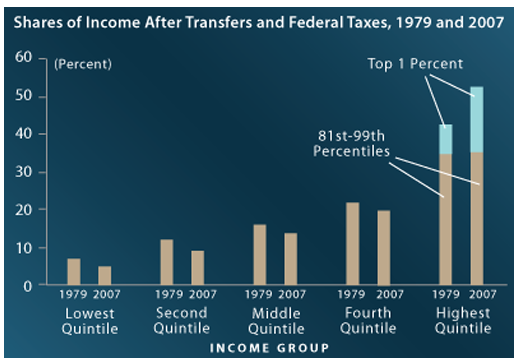
CaptureFirst of all, it is important to note that income inequality in the past 30 years has been greatly offset by federal taxes and transfer programs as shown in the October 2011 chart (above) from the Congressional Budget Office.
Capture1Secondly, the Economist discusses this situation in the article “Inequality v growth”.  The economists Jonathan Ostry, Andrew Berg and Charalambos Tasangarides have shown (see above chart) that a large amount of redistribution affects growth more negatively than a smaller amount of redistribution.
Economists generally agree that the recovery has been slowed down by a lack of demand by consumers for more goods.  So the recovery should speed up as less affluent consumers feel secure enough to spend more money.  Two things, to start with, can make this happen.  One is a restoration of the housing market so that homeowners have more equity (which can be borrowed and spent).  Another way to accomplish this is with government redistribution programs, such as food stamps and Medicaid, for low income people.
But there is an even better way to put money in the hands of people who will spend it, and at no cost to the government.  I am talking about broad based tax reform, whereby tax rates are lowered for everyone, offset by closing tax loopholes and shrinking deductions, which primarily benefit the wealthy.  For the two-thirds of taxpayers who do not itemize deductions, and who tend to be the less affluent, such a tax rate cut will put money in their pockets, most of which they will spend.
Such a tax program as this would be a direct shift of resources from the wealthy to everyone else, thereby lessening inequality.  It would stimulate the economy, creating millions of new and higher paying jobs, and thereby increasing tax revenue and lowering the deficit.  Win, win, win, win!

A Rescue That Worked But Left a Troubled Economy


The occasion of the publication of Timothy Geithner’s book “Stress Test,” giving his version of the financial crisis, has led to a number of newspaper articles looking back at the Great Recession and its aftermath.  The New York Times’ economics reporter David Leonhardt has such an analysis “A Rescue That Worked, But Left a Troubled Economy” in today’s NYT.
Capture“The Great Depression created much of modern American government and reversed decades of rising inequality.  Today, by contrast, incomes are rising at the top again, while still stagnant for most Americans.  Wall Street is flourishing again.”
“The financial crisis offered an opportunity to change this dynamic.  But the (Dodd-Frank) law seems unlikely to transform Wall Street, and the debate over finance’s huge role in today’s economy will now fall to others.  Should the banks be broken up?  Should the government tax wealth?  Should the banks face higher taxes?”
In my opinion, the real problem is not our financial system but the strong headwinds which are slowing down the economy.


  • Globalization of markets which creates huge pressure for low operating costs.
  • Labor saving technology which also puts downward pressure on wages.
  • Women and immigrants having entered the labor market in huge numbers, and therefore greatly increasing the labor supply.

The loss of wealth in the Great Recession also means that even people with good jobs have less money to spend.  What we sorely need is faster economic growth to create more jobs and higher paying jobs.  How do we accomplish this?

  • The best way to boost the economy is with broad-based tax reform to achieve the lowest possible tax rates to put more money in the hands of the working people who are the most likely to spend it. Such lower rates can be offset by closing the myriad tax loopholes and at least shrinking, if not completely eliminating, tax deductions which primarily benefit the wealthy.
  • Lowering corporate tax rates, again offset by eliminating deductions, providing a huge incentive for American multinational companies to bring their profits back home for reinvestment or redistribution.

With millions of unemployed and underemployed workers, reviving our economy with a faster rate of growth should be one of the very top priorities of Congress and the President.  Survey after survey show that this is what voters want.  Why isn’t it happening?

The Growth Deficit


I am a fiscal conservative, as well as a social moderate, which means that I don’t fit very easily into a standard mold.  I am non-doctrinaire, non-ideological and mostly nonpartisan.  I vote for candidates from both major parties as well as independents.  I prefer a balanced government with neither party in complete control.
My most direct sources of information on fiscal and economic issues are the Wall Street Journal and the New York Times, both of which I read assiduously on a daily basis.  When these two newspapers disagree on a particular issue, then I usually decide that the truth lies somewhere in between.
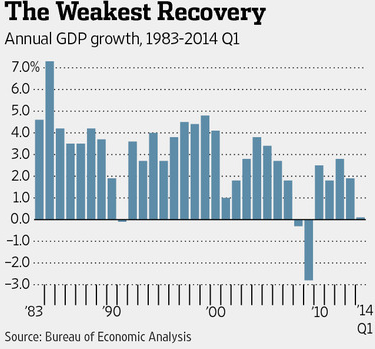
CaptureOur biggest national problem right now, in my opinion, is the stagnant economy.  In today’s WSJ, the lead editorial, “The Growth Deficit”, clearly describes how bad the situation is.  Since the Great Recession ended in June 2009, our rate of GDP growth has averaged 2.2% per year.  This compares with a 4.1% annual rate of growth for all post-1960 recovery periods.
Such a slow rate of growth causes all sorts of problems.  First of all, it explains why our unemployment rate is still so high at 6.7% after five years of recovery.  This means that between 15 and 20 million people are still unemployed or underemployed.  Such a large human toll means a huge increase in government welfare expenses for food stamps, unemployment insurance, etc.  Higher unemployment also means less tax revenue collected by the federal government.  This translates into much larger deficit spending, adding to the already massive national debt.
There are lots of things which can be done to increase growth, for example:

  • Lowering tax rates on individuals to put more money in the hands of the 2/3 of Americans who do not itemize deductions on their tax returns. They’ll spend this extra income and create more demand! Pay for this by closing loopholes and deductions, which are used primarily by the wealthy. Besides stimulating the economy, this will simultaneously address increasing income inequality.
  • Lowering tax rates on corporations to encourage multinationals to bring their foreign profits back home for reinvestment or paying dividends. Again, balanced by eliminating deductions enjoyed by privileged corporations.
  • Relax regulatory burdens on small businesses where most new jobs are created.
  • Reform immigration procedures by boosting the number of H1-B visas to attract more highly skilled, and entrepreneurial, foreign workers.
  • Grant trade promotion authority to the President to speed up new trade agreements.

We should be clamoring for our national leaders to be acting on these fronts.  A strong economy is the very backbone of our success as a nation!

Is America Falling Behind?


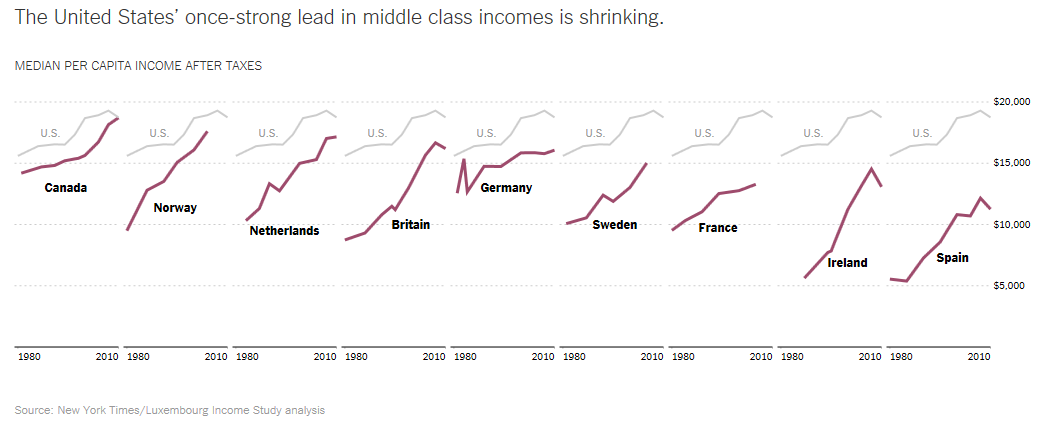
Yesterday’s New York Times has a very interesting article, “U.S. Middle Class No Longer World’s Richest”, demonstrating that from 1980 -2010 the median wage in many other developed nations has grown faster than in the U.S.  The chart below does show that the U.S. median wage is still growing but just not as fast as elsewhere.
CaptureThe authors suggest three reasons to explain what is happening:

  • Educational attainment in the U.S. is growing more slowly than in the rest of the industrialized world.
  • A larger portion of business profits in the U.S. is going to top executives meaning less for middle and low income workers.
  • There is a higher degree of income redistribution (through taxation) in Canada and Western Europe than in the U.S.

The data presented in this article is more elaborate but nevertheless consistent with what other studies are showing.  We are still on top but we need to make some major changes in order to stay there.  For example:

  • Most states have adopted the national Common Core curriculum for K – 12 schools. In today’s highly competitive global environment, this will enable a more rigorous evaluation of educational attainment between the states and should, therefore, improve overall academic achievement.
  • The best way to raise salaries for middle and low-income workers is to boost economic output overall. Fundamental tax reform, with lower tax rates for everyone, offset by closing loopholes and lowering deductions for the wealthy, will put more money in the hands of the people most likely to spend it. This will increase demand and make the economy grow faster.
  • As a highly visible way of addressing economic inequality in the U.S., institute a relatively small, i.e. 1% or 2%, wealth tax on the assets of individuals with a net worth exceeding $10 million. This would raise up to $200 billion per year which could be used for an extensive infrastructure renewal program, creating lots of jobs and further boosting the economy, with a lot left over to devote to shrinking our massive federal deficits.

A program like this encourages everyone to work hard and reach their highest potential, including accumulating as much wealth as they are able to.  But the people at the very top, i.e. the superrich, will be required to give back a little bit more in order to benefit the entire country.

Do We Need a New School of Economics?


“Consider the following scenario. You are an airline pilot charged with flying a planeload of passengers across the Atlantic. You are offered the choice of two different aircraft. The first aircraft has been prepared by chief engineer Keynes and the second by chief engineer Hayek.
You have to choose which plane to use, so naturally you ask the advice of the two engineers. Keynes urges you to use his aircraft, offering a convincing explanation of why Hayek’s plane will crash on take-off. Hayek urges you to use his aircraft, offering an equally convincing explanation of why Keynes’s plane will crash on landing.

At loss as to which plane to choose, you seek the advice of two leading independent experts – Karl Marx and Adam Smith. Marx assures you that it does not matter which aircraft you choose as both will inevitably suffer catastrophic failure. Similarly, Smith also reassures you that it does not matter which aircraft you choose, as long as you allow your chosen craft to fly itself.”
Thus begins a fascinating new book, “Money, Blood and Revolution: How Darwin and the doctor of King Charles I could turn economics into a true science,” by the fund manager and economist, George Cooper.
CaptureMr. Cooper sets up a circulatory model of democratic capitalism whereby rent, interest payments and profits flow from low income people at the bottom of the pyramid to the wealthy at the top. And then tax revenue (collected mostly from the wealthy) is redistributed downward in the form of government programs.
According to Mr. Cooper, the financial crisis was caused by a combination of lax regulation and excessive credit and monetary stimulus. The question is what to do about it. Mr. Cooper says:

  • Stop adding to the problem. High student debt and high mortgage debt are still being supported by government programs.
  • Change the course of the monetary river. Quantitative easing does not work because it just puts money into the hands of the wealthy and they have no incentive to spend it.
  • Change the course of the fiscal river. Instead put money into the hands of the people at the bottom of the pyramid with expanded government spending on infrastructure (paid for by taxing the wealthy).

Without endorsing all of Mr. Cooper’s suggestions, he nevertheless has many good ones and expresses them in a highly entertaining style!

What Is the State of the U.S. Economy?


On the eve of the President’s State of the Union address, the New York Times gives an answer to this question in today’s paper, “Obama’s Puzzle: Economy Rarely Better, Approval Rarely Worse”.  The charts below do show the basic trends all moving in the right direction.  But is this good enough?
CaptureThe unemployment rate is moving steadily downward but it is still a high 6.7% almost five years after the recession ended in June 2009.  And this is with a labor participation rate of only 58.6%, which is historically very low.
The budget deficit is dropping but is still unsustainably high.  In the five years, 2009 – 2013, deficits have totaled $6 trillion dollars.  As soon as interest rates return to their historical average of 5%, interest on this $6 trillion in new debt alone will total $300 billion per year, forever!  Furthermore, the Congressional Budget Office, the most credible source of budget information, predicts that the deficit is likely to resume an inexorable climb within a few years as baby boomers retire in ever greater numbers, rapidly driving up entitlement costs.
Economic growth was stronger than expected in the last quarter of 2013 and this is a good sign.  But it has averaged only about 2% since the recession ended which is very low by historical standards, in a post recessionary period.
The point is, do we really need to settle for such mediocre performance: a stagnant economy, high unemployment and massively accumulating debt?  Should we just declare that in a highly competitive global economy with an ever higher premium on information and technology, that we just can’t do any better than we already are?  Isn’t there some way to make our economy grow faster in order to provide more and higher paying jobs?
I think that the answer to this last question is an emphatic yes!  In fact, this is what my blog is all about.  Just read some of the other recent posts and let me know if you disagree with what I am saying!

A Global Perspective on Income Inequality II. Where Are the Jobs?


My last post on January 23 shows vividly what the challenges are in restoring the American middle class to the prosperity which existed up until the Great Recession hit in late 2007.  The problem, of course, is the gale strength force of globalization which is lifting up low wage workers all over the developing world and creating huge competition for the many low-skilled workers in the United States.
In today’s New York Times, the former Obama Administration car czar, Steven Rattner, writes about “The Myth of Industrial Rebound” in the United States, explaining why manufacturing jobs are coming back much more slowly than other jobs.  “Manufacturing would benefit from the same reforms that would help the broader economy: restructuring of our loophole-ridden corporate tax code, new policies to bring in skilled immigrants, added spending on infrastructure and, yes, more trade agreements to encourage foreign direct investment.”
CaptureThe above chart shows the huge decline in manufacturing jobs relative to other parts of the economy such as the education and health sector as well as the professional and business sector.  Of course, these more rapidly growing service sectors are the ones benefitting from the information technology revolution.  In manufacturing, on the other hand, the low skill jobs are going overseas while the high skill jobs, using technology such as robots, are much fewer in number.
Conclusion: in order to increase manufacturing jobs in the U.S., we better government policies, as outlined above by Mr. Rattner.  But we also need to recognize that there aren’t going to be as many high skilled manufacturing jobs in the future.  We are going to need much better K-12 and post-secondary educational outcomes to prepare the middle class for the high skilled service jobs which will predominate in the future.