The Folly of Building a Streetcar System in Omaha


The City of Omaha is now considering building a Streetcar System for an estimated cost of $156 million. Both of the two mayoral candidates have endorsed this proposal.

Here are the basic facts about the project:

  • It would run from TD Ameritrade Park in downtown Omaha to 42nd and Farnam Streets in midtown Omaha, a distance of about four miles. It would cost about $7.5 million per year to operate the line and would generate about $700,000 a year in annual revenue with a fare of $1.25 per ride. Adding a fee of $1.50 per ticket per College World Series event (at TD Ameritrade Park) would generate about $500,000 per year in additional income.

  • The financial assessment of the project by HDR suggests that the Federal Transit Administration could be asked for a grant of $78 million, or one-half of the total cost. The FTA is already contributing $15 million towards a $30 million Bus Rapid Transit system along Dodge Street approved by the City Council. The BRT involves 27 sleek, modern bus stop shelters along the route at a cost of $260,000 each.
  • The FTA has an annual budget of $19 billion. The Trump Administration is asking for a $2.4 billion cut in the FTA budget for 2018.  Congress has not yet taken any action on the Trump Budget proposal. But the FTA budget is clearly funding extravagant local projects around the country and is ripe for a major budget cut.

Conclusion. Omaha is simply not large enough, nor with a sufficiently dense population base, to support a downtown street car system aimed at the tourist trade. It could only be financed with massive federal support at a time when the federal government is rightly trying to cut back on unnecessary and wasteful spending. Don’t do it, Omaha!

Nebraska Senator Deb Fischer Is a Big Spender


Senator Fischer is up for re-election in 2018 and she starts out a recent fund raising letter (see below) as follows: “My goals are clear: stronger national defense, safer roads and bridges, healthcare that is accessible and affordable, protection of our fundamental liberties, less government, and a fairer, simpler tax code.” Here’s the breakdown:

  • First, and most important: national security.
  • Second, our roads and bridges must be repaired and rebuilt.
  • Third, Obamacare must be repealed and replaced.
  • Fourth, our fundamental liberties must be protected.
  • Fifth, government must shrink and the tax code must be simpler and fairer.

I don’t disagree with the specifics of any of these five goals but rather where the emphasis is placed. Her first two goals are to greatly increase spending for both the military and for infrastructure projects.  Her last goal is to shrink the federal government which is a good idea but very hard to accomplish in practice.

capture99
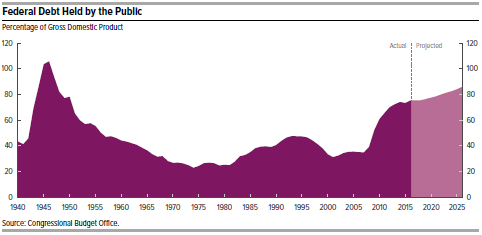
Here is the basic problem our national debt (the public part on which we pay interest) is now at 77% of GDP, the highest it has been since right after WWII, and steadily getting worse.  Right now this approximately $14 trillion debt is essentially “free” money because interest rates are so low.  But when interest rates inevitably rise to more normal levels, interest payments on the debt will soar by hundreds of billions of dollars per year and eat much more deeply into tax revenue.
It should be a very high priority for Congress to establish a plan to bring government spending more closely in line with tax revenue.  I have previously described how this could be accomplished over a ten year period without cutting hardly anything but simply using restraint for spending increases.

Conclusion. If Senator Fisher feels that it is necessary to make big spending increases in areas such as national defense and infrastructure repair, then she should be equally adamant about the need to hold down the growth of government spending overall.

Follow me on Twitter
Follow me on Facebook

capture100

capture101


What, if Anything, Will Restrain Donald Trump?


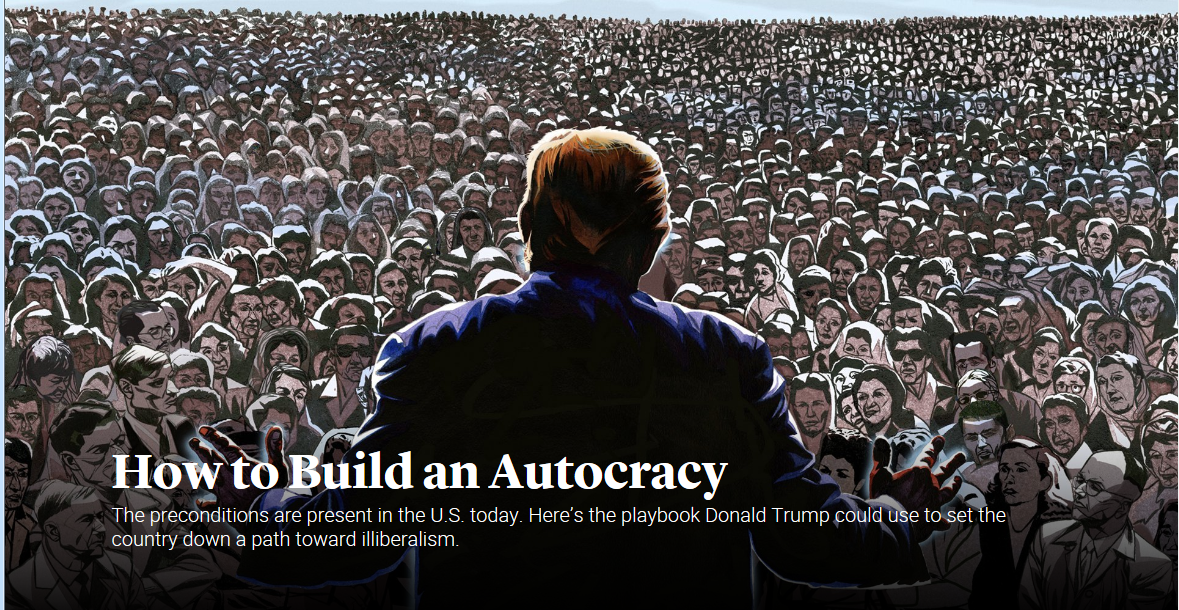
The Atlantic magazine has just released a remarkable essay written by the political commentator, David Frum, entitled, “How to Build an Autocracy.”  Says Mr. Frum, “Donald Trump will not set out to build an authoritarian state.  His immediate priority seems likely to be to use the presidency to enrich himself.  But as he does so, he will need to protect himself from legal risk.  Being Trump, he will also inevitably wish to inflict payback on his critics.  Construction of an apparatus of impunity and revenge will begin haphazardly and opportunistically.  But it will accelerate.  It will have to.”

capture99
Let’s assume that Mr. Frum is correct that Trump’s top priority is to enrich himself.  What will stop him from doing this?  A recent column in the New York Times points out that:

  •  54% of registered voters in congressional districts represented by Republicans view Mr. Trump favorably compared with only 42% who view him unfavorably.
    In these same districts, 87% of registered Republicans view Mr. Trump favorably.
  • In other words, the Republican dominated Congress is unlikely to strongly oppose his sleazy and self-enriching behavior.

But there are other constraints on what he does in office:

  • As I said in a recent post in order for Mr. Trump to be reelected in 2020, he will need to substantially speed up economic growth in order to increase the wages of his key blue-collar supporters. He clearly wants to accomplish this.
  • On the other hand, the conservative Republican base, including its representatives in the House such as the Freedom Caucus, will simply not support huge increases in deficit spending for anything (except an emergency) including infrastructure, the military or unfunded tax cuts.
  • In fact, Rep Mick Mulvaney (R, SC), a deficit hawk, has been nominated to become the Trump Administration’s Budget Director. In March the debt ceiling will have to be raised. I expect the many fiscal conservatives in Congress to insist on significant fiscal restraint (e.g. a ten year plan to balance the budget) as a tradeoff for raising the debt ceiling.

Conclusion. Just because Republicans are tolerant of Mr. Trump’s personal behavior does not mean he can successfully ignore the strong Republican desire for fiscal restraint.

Follow me on Twitter
Follow me on Facebook


Donald Trump Needs a More Positive Message


As regular readers of my blog posts know, I am not enthusiastic about either of our two main presidential candidates because neither of them has a good grasp of our two biggest economic problems which are:

  • Slow economic growth, averaging just 2% per year since the end of the Great Recession in June 2009. Faster growth would solve or alleviate many other problems, especially by creating more new jobs as well as delivering faster wage growth for all middle- and lower-income workers.
  • Massive debt now at 75% of GDP, the highest it has been since right after WWII, and projected by the Congressional Budget Office to get steadily worse unless big changes are made in spending and tax policies. Such major changes are difficult to make without presidential leadership.

Hillary Clinton promises “equitable” growth but her policy proposals will lead to a big increase in spending (bad idea) on projects of dubious value in speeding up economic growth. Donald Trump would hurt the economy with immigration controls and trade restrictions.  His proposal for lower tax rates (good idea) needs much improvement to avoid increasing annual deficits.
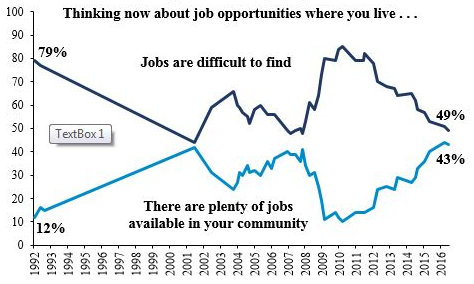
capture40Mr. Trump’s biggest problem, however, is his negative message about life in America today. Yes, we need stronger border security but we don’t need a Fortress America.  As the American Enterprise Institute has just reported, worker satisfaction is greatly improved since 2009 and workers are now much less anxious about job security than just a few years ago.
There is a really good way for Mr. Trump to sound a more positive note.  He could very easily take up the major themes of the Republican House Plan, “A Better Way” for solving America’s major economic problems.
Conclusion. There is an overwhelming desire for change in America, for new leadership which breaks out of the corruption, cronyism and elitism so rampant in Washington DC today.  But Americans are natural optimists and want a leader who can look forward to a bright future for our country.

Follow me on Twitter
Follow me on Facebook

Can U.S. Economic Growth Be Speeded Up?


It is widely recognized and deplored, see here and here, that economic growth in the U.S. has been very slow, averaging only 2% per year, since the end of the Great Recession in June 2009.
The Federal Reserve has taken unprecedented steps to limit the severity of the recession by holding down both short term and long term interest rates.  But these efforts are only partially working and are, unfortunately, having a number of negative effects as well.
It also has been made quite clear that the problem is supply side and not demand side.  This is because, on the one hand, wages are beginning to rise more quickly and consumers are spending more money but, on the other hand, business investment is shrinking which is leading to slow productivity growth.
Capture38The American Enterprise Institute’s James Pethoukoukis has just provided new data  on the current weakness of business investment as illustrated in the above chart. Furthermore he quotes the economist, Robert Gordon, who has clearly described the many headwinds holding back the U.S. economy to the effect that:

“The American tax code exerts a downward pressure on capital formation and therefore on economic growth. It is now 30 years since the passage of comprehensive federal tax reform in the U.S.  In the intervening years, nearly every developed country has reformed its tax codes to make them more competitive than that of America.  Meanwhile the U.S. has allowed its tax code to atrophy.”

Conclusion. Yes, economic growth can be speeded up. But monetary policy won’t do the trick.  Congress must intervene with the right changes to fiscal policy, i.e. lowering tax rates for both individuals and corporations, paid for by closing loopholes and shrinking deductions.

Follow me on Twitter
Follow me on Facebook

Janet Yellen vs Larry Summers


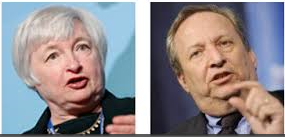
There is an informative article in the May 12, 2016 issue of Bloomberg Businessweek, “How to Pull the World Economy out of Its Rut.”  Recall that Janet Yellen succeeded Ben Bernanke as Chair of the Federal Reserve in January 2014. The other candidate for the post was Larry Summers.
Capture6They have rather different views about the role of a central bank:

  • Janet Yellen insists that economic conditions are returning to normal, even if slowly. She is neutral about the slow growth, secular stagnation hypothesis and using fiscal stimulus to overcome it.
  • Larry Summers argues that world growth is stuck in a rut because there is a chronic shortage of demand for goods and services. Growing inequality puts a bigger share of the world’s income in the hands of rich people who spend less. The new economy is asset-lite (Uber and Airbnb prosper by exploiting existing assets) and so needs less investment. Software doesn’t require the construction of new factories. He thinks that central bankers should spend more time and effort trying to influence fiscal policy. For example, more government spending on infrastructure, global warming and improving education. Also changing the tax code to put more money in the hands of lower- and middle-income families who would spend it.

I think that they are both partly right and partly wrong.

  • Janet Yellen is correct in believing that the Fed should stick to monetary policy. But she is too cautious in raising interest rates back to more normal levels. There will be some (stock market) pain in accomplishing this but it needs to be pushed faster regardless.
  • Larry Summers is correct in calling for action on the fiscal front. But his suggestions for how to do this are mostly off base because they will lead to massive new debt which must be avoided.

So what is the proper course to get out of our economic rut? It is what I’ve been saying over and over again but I’ll repeat it for good measure in my next post!  Stay tuned!

Follow me on Twitter
Follow me on Facebook

Why the GOP Should Reconcile with Donald Trump


I am a non-ideological fiscal conservative. I don’t judge government as being either too large or too small.  I just want to pay for however much government we do have without going into debt.  Such an approach normally leads to political compromise whereby Congress tries to operate efficiently and hold costs down, only raising taxes as a last resort when it is impossible to squeeze any more low priority programs out of the system.
Such common sense used to be a fundamental operating principle, adhered to by both political parties.  Unfortunately in recent years we have moved away from this model.  In fact our public debt (on which we pay interest) has rapidly accumulated to $13 trillion, 74% of GDP, and will continue to grow much higher unless we strongly change our ways.
In some ways our current presidential campaign is following a conventional path.  Both of the major Democratic candidates, Hillary Clinton and Bernie Sanders, want to expand federal programs and raise taxes to pay for the new spending.  The Republican Tea Party candidate, Ted Cruz, is a constitutional and social conservative and wants to cut back on government programs.  The leading Republican establishment candidate, Marco Rubio, supports modest new programs, such as expanding the Earned Income Tax Credit, and also modest tax reform to stimulate the economy.
Capture0The wild card in the presidential race is Donald Trump.  He is a secular populist with unconventional and even contradictory policy views.  He not only leads the Republican field in most polls, he is steadily pulling ahead.  He is doing all this by attracting huge support from working class white voters who have fallen away from the Democratic Party.  In other words, he is potentially expanding the Republican base and therefore should be taken very seriously.
Question. Can a fiscal conservative (who just wants to balance the budget!) but who also wants to address the very serious social problems in American society, support a Donald Trump candidacy for president?  I am struggling with this question.  Stay tuned!

Follow me on Twitter: https://twitter.com/jack_heidel
Follow me on Facebook: https://www.facebook.com/jack.heidel.3


Annual Deficits are Starting to Go Back Up!


As regular readers of It Does not Add Up know well, I am highly alarmed about the large budget deficits and slow economic growth in the U.S. in recent years.  Some people respond that deficits are falling and that we have entered a new era of slow-growth secular stagnation which is unavoidable.
CaptureA new report from the Congressional Budget Office, our most reliable source for objective fiscal and economic information, now predicts that the deficit for 2016 will be $544 billion, a large increase over the $439 billion deficit for 2015.  Furthermore, CBO predicts that for future years deficits will continue to grow, exceeding $1 trillion by 2022. Here is a summary of the CBO predictions:

  • Federal outlays are projected to rise by 6% this year, to $3.9 trillion, or 21.2% of GDP. This represents a 7% rise in mandatory (entitlement) spending, a 3% increase in discretionary spending, and a 14% increase in net interest on the national debt.
  • Under entitlements, Social Security payments will increase by 3% and healthcare (Medicare, Medicaid, CHIP (children’s health) and Obamacare) payments will increase by 11%.
  • Revenues will increase by 4% in 2016, to $3.4 trillion, or 18.3% of GDP.
  • Deficits are projected to increase from 74% of GDP in 2015 to 86% of GDP by 2026.
  • Spending for mandatory programs will increase from 13.1% of GDP in 2016 to 15% of GDP in 2026.

First Conclusion: The spending increases from 2015 to 2016, outlined above, illustrate a clear and alarming trend which is evident in the full ten-year set of CBO data. Discretionary spending will rise but at a sustainable rate of about 3% a year or less.  Mandatory (entitlement) spending will rise at a much faster and unsustainable rate.  It is healthcare spending, i.e. for Medicare, Medicaid, CHIP and Obamacare, and not Social Security, which is driving the rapid increase in mandatory spending.
Second Conclusion:  Although it is government healthcare spending which is driving our rapidly worsening deficit and debt problem, this is just part of the larger problem of the rapidly increasing cost of overall (including private) healthcare spending in the U.S.  This is the basic problem we need to focus on to get both fiscal and economic policy back on the right track.

Follow me on Twitter: https://twitter.com/jack_heidel
Follow me on Facebook: https://www.facebook.com/jack.heidel.3

The Just Approved 2016 Federal Budget II. A Long Term Disaster


I have been writing this blog, “It Does Not Add Up” for three years now.  It deals with fiscal and economic policy at the national level.  Of the many problems in this area, there is one which looms larger than all the others.  It is our out-of-control annual deficit spending which is in turn leading to a rapidly exploding national debt, now roughly $13 trillion or 74% of GDP.
Capture1My last post considers the details of the recently passed 2016 Federal Budget and how it will add $158 billion to the deficit in just 2016 alone.  The Committee for a Responsible Federal Budget estimates that the 10 year total in additional debt will be about $1.7 trillion.
As the above chart shows, such a huge additional debt in just ten years will lead to a total public debt in 2040 equal to 175% of GDP.  Such an enormous debt is obviously unsustainable and will almost surely lead to a new, and much worse, financial crisis long before the year 2040 arrives.
As the chart also shows, we need to be moving in exactly the opposite situation to keep our debt under any semblance of control.  Reducing deficit spending by $2 trillion over the next ten years would serve to “stabilize” the debt at 72% of GDP in 2025.
To actually end deficit spending, and therefore balance the budget, would require reducing the deficit by a total of $5 trillion over ten years.  This is exactly what the Republican Budget Resolution from Spring 2015 proposed to do.  Needless to say, this desirable goal has fallen by the wayside.
The Republicans are promising a fresh start and better process next year.  We can only hope that they are more successful in the new year.

Follow me on Twitter: https://twitter.com/jack_heidel
Follow me on Facebook: https://www.facebook.com/jack.heidel.3

Dodd-Frank Is Hurting the Recovery!


The Federal Reserve Bank plays an important role in our economy by trying to keep inflation low and stable but also by trying to make recessions less severe by increasing the money supply when the unemployment rate is high. My last post, “What the Federal Reserve Can and Can’t Do” emphasizes that, as Ben Bernanke says, “the Fed has little or no control over long term fundamentals,” such as economic growth which depends on increases in productivity which, in turn, are heavily influenced by fiscal and regulatory policy.
Capture8The American Enterprise Institute’s Peter Wallison explains very clearly in “The slow economic recovery explained,” why, for example, the Dodd-Frank Act of 2010 is having a harmful effect on economic growth:

  • Regulatory burdens imposed by Dodd-Frank have been particularly harsh for community banks, with $10 billion or less in assets; 98.5 % of U.S. banks fall into this category. Since Dodd-Frank was enacted in 2010, community banks’ share of banking assets has shrunk by 12%.
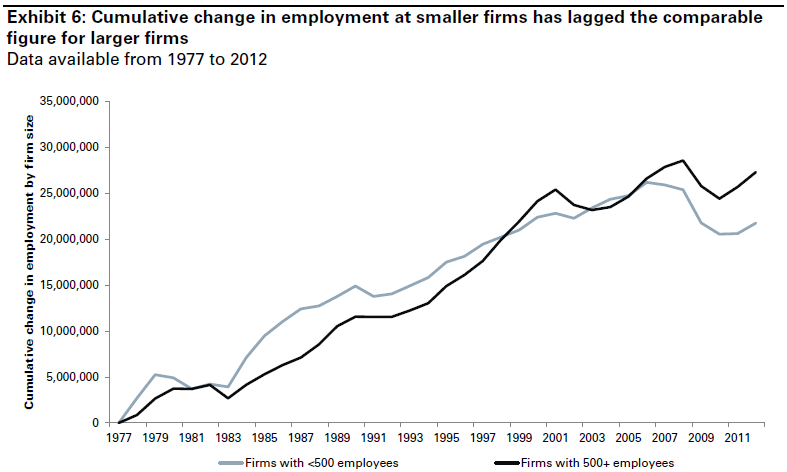
  • According to the Small Business Administration, there were approximately 23 million small businesses (with fewer than 500 employees) in 2012, compared to 18,500 firms with more than 500 employees. Large businesses have access to capital markets whereas small businesses rely on local banks for their credit needs.
  • Regulatory costs affect small banks more than large banks because the costs are fixed, independent of size of the institution. When the Consumer Financial Protection Bureau sends out voluminous regulations on mortgage lending, for example, then extensive legal fees, compliance officers and technology retooling must be paid for up front.
    Capture
  • A recent report from Goldman Sachs, “The Two-Speed Economy,” shows that large firms have grown faster than usual after 2010 while small firms have grown much slower than usual (see chart above).

Conclusion. Monetary policy alone, as conducted by the Federal Reserve, cannot return our economy to good health. This can only be accomplished by increasing productivity which is aided by smart fiscal and regulatory policy. Dodd-Frank is an example of regulatory policy which is hurting economic growth by having a harmful effect on main street banks.