Nebraska Will Benefit From Immigration Reform


Several months ago the Omaha World Herald reported that Nebraska has approximately 45,000 illegal immigrants, or about 2.5% of the state’s population.  Nebraska’s unemployment rate has now dropped to 3.4%, the third lowest in the nation behind only North Dakota and South Dakota.  Such a low unemployment rate represents a labor shortage.  There simply aren’t enough Nebraskans to perform all of the physically demanding, low skill work needed in the agriculture, meatpacking and construction industries.  It is this labor shortage which is attracting such a large number of illegal immigrants to Nebraska.
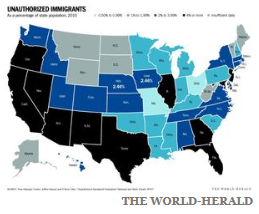
CaptureAccording to the New York Times, the Tea Party has recently changed its focus from “curtailing the reach of the federal government, cutting the deficit and countering the Wall Street wing of the Republican Party to becoming largely an anti-immigration overhaul movement.”  This is a very unfortunate development.
Why would it be so difficult to solve our illegal immigration problem in the following manner:

  • Give all businesses a limited period of time, perhaps six months, to present a list of current employees who are illegal. Everyone on this list without a criminal record would receive a guest worker visa.
  • Going forward, businesses would be authorized to hire additional foreign workers as needed with guest worker visas issued in their home country. This would eliminate the need for illegal entry into the U.S.
  • As of a certain date in the near future, all businesses would be required to periodically demonstrate the legal status of all workers on their payroll.
  • Guest workers would be eligible to apply for citizenship after a lengthy period of time, perhaps ten years.

Once an adequate guest worker visa program has been set up and is operating efficiently, security on our southern border with Mexico would hardly be more of a problem than is security on our northern border with Canada. Illegal immigration should be considered as an economic problem, not a law-enforcement problem.
If it were handled correctly in this way, the problem would disappear in short order!

Let’s Do Something about Corporate Welfare and Crony Capitalism!


The American Enterprise Institute is one of my favorite Washington think tanks.  It defines its mission as “research and education on issues of government, politics, economics and social welfare.”  I especially like its interest in social welfare which translates for me as being fiscally conservative with a heart.
CaptureThe AEI’s Timothy Carney has just proposed “An anti-corporate welfare, anti-cronyism agenda for the 114th Congress.” Most candidates for Congress condemn crony capitalism and corporate welfare.  This generally means any policies which tilt the playing field, picking winners and losers and rewarding well-connected insiders.  Such actions contribute to the public perception that the “game” is rigged and harm economic growth and innovation.  Here are some prime examples discussed by Mr. Carney:

  • Health Care: repeal Obamacare’s insurer bailout (the “risk corridors”) so that health insurers compete totally on price.
  • Health Care: end the individual mandate which forces people to buy a product from a private industry. An alternative incentive for individuals to remain covered would be limiting enrollment periods, for example, to a brief six-week sign-up period every two years.
  • Energy: end tax breaks and subsidies for both renewable energy (including ethanol) and oil and gas. Make all forms of energy compete in the market.
  • Taxes: make corporate taxes simpler, lower and more neutral. Besides being fairer, such changes will boost the economy.
  • Finance: Rein in Fannie Mae and Freddie Mac by treating them the same as all big banks. This means the same capital requirements, the same tax treatment and the same consumer protection regulation.
  • Finance: Kill Dodd-Frank’s too-big-to-fail designation. It acts as a moat, protecting the big guys from competition.
  • Trade: Kill the Export-Import Bank.
  • Trade: Repeal the Jones Act. It requires all shipping between U.S. ports be done on U.S. flagged vessels.
  • Agriculture: End the Sugar Program which costs consumers $3 billion per year.
  • Agriculture: Reform the Federal Crop Insurance Program by making it self-supporting.

These mostly well-known examples of corporate welfare represent just the tip-of-the-iceberg.  Nevertheless they provide a good place to start in cleaning things up!

Inequality Does Not Reduce Prosperity


In the national elections this year four states: Alaska, Arkansas, Nebraska and South Dakota raised their state minimum wage rates above the national rate of $7.25 per hour and, at the same time, elected Republicans to the U.S. Senate, in three cases replacing Democratic incumbents.  Does this represent contradictory behavior by the voters?
CaptureThe American Enterprise Institute’s James Pethokoukis recently reported (see above) that the U.S. has the third highest rate of billionaire entrepreneurs behind only Hong Kong and Israel, as well as by far the most billionaires over all.  These are the high-impact innovators like Bill Gates, Steve Jobs and Mark Zuckerberg and the Google Guys.
These observations are put in context by the Manhattan Institute’s Scott Winship who recently reported that “Inequality Does Not Reduce Prosperity.” Here is a summary of his findings:

  • Across the developed world, countries with more inequality tend to have higher living standards.
  • Larger increases in inequality correspond with sharper rises in living standards for the middle class and poor alike.
  • In developed nations, greater inequality tends to accompany stronger economic growth.
  • American income inequality below the top 1 percent is of the same magnitude as that of our rich-country peers in continental Europe and the Anglosphere.
  • In the English-speaking world, income concentration at the top is higher than in most of continental Europe; in the U.S., income concentration is higher than in the rest of the Anglosphere.
  • With the exception of a few small countries with special situations, America’s middle class enjoys living standards as high as, or higher than, any other nation.
  • America’s poor have higher living standards than their counterparts across much of Europe and the Anglosphere.

Conclusion: Americans are fair-minded and would like to help the working poor do better.   But Americans also appreciate the value of innovation and entrepreneurship.  When there is a tradeoff between increasing prosperity and reducing inequality, greater prosperity comes first.

Reforming Remedial Education


Many observers agree that one of the best ways to boost the economy and reduce income inequality is to improve educational outcomes at both the K-12 and postsecondary levels.  One of the main barriers to accomplishing this goal is the huge K-12 achievement gap between students from low-income families and those from middle class families.  This creates a huge need for remedial education in college as shown in the chart below.
CaptureA recent article in the Wall Street Journal, “Remedial Courses in College Stir Questions Over Cost, Effectiveness,”  shows the dramatic increase in the number of undergraduate students taking remedial courses in recent years and also the extent to which these remedial students are receiving financial aid in the form of Pell grants.  The article points out that some states such as Connecticut, Florida and Tennessee are no longer requiring remedial education for students who test poorly.
But the educators Jane Wellman and Bruce Vandal say not so fast in an article “5 Myths of Remedial Education

  • Myth #1. Remedial Education is K-12’s problem. Colleges could do a much better job of specifying clear benchmarks for college success.
  • Myth #2. Remedial Education is a Short-Term Problem. Even if the Common Core curriculum raises high school standards, there will still be a large number of poor performers, as well as older adults returning to school, who will need remediation.
  • Myth #3. Colleges Effectively Determine College Readiness. College placement tests do not provide a precise diagnosis of student skill deficiencies.
  • Myth #4. Remedial Education is Bankrupting the System. Remediation using non-tenured faculty and making heavy use of technology is not expensive and can be very effective. (The UNO Math Department, where I work, is a good example of this.)
  • Myth #5.   Maybe Some Students are Just Not College Material. This is an elitist point of view which minimizes the importance of postsecondary education in today’s economy.

As the article concludes, “Remedial education is the 800-pound gorilla that stands squarely in the path of our national objective to increase the number of adults with a college degree. … Our nation can no longer afford these myths.”

Fix the Debt


Recently I have had several posts about our national debt, for example, “Why the National Debt Is Such a Threat to the U.S.,” showing graphically that our current public debt at 74% of GDP is very high by historical standards and rising rapidly under current fiscal policies.
CaptureYesterday I attended a workshop in Washington D.C. put on by Fix the Debt.  All expenses were paid and, in return, the attendees agree to make at least three presentations to local community groups during the following year.  This means that I will soon be sending out a letter to such groups as Kiwanis and Rotary Clubs around the Omaha area where I live, offering my services as a speaker at one of their meetings.  The purpose is to build more public awareness of the threat of a huge and growing national debt to the long-term welfare of our country. Here is a summary of talking points from the workshop:

  • The deficit for the 2013-2014 fiscal year is almost $500 billion.
  • Under current fiscal policies the debt will increase to 270% of GDP by 2080.
  • Reasons for our debt problem:
  1. An aging population which means expanded Social Security spending
  2. Healthcare costs are growing for both Medicare and Medicaid
  3. Interest costs will grow rapidly as the economy recovers and interest rates rise
  • All bipartisan reform plans call for both spending cuts and revenue increases.
  • The benefits of taking action are:
  1. Increased budget flexibility
  2. Lower exposure to changes in interest rates
  3. Reduced risk of another financial crisis
  • The longer we wait:
  1. The older our population gets
  2. The higher the debt will rise
  3. The less time we have to phase in changes
  4. The slower our economy will grow
  5. The fewer tools we will have to fix it
  • How do we bring debt under control?
  1. Enact policies that grow the economy
  2. Health care cost containment
  3. Spending cuts
  4. Tax reform and tax expenditure cuts

Let me know if you’d like a speaker on this topic at your club!

Is It Feasible to Cut Tax Preferences to Pay for Lower Tax Rates?


I have been focusing lately on America’s two biggest fiscal and economic problems:

  • How to boost the economy in order to put more people back to work
  • How to either cut spending or raise revenue in order to shrink the deficit.

A few days ago in “The Great Wage Slowdown and How to Fix It,” I laid out a fairly specific proposal to make a substantial reduction in tax preferences in order to cut tax rates across the board and especially for the 64% of taxpayers who do not itemize deductions.  These are the middle- and lower-income workers with stagnant incomes who would likely spend any tax savings they received thereby giving the economy a big boost. Let’s examine whether or not this is a realistic course of action.
CaptureThe above chart from the Congressional Budget Office document, “The Distribution of Major Tax Expenditures in the Individual Income Tax System,” shows that, for example, the upper 10% of households by income receive about 40% of the total $1 trillion in individual tax expenditures per year.  Furthermore, this same top 10% of tax payers have an income of about $140,000 or more (Congressional Research Service). My basic idea is to shrink tax preferences by $250 billion per year and to lower tax rates for middle- and lower-income non-itemizers by this same amount.  If we assume that they would spend 2/3 of this new income, it would boost the economy by $170 billion per year which is 1% of GDP.
A reasonable way to achieve this savings is to expect higher income earners to contribute a greater percentage of their tax preference savings.  For example:

  • top 1% contribute $110 billion (2/3 of their total deductions).
  • top 96th % to 99th % contribute $50 billion (1/2 of their total deductions).
  • top 91st % to 95th % contribute $30 billion (1/3 of their total deductions).
  • top 81st % to 90th % contribute $30 billion (1/4 of their total deductions).
  • top 61st % to 80th % contribute $30 billion (1/5 of their total deductions).
  • this gives a total of $250 billion in tax preference savings.

This back-of-the-envelope calculation is not intended to be definitive but rather to suggest what can be done along these lines.  Those who are more well-off need to make bigger sacrifices in getting our economy back on track.

How to Shrink the Deficit: Control Entitlement Spending by Fixing Obamacare


Our country faces two major fiscal and economic problems:

  • How to boost the economy in order to put more people back to work.
  • How to either increase tax revenue or better control spending in order to shrink the deficit.

My last post, “The Great Wage Slowdown and How to Fix It” makes a specific tax reform proposal to cut tax rates for all by shrinking tax deductions for the wealthy.  This would put tax savings in the hands of millions of wage earners with stagnant incomes, who would likely spend it, thereby boosting the economy.
CaptureAs the above chart clearly shows, there is only one realistic way to shrink the deficit.  We have to do a better job of controlling entitlement spending (Social Security, Medicare and Medicaid.)  As a practical matter, this means we have to cut back the cost of American healthcare in general, both public and private.
The Manhattan Institute’s Avik Roy has come up with an attractive Plan for doing just this, “Transcending Obamacare.” Mr. Roy’s proposal is to:

  • Repeal the individual mandate. Insurers are encouraged to design policies of high quality tailored to individual need. By lowering the cost of insurance for younger and healthier individuals, the Plan will expand coverage without a mandate.
  • Repeal the employer mandate, thereby offering employers a wider range of options for subsidizing employees insurance.
  • Keep the exchanges to provide broad access as well as subsidies for those with low incomes.
  • Migrate the Medicaid population onto the exchanges.
  • Raise the Medicare eligibility age by 4 months per year indefinitely. Over time this will maintain future retirees on exchange-based or employer sponsored health plans.

By gradually moving the Medicaid and Medicare recipients onto the exchanges, both of these very large populations will receive equal quality coverage to everyone else, delivered in a cost effective manner.  Mr. Roy estimates that the Plan will expand coverage by 12 million above Obamacare levels by 2025 and reduce the deficit by $8 trillion over 30 years.
This is the sort of major healthcare reform which we need to get entitlement spending under control!

The Great Wage Slowdown and How to Fix It

With a new Congress just elected, this is a good time to reflect about what changes should be made in public policy. Our biggest economic problem is to speed up growth in order to provide more and better paying jobs.  In addition, a faster growing economy would bring in more tax revenue which would help pay our bills and reduce the deficit.
CaptureA column in today’s New York Times, “The Great Wage Slowdown, Looming over Politics,” by David Leonhardt, proposes a cut in the marginal tax rate for the middle class as a way of boosting their incomes.  As can be seen in the above chart, median household income has been flat since the year 2000, and even lower since the 2008 recession.  Mr. Leonhardt goes on to say that any tax cut for the middle class should be balanced by a tax increase for the wealthy.
It so happens that I proposed such a plan several months ago as a way of boosting the economy and reducing inequality at the same time. The idea is to enact broad-based tax reform whereby tax rates are lowered for all, offset by shrinking tax deductions.  The 64% of taxpayers who do not itemize deductions will receive a big tax cut.  But these are the very middle-class wage earners with stagnant incomes.  So they will likely spend their tax savings, thereby giving the economy a big boost.
More specifically:

  • Individual tax deductions total about $1 trillion per year.
  • Let’s suppose that these deductions are cut in half to $500 billion per year.
  • Let’s further suppose that half of this amount, or $250 billion per year, is cut from the taxes of the 64% who do not itemize deductions.
  • If these 64% spend just 2/3 of their new income (instead of saving it or paying off debt), this will total $170 billion which is 1% of GDP.
  • This would increase the rate of growth of GDP from the 2.2% average, since the end of the Great Recession, to 3.2%. This represents an enormous boost to the economy and would return average GDP growth to about its 3.3% average since 1947.

    Mr. Leonhardt suggests that presidential contenders in 2016 would greatly benefit from proposing a tax rate cut for the middle class. Here’s a specific plan they can use!

The Problem of Soaring World Population


As I remind readers from time to time, this blog is focused on the fiscal and economic problems of the U.S. Our biggest fiscal problem is not having enough tax revenue to pay our bills.  Our biggest economic problem is a stagnant economy which leaves too many people unemployed or underemployed.
My last three post have been on the subject of climate change. This is a worldwide problem which has a huge effect on the U.S.  There’s going to be a cost in cutting way back on carbon emissions.  But there will soon be a much greater cost if we don’t cut back and therefore suffer the growing adverse environmental effects.
Now there is another looming problem.  The journal Science has just published the article “World population stabilization unlikely this century,” reporting that world population, now 7.2 billion, is likely to reach 9.6 billion by 2050 and 10.9 billion by 2100.  Much of the increase will take place in Africa due to higher fertility rates because of a recent slowdown in the pace of fertility decline.
CaptureThe implications of a growing world population are huge:

  • First of all, it will add even more stress to an environment which is already being increasingly stressed by global warming.
  • Secondly, it will aggravate a slowdown in middle-income wage growth throughout the developed world. This is very evident in the above chart. What is happening is that the force of globalization is shifting lower skilled work to lower paid workers in the developing world. A larger population in the developing world will simply exacerbate this trend.

The noted economist, Tyler Cowen, has a different perspective on this problem, “A Strategy for Rich Countries: Absorb More Immigrants,” in today’s New York Times.  But Mr. Cowen’s approach is untenable for the long run.  The idea that you can offset an increase in the elderly population with an even bigger increase in the younger population will lead to an ever-growing overall population.
What then is the answer to over-population?  It is either more birth control or less sex.  Take your pick!

What Is the Best Way to Cope with Climate Change?


The Intergovernmental Panel on Climate Change has just issued it’s latest and most definitive assessment about the extent of global warming.  The earth’s average temperature has increased by .85 degrees centigrade since 1880 and is on track to increase to 2 degrees centigrade in a relatively short time span.  Such a major climate change will have severe repercussions for human life.
CaptureThere is much evidence for the IPCC’s gloomy prognosis.  Most convincing for me is that the extent of the summer artic ice cap is steadily shrinking, as demonstrated in the above chart.
The Environmental Protection Agency is attempting to decrease carbon emissions by regulation but there is a limit to what can be accomplished in this way:

  • The EPA’s goal is a 30% reduction in carbon emissions from 2005 levels by 2030. But the only way that this can possibly be achieved is by substituting the use of natural gas for coal, which reduces carbon emissions by 50%
  • The current low cost of natural gas is making nuclear power less economically viable even though nuclear power has no carbon footprint at all.
  • In addition to creating such constraints, this approach also has led the EPA to set complicated and arbitrary goals on carbon emissions for each state individually.

In other words, by employing onerous regulations the EPA will only, at best, be able to achieve a 30% reduction in carbon emissions by 2030. Of course, this is better than nothing but it is not nearly enough to significantly slow down global warming.  Even if European countries succeed in meeting similar targets as the ones set for the U.S., this leaves out the largest carbon emitter of all, namely China, as well as the rest of the developing world. Since it is impractical to eliminate the use of fossil fuels altogether, or even come close to doing so, the emphasis should be on limiting carbon emissions.  In other words, we should create incentives for carbon “sequestration,” i.e. the capture and storage of carbon when burning fossil fuels.   The way to do this is with a tax on the release of carbon into the atmosphere.  Such a carbon tax would provide a huge incentive for energy and power companies to develop the best possible sequestration techniques. With an economic incentive to do so, U.S. technological ingenuity will quickly develop effective methods for carbon sequestration.  Once discovered and perfected, their use would rapidly spread around the world. Climate change is real and we need an effective way to address it.  A carbon tax is the best way to get the job done.