How to Shrink the Deficit: Control Entitlement Spending by Fixing Obamacare


Our country faces two major fiscal and economic problems:

  • How to boost the economy in order to put more people back to work.
  • How to either increase tax revenue or better control spending in order to shrink the deficit.

My last post, “The Great Wage Slowdown and How to Fix It” makes a specific tax reform proposal to cut tax rates for all by shrinking tax deductions for the wealthy.  This would put tax savings in the hands of millions of wage earners with stagnant incomes, who would likely spend it, thereby boosting the economy.
CaptureAs the above chart clearly shows, there is only one realistic way to shrink the deficit.  We have to do a better job of controlling entitlement spending (Social Security, Medicare and Medicaid.)  As a practical matter, this means we have to cut back the cost of American healthcare in general, both public and private.
The Manhattan Institute’s Avik Roy has come up with an attractive Plan for doing just this, “Transcending Obamacare.” Mr. Roy’s proposal is to:

  • Repeal the individual mandate. Insurers are encouraged to design policies of high quality tailored to individual need. By lowering the cost of insurance for younger and healthier individuals, the Plan will expand coverage without a mandate.
  • Repeal the employer mandate, thereby offering employers a wider range of options for subsidizing employees insurance.
  • Keep the exchanges to provide broad access as well as subsidies for those with low incomes.
  • Migrate the Medicaid population onto the exchanges.
  • Raise the Medicare eligibility age by 4 months per year indefinitely. Over time this will maintain future retirees on exchange-based or employer sponsored health plans.

By gradually moving the Medicaid and Medicare recipients onto the exchanges, both of these very large populations will receive equal quality coverage to everyone else, delivered in a cost effective manner.  Mr. Roy estimates that the Plan will expand coverage by 12 million above Obamacare levels by 2025 and reduce the deficit by $8 trillion over 30 years.
This is the sort of major healthcare reform which we need to get entitlement spending under control!

The Great Wage Slowdown and How to Fix It

With a new Congress just elected, this is a good time to reflect about what changes should be made in public policy. Our biggest economic problem is to speed up growth in order to provide more and better paying jobs.  In addition, a faster growing economy would bring in more tax revenue which would help pay our bills and reduce the deficit.
CaptureA column in today’s New York Times, “The Great Wage Slowdown, Looming over Politics,” by David Leonhardt, proposes a cut in the marginal tax rate for the middle class as a way of boosting their incomes.  As can be seen in the above chart, median household income has been flat since the year 2000, and even lower since the 2008 recession.  Mr. Leonhardt goes on to say that any tax cut for the middle class should be balanced by a tax increase for the wealthy.
It so happens that I proposed such a plan several months ago as a way of boosting the economy and reducing inequality at the same time. The idea is to enact broad-based tax reform whereby tax rates are lowered for all, offset by shrinking tax deductions.  The 64% of taxpayers who do not itemize deductions will receive a big tax cut.  But these are the very middle-class wage earners with stagnant incomes.  So they will likely spend their tax savings, thereby giving the economy a big boost.
More specifically:

  • Individual tax deductions total about $1 trillion per year.
  • Let’s suppose that these deductions are cut in half to $500 billion per year.
  • Let’s further suppose that half of this amount, or $250 billion per year, is cut from the taxes of the 64% who do not itemize deductions.
  • If these 64% spend just 2/3 of their new income (instead of saving it or paying off debt), this will total $170 billion which is 1% of GDP.
  • This would increase the rate of growth of GDP from the 2.2% average, since the end of the Great Recession, to 3.2%. This represents an enormous boost to the economy and would return average GDP growth to about its 3.3% average since 1947.

    Mr. Leonhardt suggests that presidential contenders in 2016 would greatly benefit from proposing a tax rate cut for the middle class. Here’s a specific plan they can use!

The Problem of Soaring World Population


As I remind readers from time to time, this blog is focused on the fiscal and economic problems of the U.S. Our biggest fiscal problem is not having enough tax revenue to pay our bills.  Our biggest economic problem is a stagnant economy which leaves too many people unemployed or underemployed.
My last three post have been on the subject of climate change. This is a worldwide problem which has a huge effect on the U.S.  There’s going to be a cost in cutting way back on carbon emissions.  But there will soon be a much greater cost if we don’t cut back and therefore suffer the growing adverse environmental effects.
Now there is another looming problem.  The journal Science has just published the article “World population stabilization unlikely this century,” reporting that world population, now 7.2 billion, is likely to reach 9.6 billion by 2050 and 10.9 billion by 2100.  Much of the increase will take place in Africa due to higher fertility rates because of a recent slowdown in the pace of fertility decline.
CaptureThe implications of a growing world population are huge:

  • First of all, it will add even more stress to an environment which is already being increasingly stressed by global warming.
  • Secondly, it will aggravate a slowdown in middle-income wage growth throughout the developed world. This is very evident in the above chart. What is happening is that the force of globalization is shifting lower skilled work to lower paid workers in the developing world. A larger population in the developing world will simply exacerbate this trend.

The noted economist, Tyler Cowen, has a different perspective on this problem, “A Strategy for Rich Countries: Absorb More Immigrants,” in today’s New York Times.  But Mr. Cowen’s approach is untenable for the long run.  The idea that you can offset an increase in the elderly population with an even bigger increase in the younger population will lead to an ever-growing overall population.
What then is the answer to over-population?  It is either more birth control or less sex.  Take your pick!

What Is the Best Way to Cope with Climate Change?


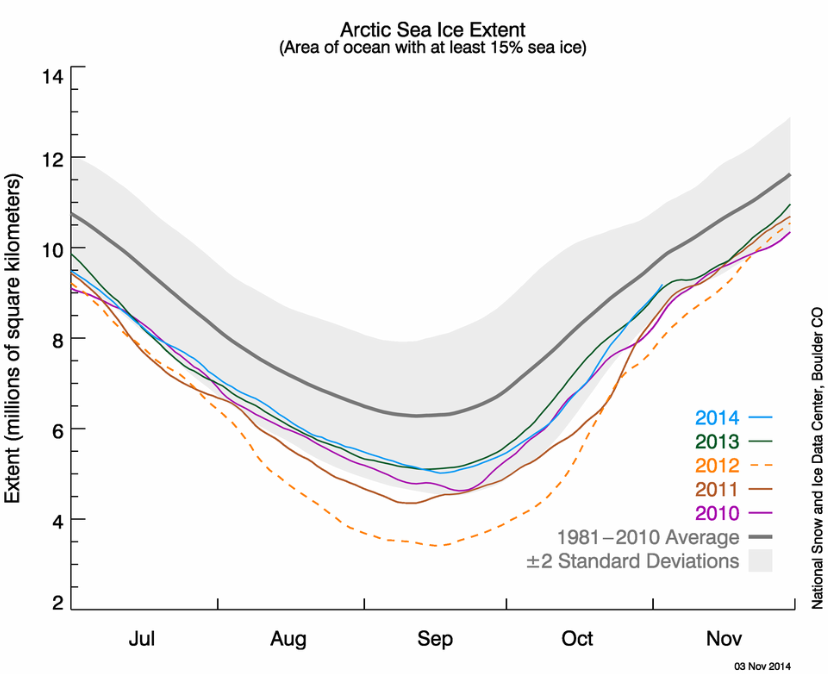
The Intergovernmental Panel on Climate Change has just issued it’s latest and most definitive assessment about the extent of global warming.  The earth’s average temperature has increased by .85 degrees centigrade since 1880 and is on track to increase to 2 degrees centigrade in a relatively short time span.  Such a major climate change will have severe repercussions for human life.
CaptureThere is much evidence for the IPCC’s gloomy prognosis.  Most convincing for me is that the extent of the summer artic ice cap is steadily shrinking, as demonstrated in the above chart.
The Environmental Protection Agency is attempting to decrease carbon emissions by regulation but there is a limit to what can be accomplished in this way:

  • The EPA’s goal is a 30% reduction in carbon emissions from 2005 levels by 2030. But the only way that this can possibly be achieved is by substituting the use of natural gas for coal, which reduces carbon emissions by 50%
  • The current low cost of natural gas is making nuclear power less economically viable even though nuclear power has no carbon footprint at all.
  • In addition to creating such constraints, this approach also has led the EPA to set complicated and arbitrary goals on carbon emissions for each state individually.

In other words, by employing onerous regulations the EPA will only, at best, be able to achieve a 30% reduction in carbon emissions by 2030. Of course, this is better than nothing but it is not nearly enough to significantly slow down global warming.  Even if European countries succeed in meeting similar targets as the ones set for the U.S., this leaves out the largest carbon emitter of all, namely China, as well as the rest of the developing world. Since it is impractical to eliminate the use of fossil fuels altogether, or even come close to doing so, the emphasis should be on limiting carbon emissions.  In other words, we should create incentives for carbon “sequestration,” i.e. the capture and storage of carbon when burning fossil fuels.   The way to do this is with a tax on the release of carbon into the atmosphere.  Such a carbon tax would provide a huge incentive for energy and power companies to develop the best possible sequestration techniques. With an economic incentive to do so, U.S. technological ingenuity will quickly develop effective methods for carbon sequestration.  Once discovered and perfected, their use would rapidly spread around the world. Climate change is real and we need an effective way to address it.  A carbon tax is the best way to get the job done.

What the EPA Is Doing about Climate Change


My last post, “The Latest Scientific Report on Climate Change,” summarizes a new report from the Intergovernmental Panel on Climate Change. It makes a very strong case that global warming is real and that it will badly disrupt human civilization before the end of the twenty-first century if not substantially mitigated.
What are we doing about it? The Environmental Protection Agency reports on its many actions as follows: “What EPA is doing about Climate Change

  • Inventorying of U.S. Greenhouse Gas Emissions and Sinks has been tracking all GHG emissions since 1990.
  • Developing “Common Sense” Regulatory Initiatives. For example, EPA’s vehicle greenhouse gas rules will eliminate 6 billion metric tons of GHG pollution by 2025. EPA is developing carbon pollution standards for the power sector which will cut carbon emissions 30% below 2005 levels.
  • Partnering with the Private Sector. EPAs partners reduced over 345 million metric tons of GHG in 2010 alone.
  • Advancing the Science. EPA works with the IPCC to understand the environmental and health impacts of climate change.


Here is how the Washington Post describes another EPA activity, the recently announced Clean Power Plan. “The rule provides every state with a target carbon-emissions intensity for its power plants, with preliminary standards kicking in by 2020 and full goals to be achieved by 2030.  As the map (below) shows, the rule generally asks the least from the states with the worst carbon-intensity at present – those that are very dependent on coal generation, such as West Virginia, Kentucky and North Dakota.  While cross-state variations in the intensity of pollution controls are a standard feature of regulation under the Clean Air Act, they usually have a compelling justification: the negative effects of emissions are local, and so areas suffering from pollution problems must be more stringent.  But greenhouse gas concentrations are uniform globally, making it somewhat awkward to subject identical emitters to divergent standards simply because their home states’ power mix is more or less carbon-intensive.”
CaptureThe purpose of this whole discussion is to illustrate how complicated it already is and will continue to be to achieve a significant reduction in GHG carbon emissions by regulation alone, even the relatively modest 30% reduction which the EPA is trying to accomplish.
Fortunately there is a better way of achieving an even bigger reduction in carbon emissions.  Stay tuned for my next post!

The Latest Scientific Report on Climate Change


The Intergovernmental Panel on Climate Change has just issued its Fifth Assessment Report summarizing the best scientific information about global warming that is available in 2014.
Capture1CaptureKey findings are:

  • It is extremely likely that humans are the dominant cause of warming since the mid-20th century.
  • Each of the past three decades has been successively warmer than the preceding decades since 1850.
  • Oceans absorb more than 90% of the heat.
  • Land temperatures remain at historic highs while ocean temperatures continue to climb.
  • Oceans will continue to warm during the 21st century.
  • Global mean sea level will continue to rise during the 21st century.
  • It is very likely that the Artic sea ice cover will continue to shrink and thin as global mean surface temperature rises.
  • Some of the changes in extreme weather and climate events observed since about 1950 have been linked to human influence.
  • The globally averaged temperature shows a warming of .85 degrees centigrade over the period 1880 – 2012. And 65% of the carbon budget compatible with limiting future temperature to an overall 2 degrees C increase has already been used.
  • Energy production remains the primary driver of greenhouse gas emissions.
  • Measures exist to achieve the substantial emissions reductions required to limit likely warming to 2 degrees C.
  • Delaying mitigation will substantially increase the challenges associated with limiting warming to 2 degrees C.

I consider the above information from the IPCC report to be noncontroversial and providing overwhelmingly strong evidence that global warming is taking place. Next question:  What do we do about it?  This will be the subject of my next post!

Which Nebraska Senate Candidate Is Most Serious about the National Debt?


“The single biggest threat to our national security is our debt”
Admiral Mike Mullen, former Chairman of the Joint Chiefs of Staff

My last blog, “Why the National Debt Is Such a Threat to the U.S.” observes that our debt is very large by historical standards and will just keep getting worse under current policies now in effect.  This has many severe consequences for the well-being of our country.
What do we do about it?  We have to shrink the size of our annual deficits which are continuing to make the debt bigger and bigger.  The deficit for the 2014-2015 budget year just ended is $483 billion which is 2.8% of GDP.  Since our economy has been growing at a rate of only 2.2% for the past five years, this means that the debt is still growing faster than the economy.  We have to do better than this.
CaptureThe above chart from the Congressional Budget Office shows that the main contributors to the deficit, and therefore also the debt, over the next 20 years, will be entitlements (Social Security, Medicare and Medicaid) and interest payments on the debt.  All other programs, i.e. almost all of traditional federal spending, will decrease as a percentage of GDP.
This means that there are just two basic ways to solve our debt problem: trim entitlement spending and/or increase government revenue.  We’ll need to do both.  Furthermore, it is unrealistic to expect middle-income and lower-income people to pay higher taxes when their wages have been stagnant for many years.  New tax revenue will have to come from the wealthy including upper-income wage earners.  The best way to do this is by cutting back on the annual $1.2 trillion in loopholes and deductions built into the tax code.
CaptureOnly one Senate candidate from Nebraska is willing to both trim entitlement spending and raise additional tax revenue: Jim Jenkins, a registered independent from Calloway.  The Democratic candidate, David Domina, will not support any significant reining in of entitlement spending.  The Republican candidate, Ben Sasse, is too beholden to wealthy contributors to be willing to raise their taxes by cutting back on their tax deductions.
We badly need elected representatives in Washington who will make it their top priority to “fix the debt.”  Jim Jenkins is such a person.  I hope you will vote for him!

Why the National Debt Is Such a Threat to the U.S.


In my last post I discussed several commonly held myths about the national debt, along the line that it is a fairly minor problem that can easily be solved sometime in the future if we decide that it is important enough to do so.
CaptureThe above chart shows that the debt is already very large by historical standards and that it is projected (by the Congressional Budget Office) to just keep getting worse if we continue on our current path of excessive borrowing to pay our bills.
The national organization, “Fix the Debt” lays out very clearly the reasons why our ever-growing debt level is so harmful:

  • It causes lower wages and fewer job opportunities. The debt will “crowd out” productive investments in people, technology and new ventures. The CBO estimates that wages will grow more slowly if debt is on an upward path compared to a downward path. This will amount to an average $7000 wage cut 25 years from now in the year 2040.
  • It leaves less room for investment in infrastructure, research and the next generation. A growing debt means higher interest payments. The CBO projects that interest payments could nearly quadruple from $220 billion in 2013 to about $800 billion in 2024. That leaves far less for investments in education, infrastructure, research, etc.
  • It increases the likelihood of a fiscal crisis. Failure to get the national debt under control could precipitate a crisis where investors are no longer willing to loan money to the government at affordable rates. This could mean large investment losses, tanking markets, mass unemployment, rapid inflation, etc.
  • It means a missed opportunity to grow the economy. Deficit reduction legislation presents an opportunity to enact pro-growth tax reform, improve programs to reward work, re-orient spending to important investments, and capture the economic benefits of putting the debt on a sustainable path.


Let’s hope and pray that our national leaders appreciate the urgent nature of the debt problem and have the political courage to do something serious about it!  

Straight Talk about the National Debt


The deficit for fiscal year 2014-2015 just ended is “only” $483 billion, about 2.7% of current GDP, and some observers are saying this means that our deficit and debt problems are now under control and we should stop fretting so much about them.
CaptureThere is a nonpartisan outfit in Washington DC, “Fix the Debt,” which focuses on this very problem and they’re saying not so fast.  In their document, “Common Myths about the Debt,” they debunk several false impressions about the national debt:

  • Myth: Deficit levels are falling and therefore debt is no longer a concern.
  • Fact: Over the next decade our debt is on track to grow about $8 trillion (see above chart). Its growth will accelerate after 2018 and will exceed the size of the entire economy by 2035.
  • Myth: Deficit reduction is just code for austerity which will ultimately hurt the economy.
    Fact: A comprehensive and gradual deficit reduction plan can replace austerity with targeted and pro-growth reforms which promote economic recovery and accelerate long-term wage growth.
  • Myth: Deficit reduction will harm low-income and vulnerable populations.
  • Fact: Every recent bipartisan deficit reduction plan has included progressive reforms that ask more from those who can afford it and protect low-income programs.
  • Myth: The debt can be solved with faster economic growth.
  • Fact: Economic growth must be part of the solution, but it can’t solve the debt problem alone. Productivity growth would have to be 50% higher over the next quarter century just to hold debt to its current record-high levels.
  • Myth: Taxing the wealthy more will solve the debt problem.
  • Fact: Our debt problems are too large, and the top 1% too few, to solve the entire problem by raising taxes on the wealthy.

Conclusion: Our debt problem is so large that it can only be solved by stern measures, such as tax reform, including reducing tax breaks, and also spending reform to slow the growth of entitlement programs. Stay tuned for further discussion of this critical problem!

Why It Is Imperative to Lower the U.S. Corporate Tax Rate


Several large U.S. corporations have recently announced that they are planning to merge with foreign companies and move their corporate headquarters to a low tax country such as Ireland or Great Britain.  The Obama Administration proposes to disallow such tax inversions by requiring that after such a merger at least 50% of the stock of the new company would have to be foreign owned.  Such a regulatory fix is unlikely to solve a much more fundamental problem.
CaptureThe Tax Foundation has just published a new study, “Tax Reform in the UK Reversed the Tide of Corporate Tax Inversions,” describing a similar situation in Great Britain just a few years ago and what was done to reverse it.  Basically GB took two actions:

  • Implementing a territorial tax system where profits are only taxed in the country where they are earned, and
  • Lowering the corporate tax rate from 28% in 2010 to 21% in 2014 and 20% in 2015. The GB rate had already been somewhat lower than the U.S. rate since the early nineteen-eighties.

These two changes in the corporate tax code have had a dramatic effect. First of all, the number of corporations in GB has been increasing steadily.  By 2017 GB is likely to overtake the U.S. in total number of corporations.
Capture1Secondly, GB actually raises more corporate tax revenue than the U.S. and has been doing so for some years. It should be clear from this discussion that the U.S. should significantly lower its corporate tax rate.
Capture2The biggest problem in doing this is public opinion.  The organization Wallet Hub has just published its “2014 Tax Fairness Survey” which shows that only 10% of the population believes that taxes should be higher on wages than on investment income, whereas 33% thinks the reverse.  An equal tax rate on both is preferred by 57% of respondents.
Capture3This will make it politically difficult, for example, for the U.S. to match GB’s 20% maximum rate on corporations since even middle class U.S. taxpayers pay a tax rate of 25% or higher.  However it might be possible to abolish the corporate tax altogether if dividends and capital gains were then taxed at the same rate as wage income.
The most important thing, however, is to significantly lower the corporate tax rate, one way or the other, in order to incentivize U.S. multinational corporations to keep more of their business and profits in the U.S.