Saving the System


I seldom use the New York Times sociological columnist, David Brooks, as a source for my blog posts because I am focused primarily on economic and fiscal issues.  But his column today, “Saving The System,” is highly pertinent to my message.
Capture1“All around, the fabric of peace and order is fraying.  The leaders of Russia and Ukraine escalate their apocalyptic rhetoric.  The Sunni-Shiite split worsens as Syria and Iraq slide into chaos.  China pushes its weight around in the Pacific. … The U.S. faces a death by a thousand cuts dilemma.  No individual problem is worth devoting giant resources to.  But, collectively, all the little problems can undermine the modern system.”
In addition to all of these pesky worldwide problems, our free enterprise economic system is under siege.  Wages have been largely stagnant since the early 1970s and income inequality is growing as the top 1%, and perhaps the top 10 or 15% as well, do much better than everyone else.  And just lately we have also learned from the French economist, Thomas Piketty, that wealth inequality has been growing steadily ever since about 1950 and is likely to get substantially worse in the future.
In other words, western civilization is under threat in more ways than one.  What are we going to do about it?  At the risk of oversimplifying, I believe that the single best thing we can do is to undertake fundamental tax reform to make our economy stronger.  Cut everyone’s tax rates and pay for it by closing loopholes and deductions which primarily benefit the wealthy.

  • Lower tax rates will put more money in the hands of the two thirds of Americans who don’t itemize their tax deductions. These are largely the same people with stagnant wages and so they will spend this extra income they receive.
  • The resulting increase in demand will put millions of people back to work and thereby increase tax revenues which will help balance the budget. This shift of income from the wealthy to the less wealthy will reduce income inequality.
  • Although harder to implement politically, a low (between 1% and 2%) wealth tax on financial assets above a threshold of $10 million per individual, would be a highly visible way to address wealth inequality. The substantial sum of revenue raised by this method could be used to fund national priorities as well as paying down the deficit.

I don’t want to leave the impression that I consider this program to be a panacea for strengthening our country.  But it would help and we need to make some big changes to maintain our status as world leader.
Trickle-Down Monetary Policy and What to Do About It


“There is no means of avoiding the final collapse of a boom brought about by credit expansion.  The alternative is only whether the crisis should come sooner as the result of a voluntary abandonment of further credit expansion, or later as a final and total catastrophe.”
Ludwig von Mises, Austrian economist, 1881 – 1973

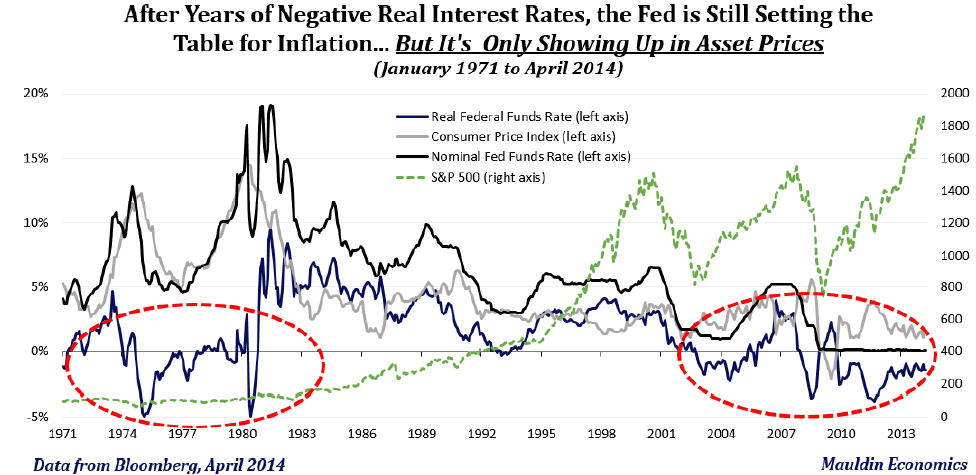
The economist/investor John Mauldin writes a weekly newsletter, “Thoughts from the Front Line” (http://d21uq3hx4esec9.cloudfront.net/uploads/pdf/140426_TFTF2.pdf) which offers good general insight.  In the latest issue Mr. Mauldin writes “For all intents and purposes we have adopted a trickle-down monetary policy, one which manifestly does not work and has served only to enrich financial institutions and the already wealthy.  Now I admit that I benefit from that, but it’s a false type of enrichment, since it has come at the expense of the general economy, which is where true wealth is created.”
CaptureMr. Mauldin also quotes the economist William White, “When you talk about crisis resolution, it’s about attacking the fundamental problems that got you into trouble in the first place.  And the fundamental problem we are still facing is excessive debt.  Not excessive public debt, mind you, but excessive debt in the private and public sectors. … With ultra-loose monetary policy, governments have no incentive to act.  But if we don’t deal with this now, we will be in worse shape than before.”
What then should government do?  The best single thing is to develop a concentrated focus on boosting the economy.  This would put millions of people back to work and raise salaries for the entire workforce.  Tax revenue would rise and both public and private debt would be paid down more quickly.
The way to do this is with fundamental, broad-based tax reform.  This means lowering tax rates for both individuals and corporations, paid for by closing loopholes and shrinking deductions.  This would have the effect of taking from the rich and giving to the poor, i.e. putting more money in the hands of those who are most likely to spend it, thereby creating more demand leading to faster economic growth.
It’s not that hard to figure out!

Is America Falling Behind?


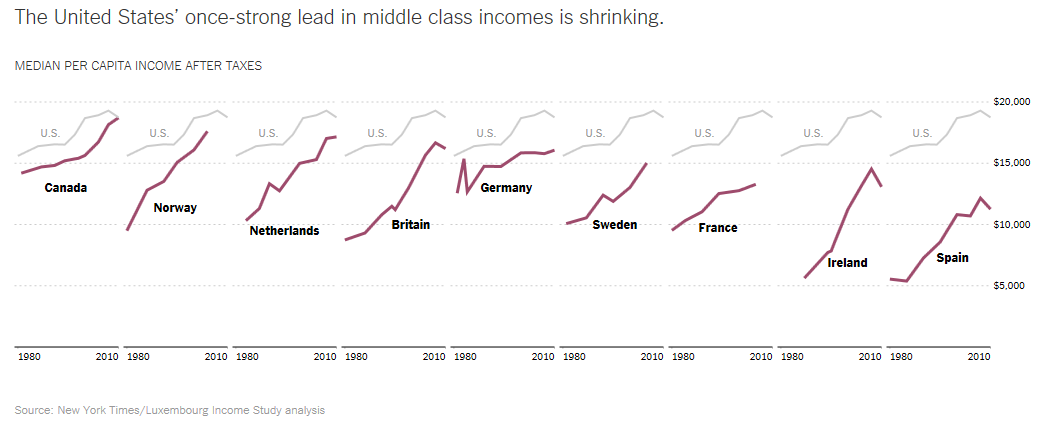
Yesterday’s New York Times has a very interesting article, “U.S. Middle Class No Longer World’s Richest”, demonstrating that from 1980 -2010 the median wage in many other developed nations has grown faster than in the U.S.  The chart below does show that the U.S. median wage is still growing but just not as fast as elsewhere.
CaptureThe authors suggest three reasons to explain what is happening:

  • Educational attainment in the U.S. is growing more slowly than in the rest of the industrialized world.
  • A larger portion of business profits in the U.S. is going to top executives meaning less for middle and low income workers.
  • There is a higher degree of income redistribution (through taxation) in Canada and Western Europe than in the U.S.

The data presented in this article is more elaborate but nevertheless consistent with what other studies are showing.  We are still on top but we need to make some major changes in order to stay there.  For example:

  • Most states have adopted the national Common Core curriculum for K – 12 schools. In today’s highly competitive global environment, this will enable a more rigorous evaluation of educational attainment between the states and should, therefore, improve overall academic achievement.
  • The best way to raise salaries for middle and low-income workers is to boost economic output overall. Fundamental tax reform, with lower tax rates for everyone, offset by closing loopholes and lowering deductions for the wealthy, will put more money in the hands of the people most likely to spend it. This will increase demand and make the economy grow faster.
  • As a highly visible way of addressing economic inequality in the U.S., institute a relatively small, i.e. 1% or 2%, wealth tax on the assets of individuals with a net worth exceeding $10 million. This would raise up to $200 billion per year which could be used for an extensive infrastructure renewal program, creating lots of jobs and further boosting the economy, with a lot left over to devote to shrinking our massive federal deficits.

A program like this encourages everyone to work hard and reach their highest potential, including accumulating as much wealth as they are able to.  But the people at the very top, i.e. the superrich, will be required to give back a little bit more in order to benefit the entire country.

The Resurrection of Karl Marx II. Let’s React But Not Overreact!


This morning’s Wall Street Journal has a book review by the New York fund manager, Daniel Shuchman, “Thomas Piketty Revives Karl Marx for the 21st Century” of Thomas Piketty’s new book “Capitalism in the Twenty-First Century.” As I recently discussed, Piketty makes the simple observation that income from wealth, i.e. investment income, grows faster than income from wages or GDP.
CaptureHe then provides a large quantity of data showing how this has played out since the end of WWII.  He plausibly predicts that the value of private capital as a percentage of national income will continue to grow indefinitely into the future.
CaptureThis much is straightforward.  The question is how we should react to a steadily increasing and very large concentration of wealth in the hands of a small percentage of people.  Mr. Piketty’s own idea is, for example, to establish an 80% tax rate on incomes starting at “$500,000 or $1,000,000” in order “to put an end to such incomes.”  Mr. Shuchman attempts to discredit Mr. Piketty by focusing in on such socialistic views for dealing with the problem rather than discussing the intrinsic merit of Piketty’s basic thesis about the buildup of great wealth in the first place.
My own view is that Mr. Piketty has clearly identified a weakness of capitalism and that it behooves supporters of free markets and private initiative to address this problem in a constructive way, for example, as follows.
We need fundamental broad-based tax reform, i.e. lower tax rates in exchange for closing loop-holes and lowering deductions, in order to boost the economy and create more jobs.  As part of a major tax overhaul, we could also establish a relatively small wealth tax, of about 1% or 2%, on assets over $10,000,000, which would raise as much as $200 billion per year.  This much money could be used to begin a large scale program of infrastructure renewal as well as leaving a lot left over to make significant payments on reducing our annual deficit.
Such an overall plan would address both income inequality and wealth inequality in a highly visible manner while simultaneously helping our economy.

The Resurrection of Karl Marx


The French economist Thomas Piketty is creating a huge stir with the publication in English of his new book “Capital in the 21st Century.”  Mr. Piketty develops a very simple idea, with reams and reams of data.  Namely that income from wealth, i.e. investment income, typically grows faster than income from wages and GDP.  This means that the value of private capital is growing steadily as a percentage of national income.  This trend has been occurring ever since 1950, at the end of WWII, and is likely to continue indefinitely absent new mega shocks to the global economy such as another world war.
CaptureIn other words, wealth inequality is rapidly increasing just as is income inequality.  Today’s New York Times has an interesting article “Taking on Adam Smith (and Karl Marx)”  discussing Mr. Piketty’s background and how it has influenced his research.  “No revolutionary, Mr. Piketty says that inequality by itself is acceptable to the extent it spurs individual initiative and the generation of wealth.  But extreme economic inequality, he contends, will have a deep and deleterious impact on democratic values,” says the reporter.
Now that income inequality and wealth inequality are clearly well documented, the question is how our democratic society will respond through the political process.  First of all, we need to agree to take the problem seriously.  Equality of opportunity and economic mobility still exist but it is getting harder and harder to move up the income ladder. What our country badly needs right now is an economic program that will get our economy growing faster in order to create more jobs as well as bringing in more tax revenue to pay for government.
One way to accomplish this is with

  • Broad-based tax reform to lower rates in order to put more money in the hands of people who will spend it on basic necessities as well as business expansion. Lower rates can be paid for by closing loopholes and deductions which primarily affect the wealthy.
  • A low percentage (1% or 2%) tax on wealth (i.e. financial assets) with a fairly high personal exemption of perhaps $10 million in order to only include the most wealthy. This would raise about $200 billion per year which could be used to fund a wide scale infrastructure renovation program which would provide employment to millions of people.

Such a wealth tax would be a highly visible means of addressing economic inequality in a way which would greatly benefit to the economy at the same time.

Is Capitalism in Crisis?


The economist and public lecturer, Richard Wolff, gave an address in Omaha NE last night, entitled “Capitalism in Crisis: How Lopsided Wealth Distribution Threatens Our Democracy”.  His thesis is that after 150 years, from 1820 – 1970, of steadily increasing worker productivity and matching wage gains, a structural change has taken place in our economy.  Since 1970 worker productivity has continued to increase at the same historical rate while the median wage level has been flat with no appreciable increase. This wage stagnation has been caused by an imbalance of supply and demand as follows:
Capture

  • Technology has eliminated lots of low skill and medium skill jobs in the U.S.
  • Globalization has made it less expensive for low skill jobs to be performed in the developing world at lower cost than in the U.S.
  • At the same time as jobs were being replaced by technology and disappearing overseas, millions of women entered the labor force.
  • A new wave of Hispanic immigration has caused even more competition for low skilled jobs.

In addition, stagnant wages for the low skilled and medium skilled worker have been accompanied by an increase in private debt through the advent of credit cards and subprime mortgage borrowing.  This enormous increase of consumer debt led to the housing bubble, its bursting in 2007-2008, and the resulting Great Recession.
Five years after the end of the recession in June 2009, we still have an enormous mess on our hands: a stagnant economy, high unemployment, massive and increasing debt and a fractious political process.  How in the world are we going to come together to address our perilous situation in a rational and timely manner?
Mr. Wolff believes that capitalism’s faults are too severe to be fixed with regulatory tweaks.  He also agrees that socialism has proven to be unsuccessful where it has been tried.  He proposes a new economic system of “Workers’ Self-Directed Enterprises” as an alternative.
I agree with Mr. Wolff that capitalism is in a crisis but I think that it can be repaired from within.  The challenge is to simultaneously give our economy a sufficient boost to put millions of people back to work and to do this while dramatically shrinking our annual deficits in order to get our massive debt on a downward trajectory as a percent of GDP. How to do this is the main focus of my blog, day in and day out!

Global Warming Is For Real II. How Do We Move Forward?


The Intergovernmental Panel on Climate Change has just issued a new report, reported in yesterday’s New York Times, “Climate Efforts Falling Short, U.N. Panel Says”. The IPCC is saying that an intensive effort is needed in the next 15 years to prevent the global average temperature from rising more than 3.6 degrees Fahrenheit (2 degrees Celsius) above the preindustrial level. Since the U.S. and China are the biggest emitters of carbon, it is critical for the U.S. to show leadership on this issue.
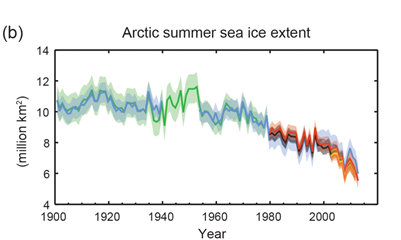
CaptureOne dramatic piece of evidence that global warming is real is the rapidly shrinking size of the artic polar ice cap measured at the end of each summer. In a previous post last December 8, I took note that at least 29 U.S. companies “are incorporating a price on carbon into their long range plans.” I also noted a report from the Congressional Budget Office which estimates that a tax on energy companies of $20 to emit a ton of CO2 would raise $120 billion a year and raise the cost of gasoline by 10 to 15 cents per gallon.
The scene is clearly set. There is a serious threat to life on earth. We have a good estimate of what it will take to meet the threat and a specific time window for responding. We also know the approximate cost of a sensible plan for doing so. Can our democratic political system be moved to action?
A large energy tax like this will take a bite out of the economy. An attractive way of building support would be to make it part of broad based tax reform designed to stimulate the economy with lower individual and corporate rates offset by closing loopholes and eliminating deductions. In fact a carefully assembled package might be able to reduce carbon emissions, stimulate the economy (with lower tax rates) and raise revenue to pay down the deficit, all at the same time!
Is this too much to hope for?

Wealth Inequality vs Income Inequality


The Yale Economist and Nobel Prize winner, Robert Shiller, has an article in today’s New York Times, “Better Insurance Against Inequality”, proposing that “taxes should be indexed to income inequality so that they automatically become more progressive – meaning that the marginal tax rate for the highest income people will rise – if income equality becomes much worse.”
CaptureWe do know, of course, that income inequality is steadily increasing in the U.S. It is in fact essentially folklore that the top 1% of Americans is collecting a larger and larger share of the national income. Furthermore the French economist, Thomas Piketty, has recently shown that there is also “a relentless widening of disparity in wealth”.
Our democratic political system will surely respond in some way to this increasing gap between the rich and the poor. It is important to our future wellbeing to respond in a constructive manner. Today’s top tax rate of 39.6% is already very high and Mr. Shiller admits that the top rate would have to rise well over 75% in his plan.
Our biggest economic problem today is a stagnant economy. We badly need faster economic growth, in order to put people back to work and to bring in more revenue to shrink the deficit. Today what we need is lower tax rates, to put more money in the hands of people who will spend it, including potential entrepreneurs who will invest it in new businesses. Raising tax rates to address rising income inequality is therefore self-defeating as an economic strategy.
Rather let’s tax people’s financial assets after they have earned their money. A 1% wealth tax with a relatively high $10,000,000 personal exemption would bring in approximately $200 billion per year.  $200 billion per year would enable us to pay down our deficit at a much faster rate as well as having a lot left over to begin an extensive infrastructure renewal program (for example)!

Why Debt Matters II. “Go for the Heart”


The author and lecturer, David Horowitz, has just published a little pamphlet,”Go for The Heart: How Republicans Can Win” describing how conservatives are being outmaneuvered on the campaign trail.
Capture“Year after year the Democrats’ campaign themes are monotonously familiar. They rely on scaring the voters by accusing Republicans of the same imaginary crimes: Republicans are a party that wages war on women, minorities, and vulnerable Americans. They don’t care about the vulnerable and the poor. Their policies inflict pain on working families to benefit the wealthy few.”
“ ’Caring’ is not one among many issues in a democratic election. It is the central one. Since most issues are complex and require too much information, voters care less about policy than about the candidates themselves. Above everything else they want to know who they can trust. Far more important to voters than a particular policy, they want a candidate or party who cares about them.”
“Behind Republican campaign failures lies an attitude that reflects an administrative rather than political approach to election campaigns. Such an approach focuses on policies for running the country and fixing problems rather than the political aspect of the electoral battle.”
In other words, fiscal conservatives must make a compelling moral case why it is so important to stop spending money that we don’t have.

  • By piling up more and more debt year after year, we are creating a huge burden for future generations. Is this the legacy we want to leave for our children and grand- children?
  • If we do not control the growth of entitlement programs, we are endangering their very existence. It’s ordinary people with average incomes who will need Social Security and Medicare when they retire. It’s our moral obligation to keep these programs sound for their sake!
  • Boosting the economy with lower tax rates has nothing to do with helping the rich. In fact, it’s the rich who benefit from the tax loopholes and preferences which must be eliminated to pay for these rate cuts to benefit the people who really need them!
  • Insisting on a work requirement for welfare recipients is demonstrating the tough love that they need to gain the dignity of becoming productive citizens. We need to give them a hand as well as a handout!

These are just a few examples of ways that conservatives can address the debt and deficit issues in a positive, and non-punitive, manner. Thanks to Mr. Horowitz I will attempt to take this approach consistently from now on.

Why Debt Matters


The House Committee on Financial Services recently held a hearing on the topic “Why Debt Matters.” One of the speakers was David Cote, CEO of Honeywell International. He pointed out that the percentage of world GDP generated by the developed countries (the U.S., Western Europe, Canada and Japan) is predicted to decline from 41% in 2010 to 29% by 2030. High growth developing economies are expected to grow in GDP from 33% in 2010 to 47% in 2030. In order to compete in this new world we need an “American Competitiveness Agenda.”
Mr.Cote suggests eight components: debt reduction, infrastructure development, better math and science education, immigration reform, tort reform, stronger patent support, more energy generation and efficiency, and trade expansion. “To compete effectively on the increasingly competitive world stage, we have to have a strong balance sheet. We don’t have a strong balance sheet today and it will worsen over time with our current plan. … In 2025, just 11 years from now, we will be spending a trillion dollars a year just in interest.” And this is assuming no more recessions in the meantime!
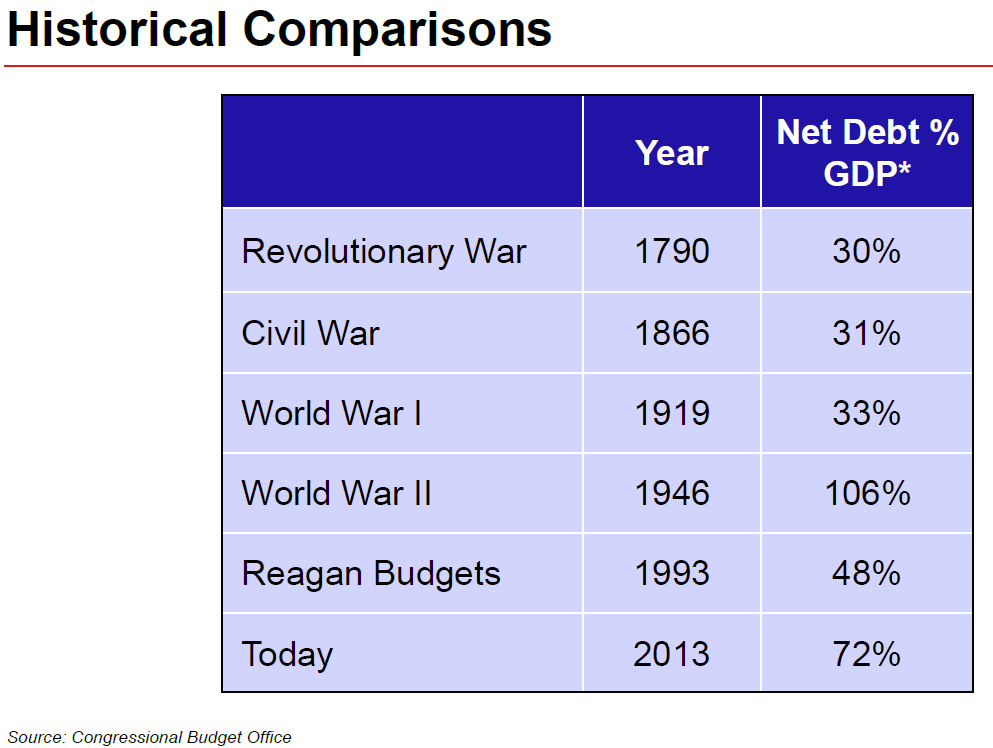
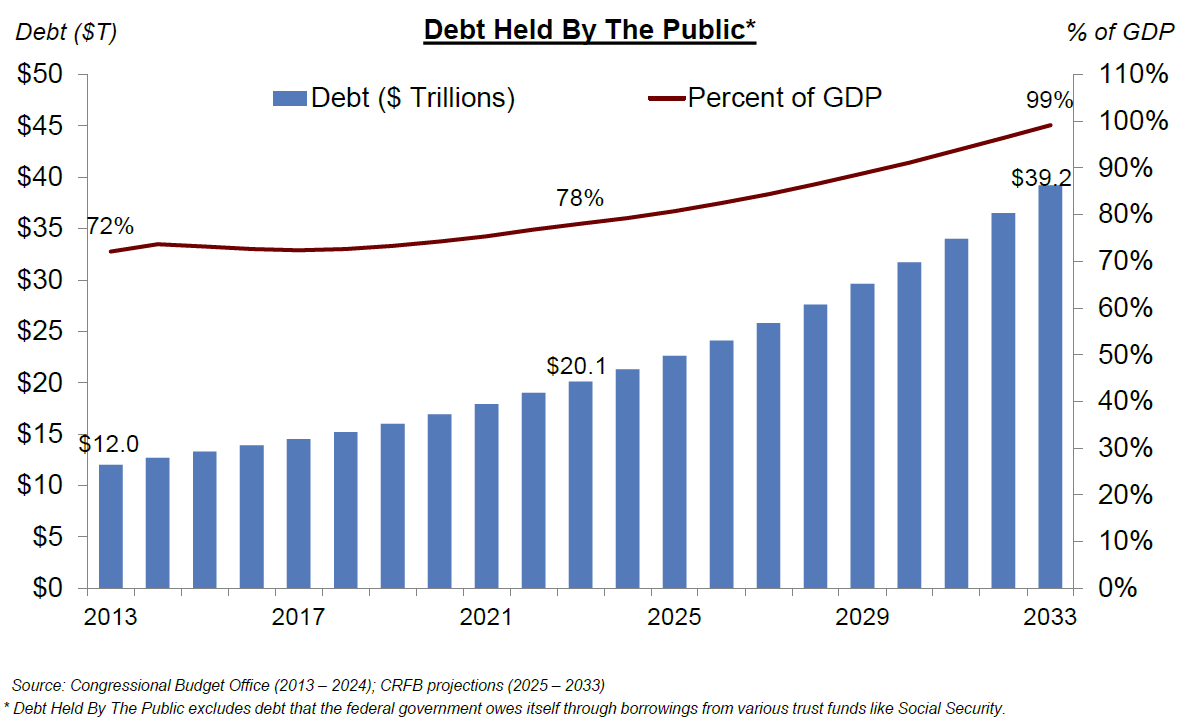
CaptureOur public debt level today, at 72% of GDP, is higher than at any time in our nation’s past, except for during World War II when the survival of the free world was at stake. And while public debt will be 78% of GDP in 2023, which might not sound much worse than today, it is also projected to be much higher, 99% of GDP, by 2033. Is this really the legacy that we want to leave for our children and grandchildren?
Capture1Some people say that we should run even bigger deficits right now until we are fully recovered from the Great Recession. But this is what we’ve been doing for the past five years and it’s not working. How much longer do we wait until we change course?
It’s possible to shrink our deficits and speed up the growth of our economy both at the same time. This is what Mr. Cote is saying and what I am constantly talking about on this website!