Let’s Devolve Federal Programs Back to the States!


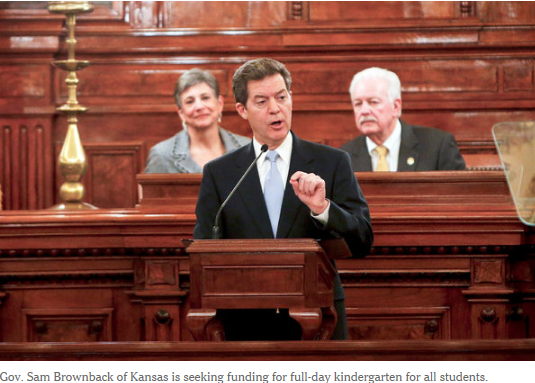
Yesterday’s New York Times has an article “Battles Looming Over Surpluses in Many States”, pointing out that “unexpectedly robust revenues from taxes and other sources are filling most state coffers, creating surpluses not seen in years and prompting statehouse battles over what to do with the money.”  For example, in Kansas, Governor Sam Brownback is calling for full day kindergarten for all students.
CaptureThis raises a larger issue.  The states are recovering from the Great Recession and have lots of money.  We know that states spend money far more efficiently than the federal government, because states have constitutional requirements to balance their budgets.  On the other hand, the federal government is hemorrhaging red ink at a frightening rate which will just keep getting worse indefinitely until strong measures are taken.  It has taken on far too many responsibilities and spends money very inefficiently.
All of this suggests an obvious course of action to turn around a very bad situation.  We should devolve as many federal programs as possible back to the states.  Here are three good ones to start with:

  • Medicaid costs the federal government about $250 billion per year with another $150 billion being paid for by the states.  The problem is that federal support is a fixed percentage of what the states spend.  This makes Medicaid a very expensive program with no limit on the cost to the federal government.  A good way to solve this problem is to “block grant” Medicaid to the states and let each state figure out the best way to spend its own federal allotment.  Annual increases in the size of federal block grants could be tied to the rate of inflation in order to limit their growth.
  • Education spending at the federal level is a $100 billion per year (not counting student loans) item.  Just at the K-12 level alone there are over 100 individual programs to which states and school districts have to apply for funds separately.  Wouldn’t it make far more sense to “block grant” education funds back to the states so that this large sum of money can be spent more effectively and efficiently by targeting it at the biggest needs in each state?
  • Job-Training costs the federal government $18 billion per year for 47 different programs.  Again it would be so much more sensible to block-grant job training funds to the states and measure effectiveness by the number of workers hired.

There really are relatively simple ways for the federal government to operate more effectively and at much lower cost.  We need national leaders who are committed to getting this done.

What Is the State of the U.S. Economy?


On the eve of the President’s State of the Union address, the New York Times gives an answer to this question in today’s paper, “Obama’s Puzzle: Economy Rarely Better, Approval Rarely Worse”.  The charts below do show the basic trends all moving in the right direction.  But is this good enough?
CaptureThe unemployment rate is moving steadily downward but it is still a high 6.7% almost five years after the recession ended in June 2009.  And this is with a labor participation rate of only 58.6%, which is historically very low.
The budget deficit is dropping but is still unsustainably high.  In the five years, 2009 – 2013, deficits have totaled $6 trillion dollars.  As soon as interest rates return to their historical average of 5%, interest on this $6 trillion in new debt alone will total $300 billion per year, forever!  Furthermore, the Congressional Budget Office, the most credible source of budget information, predicts that the deficit is likely to resume an inexorable climb within a few years as baby boomers retire in ever greater numbers, rapidly driving up entitlement costs.
Economic growth was stronger than expected in the last quarter of 2013 and this is a good sign.  But it has averaged only about 2% since the recession ended which is very low by historical standards, in a post recessionary period.
The point is, do we really need to settle for such mediocre performance: a stagnant economy, high unemployment and massively accumulating debt?  Should we just declare that in a highly competitive global economy with an ever higher premium on information and technology, that we just can’t do any better than we already are?  Isn’t there some way to make our economy grow faster in order to provide more and higher paying jobs?
I think that the answer to this last question is an emphatic yes!  In fact, this is what my blog is all about.  Just read some of the other recent posts and let me know if you disagree with what I am saying!

Fundamental Tax Reform Is the Key to Solving Our Economic and Fiscal Problems II. The Graetz Plan

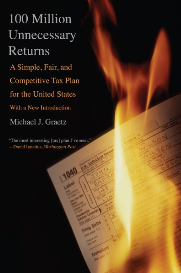
The Yale Tax Law Professor, Michael Graetz, has proposed a new tax system “100 Million Unnecessary Returns: A Simple, Fair, and Competitive Tax Plan for the United States” which would do wonders towards straightening out the huge fiscal and economic problems now facing our country.
CaptureHow do we rev up the national economy in order to put more people back to work and, at the same time, raise the revenue needed to operate the government in the 21st century without mountains of debt?  Mr. Graetz’s basic idea is to tax consumption rather than relying totally on an income tax.  Under his plan both savings and investments will be taxed at a lower rate which will encourage more of both.  The Plan has these features:

  • A broad based Value Added Tax of about 14% is enacted on goods and services.  The U.S. is the only advanced economy without a VAT.
  • Families earning less than $100,000 are exempted from the income tax.  For incomes between $100,000 and $250,000, the tax rate would be 15%.  For income over $250,000, the rate would be 25%.
  • The corporate income tax rate is lowered to 15%.
  • The Earned Income Tax Credit (EITC) is used to provide relief from the VAT burden to low-income families by using payroll tax offsets.
  • The plan is designed to be revenue neutral as verified by the Tax Policy Center.

This plan has many advantages including:

  • Taxing consumption and lowering the corporate tax rate to 15% from its current level of 35% would dramatically encourage investment in the U.S. thereby stimulating the economy and creating both new jobs and higher wages for American workers.
  • It would eliminate more than 100 million of the 140 million U.S. tax returns.
  • With many fewer Americans paying income taxes there would be far less temptation for Congress to use income tax exclusions, deductions and credits to try to address social and economic problems.
  • The plan retains all of the progressive features of our current tax system whereby higher income earners pay higher tax rates.

The point of describing the Graetz Plan in some detail is not to suggest that it is the best way to implement tax reform but rather that here, at least, is one attractive way to do it.  The purpose is to move the discussion forward.  We badly need to make changes along these lines!

Fundamental Tax Reform Is the Key to Solving Our Economic and Fiscal Problems I. Why Change Is Needed

I have been writing this blog for just over a year.  It addresses what I consider to be the two biggest problems faced by our country at the present time.  First is our enormous national debt, now over $17 trillion, and the huge annual budget deficits which are continuing to make it worse.  The second problem, of equal magnitude, is our slow rate of economic growth, about 2% of GDP annually, ever since the Great Recession ended in June 2009.
CaptureThese two problems are closely related.  If the economy grew faster, federal tax revenue would grow faster and the annual deficit would shrink faster.  Not to mention that a faster growing economy would create more jobs and lower the unemployment rate, which is still a high 7%.
The impediments to solving these problems are huge.  Our public debt, on which we pay interest, is now over $12 trillion or 73% of GDP.  Although it may stabilize at this level for a few years, it will soon begin climbing much higher, without major changes in current policy.  This is primarily because of exploding entitlement spending for retirees (Social Security and Medicare) who will increase in number from about 50 million today to over 70 million in just 20 years.  As interest rates return to normal higher levels, just paying interest on the national debt will become, all by itself, a larger and larger drain on the economy.
The impediments to faster economic growth are increasing global competition, such as inexpensive foreign labor, as well as rapid advances in technology, such as electronics and robotics.  Both of these trends reduce the need for unskilled workers in America which in turn holds down wages and slows down economic growth.
At the same time we have an antiquated tax code to raise the huge sums of money necessary to pay for a large and complex national government.  It worked fine through the post-World War II period, as long as the U.S. had the dominant world economy with little significant competition from others.  But this situation no longer exists.  We now have a tax system which doesn’t raise enough money to pay our bills and at the same time is so progressive that the highest rates (39.6% on individuals and 35% for corporations) are not sufficiently competitive with other countries.  This discourages the entrepreneurship and business investment we need to grow the economy faster and create more jobs.
We have an enormous problem on our hands!  Is it possible to fundamentally change our tax system to turn things around?  My next post will answer this question in the affirmative!

How Do We Fight Economic Inequality? By Restoring Growth!

The liberal economist Paul Krugman returns to one of his favorite topics in yesterday’s New York Times, “Why Inequality Matters”.  “On average, Americans remain a lot poorer today than they were before the economic crisis.  For the bottom 90 percent of families, this impoverishment reflects both a shrinking economic pie and a declining share of that pie.”  The problem with Mr. Krugman’s analysis is that he offers no solution beyond more fiscal stimulus: “the premature return to fiscal austerity has done more than anything to hobble the recovery.”
CaptureBut there is another route to recovery and it is propounded in today’s Wall Street Journal by George Osborne, the United Kingdom’s Chancellor of the Exchequer, “How Britain Returned to Growth”. “We cut spending and top tax rates, and now deficits are down and jobs are being created at a healthy clip … at the rate of 60,000 per month, roughly equivalent to 300,000 in the U.S. … The corporate tax rate is being cut to 20% from 28%. … As a result, more international firms are moving their headquarters to Britain and investment is flowing into our country.”
Yes, as Mr. Krugman says, economic inequality in the U.S. is bad and getting worse.  The question is what to do about it.  Shall we try to improve the situation with artificial stimulation, increasing government debt, already very high, for future generations?  Or shall we address this inequality by encouraging businesses to grow and expand and thereby raise wages and hire more people.
The good news is that America is the success story of the 20th century.  The bad news is that everyone else in the world has figured this out and is now copying our own best methods.  Either we can compete, innovate, stay on top and thrive, or else we can get lazy, stagnate and sink down in the pack.
Will it be more inequality or more growth?  The choice is up to us!

How to Get the Economy Back on Track


Harvard Economist, Martin Feldstein, has an Op Ed column in yesterday’s New York Times, “Saving The Fed From Itself”, which gets our current economic situation half right.  First of all, Mr. Feldstein says that the Fed’s quantitative easing policy is inadequate because “the magnitude of the effect has been too small to raise economic growth to a healthy rate.  … The net result is that the economy has been growing at an annual rate of less than 2 percent.  … Weak growth has also meant weak employment gains.  … Total private sector employment is actually less than it was six years ago.  … While doing little to stimulate the economy, the Fed’s policy of low long-term interest rates has caused individuals and institutions to take excessive risks that could destabilize the economy just as it did before the 2007-2009 recession.”  So far he’s right on the button!
But then he goes on to say, “To get the economy back on track,” Congress should enact a five year plan to spend a trillion dollars or more on infrastructure improvement and that this would “move the growth of gross domestic product to above three percent a year.”  An artificial stimulus like this might work temporarily but then it ends and we’re back where we started.  We need a self-generating stimulus that will keep going indefinitely on its own.  How do we accomplish this?
The answer should be obvious.  We do it by stimulating the private sector to take more risk in order to generate more profits. In the process they will hire more employees and boost the economy.
How do we motivate the private sector?  By lowering tax rates and loosening the regulations which stifle growth.  Closing tax loopholes and lowering deductions (which will raise revenue to offset the lower tax rates) has the added benefit of attacking the corporate cronyism which everyone deplores.
We really do need to put first things first.  If we can jump start the economy by motivating the private sector to invest and grow, we will have more tax revenue to spend on new and expanded government programs as well as shrinking the federal deficit.
Why is this so hard for so many people to understand?

The Mess in Detroit: A Stern Warning for the Whole Country


An article in yesterday’s New York Times, “Detroit Ruling Lifts a Shield on Pensions”, reports a ruling by bankruptcy judge Steven W. Rhodes that Detroit “could formally enter bankruptcy and that Detroit’s obligations to pay pensions in full is not inviolable.”
The article goes on to say “that most here agree that the city’s situation is dire:  annual operating deficits since 2008, a pattern of new borrowing to pay for old borrowing, miserably diminished city services, and the earmarking of about 38 percent of tax revenues for debt service.  A city that was once the nation’s fourth largest has dropped to 18th, losing more than half of its population since 1950.  The city was once home to 1.8 million people but now has closer to 700,000.”
The parallels and analogies between what has happened in Detroit and what is now happening in the U.S. are striking.  The U.S. has had huge annual deficits for five years in a row and the accumulated debt is enormous, the Federal Reserve is holding interest rates down to make borrowing cheaper, and our country’s infrastructure is deteriorating much faster than it is being repaired.
Right now interest on the national debt is small ($223 billion in 2013, or 8% of federal revenues).  But interest rates will inevitably return before long to their average historical rate of about 5%.  Right now the public debt (on which we pay interest) is just over $12 trillion.  This means that in the near future interest on the national debt will be at least $600 billion per year and probably much larger because the debt is still growing so rapidly.  This will take a huge bite out of revenue and leave far less of it for other purposes.
This problem will continue to exist even if the budget were to be miraculously balanced from now on but it would at least lessen over time as the economy continues to grow.  Without budget restraint the problem will never go away and will be a perpetual drag on our national welfare.
This is, of course, exactly the condition in which Detroit finds itself at the present time.  Detroit has the option to declare bankruptcy and make its creditors and pensioners take big losses.  Once it does this it can make a fresh start and perhaps recover its former status.
But are we prepared to let the whole country suffer a similar fate?  The consequences would be enormous.  If the U.S. goes down, the whole western world could come down with it.  Democracy and human progress would be severely threatened.  This is really too terrible a tragedy to even contemplate.  Let’s turn things around before they get any worse!

Controlling the Cost of Healthcare

Capture

The New York Times is running a series of articles, “Paying Till It Hurts,” giving many examples of the very high cost of healthcare in the U.S. today.  The latest article “As Hospital Prices Soar, A Single Stitch Tops $500”, focuses on the high cost of emergency room treatment around the country.
We spend 18% of GDP on healthcare, twice as much as any other country in the world.  It is specifically the cost of healthcare entitlements, Medicare and Medicaid, which is driving our huge deficits and rapidly growing national debt.  But to limit the cost of these entitlement programs, we first have to address the more fundamental problem: how to control the overall cost of healthcare in general.
Our current healthcare system, a combination of private insurance and government programs, is very inefficient. The basic problem is that the tax treatment of employer provided health insurance takes away the incentive for individuals to control the cost of their own care.   And Obamacare does not solve this problem, because it just extends the present system to more people, rather than revamping it.
There are essentially two different ways to transform our current healthcare system to make it far more efficient.  One way is to turn it into a single payer system, like what most of the rest of the world has.  This could be accomplished by simply expanding Medicare to everyone.  Costs would then be controlled by government regulation which would, of course, include rationing.  Given the unpopularity of Obamacare, with all of its mandates and uniform coverage requirements, it is unlikely that Americans would be happy with such a highly proscribed single payer system.
The alternative is to change over to a truly consumer based, market oriented system.  This could be accomplished by limiting the present tax exemption for employer provided insurance.  For example, the current system could be replaced by a (refundable) tax credit equal to the cost of catastrophic insurance (i.e. insurance with a very high deductible).  All other healthcare costs, whether paid for directly by consumers or through insurance, would be with after tax dollars.  Subsidies could be provided to lower income people through the Obamacare exchanges.  Once such a system is set up and running smoothly, it could fairly easily be extended to encompass Medicare and Medicaid.
Insurance companies selling catastrophic coverage would negotiate with hospitals and other healthcare providers to get the lowest possible prices for their customers.  In other words, both insurance companies and providers would compete in the open market to deliver healthcare products at the lowest possible cost.
Something along this line will have to be done and the sooner we get started the better!

Should the Minimum Wage Be Raised?

In today’s New York Times, the economist Arindrajit Dube has an Op Ed column in the Great Divide series, “The Minimum We Can Do”, pointing out that today’s minimum wage of $7.25 per hour is only 37% of today’s median hourly wage of about $20 per hour.  This compares with the 1968 minimum wage of $10.60 per hour (in today’s dollars, adjusted for inflation) which was 55% of the median wage at that time.  This is in line with the current Democratic proposal to raise the minimum wage to $10.10 per hour.
The standard argument against raising the minimum wage is that it will reduce employment because “when labor is made more costly, employers will hire less of it.”  However Mr. Dube offers empirical data which “suggest that a hypothetical 10% increase in the minimum wage affects employment in the restaurant or retail industries by much less than 1 percent” and therefore very little.
Basically Mr. Dube is arguing that raising the minimum wage won’t hurt the economy and it will help many low-paid workers.  The problem with this point of view is that it distracts attention from what we really should be doing: namely, everything we possibly can to speed up economic growth.  By far the best way to raise wages is to increase the value of labor by creating more jobs!
I may sound like a broken record, repeating the same thing over and over again, but we badly need to concentrate on the fundamentals of growing the economy: lowering tax rates, individual and corporate, to stimulate business investment and risk taking by entrepreneurs; removing onerous regulatory burdens, especially on new businesses and existing small businesses; and emphasizing career education and job training to fill the millions of high skill job openings which exist.
There are strong headwinds facing our economy: bad demographics (rapidly retiring baby boomers), pressure from technological progress and globalization which put a high premium on education and advanced skills, and massive national debt which will become a huge burden as interest rates inevitably increase.
These strong headwinds aren’t going away.  To overcome them we need national leaders who are able to rise above ideology and focus on the fundamentals.
Conclusion: we should raise the minimum wage when unemployment drops to 6% or, perhaps, tie a raise in the minimum wage to a tax reform measure which significantly lowers tax rates.

The Floundering of America


In yesterday’s Wall Street Journal, columnist William Galston talks about “The Floundering of America”.  Based on recent reports from the Congressional Budget Office, Mr. Galston says that “Today we are hurtling toward a less dynamic economy, a meaner society and a riskier world.”
His argument is based on these observations:

  • For the past 40 years, 1970-2010, the labor force expanded at an average rate of 1.6% per year.  It will soon slow to only .4% annual growth, because of more retirements and a plateauing of women’s labor-force participation. This means that growth in GDP will slow down to about 2% annually from its historical average of over 3%.
  • America is aging very fast.  Today there are 57 million Social Security beneficiaries which will increase to 76 million in 2023.  Obviously this will rapidly increase entitlement spending on retirees.
  • America already spends 18% of GDP on healthcare costs and the CBO projects that this will grow to 22% by 2038.

“In sum, current trends and policies will yield lower rates of economic growth, painfully slow gains in real incomes, huge increases in outlays for expenses related to an aging population, and a health sector that devours more and more of the national product”, he says.
These trends are all contributing to an explosion of the national debt.  The only current strategy to keep this debt even roughly stable during the next decade, let alone reduce it, is to shrink discretionary spending through sequestration.  This will lead to a decline in discretionary spending to 5.3% of GDP by 2023.  This means roughly 2.6% of GDP for national defense with an equal share or all other domestic purposes.
“This is pure folly”, says Mr. Galston. “The country needs a new national strategy for a viable future.”
How do we achieve a new strategy?  Immigration reform will increase the size of the workforce.  Tax reform could boost the economy by encouraging business expansion, risk taking and entrepreneurship.  True (consumer-driven) healthcare reform could dramatically lower the cost of healthcare.  In other words there are potential policies out there that address our national floundering. We simply need leaders who are capable of going beyond partisanship in order to help create a better future!