The Economy Is Improving But Not Enough


It has been widely reported that medium household incomes were up 5.2% to $56,500 in 2015.  Furthermore the lower income quintiles have gained the most.  This is very good news.
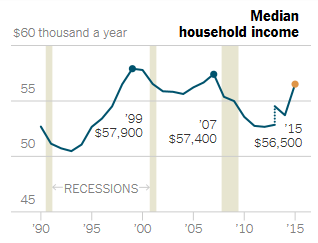
capture54But this new peak is below the previous peak of $57,400 in 2007, before the Great Recession started, which in turn is below the absolute peak of $57,900 in 1999. Now look at economic growth more broadly.
capture55The second chart shows the annual rate of real (i.e. inflation adjusted) GDP growth, by expansion period, all the way back to 1949.  What is most striking is that growth has been steadily decreasing over this entire time period and is now down to an average rate of just 2% during the current recovery. There is really only one way to reverse this steep decline.  It is to return to proven fundamentals as well explained by the economist, John Cochrane.  In summary:

  • There is only one source of growth. Nothing other than productivity matters in the long run. And, unfortunately, the business investment which leads to gains in productivity is way down.
  • The vast expansion in regulation is the most obvious change in public policy accompanying America’s growth slowdown.
  • The basic structure of growth-oriented tax reform is lower marginal rates paid for by removing exemptions and loopholes. A high corporate tax rate hurts workers more than anyone else.
  • Solving our immigration problem would turn 11 million illegal immigrants into productive citizens. Guest worker and e-Verify enforcement are fixable problems.
  • International trade with strict reciprocity between trading partners will benefit almost everyone. Manufacturing workers who lose their jobs to foreign competition need robust retraining programs for the many manufacturing jobs which still exist.

Conclusion. Faster economic growth is imminently doable. Just follow tried and true economic fundamentals!
Follow me on Twitter
Follow me on Facebook

The Remarkable Human Progress of the Last 200 Years II. What Has Caused It?


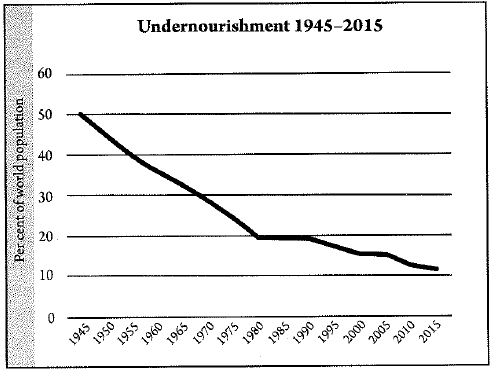
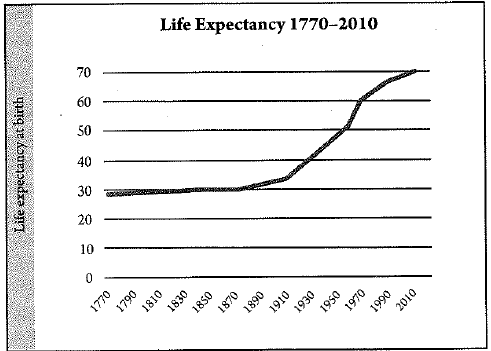
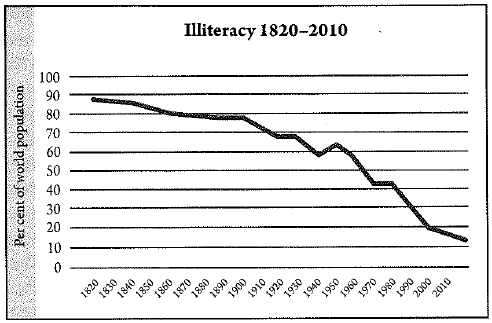
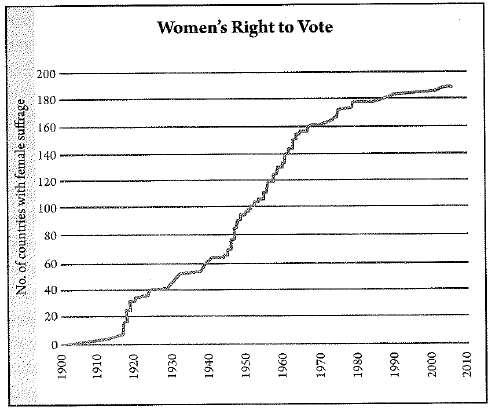
In my last post, “The Remarkable Human Progress of the Last 200 Years,” I presented the findings of a new book by Johan Norberg, “Progress: ten reasons to look forward to the future.”  Mr. Norberg details how much human welfare has progressed in such fundamental ways as food availability, improvements in sanitation, increased life expectancy, poverty reduction, gains in literacy, decline of slavery, and equal rights for all.
This raises the obvious question: What is responsible for all of this enormous progress?

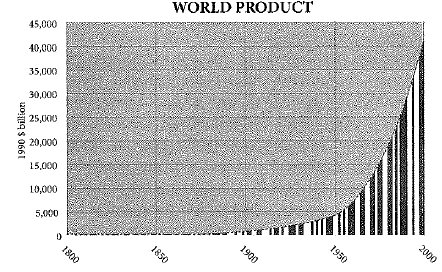
capture52An answer to this question is provided by Matt Ridley in his book, “The Rational Optimist: how prosperity evolves.”  First of all, Mr. Ridley points out that since the year 1800, income per capita has increased nine times (in constant dollars) and even though the rich have gotten richer, the poor have done even better.
But in addition it is the “invention of invention” attributed to the evolution of human nature which has led to the explosion of innovation in the past two centuries.  So what propels this explosion of invention?  According to Mr. Ridley:

  • It is not Driven by Science. In fact science is more like the daughter than the mother of technology.
  • Money is important to innovation but not paramount. For example, the pharmaceutical industry often simply buys small firms which have developed big ideas, rather than large companies developing their own products,
  • There is little evidence that Intellectual Property, i.e. patents, is what drives inventors to invent.
  • Government is bad at innovation. In fact it is more likely to crowd out resources which could be put to better use by the private sector.
  • In fact it is the ever-increasing Exchange of ideas which causes the ever-increasing rate of innovation in the modern world.

Conclusion. “The more you prosper, the more you can prosper. The more you invent, the more inventions become possible. … There is an inexhaustible river of invention and discovery irrigating the fragile crop of human welfare.”

Follow me on Twitter
Follow me on Facebook


The Remarkable Human Progress of the Last 200 Years


About a month ago I had a post, “Optimism or Pessimism for the Future: Which is More Justified?” in which I referred to the book, “The Rational Optimist,” by Matt Ridley to point out all of the positive trends in present day society. I come back to this topic today because of another remarkable new book, “Progress: ten reasons to look forward to the future,” by the Swedish economic historian, Johan Norberg. The following brief illustrated comments give the flavor of Mr. Norberg’s book:

  • The Good Old Days Are Now, referring to the rapid rise in global wealth starting in about the year 1800.capture43
  • Food. In 1968 Paul Ehrlich wrote in The Population Bomb that “in the 1970s, the world will undergo famines and hundreds of millions of people are going to starve to death.” Yet just the opposite happened.capture44
  • Sanitation. Consider that in 1980 only 24% of the world’s population had access to proper sanitation and today this has increased to 68%.capture48
  • Life Expectancy. Consider that smallpox was totally eradicated in 1980 and that the number of annual cases of polio has been reduced from 350,000 in 1988 to just 416 today.capture49
  • Poverty. Between 1981 and 2015 the proportion of the developing world population living in extreme poverty (less than $2 per day) fell from 54% to 12%.capture50
  • Literacy. The global ratio of female literacy to male literacy increased from 59% to 91% between 1970 and 2010.capture45
  • Freedom. In 1950 31% of the world population lived in democracies, increasing to 58% in the year 2000. Today that number has increased to 64%.capture46
  • Equality. Minority rights, women’s rights and gay rights have all increased enormously during the last 100 years.capture51

The author concludes, “Even though wealth and human lives can be destroyed, knowledge rarely disappears. It keeps on growing.  Therefore any kind of backlash is unlikely to ruin human progress entirely.  But progress is not automatic.  It is the result of hard-working people and brave individuals. If progress is to continue, you and I will have to carry the torch.”

Follow me on Twitter
Follow me on Facebook

Why Medicaid Needs to Be Reformed


One of the very most serious problems facing our nation is our massive federal debt, now over $13 trillion (the public debt on which we pay interest), or 75% of GDP, the highest since right after WWII, and predicted by the CBO to keep getting worse unless major policy changes are made.
The main contributors to this rising debt are the big three entitlement programs of Social Security, Medicare and Medicaid. All three need substantial reforms in order to rein in spending.
Today I will discuss Medicaid, based on an excellent analysis performed by the Manhattan Institute’s Oren Cass, “Over-Medicaid-Ed: how Medicaid distorts and dilutes America’s Safety net.”
capture41Consider these pertinent points:

  • Badly designed incentives for Medicaid expansion. Each state sets the size of its Medicaid program and receives matching federal dollars, from $1 to $4, for every dollar spent. States thus have a strong incentive to overinvest in Medicaid, expanding their programs far beyond the point where a marginal dollar of their own spending produces a dollar of value.
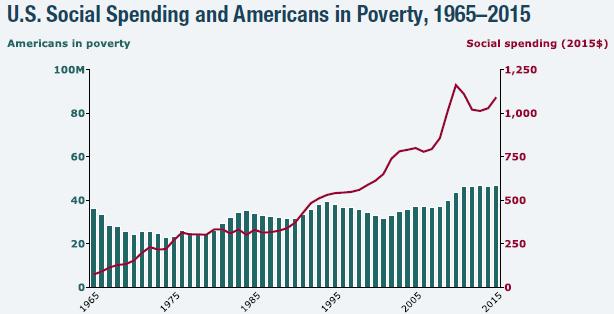
  • Health care dominates safety-net spending. During 1975 – 2015, government social spending per person in poverty more than doubled (in constant 2015 dollars) from $11,600 to $23,400. Rising health care expenditures accounted for more than 90% of that increase.

    capture42

  • Medicaid spending in 2012 was 39% higher than if it had remained a constant share of state budgets since 2000. State spending on education and welfare was 9% and 54% lower, respectively.
  • This allocation is an ineffective poverty-fighting strategy. While the majority of government social spending goes to health care, low-income households not enrolled in Medicaid allocate less than 10% of their spending to health care. Studies consistently show little or no positive impact on health outcomes from Medicaid enrollment.
  • How to strengthen America’s safety net. The federal government should consolidate all antipoverty funding streams, including Medicaid, and allow states to design programs and allocate funding to such programs as states see fit.

Conclusion. The above program outlines a way to both improve the effectiveness of social welfare spending and curtail its costs to both states and the federal government. Let’s do it!

Follow me on Twitter
Follow me on Facebook


Donald Trump Needs a More Positive Message


As regular readers of my blog posts know, I am not enthusiastic about either of our two main presidential candidates because neither of them has a good grasp of our two biggest economic problems which are:

  • Slow economic growth, averaging just 2% per year since the end of the Great Recession in June 2009. Faster growth would solve or alleviate many other problems, especially by creating more new jobs as well as delivering faster wage growth for all middle- and lower-income workers.
  • Massive debt now at 75% of GDP, the highest it has been since right after WWII, and projected by the Congressional Budget Office to get steadily worse unless big changes are made in spending and tax policies. Such major changes are difficult to make without presidential leadership.

Hillary Clinton promises “equitable” growth but her policy proposals will lead to a big increase in spending (bad idea) on projects of dubious value in speeding up economic growth. Donald Trump would hurt the economy with immigration controls and trade restrictions.  His proposal for lower tax rates (good idea) needs much improvement to avoid increasing annual deficits.
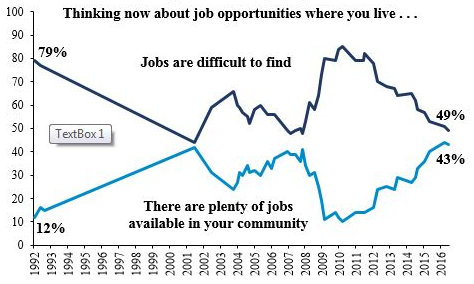
capture40Mr. Trump’s biggest problem, however, is his negative message about life in America today. Yes, we need stronger border security but we don’t need a Fortress America.  As the American Enterprise Institute has just reported, worker satisfaction is greatly improved since 2009 and workers are now much less anxious about job security than just a few years ago.
There is a really good way for Mr. Trump to sound a more positive note.  He could very easily take up the major themes of the Republican House Plan, “A Better Way” for solving America’s major economic problems.
Conclusion. There is an overwhelming desire for change in America, for new leadership which breaks out of the corruption, cronyism and elitism so rampant in Washington DC today.  But Americans are natural optimists and want a leader who can look forward to a bright future for our country.

Follow me on Twitter
Follow me on Facebook

Can U.S. Economic Growth Be Speeded Up? II. A Major Roadblock


In my last post, “Can U.S. Economic Growth Be Speeded Up?”  I pointed out that:

  • GDP growth has averaged just 2% since the end of the Great Recession in May 2009.
  • The Federal Reserve has taken unprecedented steps to keep interest rates low in the meantime but these efforts aren’t boosting GDP and, in addition, have quite harmful side effects.
  • Wages are growing and consumers are spending money but business investment is shrinking and productivity growth is slowing.
  • This means that the problem is supply side rather than demand side, contrary to what many economists are saying.

At least part of the problem is a lack of skilled workers. Two articles in today’s Wall Street Journal, here and here point out that:

  • America is now home to a vast army of jobless men, seven million of them age 25 to 54, who are no longer even looking for work. This is 15.6% of the traditional prime of working life.
  • Openings for manufacturing jobs this year have averaged 353,000 per month up from 311,000 per month in 2015 and 121,000 per month in 2009.
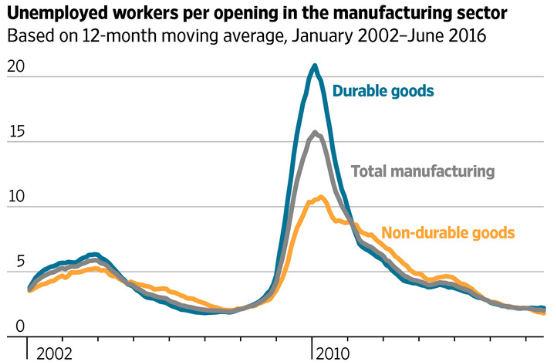
  • According to the Manufacturing Institute, 8 in 10 manufacturing executives say that the growing skills gap will affect their ability to keep up with customer demand.Capture39
  • As shown in the above chart, at the present time there are only an average of two unemployed manufacturing workers for each job opening, way down from the level in 2010.

Conclusion. Speeding up economic growth requires new business investment in order to increase worker productivity. But a lack of skilled and trained workers will greatly hamper this effort.  The solution here is better vocational and career training in high schools and at community colleges.

Follow me on Twitter
Follow me on Facebook

Can U.S. Economic Growth Be Speeded Up?


It is widely recognized and deplored, see here and here, that economic growth in the U.S. has been very slow, averaging only 2% per year, since the end of the Great Recession in June 2009.
The Federal Reserve has taken unprecedented steps to limit the severity of the recession by holding down both short term and long term interest rates.  But these efforts are only partially working and are, unfortunately, having a number of negative effects as well.
It also has been made quite clear that the problem is supply side and not demand side.  This is because, on the one hand, wages are beginning to rise more quickly and consumers are spending more money but, on the other hand, business investment is shrinking which is leading to slow productivity growth.
Capture38The American Enterprise Institute’s James Pethoukoukis has just provided new data  on the current weakness of business investment as illustrated in the above chart. Furthermore he quotes the economist, Robert Gordon, who has clearly described the many headwinds holding back the U.S. economy to the effect that:

“The American tax code exerts a downward pressure on capital formation and therefore on economic growth. It is now 30 years since the passage of comprehensive federal tax reform in the U.S.  In the intervening years, nearly every developed country has reformed its tax codes to make them more competitive than that of America.  Meanwhile the U.S. has allowed its tax code to atrophy.”

Conclusion. Yes, economic growth can be speeded up. But monetary policy won’t do the trick.  Congress must intervene with the right changes to fiscal policy, i.e. lowering tax rates for both individuals and corporations, paid for by closing loopholes and shrinking deductions.

Follow me on Twitter
Follow me on Facebook

The Economic Damage Caused by Very Low Interest Rates


As is well known, the Federal Reserve’s main tool in responding to the Financial Crisis in 2007 – 2009 has been quantitative easing (to lower long term interest rates) and direct reduction of the Federal Funds Rate (to lower short term interest rates). These measures definitely limited the severity of the Great Recession resulting from the Financial Crisis.  But the recession ended in June 2009, more than seven years ago.
Capture37In the meantime the continuation of such low interest rates is having many detrimental effects such as:

  • Pension funds, both public and private, have become greatly underfunded,  creating crises especially for state and local governments with defined contribution plans.
  • Retirement plans for millions of seniors have been upset by erosion of savings.
  • Inequality has increased as affluent stock owners benefit from the rapid increase of asset prices as investors reach for yield.
  • An immense misallocation of capital towards bond issuers at the expense of small business is taking place.
  • Federal debt is soaring as low interest rates make it much easier for Congress to ignore large budget deficits.
  • The next recession, when it inevitably arrives, will leave the Fed in a bind. The only tools remaining are a new round of quantitative easing (additional bond purchases) and even lower (i.e. negative) interest rates.
  • The Fed’s dual mandate of low unemployment (currently 4.9%) and price stability (low inflation) is being met but is accompanied by anemic GDP growth averaging only 2% since the end of the Great Recession. Such slow economic growth is largely responsible for the populist revolt in the 2016 presidential race.

Conclusion. Monetary policy can only accomplish so much. It is critical for the Fed to wind down its $4.5 trillion balance sheet as its bond holdings mature and to keep raising short term interest rates.  This will force Congress to step up to the plate with the changes in fiscal policy which are needed to stimulate economic growth.

Follow me on Twitter
Follow me on Facebook

How to Solve the Student Debt Problem: Grow the Economy Faster!


Based on a post I wrote last fall, “Solving the Student Debt Problem,” and a recent Op Ed by the economics journalist, Robert Samuelson, “Good News on the College Debt Front,” here is where I think we are on this serious problem:

  • The unemployment rate is very low for college graduates, about 2.5%. We should strongly encourage post-secondary education for all.
  • Since 1996 outstanding student loans have risen from $200 billion to $1.3 trillion.
  • Counting both community colleges, four year colleges and universities, 56% of college students borrow money to pay for college costs.
  • For undergraduates who attended two and four year colleges, more than half of loans were less than $20,000. Only 10% exceeded $40,000.
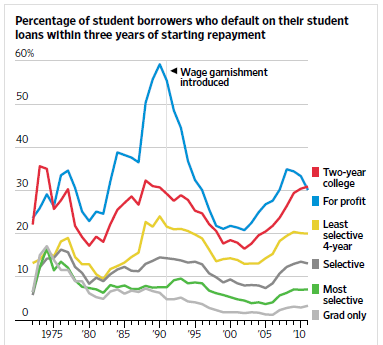
  • The highest default rates occur at community colleges (23% in 2012) and at for-profit colleges (18%). Hurt worst are low-income and minority students who never graduated but have unpaid debts.
  • The Federal Reserve Bank of New York has found a close correlation between subsidized loan and Pell Grant limits and the rapid increase of college tuition costs.

It seems clear that the way to address this problem is to focus on where it is worst: for the low-income and minority students who attend community colleges and for-profit colleges.
Capture36In other words:

  • Place a strict lid on the total amount of subsidized loans available for undergraduates, say $25,000 to $30,000 per person.
  • Use the savings achieved in doing this to increase the size of Pell grants for the lowest income students who need help the most.
  • Overall faster economic growth will help college graduates and dropouts alike find better paying jobs and make it easier for them to pay back their college debts.
  • On an individual basis, urge all students, but especially low-income and minority students, to avoid debt as much as possible in the first place!

Conclusion: Careful analysis of the student debt problem shows that there are very useful steps to take which will not cost the federal government more money.

Follow me on Twitter
Follow me on Facebook

How to Improve Obamacare and Lower It’s Costs


I have been making the case for some time now that the rapidly increasing costs of U.S. health care, especially for the entitlement programs of Medicare and Medicaid, is the fundamental cause of our exploding national debt, and therefore these costs must be curtailed.  The only way to fix this problem is for Americans to have more “skin in the game” regarding these costs.
Capture10My last post, “The Inherent Instability of Obamacare,” discusses the separate but related problem that the Affordable Care Act is actuarially unsound because it misprices the basic risks involved in health insurance.  This is why costs on the exchanges are going up so fast which, in turn, leads to fewer enrollees.
A good way to address this double whammy of problems is to use a plan developed (mostly) by the American Enterprise Institute in December, 2015.  The main features are:

  • ACA Mandates, for both individuals and employers, would be abolished.
  • Retain tax preferences for employer-paid premiums, with an upper limit comparable to the cost of catastrophic health insurance.
  • Provide refundable tax credits to households without access to employer coverage, gradually replacing subsidies provided by ACA exchanges.
  • Persons with pre-existing conditions would have continuous coverage protection.
  • Medicare would migrate to a defined contribution, refundable tax credit model as above, with eligibility gradually rising to age 67.
  • Medicaid would be financed with block grants to the states and would supplement the refundable tax credit model.
  • Health Savings Accounts, to accompany high deductible plans, would be encouraged with a one-time federal tax credit matching enrollee contributions.
  • Health Care for Veterans would be integrated into mainstream care.

Summary. Abolishing the mandates means that coverage levels and price would be actuarially determined in the market place. Equal tax credits for insurance and help in setting up health savings accounts ensure fairness and widespread accessibility.  The overall free market model will guarantee both low cost and the greatest possible degree of flexibility, innovation and quality of care.

Follow me on Twitter
Follow me on Facebook