What Is the Best Way to Boost the Economy and Create More Jobs?


The publication of two new books is causing a reevaluation of the financial rescue and its aftermath, e.g. “The Case Against the Bernanke-Obama Financial Rescue”.  The two books are “Stress Test” by Timothy Geithner, former Treasury Secretary, and “House of Debt” by the economists Atif Mian and Amir Sufi.
CaptureMr. Mian and Mr. Sufi maintain that the government’s response to the financial crisis should have focused less on saving the banking system and more on the problem of excessive household debt.  They discovered in their research that, during the housing bubble, less affluent people were spending as much as 25 – 30 cents for every dollar of increase in housing equity.  When the bubble burst, and housing prices started to fall, these borrowers cut way back on spending which caused many businesses to lay off employees.  The authors propose setting up a government program to help borrowers decrease what they owe in underwater mortgages.
Five years after the end of the Great Recession it would still be very helpful to speed up our lagging economy.  Here are three different possible ways to do this:

  • The Keynesians say the best way to stimulate the economy is with more government (deficit) spending. For example, spending several hundred billion dollars a year on infra-structure would create hundreds of thousands, if not millions, of new construction jobs. I think this is a good idea, but only if it’s paid for with a new tax (e.g. a carbon tax or a wealth tax).
  • The Mian/Sufi plan, as described above, would alleviate mortgage debt problems for millions of middle class homeowners who are still under water, encouraging them to spend more money which would in turn boost the economy. The problem is that the M/S plan creates a moral hazard for mortgage holders unless it’s paid for by mortgage insurance which would raise costs for borrowers.
  • Broad-based tax reform, with lower tax rates for everyone, paid for by closing loopholes and limiting tax deductions for the wealthy, would automatically put more income in the hands of the two-thirds of tax payers who do not itemize deductions. These middle class wage earners would tend to spend this extra money thereby boosting the economy.

The point is that there very definitely are ways to boost the economy, some better than others, and it should be a top priority of Congress and the President to get this done.

The Government We Deserve II. How Do We Make It Better?


“When the Athenians finally wanted not to give to society but for society to give to them, when the freedom they wished for most was freedom from responsibility, then Athens ceased to be free.”
Edward Gibbon, 1737 – 1794, The Decline and Fall of the Roman Empire

In my last blog, “The Government We Deserve,” I reported on a new book “Dead Men Ruling” by Eugene Steuerle, which shows how “Dead and retired policymakers have put America on a budget path in which spending will grow faster than any conceivable growth in revenues.”
CaptureOur country is clearly in a huge predicament.  We can get out of this jam by:

  • Restoring Balance: our legislators should only appropriate spending for one year at a time.
  • Investing in our future: i) opportunity is a more optimistic goal than adequacy ii) policies to assure adequacy often reduce opportunity by creating negative incentives    (e.g. food stamps, disability programs, housing vouchers) iii) means-tested programs are often anti-family (i.e. discourage marriage)
  • Building a Better Government: our main goal today should be to restore fiscal freedom by allowing future generations to create the government they need and want. i)   constrain the automatic growth in big federal tax subsidy, health and retirement      programs ii) reorient government towards investment, children, opportunity and leanness

“Both parties talk the talk about deficit reduction but fail to see that the deficit is but a symptom of a much broader disease – the extent to which both have tried to legislate far too much of what future government should look like.”
Here are the kinds of fixes which are needed:

  • Eschew Constitutional Fixes (i.e. a balanced budget amendment, term limits).
  • Require Presidents to propose budgets which balance over a business cycle.
  • A True Grand Compromise (end automatic growth of entitlements, generate revenues needed to pay current bills).

As Mr. Steuerle says, “If the obstacles to progress are considerable, the payoffs are enormous.”

The Government We Deserve


“As for the future, your task is not to foresee it, but to enable it.”
Antoine de Saint-Exupery, 1900 – 1944

An important new book, “Dead Men Ruling,” by the Urban Institute’s C. Eugene Steuerle, has just been published.  Here is the flavor of its message:
Capture“Dead and retired policymakers have put America on a budget path in which spending will grow faster than any conceivable growth in revenues. … The same policy makers also cut taxes so much below spending that they created huge deficits, which have now compounded the problem with additional debt.”
“Both sides have largely achieved their central policy goals – liberals have expanded social welfare programs, conservatives have delivered lower taxes.  Both now cling tenaciously to their victories.”
In short, “our central problem is the loss of fiscal freedom.” There are “four deadly economic consequences of this disease:

  • rising and unsustainable levels of debt,
  • shrinking ability of policymakers to fight recession or address other emergencies,
  • a budget that invests ever less in our future and is now a blueprint for a declining nation, and
  • a broken government, as reflected in antiquated tax and social welfare systems.”

In addition there are “three deadly political consequences:

  • a decline of ‘fiscal democracy’ depriving current and future voters of the right to control their own budget,
  • a classic ‘prisoner’s dilemma’ where both left and right leaning elected officials conclude that they will suffer politically if they lead efforts to impose either spending cuts or tax hikes, and
  • rising hurdles to changing our fiscal course because, to do anything new, requires reneging on past promises of rising benefits and low taxes, that voters have come to expect.”

In other words the U.S. is in a very difficult predicament.  Mr. Steuerle thinks it will take a major “fiscal turning point” to escape from the present danger.  Both sides will have to make big concessions in order for us to get out of this jam.  But how is this possibly ever going to happen?  More next time!

A Rescue That Worked But Left a Troubled Economy


The occasion of the publication of Timothy Geithner’s book “Stress Test,” giving his version of the financial crisis, has led to a number of newspaper articles looking back at the Great Recession and its aftermath.  The New York Times’ economics reporter David Leonhardt has such an analysis “A Rescue That Worked, But Left a Troubled Economy” in today’s NYT.
Capture“The Great Depression created much of modern American government and reversed decades of rising inequality.  Today, by contrast, incomes are rising at the top again, while still stagnant for most Americans.  Wall Street is flourishing again.”
“The financial crisis offered an opportunity to change this dynamic.  But the (Dodd-Frank) law seems unlikely to transform Wall Street, and the debate over finance’s huge role in today’s economy will now fall to others.  Should the banks be broken up?  Should the government tax wealth?  Should the banks face higher taxes?”
In my opinion, the real problem is not our financial system but the strong headwinds which are slowing down the economy.


  • Globalization of markets which creates huge pressure for low operating costs.
  • Labor saving technology which also puts downward pressure on wages.
  • Women and immigrants having entered the labor market in huge numbers, and therefore greatly increasing the labor supply.

The loss of wealth in the Great Recession also means that even people with good jobs have less money to spend.  What we sorely need is faster economic growth to create more jobs and higher paying jobs.  How do we accomplish this?

  • The best way to boost the economy is with broad-based tax reform to achieve the lowest possible tax rates to put more money in the hands of the working people who are the most likely to spend it. Such lower rates can be offset by closing the myriad tax loopholes and at least shrinking, if not completely eliminating, tax deductions which primarily benefit the wealthy.
  • Lowering corporate tax rates, again offset by eliminating deductions, providing a huge incentive for American multinational companies to bring their profits back home for reinvestment or redistribution.

With millions of unemployed and underemployed workers, reviving our economy with a faster rate of growth should be one of the very top priorities of Congress and the President.  Survey after survey show that this is what voters want.  Why isn’t it happening?

Do Programs for the Poor Become Poor Programs?


Most Americans agree that achieving better educational outcomes is one of the key ingredients to providing better opportunities for moving up the economic ladder.  As one way to accomplish this, more and more attention is being given to early childhood education.  The preeminent early childhood program in the U.S. is Head Start, which was begun in the 1960s as part of LBJ’s war on poverty.  But a 2012 federal evaluation of Head Start showed that children who have participated in Head Start have been no more successful in elementary school than those who haven’t.
In today’s New York Times, UC Berkeley Professor David Kirp addresses this problem, “The Benefits of Mixing Rich and Poor”.  Mr. Kirp reminds us that only low-income children are eligible to participate in Head Start.  He then goes on to describe several pre-K programs around the country which serve kids from both low-income and middle class families together.  These programs achieve much better success for low-income kids without sacrificing the interests of the well-off kids.
CaptureA similar phenomenon has been observed in the Learning Community of Omaha Nebraska.  The LC is a six year old experiment created by the State to close the achievement gap between children from low income and middle class families.  The Open Enrollment facet of the LC enables low income kids to receive free transportation to transfer to other schools within the 11 individual school districts which comprise the LC.  The above chart shows that resident FRL (free and reduced price lunch) students in low poverty schools perform substantially better than resident FRL students in high poverty schools.  In other words, low-income students benefit academically from associating with middle class students.
The question is how to design efficient public policy around this widely noted and common sense observation.  It would be too expensive, in today’s tight budget climate, to provide universal pre-K education for all three and four year olds in the U.S.  But the Rosemount Center, in Washington D.C., one of the pre-K programs described by Mr. Kirp., admits children from middle class families on a paying basis.
This could become an affordable and effective national model for providing pre-K education for rich and poor together!

Why We Need a Carbon Tax II. The Scientific Evidence Is Very Strong


A few days ago I made the argument that “we need a carbon tax” because global warming is real and our response to it should not be defaulted to regulatory action by the EPA and individual states acting on their own.  Just two days ago the U.S. Global Change Research Program released a voluminous new report, the “Third National Climate Assessment”, giving many examples of how dramatically global warming is already affecting life in the United States as well as all over the world.
CapturePerhaps the most direct effect in the U.S. is an increase in average temperatures of almost 2 degrees Fahrenheit since 1900.  This means that summers are longer and hotter and that winters are shorter and warmer, on average.  Hotter temperatures mean that there is more moisture in the atmosphere and rain comes in heavier downpours.
Capture1It is going to be harder and harder for doubters to deny the accumulating evidence.  Global average temperatures have also increased by almost 2 degrees F in the past century.  The most dramatic, and visible, evidence worldwide for climate change is the shrinking of the artic polar icecap measured each year in September.  Although the ice extent fluctuates from one year to another, the pattern of decline, as shown below, is clearly evident.
Capture2A worldwide response is urgently needed and the wealthiest country in the world should step up to the plate and lead the way.  A carbon tax does not mean an end to using to using fossil fuels but simply provides a strong incentive, without government picking winners and losers, to cut back on carbon emissions.  We can be confident that, with a strong economic incentive, American technology will figure out how to remove carbon from fossil fuels during combustion.
The sooner we begin a program along these lines, the better off we will all be in the very near future as the world continues to get warmer.

An Inequality Culprit: Single-Parent Families


It is generally agreed that income inequality in the U.S. is bad and getting worse.  Before we can address it effectively, we have to understand what is causing it.  In this regard the Wall Street Journal had an article recently, “Ignoring an Inequality Culprit: Single-Parent Families”, by two scholars, Robert Maranto and Michael Crouch, from the Department of Education Reform at the University of Arkansas.
CaptureMr. Maranto and Mr. Crouch call attention to what they call “the strongest statistical correlate of inequality in the United States: the rise of single parent families during the past half century. … In 1960, more than 76% of African-Americans and nearly 97% of whites were born to married couples.  Today the percentage is 30% for blacks and 70% for whites. … This trend, coupled with high divorce rates, means that roughly 25% of American children now live in single-parent homes, twice the percentage in Europe (12%).  Roughly a third of American children live apart from their fathers.” In addition, “more than 20% of children in single-parent families live in poverty long-term, compared with 2% of those raised in two parent families.”  It is estimated “that 41% of the economic inequality created between 1976-2000 was the result of changed family structure.”
The authors wonder why there is not more public attention given to this depressing state of affairs and conclude that

  • Intellectual and cultural elites lean to the left and it is primarily social conservatives who promote traditional family structure.
  • Family breakup has hit minority communities the hardest. Therefore public discussion can be characterized as being racist.
  • This is a very hard problem to solve. Marriage and childrearing involve highly personal choices which cannot be dictated by society.

In this regard, my March 11, 2014 post “A balanced and Sensible Antipoverty Program”, emphasizes the need to at least remove marriage penalties from government welfare policy.
As the authors conclude, “The first step is to acknowledge the problem.”

The Growth Deficit


I am a fiscal conservative, as well as a social moderate, which means that I don’t fit very easily into a standard mold.  I am non-doctrinaire, non-ideological and mostly nonpartisan.  I vote for candidates from both major parties as well as independents.  I prefer a balanced government with neither party in complete control.
My most direct sources of information on fiscal and economic issues are the Wall Street Journal and the New York Times, both of which I read assiduously on a daily basis.  When these two newspapers disagree on a particular issue, then I usually decide that the truth lies somewhere in between.
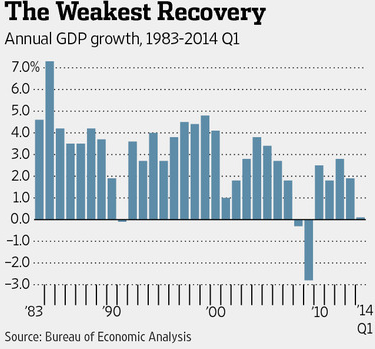
CaptureOur biggest national problem right now, in my opinion, is the stagnant economy.  In today’s WSJ, the lead editorial, “The Growth Deficit”, clearly describes how bad the situation is.  Since the Great Recession ended in June 2009, our rate of GDP growth has averaged 2.2% per year.  This compares with a 4.1% annual rate of growth for all post-1960 recovery periods.
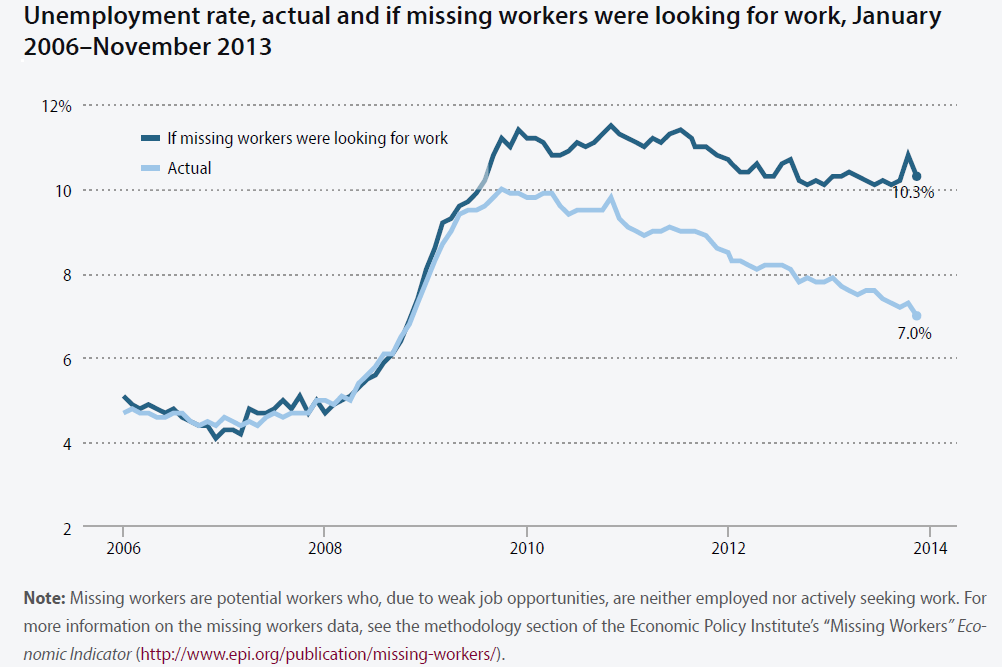
Such a slow rate of growth causes all sorts of problems.  First of all, it explains why our unemployment rate is still so high at 6.7% after five years of recovery.  This means that between 15 and 20 million people are still unemployed or underemployed.  Such a large human toll means a huge increase in government welfare expenses for food stamps, unemployment insurance, etc.  Higher unemployment also means less tax revenue collected by the federal government.  This translates into much larger deficit spending, adding to the already massive national debt.
There are lots of things which can be done to increase growth, for example:

  • Lowering tax rates on individuals to put more money in the hands of the 2/3 of Americans who do not itemize deductions on their tax returns. They’ll spend this extra income and create more demand! Pay for this by closing loopholes and deductions, which are used primarily by the wealthy. Besides stimulating the economy, this will simultaneously address increasing income inequality.
  • Lowering tax rates on corporations to encourage multinationals to bring their foreign profits back home for reinvestment or paying dividends. Again, balanced by eliminating deductions enjoyed by privileged corporations.
  • Relax regulatory burdens on small businesses where most new jobs are created.
  • Reform immigration procedures by boosting the number of H1-B visas to attract more highly skilled, and entrepreneurial, foreign workers.
  • Grant trade promotion authority to the President to speed up new trade agreements.

We should be clamoring for our national leaders to be acting on these fronts.  A strong economy is the very backbone of our success as a nation!

Saving the System


I seldom use the New York Times sociological columnist, David Brooks, as a source for my blog posts because I am focused primarily on economic and fiscal issues.  But his column today, “Saving The System,” is highly pertinent to my message.
Capture1“All around, the fabric of peace and order is fraying.  The leaders of Russia and Ukraine escalate their apocalyptic rhetoric.  The Sunni-Shiite split worsens as Syria and Iraq slide into chaos.  China pushes its weight around in the Pacific. … The U.S. faces a death by a thousand cuts dilemma.  No individual problem is worth devoting giant resources to.  But, collectively, all the little problems can undermine the modern system.”
In addition to all of these pesky worldwide problems, our free enterprise economic system is under siege.  Wages have been largely stagnant since the early 1970s and income inequality is growing as the top 1%, and perhaps the top 10 or 15% as well, do much better than everyone else.  And just lately we have also learned from the French economist, Thomas Piketty, that wealth inequality has been growing steadily ever since about 1950 and is likely to get substantially worse in the future.
In other words, western civilization is under threat in more ways than one.  What are we going to do about it?  At the risk of oversimplifying, I believe that the single best thing we can do is to undertake fundamental tax reform to make our economy stronger.  Cut everyone’s tax rates and pay for it by closing loopholes and deductions which primarily benefit the wealthy.

  • Lower tax rates will put more money in the hands of the two thirds of Americans who don’t itemize their tax deductions. These are largely the same people with stagnant wages and so they will spend this extra income they receive.
  • The resulting increase in demand will put millions of people back to work and thereby increase tax revenues which will help balance the budget. This shift of income from the wealthy to the less wealthy will reduce income inequality.
  • Although harder to implement politically, a low (between 1% and 2%) wealth tax on financial assets above a threshold of $10 million per individual, would be a highly visible way to address wealth inequality. The substantial sum of revenue raised by this method could be used to fund national priorities as well as paying down the deficit.

I don’t want to leave the impression that I consider this program to be a panacea for strengthening our country.  But it would help and we need to make some big changes to maintain our status as world leader.

Trickle-Down Monetary Policy and What to Do About It


“There is no means of avoiding the final collapse of a boom brought about by credit expansion.  The alternative is only whether the crisis should come sooner as the result of a voluntary abandonment of further credit expansion, or later as a final and total catastrophe.”
Ludwig von Mises, Austrian economist, 1881 – 1973

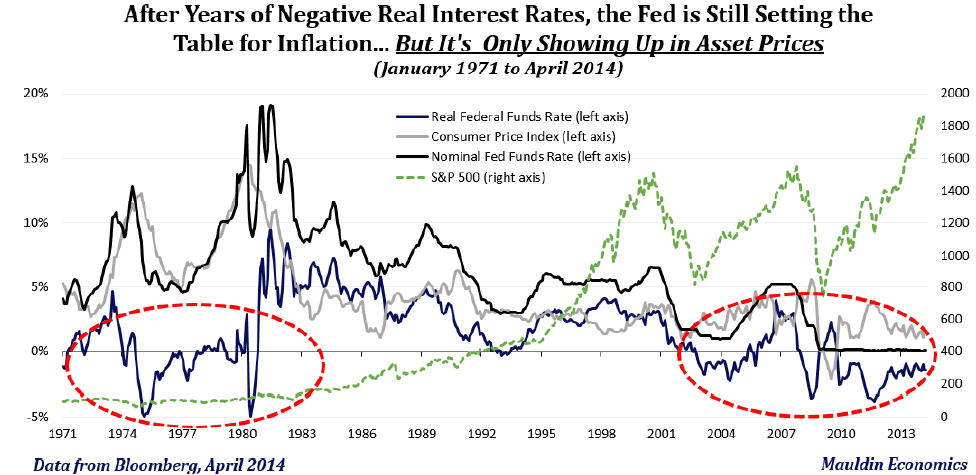
The economist/investor John Mauldin writes a weekly newsletter, “Thoughts from the Front Line” (http://d21uq3hx4esec9.cloudfront.net/uploads/pdf/140426_TFTF2.pdf) which offers good general insight.  In the latest issue Mr. Mauldin writes “For all intents and purposes we have adopted a trickle-down monetary policy, one which manifestly does not work and has served only to enrich financial institutions and the already wealthy.  Now I admit that I benefit from that, but it’s a false type of enrichment, since it has come at the expense of the general economy, which is where true wealth is created.”
CaptureMr. Mauldin also quotes the economist William White, “When you talk about crisis resolution, it’s about attacking the fundamental problems that got you into trouble in the first place.  And the fundamental problem we are still facing is excessive debt.  Not excessive public debt, mind you, but excessive debt in the private and public sectors. … With ultra-loose monetary policy, governments have no incentive to act.  But if we don’t deal with this now, we will be in worse shape than before.”
What then should government do?  The best single thing is to develop a concentrated focus on boosting the economy.  This would put millions of people back to work and raise salaries for the entire workforce.  Tax revenue would rise and both public and private debt would be paid down more quickly.
The way to do this is with fundamental, broad-based tax reform.  This means lowering tax rates for both individuals and corporations, paid for by closing loopholes and shrinking deductions.  This would have the effect of taking from the rich and giving to the poor, i.e. putting more money in the hands of those who are most likely to spend it, thereby creating more demand leading to faster economic growth.
It’s not that hard to figure out!