Inequality III: Is the Game Rigged?


The economist Joseph Stiglitz has an Op Ed column in today’s New York Times, “In No One We Trust”, blaming the financial crisis on the banking industry.  “In the years leading up to the crisis our traditional bankers changed drastically, aggressively branching out into other activities, including those historically associated with investment banking.  Trust went out the window. … When 1 percent of the population takes home more than 22 percent of the country’s income – and 95 percent of the increase in income in the post-crisis recovery – some pretty basic things are at stake. … Reasonable people can look at this absurd distribution and be pretty certain that the game is rigged. … I suspect that there is only one way to really get trust back.  We need to pass strong regulations, embodying norms of good behavior, and appoint bold regulators to enforce them.”  
CaptureMr. Stiglitz is partially correct.  Although the housing bubble, caused by poor government policy – loose money, subprime mortgages, and lax regulation – was the primary cause of the financial crisis, nevertheless, poorly regulated banking practices made the crisis much worse.  But this is all being fixed with Dodd-Frank, a just recently implemented Volker Rule, and a soon coming wind-down of Fannie Mae and Freddie Mac. 
Mr. Stiglitz concludes, “Without trust, there can be no harmony, nor can there be a strong economy.  Inequality is degrading our trust.  For our own sake, and for the sake of future generations, it is time to start rebuilding it. 
But how do we reduce the inequality in order to restore the trust which is necessary for a strong economy?  Mr. Stiglitz doesn’t say!
What we need is faster economic growth in order to create more new jobs.  The last four years have demonstrated that the Federal Reserve can’t accomplish this with quantitative easing.  It needs to be done by private business and entrepreneurship.  Tax reform and the easing of regulations on new businesses is what we need.  It’s too bad that ideological blinders prevent so many people from understanding this basic truth!    
    

More on Inequality: How Bad Is It and Why?


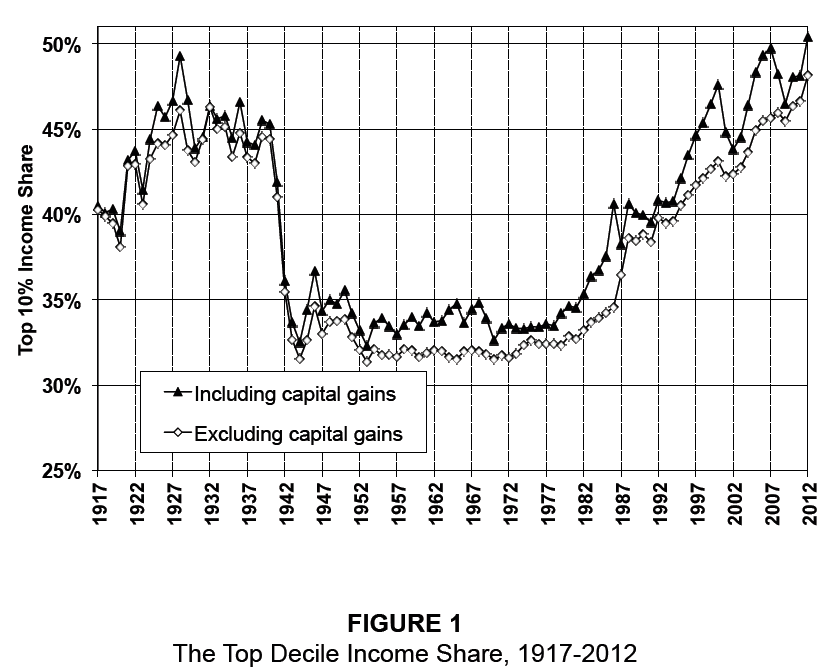
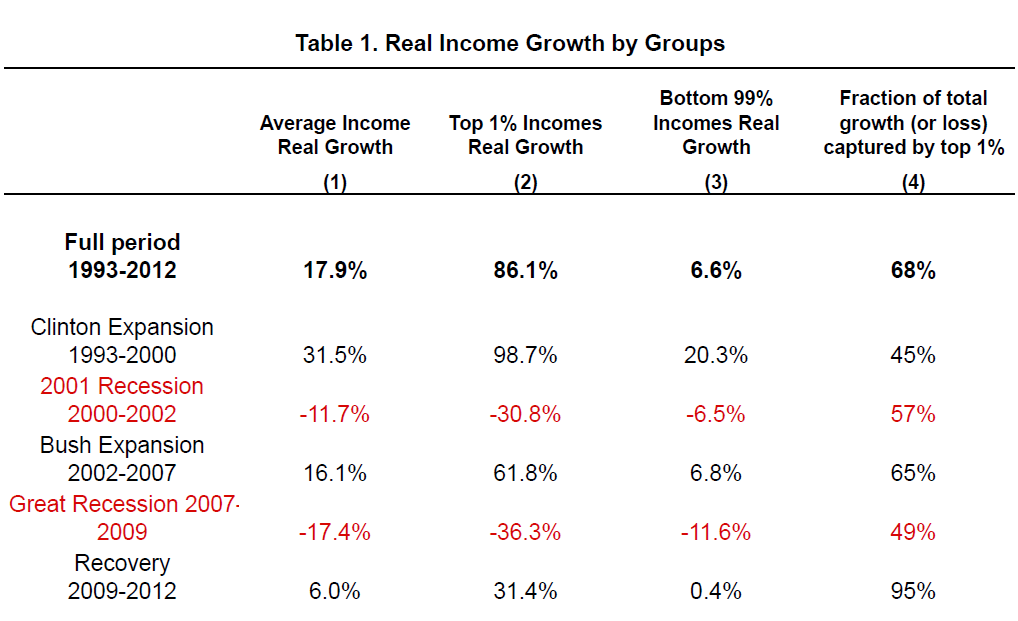
A recent article in Bloomberg View by Cass Sunstein, “How Did the 1 Percent Get Ahead So Fast?“, discusses the significance of new research by the economist Emmanuel Saez, ”Striking it Richer: The Evolution of Top Incomes in the United States”.  Referring to Saez’s table and chart below, the conclusion is that income inequality has been getting steadily worse since the early 1980s and has been especially pronounced since June 2009 when the Great Recession ended.
Capture1Capture2In particular, 95% of all income gain in the last four years has gone to the top 1%.  This is a much greater disparity than during the so-called Clinton Expansion, from 1993 – 2000 (45% to the top 1%) or during the Bush Expansion, from 2002 – 2007 (65% to the top 1%).  According to Mr. Sunstein, “one point is clear: through 2012 the gains from the current recovery were concentrated among the top 1 percent, and that pattern, extreme though it is, fits with a general surge in economic inequality over the last 40 years.”
CaptureBut there is more to the story!  Looking at the final chart, just above, it is clear that the economy grew much faster during the Clinton Expansion than during the Bush Expansion, and, in turn, much more slowly during the Obama Recovery.  In other words, the way to reduce inequality is to speed up economic growth.  There are tried and true ways to speed up growth (e.g. tax reform with lower rates, emphasis on deregulation, boosting entrepreneurship, etc.).  It is unfortunate that too many in Congress, as well as the President have ideological blinders which prevent them from moving in this direction!

How Do We Fight Economic Inequality? By Restoring Growth!

The liberal economist Paul Krugman returns to one of his favorite topics in yesterday’s New York Times, “Why Inequality Matters”.  “On average, Americans remain a lot poorer today than they were before the economic crisis.  For the bottom 90 percent of families, this impoverishment reflects both a shrinking economic pie and a declining share of that pie.”  The problem with Mr. Krugman’s analysis is that he offers no solution beyond more fiscal stimulus: “the premature return to fiscal austerity has done more than anything to hobble the recovery.”
CaptureBut there is another route to recovery and it is propounded in today’s Wall Street Journal by George Osborne, the United Kingdom’s Chancellor of the Exchequer, “How Britain Returned to Growth”. “We cut spending and top tax rates, and now deficits are down and jobs are being created at a healthy clip … at the rate of 60,000 per month, roughly equivalent to 300,000 in the U.S. … The corporate tax rate is being cut to 20% from 28%. … As a result, more international firms are moving their headquarters to Britain and investment is flowing into our country.”
Yes, as Mr. Krugman says, economic inequality in the U.S. is bad and getting worse.  The question is what to do about it.  Shall we try to improve the situation with artificial stimulation, increasing government debt, already very high, for future generations?  Or shall we address this inequality by encouraging businesses to grow and expand and thereby raise wages and hire more people.
The good news is that America is the success story of the 20th century.  The bad news is that everyone else in the world has figured this out and is now copying our own best methods.  Either we can compete, innovate, stay on top and thrive, or else we can get lazy, stagnate and sink down in the pack.
Will it be more inequality or more growth?  The choice is up to us!

Why Is It So Hard For Congress To Do Its Job?


In response to the recent budget deal which has already passed the House of Representatives, Taxpayers for Common Sense has issued a new report “Real Savings, Real Deficit Reduction: Relieving Budget Caps with Common Sense Savings in Fiscal Year 2014”, showing how $100 billion could be cut from the federal budget for fiscal 2014, completely offsetting the supposedly onerous cuts required by the sequester.  Here is a summary of what TCS has come up with:
Capture
Of course there are many ways to achieve $100 billion in savings in a single year and this is only one particular way to do it.  But it is a balanced plan making roughly comparable cuts from many different agencies and also including a significant amount of tax expenditure savings.  It would, of course, be much better to also include adjustments to entitlement spending such as Social Security and Medicare.  A big reason for keeping the sequester in place, or offsetting it with equivalent cuts, as TCS is suggesting, is to create more interest in making necessary changes in entitlement programs.
Yet another way of accomplishing the same goal would be to keep the sequester spending levels in place but to give each government agency the authority to rearrange the spending cuts within its only agency.  This is what management should be doing anyway on a routine basis.
It is very disappointing that Congress will not do the job, one way or another, that is required to operate the government on a sound financial basis.  Let’s hope that the voters make big changes in the elections coming up in 2014!

How to Get the Economy Back on Track


Harvard Economist, Martin Feldstein, has an Op Ed column in yesterday’s New York Times, “Saving The Fed From Itself”, which gets our current economic situation half right.  First of all, Mr. Feldstein says that the Fed’s quantitative easing policy is inadequate because “the magnitude of the effect has been too small to raise economic growth to a healthy rate.  … The net result is that the economy has been growing at an annual rate of less than 2 percent.  … Weak growth has also meant weak employment gains.  … Total private sector employment is actually less than it was six years ago.  … While doing little to stimulate the economy, the Fed’s policy of low long-term interest rates has caused individuals and institutions to take excessive risks that could destabilize the economy just as it did before the 2007-2009 recession.”  So far he’s right on the button!
But then he goes on to say, “To get the economy back on track,” Congress should enact a five year plan to spend a trillion dollars or more on infrastructure improvement and that this would “move the growth of gross domestic product to above three percent a year.”  An artificial stimulus like this might work temporarily but then it ends and we’re back where we started.  We need a self-generating stimulus that will keep going indefinitely on its own.  How do we accomplish this?
The answer should be obvious.  We do it by stimulating the private sector to take more risk in order to generate more profits. In the process they will hire more employees and boost the economy.
How do we motivate the private sector?  By lowering tax rates and loosening the regulations which stifle growth.  Closing tax loopholes and lowering deductions (which will raise revenue to offset the lower tax rates) has the added benefit of attacking the corporate cronyism which everyone deplores.
We really do need to put first things first.  If we can jump start the economy by motivating the private sector to invest and grow, we will have more tax revenue to spend on new and expanded government programs as well as shrinking the federal deficit.
Why is this so hard for so many people to understand?

Global Warming Is For Real. What Should We Do About It?

Although the threat of global warming is vastly overhyped, it is happening nonetheless.  Perhaps the best single indication of this is the shrinking of the north-pole ice cap.  The New York Times reported just a few days ago, “Large Companies Prepared to Pay Price on Carbon”, that at least 29 major companies “are incorporating a price on carbon into their long-range financial plans.”  This includes five big oil companies ExxonMobil, ConocoPhillips, Chevron, BP and Shell.  Specifically, these major companies have all come to accept the reality of global warming and are preparing for a carbon tax to be levied before long.
The Congressional Budget Office has recently released a report “Effects of a Carbon Tax on the Economy and the Environment”, which concludes that a tax of $20 to emit a ton of CO2 would raise a total of $1.2 trillion over a decade.  Such a tax would, for example, raise the price of gasoline by 10 to 15 cents per gallon.
Once we admit that global warming is for real, and that we need to address it in a serious way, a carbon tax is almost certainly the most efficient, and least economically harmful, way to do it.  A tax on carbon output would do many things.  It would give a big boost to renewable energy (solar and wind) with, or without, special subsidies for renewables.  It would speed up the transformation from the use of coal to natural gas, since natural gas only contains half as much carbon as coal does.  And it would create an economic incentive to speed up the development of carbon capture in order to make the burning of coal more cost competitive.
Of course, a new $120 billion per year carbon tax will affect the economy.  But it will do the least damage if the proceeds are used entirely for deficit reduction.  So we can address a serious environmental problem which effects life on earth and can do so in a way which also addresses a very serious fiscal problem.
I believe that the American people are up to making a sacrifice like this if the consequences of inaction are clearly explained to them.

The Mess in Detroit: A Stern Warning for the Whole Country


An article in yesterday’s New York Times, “Detroit Ruling Lifts a Shield on Pensions”, reports a ruling by bankruptcy judge Steven W. Rhodes that Detroit “could formally enter bankruptcy and that Detroit’s obligations to pay pensions in full is not inviolable.”
The article goes on to say “that most here agree that the city’s situation is dire:  annual operating deficits since 2008, a pattern of new borrowing to pay for old borrowing, miserably diminished city services, and the earmarking of about 38 percent of tax revenues for debt service.  A city that was once the nation’s fourth largest has dropped to 18th, losing more than half of its population since 1950.  The city was once home to 1.8 million people but now has closer to 700,000.”
The parallels and analogies between what has happened in Detroit and what is now happening in the U.S. are striking.  The U.S. has had huge annual deficits for five years in a row and the accumulated debt is enormous, the Federal Reserve is holding interest rates down to make borrowing cheaper, and our country’s infrastructure is deteriorating much faster than it is being repaired.
Right now interest on the national debt is small ($223 billion in 2013, or 8% of federal revenues).  But interest rates will inevitably return before long to their average historical rate of about 5%.  Right now the public debt (on which we pay interest) is just over $12 trillion.  This means that in the near future interest on the national debt will be at least $600 billion per year and probably much larger because the debt is still growing so rapidly.  This will take a huge bite out of revenue and leave far less of it for other purposes.
This problem will continue to exist even if the budget were to be miraculously balanced from now on but it would at least lessen over time as the economy continues to grow.  Without budget restraint the problem will never go away and will be a perpetual drag on our national welfare.
This is, of course, exactly the condition in which Detroit finds itself at the present time.  Detroit has the option to declare bankruptcy and make its creditors and pensioners take big losses.  Once it does this it can make a fresh start and perhaps recover its former status.
But are we prepared to let the whole country suffer a similar fate?  The consequences would be enormous.  If the U.S. goes down, the whole western world could come down with it.  Democracy and human progress would be severely threatened.  This is really too terrible a tragedy to even contemplate.  Let’s turn things around before they get any worse!

Controlling the Cost of Healthcare

Capture

The New York Times is running a series of articles, “Paying Till It Hurts,” giving many examples of the very high cost of healthcare in the U.S. today.  The latest article “As Hospital Prices Soar, A Single Stitch Tops $500”, focuses on the high cost of emergency room treatment around the country.
We spend 18% of GDP on healthcare, twice as much as any other country in the world.  It is specifically the cost of healthcare entitlements, Medicare and Medicaid, which is driving our huge deficits and rapidly growing national debt.  But to limit the cost of these entitlement programs, we first have to address the more fundamental problem: how to control the overall cost of healthcare in general.
Our current healthcare system, a combination of private insurance and government programs, is very inefficient. The basic problem is that the tax treatment of employer provided health insurance takes away the incentive for individuals to control the cost of their own care.   And Obamacare does not solve this problem, because it just extends the present system to more people, rather than revamping it.
There are essentially two different ways to transform our current healthcare system to make it far more efficient.  One way is to turn it into a single payer system, like what most of the rest of the world has.  This could be accomplished by simply expanding Medicare to everyone.  Costs would then be controlled by government regulation which would, of course, include rationing.  Given the unpopularity of Obamacare, with all of its mandates and uniform coverage requirements, it is unlikely that Americans would be happy with such a highly proscribed single payer system.
The alternative is to change over to a truly consumer based, market oriented system.  This could be accomplished by limiting the present tax exemption for employer provided insurance.  For example, the current system could be replaced by a (refundable) tax credit equal to the cost of catastrophic insurance (i.e. insurance with a very high deductible).  All other healthcare costs, whether paid for directly by consumers or through insurance, would be with after tax dollars.  Subsidies could be provided to lower income people through the Obamacare exchanges.  Once such a system is set up and running smoothly, it could fairly easily be extended to encompass Medicare and Medicaid.
Insurance companies selling catastrophic coverage would negotiate with hospitals and other healthcare providers to get the lowest possible prices for their customers.  In other words, both insurance companies and providers would compete in the open market to deliver healthcare products at the lowest possible cost.
Something along this line will have to be done and the sooner we get started the better!

Should the Minimum Wage Be Raised?

In today’s New York Times, the economist Arindrajit Dube has an Op Ed column in the Great Divide series, “The Minimum We Can Do”, pointing out that today’s minimum wage of $7.25 per hour is only 37% of today’s median hourly wage of about $20 per hour.  This compares with the 1968 minimum wage of $10.60 per hour (in today’s dollars, adjusted for inflation) which was 55% of the median wage at that time.  This is in line with the current Democratic proposal to raise the minimum wage to $10.10 per hour.
The standard argument against raising the minimum wage is that it will reduce employment because “when labor is made more costly, employers will hire less of it.”  However Mr. Dube offers empirical data which “suggest that a hypothetical 10% increase in the minimum wage affects employment in the restaurant or retail industries by much less than 1 percent” and therefore very little.
Basically Mr. Dube is arguing that raising the minimum wage won’t hurt the economy and it will help many low-paid workers.  The problem with this point of view is that it distracts attention from what we really should be doing: namely, everything we possibly can to speed up economic growth.  By far the best way to raise wages is to increase the value of labor by creating more jobs!
I may sound like a broken record, repeating the same thing over and over again, but we badly need to concentrate on the fundamentals of growing the economy: lowering tax rates, individual and corporate, to stimulate business investment and risk taking by entrepreneurs; removing onerous regulatory burdens, especially on new businesses and existing small businesses; and emphasizing career education and job training to fill the millions of high skill job openings which exist.
There are strong headwinds facing our economy: bad demographics (rapidly retiring baby boomers), pressure from technological progress and globalization which put a high premium on education and advanced skills, and massive national debt which will become a huge burden as interest rates inevitably increase.
These strong headwinds aren’t going away.  To overcome them we need national leaders who are able to rise above ideology and focus on the fundamentals.
Conclusion: we should raise the minimum wage when unemployment drops to 6% or, perhaps, tie a raise in the minimum wage to a tax reform measure which significantly lowers tax rates.

Why Is Obamacare So Unpopular? Because It’s Too Coercive!


The individual mandate for health insurance, upheld by the Supreme Court a year and a half ago, is now leading to millions of policy cancellations in the individual insurance market.  The mandate overrides any existing policy which does not provide minimum coverage.  The employer mandate, stipulating that any business with 50 or more employees must provide health insurance for all fulltime employees, has caused many businesses to replace fulltime employees with part-timers.
But these are not the only forms of coercion under Obamacare.  As reported in yesterday’s New York Times, “Court Confronts Religious Rights of Corporations”, the Supreme Court is expected to accept a case involving the Hobby Lobby’s refusal, on religious grounds, to pay for insurance coverage for the contraceptive coverage which is required to meet minimum standards.
It would be much better to replace all of these coercive mandates with economic incentives.  This could actually be done in such a way that would also make healthcare less expensive, thereby giving a big boost to our economy.  Here is one way to do this, as I discussed in my November 14, 2013 post:

  • Provide a flat and universal tax credit for health insurance coverage which applies to everyone and not just for employer provided healthcare.  The (refundable) credit would be roughly the amount necessary for catastrophic insurance coverage.
  • Convert Medicare and Medicaid into a means-based addition to this tax credit.
  • Everyone with continuous coverage (paid for by the tax credit) would be protected from price spikes or cancellations if they get sick.  This provides a strong incentive for everyone to buy and retain coverage.

It is entitlement spending which is driving our country’s fiscal crisis.  And healthcare programs such as Medicare and Medicaid make up a big part of entitlements.  In order to get these costs under control, we need to first get the cost of private healthcare under control.  The best way to do this is with economic incentives rather than coercive mandates.
Obamacare doesn’t need to be repealed.  It could just as well be modified and improved as described above.