Poverty, Inequality and the Minimum Wage


Poverty and income inequality are getting increasingly worse in the United States and need to be seriously addressed by our political system.  In my last post on February 16, I presented data from the Heritage Foundation which shows that the War on Poverty has been quite successful in eliminating destitute poverty in the U.S.  What this means is that most low-income families have the basic necessities of enough food to eat (96%), a refrigerator (99%), a telephone (96%), air conditioning (81%), a car (74%), etc.  Of course, these “amenities” are provided at a great cost to society of about $1 trillion per year in social transfer payments.
CaptureCan we do a better job in helping the poor in the near term?  The conservative writer and political activist, Ron Unz, thinks we can.  He has just written a perceptive blog post “The Conservative Case for a Higher Minimum Wage”, proposing a national minimum wage of $12 per hour.  His reasoning is as follows.  Low wage jobs are primarily in the non-tradable service sector and so these jobs are hard to outsource and also hard to automate.  Therefore the unemployment effects of such a minimum wage increase would be minimal.  Mr. Unz estimates that, Walmart could accommodate a $12 per hour minimum wage with a one-time price hike of just 1.1%.  The grocery prices of home-grown agricultural products would rise by less than 2%.
A $12 per hour wage for a full time 40 hour per week worker would mean an annual salary of $25,000 per year or $50,000 per year for a couple.  At this income level, the family would be paying more in taxes and receiving fewer government benefits.  This would turn many net tax recipients into net taxpayers and thereby raise their stakes in the American way of life as well as lowering the deficit.
I emphasize that this is a program to alleviate poverty in the U.S.  It will not do anything to help the middle class worker whose wages have been stagnant ever since the recession started six years ago.  This is a much harder problem which will require politically charged changes in U.S. economic policy.
Stay tuned!

Poverty, Inequality and Mobility in a Free Society: Can We Do Better?

There has been a lot of public attention given to these topics recently.  Our stagnant economy since the end of the recession almost five years ago has meant high levels of unemployment and underemployment which naturally causes widespread discontent.  The 50th anniversary of President Johnson declaring War on Poverty provides an opportunity to look back and evaluate its success.
A very good summary of where we stand on poverty was given two years ago by Robert Rector and Rachel Sheffield of the Heritage Foundation: “Understanding Poverty in the United States: Surprising Facts about America’s Poor”.  The authors used 2010 census data for their study.  Poverty was defined to be a cash income of $22,314 or less for a family of four in 2010 (which increased to $23,550 in 2013).  They pointed out, for example, that “96% of poor parents stated that their children were never hungry at any time during the year because they could not afford food.”  The chart below shows that poor households, in general, have many of the common amenities.
CaptureIn other words, the close to $1 trillion spent per year ($871 billion in 2010) by federal and state governments on means tested assistance for the poor has largely eliminated destitute poverty in the U.S.  Further progress will require successfully addressing both the collapse of marriage and the lack of parental work in low-income communities.  These very difficult problems can only be addressed with a long term educational effort to turn poor children into productive citizens.
Conclusion:  the War on Poverty has had reasonable success at huge cost and further gains will be more expensive and more drawn out over time.  We’ve already started on this second phase by emphasizing early childhood education and so the focus now should be to implement this new direction.
Next step: it’s now time to direct our serious attention to the issues of inequality and mobility.  That will be the subject of my next post!

Inequality, Productivity and Compensation

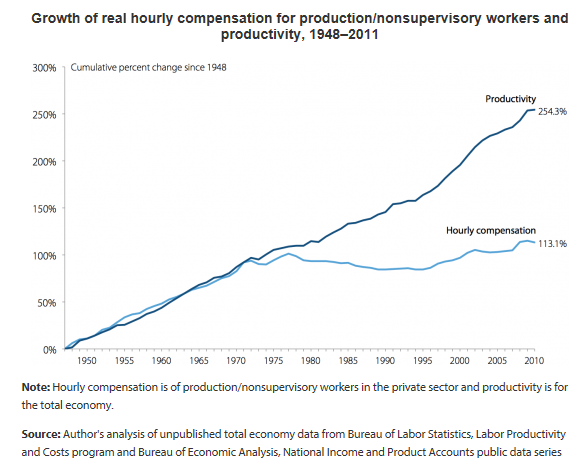
The Brookings Institution social economist, William Galston, has an interesting column in yesterday’s Wall Street Journal, “The U.S. Needs a New Social Contract”, deploring the fact that worker compensation (i.e. wages + benefits) has not kept up with gains in worker productivity since the 1970s.  Here is a chart published by the Economic Policy Institute showing the divergence between productivity and compensation for a “typical” ( i.e. in the middle) worker beginning in the 1970s:
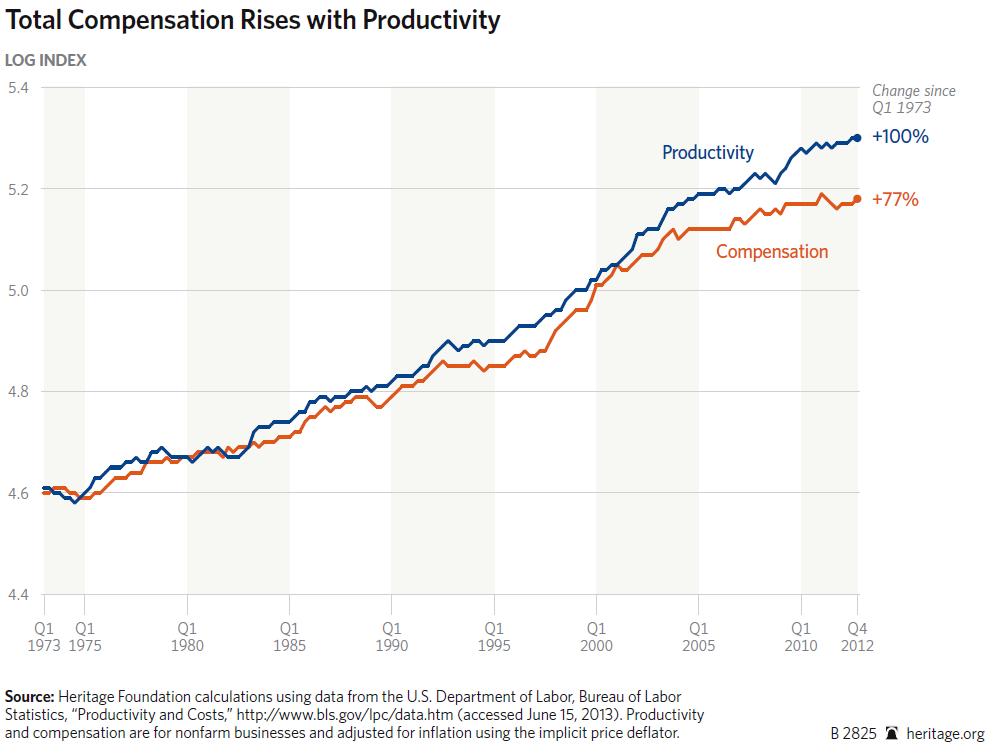
CaptureThe Heritage Foundation’s James Sherk has addressed this same question in a recent report “Productivity and Compensation: Growing Together” and shows that the “average” compensation of an American worker does track productivity very closely as shown in the chart below:
Capture1What is the explanation for this apparent discrepancy?  In fact, it is the difference between the average earnings of U.S. workers and the earnings of the median or middle worker.  The very high earnings of the top 10% and the even higher earnings of the top 1% raise average worker compensation way above the income level of the median worker.  In other words it is the result of the skewed and unequal distribution of incomes which is heavily weighted toward those at the top of the scale.  The typical or median worker is falling behind and is not benefitting from the steady rise in the overall productivity of the American economy.  This is what income inequality is all about.
The question is what to do about it.  Faster economic growth will create more opportunity by creating more jobs and better paying jobs.  Raising high school graduation rates as well as creating high quality technical training programs will also help.
Mr. Galston insists that this is not enough.  Too many workers will continue to lag farther and farther behind.  We could raise the Earned Income Tax Credit for low income workers but this would be very expensive in our currently tight fiscal situation which is likely to continue indefinitely.
Do we need a new social contract?  If so, what form will it take?  How will we pay for it?  These are indeed very difficult questions to answer!

The Economic Outlook: 2014 – 2024 II. How Can We Grow Faster?

Last week I summarized the latest economic report from the Congressional Budget Office which very clearly describes both the slow rate of growth of our economy since the end of the recession, the enormous buildup of our national debt in the past five years and also the likelihood that it will continue getting worse for the foreseeable future unless big changes are made.
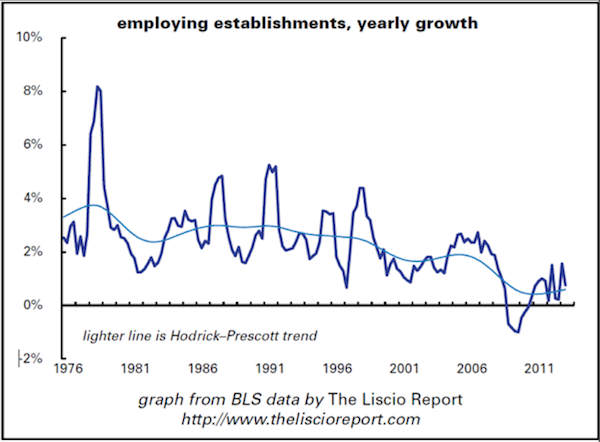
CaptureAbout a week ago the two economists Edward Prescott and Lee Ohanian had an Op Ed in the Wall Street Journal, “U.S. Productivity Growth Has Taken a Dive”, pointing out that the productivity of U.S. workers has grown at an average annual rate of only 1.1% since 2011, much lower than the average annual rate of about 2.5% since 1948 (see the above chart).  They also point out that the rate of new business creation is 28% below where it was in the 1980s (see the chart just below).  Growth of worker productivity and growth of new business formation are the two main forces which drive economic growth.
Capture1“Why is the startup rate so low?  The answer lies in Washington and the policies implemented in the wake of the 2008 financial crisis that were, ironically, intended to grow and stabilize the economy.” Mr. Prescott and Mr. Ohanian continue that it is the “explosion in federal regulation, intervention and subsidies (which) has retarded productivity growth by protecting incumbents at the expense of more efficient producers, including startups.”
It is easy to be pessimistic about the prospects for change in the government policies which are retarding economic growth.  Unfortunately, many political and social leaders have the point of view that it is income inequality which is “the defining issue of our time.”
The best response to this pervasive attitude is to shift the conversation towards equality of opportunity rather than dwelling on income inequality.  By far the best way to increase opportunity for those who desire it and are willing to work for it is to grow the economy faster in order to create more and better jobs. If we are able to do this, we’ll all be much better off.

The Economic Effect of ObamaCare

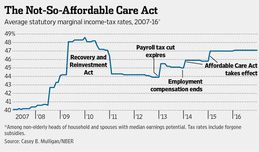
Last week’s report from the Congressional Budget Office “The Economic Outlook: 2014 – 2024” (which I discussed in my last post) caused a big stir with its prediction that ObamaCare will cause a loss of 2,000,000 mostly low wage jobs by 2017 and 2,500,000 such jobs by 2024.  The lost jobs aren’t necessarily from workers being fired or fewer workers being hired but rather the overall decreased incentive for individuals to find work.  The CBO analysis is based on the research of the economist Casey Mulligan featured in yesterday’s Wall Street Journal as “The Economist Who Exposed ObamaCare”.
CaptureThe above chart of Mr. Mulligan interprets several recent government subsidy programs as a new marginal tax rate, i.e. the “extra taxes paid and government benefits foregone as a result of earning an extra dollar of income.”  The 2009 stimulus, the Recovery and Reinvestment Act, had an effect like this but it was temporary.  The marginal tax increase of the Affordable Care Act will last as long as it remains in effect.
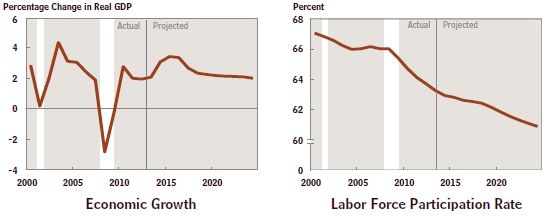
Capture1The above chart from the same CBO report, showing the steady decline in the Labor Force Participation Rate from the year 2000 onward, demonstrates the critical nature of this problem.  Lower labor force participation means lower growth in overall labor productivity which in turn means slower economic growth.  Since the Great Recession ended in June 2009, GDP growth has averaged only about 2% annually.
Slow GDP growth means, in addition to a higher unemployment rate, that America’s standard of living will not increase very rapidly if at all.  But the problem is really much worse than this.  We have an enormous debt problem which is only getting worse every year that we continue to have large deficits.  The CBO report predicts increasing growth in the size of our national debt.  By far the least painful way of shrinking our debt (relative to the size of the economy) is to grow the economy as fast as we reasonably can.  But our economy is actually slowing down, not speeding up!
This is a very serious problem which many of our national leaders are much too complacent about!

The Economic Outlook: 2014 – 2024 I. The Basic Data


The Congressional Budget Office has just issued the report ”The Budget and Economic Outlook: 2014 to 2024”, giving its usual objective and nonpartisan look at our prospects for the next ten years.  My purpose today is to give a simple interpretation of its basic data.  In my next post I will address the implications of this interpretation.
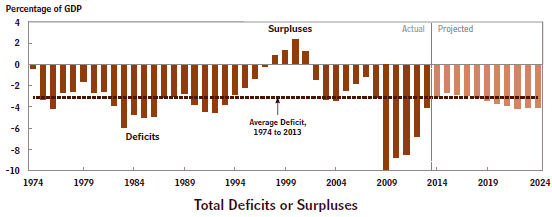
CaptureCapture1The first chart above shows a forty year history of government deficit spending.  The average deficit for this time period is 3% of GDP.  From 1982 – 1987 the deficits were worse than this and from 2009 – 2013 they were much worse.  The real problem is the accumulated deficits, i.e. the debt.  The second chart above shows the public debt (what we pay interest on) all the way back to 1940 as a percent of GDP.  As recently as 2008, the public debt was below 40% of GDP.  Now it is 73% and climbing.  This is very serious for two reasons.  Right now our public debt is almost free money because interest rates are so low.  But when interest rates return to their normal level of about 5%, interest payments will explode and be a huge drain on the economy.  In addition, these CBO predictions assume continued steady growth of the economy.  If and when we have a new recession or some other financial crisis, there will be much less flexibility available for dealing with it.
Capture2Now look at the last two charts.  The first one shows the rate of GDP growth since 2000 which has averaged about 2% since the end of the recession in June 2009 and is projected by the CBO to level off at this same rate over the next 10 years.  This is an historically low rate of growth for our economy. The final chart shows the gradual decrease of the labor force participation rate over this same time period.  These two graphs are related!  When fewer people are working, the economy simply will not grow as fast.
High debt and slow growth are big problems for an economy.  We’re falling more deeply into this perilous state of affairs all the time.  We need to take strong measures to break out of this dangerous trap!

Let’s Devolve Federal Programs Back to the States!


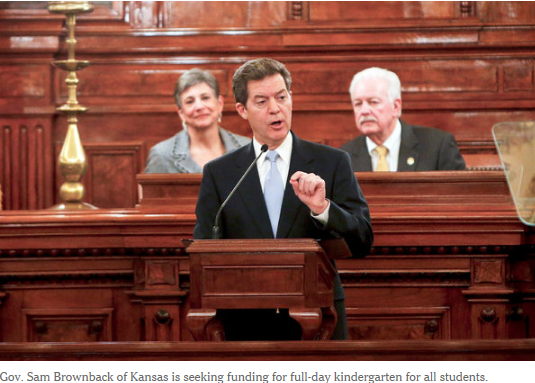
Yesterday’s New York Times has an article “Battles Looming Over Surpluses in Many States”, pointing out that “unexpectedly robust revenues from taxes and other sources are filling most state coffers, creating surpluses not seen in years and prompting statehouse battles over what to do with the money.”  For example, in Kansas, Governor Sam Brownback is calling for full day kindergarten for all students.
CaptureThis raises a larger issue.  The states are recovering from the Great Recession and have lots of money.  We know that states spend money far more efficiently than the federal government, because states have constitutional requirements to balance their budgets.  On the other hand, the federal government is hemorrhaging red ink at a frightening rate which will just keep getting worse indefinitely until strong measures are taken.  It has taken on far too many responsibilities and spends money very inefficiently.
All of this suggests an obvious course of action to turn around a very bad situation.  We should devolve as many federal programs as possible back to the states.  Here are three good ones to start with:

  • Medicaid costs the federal government about $250 billion per year with another $150 billion being paid for by the states.  The problem is that federal support is a fixed percentage of what the states spend.  This makes Medicaid a very expensive program with no limit on the cost to the federal government.  A good way to solve this problem is to “block grant” Medicaid to the states and let each state figure out the best way to spend its own federal allotment.  Annual increases in the size of federal block grants could be tied to the rate of inflation in order to limit their growth.
  • Education spending at the federal level is a $100 billion per year (not counting student loans) item.  Just at the K-12 level alone there are over 100 individual programs to which states and school districts have to apply for funds separately.  Wouldn’t it make far more sense to “block grant” education funds back to the states so that this large sum of money can be spent more effectively and efficiently by targeting it at the biggest needs in each state?
  • Job-Training costs the federal government $18 billion per year for 47 different programs.  Again it would be so much more sensible to block-grant job training funds to the states and measure effectiveness by the number of workers hired.

There really are relatively simple ways for the federal government to operate more effectively and at much lower cost.  We need national leaders who are committed to getting this done.

Does Free Trade Increase Inequality?


Several days ago, David Bonior, a former Congressman from Michigan, wrote in the New York Times about “Obama’s Free-Trade Conundrum”. “The President cannot both open markets and close the wage gap.”  There is an “academic consensus that trade flows contribute to between 10 and 40 percent of inequality increases.”  This happens because “there is downward pressure on middle-class wages as manufacturing workers are forced to compete with imports made by poorly paid workers from abroad.”
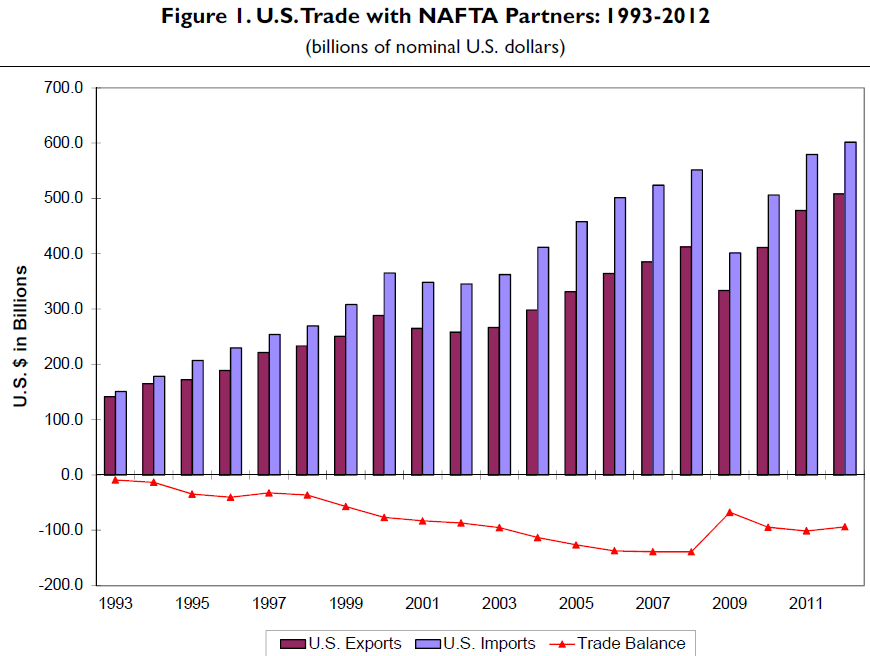
CaptureBut there is another point of view, provided, for example, by the report “NAFTA at 20: Overview and Trade Effects”, prepared by the Congressional Research Service about a year ago.  “U.S. trade with its NAFTA partners has more than tripled since the agreement took effect (in 1993).  (Canada and Mexico) accounted for 32% of U.S. exports in 2012.  40% of the content of U.S. imports from Mexico and 25% of U.S. exports from Canada are of U.S. origin.  In comparison, U.S. imports from China are said to have only 4% U.S. content.”  In other words, NAFTA at least has been a huge success.
Being able to trade with others is the foundation of private enterprise.  Foreign trade is simply an extension of domestic trade.  To limit trading opportunities with other countries would be a huge barrier to economic growth and therefore to future prosperity as well.
But at the same time we do want a more equal society as well as well as a more prosperous one.  The key to resolving this “conundrum”, as Mr. Bonior puts it, is to address “opportunity inequality” as well as “income inequality.”
It is estimated that each billion dollars in U.S. exports provides employment for about 5000 workers.  Nebraska, for example, exported $12.6 billion worth of goods and services in 2012 which translates into 63,000 jobs.
More jobs and better jobs are what create economic opportunity.  One way to create more jobs and better jobs is to promote foreign trade by removing as many trade barriers as possible.  Hopefully Congress and the President can work together to get this done!

Invested in America


The Business Roundtable, an association of chief executive officers of leading U.S. companies, has just issued a new report, “Invested in America: A Growth Agenda for the U.S. Economy”, describing four actions which policymakers can take to rejuvenate the U.S. economy.
CaptureThey are:

  • Restore Fiscal Stability: constrain federal spending in a manner that reduces long-term spending growth, making both Medicare and Social Security more progressive and less expensive.
  • Enact Comprehensive Tax Reform: adopt a competitive, pro-growth tax framework that levels the playing field for U.S. companies competing in global markets.  Several studies estimate that cutting the U.S. corporate tax rate by 10 % (e.g. from 35% to 25%) would boost GDP by 1% or more.
  • Expand U.S. Trade and Investment Opportunities: pass updated Trade Promotion Authority legislation and use TPA to complete many new trade agreements which are already pending.
  • Repair America’s Broken Immigration System: increase the number of visas for higher skilled workers and provide legal status for the millions of undocumented immigrants currently living in the U.S.

These are the same “big four” policy changes which many progressive business leaders as well as evenhanded think tank experts often recommend.  They are really just common sense ideas which reasonable people should be able to come together on.
Isn’t it obvious that we’ll soon be in big trouble if we don’t get our enormous budget deficits under control?  And that controlling entitlement spending is key to getting this done?
Isn’t it just as obviously commonsensical that even U.S. based multinational corporations will try to avoid locating business operations in countries like the United States with very high corporate tax rates?
Isn’t it likewise obvious that foreign trade is just an extension of domestic trade and that the world is better off with as much trade as possible?
Finally, the secret of a vibrant, growing economy is to encourage as much initiative and innovation as possible.  Who take more initiative than the immigrants who figure out how to get here in the first place?
We don’t have to accept a sluggish economy, high unemployment and massive debt!  But we do need to take intelligent action to extricate ourselves from the predicament we are in!

What Is the State of the U.S. Economy?


On the eve of the President’s State of the Union address, the New York Times gives an answer to this question in today’s paper, “Obama’s Puzzle: Economy Rarely Better, Approval Rarely Worse”.  The charts below do show the basic trends all moving in the right direction.  But is this good enough?
CaptureThe unemployment rate is moving steadily downward but it is still a high 6.7% almost five years after the recession ended in June 2009.  And this is with a labor participation rate of only 58.6%, which is historically very low.
The budget deficit is dropping but is still unsustainably high.  In the five years, 2009 – 2013, deficits have totaled $6 trillion dollars.  As soon as interest rates return to their historical average of 5%, interest on this $6 trillion in new debt alone will total $300 billion per year, forever!  Furthermore, the Congressional Budget Office, the most credible source of budget information, predicts that the deficit is likely to resume an inexorable climb within a few years as baby boomers retire in ever greater numbers, rapidly driving up entitlement costs.
Economic growth was stronger than expected in the last quarter of 2013 and this is a good sign.  But it has averaged only about 2% since the recession ended which is very low by historical standards, in a post recessionary period.
The point is, do we really need to settle for such mediocre performance: a stagnant economy, high unemployment and massively accumulating debt?  Should we just declare that in a highly competitive global economy with an ever higher premium on information and technology, that we just can’t do any better than we already are?  Isn’t there some way to make our economy grow faster in order to provide more and higher paying jobs?
I think that the answer to this last question is an emphatic yes!  In fact, this is what my blog is all about.  Just read some of the other recent posts and let me know if you disagree with what I am saying!