How to Control Federal Spending: The Highway Trust Fund


The federal Highway Trust Fund is almost out of money.  It takes in $35 billion per year from the 18.4 cents per gallon federal gas tax, which has not been raised since 1993.  Sometime this summer the government will have to cut back on payments to state highway departments unless Congress acts.
CaptureAs the above chart from the Economist  shows, the U.S. spends much less of GDP on roads than many other developed nations.  Something clearly needs to be done because we need many improvements in infrastructure.  But there are better ways and poorer ways to solve this problem.  Here are two good ways as described by Thomas Donlan in a recent issue of Barron’s:

  • A bill to raise the gas tax by 12 cents per gallon over two years has been introduced in the Senate by Bob Corker (R, Tenn.) and Chris Murphy (D, Conn.). Each penny added to the federal gas tax rate will raise $1.3 billion and this would solve the problem.
  • Repeal the federal gas tax and turn federal highway construction entirely over to the states. Each state could then increase its own gas tax and/or pay for construction with tolls on bridges and roads.

Here are two examples of poor ways to replenish the Highway Trust Fund:

  • Continue adding to the Fund with borrowed money. $54 billion has been borrowed since 2008 for this purpose. Presumably the Sequester will make it much harder to continue such deficit financing.
  • Rep John Delaney (D, Mary.) has proposed a tax break for repatriated foreign profits by multinational American companies if part of the money brought back was spent on infrastructure bonds. This would interfere with the urgent need to reform corporate taxes with significantly lower rates offset by lowering deductions, in order to make our corporate tax internationally competitive.

Conclusion: There is a good chance that the Budget Sequester established by Congress in 2011 to control discretionary spending, as well as the widely recognized urgent need for corporate tax reform, will lead to a “good” rather than “bad” solution to the shortfall in the Highway Trust Fund. This is just one specific example of the challenge to sensible budgeting by Congress.
A much broader approach is needed to really shrink the deficit.  Stay tuned!
Privatize Veteran’s Health Care

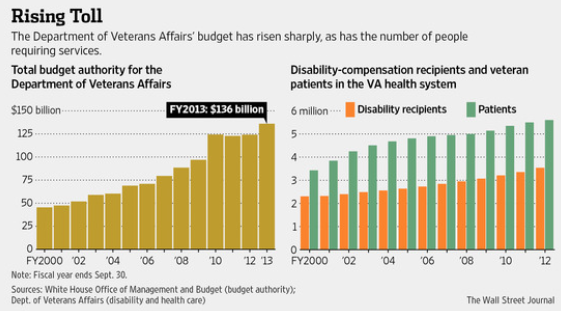
The current Veterans Administration waitlist scandal is an unfortunate symptom of a much bigger problem, namely the very high and rapidly increasing cost of providing healthcare to our nation’s veterans.  Especially at a time of huge budget deficits and exploding national debt, all branches of government, including our VA system, must operate more efficiently.
CaptureAs we celebrate Memorial Day and the 70th anniversary of the Normandy Invasion in WWII, this is a good time to contemplate a major restructuring of the VA.  As pointed out two days ago in the Wall Street Journal, “VA’s Budget, and Rolls, Have Boomed”, not only has the number of VA healthcare patient visits increased dramatically from 3.4 million in 2000 to 5.6 million in 2012, but the average annual expenditure per patient has also risen by 62% over the same time period.
The purpose of having a separate healthcare system for veterans is to give them better care than they would otherwise receive.  But the scarcity of resources means that their healthcare is being effectively rationed with longer waiting times.
The situation for veteran’s healthcare is a harbinger of what awaits us for our big government entitlement problems: Social Security, Medicare and Medicaid.  For the sake of all recipients, present and future, the rapidly growing costs of these programs must be contained.  There are lots of possible ways to do this.  Our national leaders simply need to take the problem seriously and insist on action.
At the same time it makes no sense to maintain a separate health care system for our nation’s 22 million veterans, only 7% of our total population.  The VA has lots of other responsibilities to take care of anyway: providing life-insurance, mortgage, and housing programs, managing cemeteries, and providing job training, for example.  Veteran’s healthcare could and should be privatized with a voucher system administered by the VA.  It will save billions of dollars for taxpayers and provide better, and timelier, healthcare for our nation’s veterans.

The Government We Deserve


“As for the future, your task is not to foresee it, but to enable it.”
Antoine de Saint-Exupery, 1900 – 1944

An important new book, “Dead Men Ruling,” by the Urban Institute’s C. Eugene Steuerle, has just been published.  Here is the flavor of its message:
Capture“Dead and retired policymakers have put America on a budget path in which spending will grow faster than any conceivable growth in revenues. … The same policy makers also cut taxes so much below spending that they created huge deficits, which have now compounded the problem with additional debt.”
“Both sides have largely achieved their central policy goals – liberals have expanded social welfare programs, conservatives have delivered lower taxes.  Both now cling tenaciously to their victories.”
In short, “our central problem is the loss of fiscal freedom.” There are “four deadly economic consequences of this disease:

  • rising and unsustainable levels of debt,
  • shrinking ability of policymakers to fight recession or address other emergencies,
  • a budget that invests ever less in our future and is now a blueprint for a declining nation, and
  • a broken government, as reflected in antiquated tax and social welfare systems.”

In addition there are “three deadly political consequences:

  • a decline of ‘fiscal democracy’ depriving current and future voters of the right to control their own budget,
  • a classic ‘prisoner’s dilemma’ where both left and right leaning elected officials conclude that they will suffer politically if they lead efforts to impose either spending cuts or tax hikes, and
  • rising hurdles to changing our fiscal course because, to do anything new, requires reneging on past promises of rising benefits and low taxes, that voters have come to expect.”

In other words the U.S. is in a very difficult predicament.  Mr. Steuerle thinks it will take a major “fiscal turning point” to escape from the present danger.  Both sides will have to make big concessions in order for us to get out of this jam.  But how is this possibly ever going to happen?  More next time!

The Resurrection of Karl Marx II. Let’s React But Not Overreact!


This morning’s Wall Street Journal has a book review by the New York fund manager, Daniel Shuchman, “Thomas Piketty Revives Karl Marx for the 21st Century” of Thomas Piketty’s new book “Capitalism in the Twenty-First Century.” As I recently discussed, Piketty makes the simple observation that income from wealth, i.e. investment income, grows faster than income from wages or GDP.
CaptureHe then provides a large quantity of data showing how this has played out since the end of WWII.  He plausibly predicts that the value of private capital as a percentage of national income will continue to grow indefinitely into the future.
CaptureThis much is straightforward.  The question is how we should react to a steadily increasing and very large concentration of wealth in the hands of a small percentage of people.  Mr. Piketty’s own idea is, for example, to establish an 80% tax rate on incomes starting at “$500,000 or $1,000,000” in order “to put an end to such incomes.”  Mr. Shuchman attempts to discredit Mr. Piketty by focusing in on such socialistic views for dealing with the problem rather than discussing the intrinsic merit of Piketty’s basic thesis about the buildup of great wealth in the first place.
My own view is that Mr. Piketty has clearly identified a weakness of capitalism and that it behooves supporters of free markets and private initiative to address this problem in a constructive way, for example, as follows.
We need fundamental broad-based tax reform, i.e. lower tax rates in exchange for closing loop-holes and lowering deductions, in order to boost the economy and create more jobs.  As part of a major tax overhaul, we could also establish a relatively small wealth tax, of about 1% or 2%, on assets over $10,000,000, which would raise as much as $200 billion per year.  This much money could be used to begin a large scale program of infrastructure renewal as well as leaving a lot left over to make significant payments on reducing our annual deficit.
Such an overall plan would address both income inequality and wealth inequality in a highly visible manner while simultaneously helping our economy.

Is Capitalism in Crisis?


The economist and public lecturer, Richard Wolff, gave an address in Omaha NE last night, entitled “Capitalism in Crisis: How Lopsided Wealth Distribution Threatens Our Democracy”.  His thesis is that after 150 years, from 1820 – 1970, of steadily increasing worker productivity and matching wage gains, a structural change has taken place in our economy.  Since 1970 worker productivity has continued to increase at the same historical rate while the median wage level has been flat with no appreciable increase. This wage stagnation has been caused by an imbalance of supply and demand as follows:
Capture

  • Technology has eliminated lots of low skill and medium skill jobs in the U.S.
  • Globalization has made it less expensive for low skill jobs to be performed in the developing world at lower cost than in the U.S.
  • At the same time as jobs were being replaced by technology and disappearing overseas, millions of women entered the labor force.
  • A new wave of Hispanic immigration has caused even more competition for low skilled jobs.

In addition, stagnant wages for the low skilled and medium skilled worker have been accompanied by an increase in private debt through the advent of credit cards and subprime mortgage borrowing.  This enormous increase of consumer debt led to the housing bubble, its bursting in 2007-2008, and the resulting Great Recession.
Five years after the end of the recession in June 2009, we still have an enormous mess on our hands: a stagnant economy, high unemployment, massive and increasing debt and a fractious political process.  How in the world are we going to come together to address our perilous situation in a rational and timely manner?
Mr. Wolff believes that capitalism’s faults are too severe to be fixed with regulatory tweaks.  He also agrees that socialism has proven to be unsuccessful where it has been tried.  He proposes a new economic system of “Workers’ Self-Directed Enterprises” as an alternative.
I agree with Mr. Wolff that capitalism is in a crisis but I think that it can be repaired from within.  The challenge is to simultaneously give our economy a sufficient boost to put millions of people back to work and to do this while dramatically shrinking our annual deficits in order to get our massive debt on a downward trajectory as a percent of GDP. How to do this is the main focus of my blog, day in and day out!

Why Debt Matters II. “Go for the Heart”


The author and lecturer, David Horowitz, has just published a little pamphlet,”Go for The Heart: How Republicans Can Win” describing how conservatives are being outmaneuvered on the campaign trail.
Capture“Year after year the Democrats’ campaign themes are monotonously familiar. They rely on scaring the voters by accusing Republicans of the same imaginary crimes: Republicans are a party that wages war on women, minorities, and vulnerable Americans. They don’t care about the vulnerable and the poor. Their policies inflict pain on working families to benefit the wealthy few.”
“ ’Caring’ is not one among many issues in a democratic election. It is the central one. Since most issues are complex and require too much information, voters care less about policy than about the candidates themselves. Above everything else they want to know who they can trust. Far more important to voters than a particular policy, they want a candidate or party who cares about them.”
“Behind Republican campaign failures lies an attitude that reflects an administrative rather than political approach to election campaigns. Such an approach focuses on policies for running the country and fixing problems rather than the political aspect of the electoral battle.”
In other words, fiscal conservatives must make a compelling moral case why it is so important to stop spending money that we don’t have.

  • By piling up more and more debt year after year, we are creating a huge burden for future generations. Is this the legacy we want to leave for our children and grand- children?
  • If we do not control the growth of entitlement programs, we are endangering their very existence. It’s ordinary people with average incomes who will need Social Security and Medicare when they retire. It’s our moral obligation to keep these programs sound for their sake!
  • Boosting the economy with lower tax rates has nothing to do with helping the rich. In fact, it’s the rich who benefit from the tax loopholes and preferences which must be eliminated to pay for these rate cuts to benefit the people who really need them!
  • Insisting on a work requirement for welfare recipients is demonstrating the tough love that they need to gain the dignity of becoming productive citizens. We need to give them a hand as well as a handout!

These are just a few examples of ways that conservatives can address the debt and deficit issues in a positive, and non-punitive, manner. Thanks to Mr. Horowitz I will attempt to take this approach consistently from now on.

How Do We Break Out of Our Economic Rut?


The U.S. economy is in a rut. On the one hand, growth is stagnant, unemployment is high and huge deficits are leading to massive debt. On the other hand our population has an increasing number of retirees and also an increasing number of low income (often immigrant and minority) service workers. These groups demand more services in the form of entitlements and social welfare programs. In a democracy these needs are hard to deny. Is it possible to better stimulate the economy, alleviate inequality and shrink deficit spending at the same time?   I believe it is!
Capture 

  • Stimulating the economy. The best way to do this is to lower both individual and corporate tax rates in a revenue neutral way by eliminating, or at least greatly reducing, tax preferences. Faster growth of GDP will both reduce unemployment and bring in more tax revenue and thereby lower the deficit.
  • Reducing inequality. I join many others to propose a large scale, government funded, infrastructure development program, badly needed for its own sake, but also as a way of putting hundreds of thousands, if not millions, of people back to work. However, and this is essential, it has to be paid for by a major new source of revenue. My own preference is to establish a new tax, on the assets of very wealthy people, say with a net worth of $10,000,000 or more. An asset tax of between one and two percent per year would bring in several hundred billion dollars and also represents a highly visible way of reducing inequality without adversely affecting the economy.
  • Shrinking the Deficit. One of the biggest problems with many federal programs is that there is neither built in quality control nor cost control. There is little incentive for either Congress or federal bureaucrats to set priorities and control costs. A good way to change this system is to devolve many federal programs back to the states where such controls do exist. I will have more to say about this in future posts.

Big changes are needed at the federal level to get our economy back on track and put people back to work. There are ways to do this and we simply need leaders with enough vision and determination to get the job done!

The Economic Outlook: 2014 – 2024 I. The Basic Data


The Congressional Budget Office has just issued the report ”The Budget and Economic Outlook: 2014 to 2024”, giving its usual objective and nonpartisan look at our prospects for the next ten years.  My purpose today is to give a simple interpretation of its basic data.  In my next post I will address the implications of this interpretation.
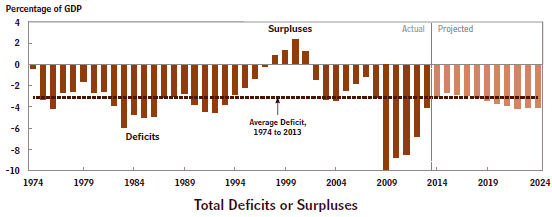
CaptureCapture1The first chart above shows a forty year history of government deficit spending.  The average deficit for this time period is 3% of GDP.  From 1982 – 1987 the deficits were worse than this and from 2009 – 2013 they were much worse.  The real problem is the accumulated deficits, i.e. the debt.  The second chart above shows the public debt (what we pay interest on) all the way back to 1940 as a percent of GDP.  As recently as 2008, the public debt was below 40% of GDP.  Now it is 73% and climbing.  This is very serious for two reasons.  Right now our public debt is almost free money because interest rates are so low.  But when interest rates return to their normal level of about 5%, interest payments will explode and be a huge drain on the economy.  In addition, these CBO predictions assume continued steady growth of the economy.  If and when we have a new recession or some other financial crisis, there will be much less flexibility available for dealing with it.
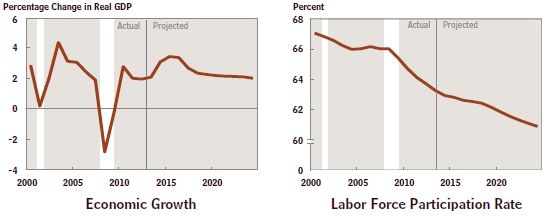
Capture2Now look at the last two charts.  The first one shows the rate of GDP growth since 2000 which has averaged about 2% since the end of the recession in June 2009 and is projected by the CBO to level off at this same rate over the next 10 years.  This is an historically low rate of growth for our economy. The final chart shows the gradual decrease of the labor force participation rate over this same time period.  These two graphs are related!  When fewer people are working, the economy simply will not grow as fast.
High debt and slow growth are big problems for an economy.  We’re falling more deeply into this perilous state of affairs all the time.  We need to take strong measures to break out of this dangerous trap!

Let’s Devolve Federal Programs Back to the States!


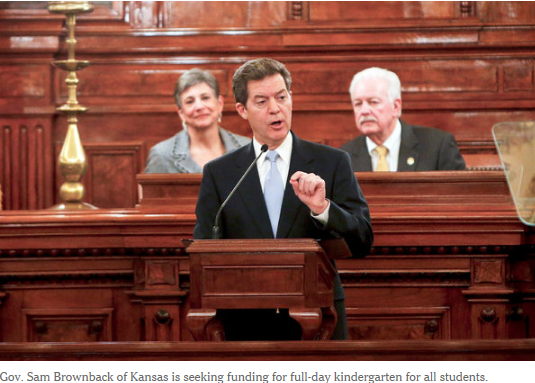
Yesterday’s New York Times has an article “Battles Looming Over Surpluses in Many States”, pointing out that “unexpectedly robust revenues from taxes and other sources are filling most state coffers, creating surpluses not seen in years and prompting statehouse battles over what to do with the money.”  For example, in Kansas, Governor Sam Brownback is calling for full day kindergarten for all students.
CaptureThis raises a larger issue.  The states are recovering from the Great Recession and have lots of money.  We know that states spend money far more efficiently than the federal government, because states have constitutional requirements to balance their budgets.  On the other hand, the federal government is hemorrhaging red ink at a frightening rate which will just keep getting worse indefinitely until strong measures are taken.  It has taken on far too many responsibilities and spends money very inefficiently.
All of this suggests an obvious course of action to turn around a very bad situation.  We should devolve as many federal programs as possible back to the states.  Here are three good ones to start with:

  • Medicaid costs the federal government about $250 billion per year with another $150 billion being paid for by the states.  The problem is that federal support is a fixed percentage of what the states spend.  This makes Medicaid a very expensive program with no limit on the cost to the federal government.  A good way to solve this problem is to “block grant” Medicaid to the states and let each state figure out the best way to spend its own federal allotment.  Annual increases in the size of federal block grants could be tied to the rate of inflation in order to limit their growth.
  • Education spending at the federal level is a $100 billion per year (not counting student loans) item.  Just at the K-12 level alone there are over 100 individual programs to which states and school districts have to apply for funds separately.  Wouldn’t it make far more sense to “block grant” education funds back to the states so that this large sum of money can be spent more effectively and efficiently by targeting it at the biggest needs in each state?
  • Job-Training costs the federal government $18 billion per year for 47 different programs.  Again it would be so much more sensible to block-grant job training funds to the states and measure effectiveness by the number of workers hired.

There really are relatively simple ways for the federal government to operate more effectively and at much lower cost.  We need national leaders who are committed to getting this done.

Fundamental Tax Reform Is the Key to Solving Our Economic and Fiscal Problems II. The Graetz Plan

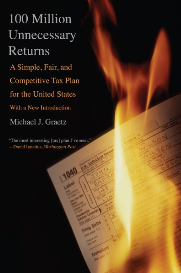
The Yale Tax Law Professor, Michael Graetz, has proposed a new tax system “100 Million Unnecessary Returns: A Simple, Fair, and Competitive Tax Plan for the United States” which would do wonders towards straightening out the huge fiscal and economic problems now facing our country.
CaptureHow do we rev up the national economy in order to put more people back to work and, at the same time, raise the revenue needed to operate the government in the 21st century without mountains of debt?  Mr. Graetz’s basic idea is to tax consumption rather than relying totally on an income tax.  Under his plan both savings and investments will be taxed at a lower rate which will encourage more of both.  The Plan has these features:

  • A broad based Value Added Tax of about 14% is enacted on goods and services.  The U.S. is the only advanced economy without a VAT.
  • Families earning less than $100,000 are exempted from the income tax.  For incomes between $100,000 and $250,000, the tax rate would be 15%.  For income over $250,000, the rate would be 25%.
  • The corporate income tax rate is lowered to 15%.
  • The Earned Income Tax Credit (EITC) is used to provide relief from the VAT burden to low-income families by using payroll tax offsets.
  • The plan is designed to be revenue neutral as verified by the Tax Policy Center.

This plan has many advantages including:

  • Taxing consumption and lowering the corporate tax rate to 15% from its current level of 35% would dramatically encourage investment in the U.S. thereby stimulating the economy and creating both new jobs and higher wages for American workers.
  • It would eliminate more than 100 million of the 140 million U.S. tax returns.
  • With many fewer Americans paying income taxes there would be far less temptation for Congress to use income tax exclusions, deductions and credits to try to address social and economic problems.
  • The plan retains all of the progressive features of our current tax system whereby higher income earners pay higher tax rates.

The point of describing the Graetz Plan in some detail is not to suggest that it is the best way to implement tax reform but rather that here, at least, is one attractive way to do it.  The purpose is to move the discussion forward.  We badly need to make changes along these lines!