An Economy Doing Half Its Job


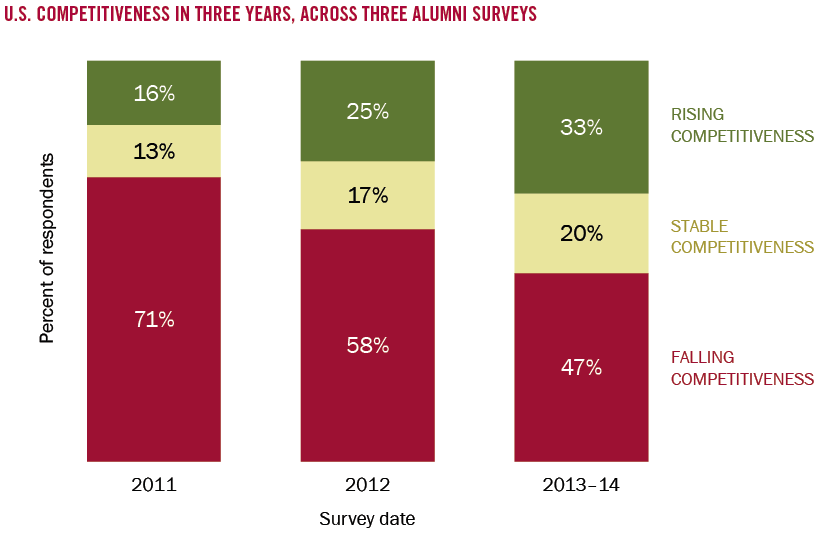
The Harvard Business School has just conducted its third alumni survey on U.S. competitiveness and finds “An Economy Doing Half Its Job.”  “Our report on the findings focuses on a troubling divergence in the American economy: large and midsize firms have rallied strongly from the Great Recession, and highly skilled individuals are prospering.  But middle- and working-class citizens are struggling, as are small businesses.  We argue that such a divergence is unsustainable.”
CaptureHighlights of the survey are:

  • Survey respondents were pessimistic on balance, although less so than in previous surveys. By a ratio of three to two, those who foresaw a decline in U.S. competitiveness in the next three years outnumbered those who predicted an improvement. Respondents were much more hopeful about the future competitive success of America’s firms than they were about the future pay of America’s workers.
  • Respondents saw weaknesses in those aspects of the U.S. business environment that drive the prospects of middle- and working-class citizens, for instance, the education system, the quality of workplace skills, and the effectiveness of the political system.
  • Alumni working in small businesses had more negative views of virtually every aspect of the U.S. business environment. This finding echoes growing evidence from other sources that small businesses are disadvantaged in America.

Capture1The authors of the report “see a need for business leaders to move toward strategic, collaborative efforts that make the average American productive enough to command higher wages even in competitive global labor markets.  Without such actions, the U.S. economy will continue to do only half its job, with many citizens struggling.” What’s interesting about this report is that it describes the problems of the American economy in a straightforward and practical way with no apparent ideological slant.  Of course, addressing these issues requires political action with all of its messy, partisan overtones. Nevertheless perhaps all parties can at least agree on what the basic problem is.

Another Voice for Abolishing the Corporate Income Tax: Sheila Bair


My last post “Real Tax Reform: Abolish the Corporate Income Tax,” gives six substantial reasons for abolishing the U.S. corporate income tax.  As shown in the table below, many American companies are keeping large percentages of their total cash balances overseas in order to avoid paying the very high U.S. corporate tax rate of 35% on these funds.
Capture1Sheila Bair, former chair of the Federal Deposit Insurance Corporation from 2006 – 2011, has recently endorsed the same idea in “Why Getting Rid of the Corporate Income Tax Makes Sense”.  Ms. Bair’s recent book, “Bull by the Horns,” is one of the best books written about the financial crisis.
Ms. Bair makes many of the same points as in my last post including the suggestion that in return for totally eliminating this tax, both dividends and capital gains should be taxed at the same (higher) rates as for ordinary earned income.  She points out that applying ordinary tax rates to realized investment income would make up only about $90 billion of the approximately $300 billion annual cost of eliminating the corporate tax.  She suggests that the remaining $210 billion could be raised by implementing Martin Feldstein’s proposal to cap individual tax deductions, excluding for charitable contributions, at 2% of adjusted gross income.
As she says, “We are on an unsustainable path.  Caught between eroding corporate revenue on one side and low tax rates for wealthy investors on the other, middle and upper-income wage earners are being squeezed – and there are only so many of us.  At some point we might start thinking about moving too.”
Keep in mind the fundamental reason for this proposal: to incentivize U.S. companies to bring their foreign earnings back home for reinvestment and distribution of profits to shareholders (who will then be taxed on this income).  This will give our economy the large and permanent boost which it so badly needs to regain its former vigor.

Real Tax Reform: Abolish the Corporate Income Tax


Several large U.S. corporations have recently announced that they are planning to move their headquarters to a low tax company such as Ireland or Great Britain, in order to reduce the high corporate taxes which they now have to pay. Many observers agree that the best way to address this problem is to lower the corporate tax rate down to an internationally competitive rate of about 20% to 25%.  Such a rate cut would be paid for by closing the loopholes and deductions which many corporations now enjoy.
CaptureThe Business Insider reporter, Danny Vinik, makes a very good argument for going further and completely eliminating the corporate income tax for the following reasons:

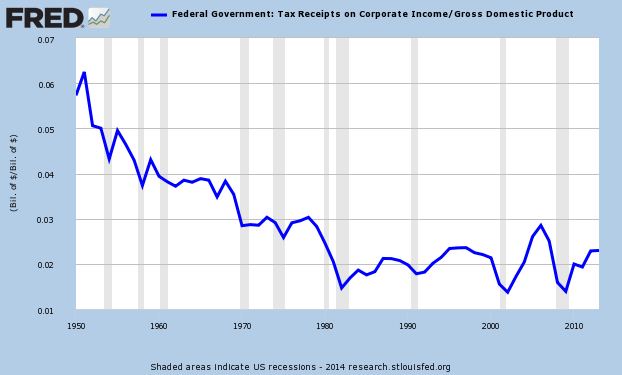
  • Corporate taxes don’t collect that much revenue. As shown above the revenue from this tax has dropped to about 2% of GDP which is about $300 billion at the present time. This is roughly 10% of total annual federal tax revenue.
  • Tax capital gains and dividends at the same rate as earned income. This would make up for the lost revenue and is justified because there would no longer be double taxation of corporate earnings.
  • The corporate tax is not progressive. It is now paid for by both workers (with lower wages) and shareholders. Eliminating this tax (and replacing it with higher taxes on dividends and capital gains) makes the tax more progressive.
  • Corporations waste huge amounts of money trying to reduce their tax bill.  What they now spend on tax lawyers and lobbyists could be put to more productive use.
  • The current system disadvantages new businesses. It’s the old firms which have collected all the deductions. New firms start out paying the full 35% rate which puts them at a large competitive disadvantage.
  • It will make our financial system safer. Since debt payments are tax deductible and equity financing is not, debt financing is currently incentivized. The elimination of the corporate tax would end this preference of debt over equity.

Taking this action would not only have all of these benefits, it would make the U.S. the most desirable place in the world to locate a business.  We would experience a huge economic boom, creating millions of new jobs.  It would end our present economic funk and put us back on a rapid growth trajectory.   What are we waiting for!

The Big Picture on Debt Part IV The Full Model


For the past week I have been discussing different aspects of our alarming debt problem as vividly illustrated in a recent report from the Congressional Budget Office  (see chart below).  My last post discusses what I call the Buffett Model:  G > D, meaning that as long as nominal growth G (real growth plus inflation) is greater than the deficit D, then the accumulated debt will decrease as a percentage of GDP and the debt is said to be “stabilized”.  This, of course, is what has happened in the U.S. historically after all of our major wars and especially after WWII (see below).  The problem is that our current situation in 2014 appears much bleaker going forward because the debt is projected (by CBO) to just keep on growing indefinitely.
CaptureToday I look at a broader model, the so-called BRITS model:  R + I > (S – T) + B   where

  • B = borrowing costs
  • R = real growth
  • I = inflation
  • T = taxes
  • S = spending.

The BRITS model reduces to the Buffett model by letting G = R + I and D = (S – T) + B.  The value of this more general model is to show the relationship between all five of these important variables.  To meet the objective of stabilizing debt, according to this intuitive model, we should increase both R and I and decrease S – T and B.
The Federal Reserve is involved by keeping B as low as possible and making sure that I is large enough (but not too large or other problems will occur).  Congress can help by cutting spending or raising taxes but, of course, both of these actions are hard to do politically.
If real growth R is high enough then the desired inequality will hold and debt will be stabilized.  But how is this accomplished?  The Fed has been trying to increase growth through quantitative easing but it’s not working very well.  Many economists think that it would be more helpful for Congress to implement broad based tax reform, whereby tax rates are lowered and loopholes and deductions are closed in a revenue neutral manner so that overall tax revenue remains the same.  But nobody wants to lose their own deductions so this is hard to do.
CaptureAs much as faster growth will help, it is still critical for Congress to get spending under control.  The above chart from the Heritage Foundation shows that under current trends by 2030 federal spending will have increased so much that all federal tax revenue will be spent on just entitlements and interest payments alone!  Since this is unrealistic, some sort of a major new crisis is likely to occur before 2030!
Conclusion: The BRITS model helps to understand the complexity of our debt problem and some of the steps that need to be taken to alleviate it.  I will return to it in the future.

The Big Picture on Debt Part III. The Oracle of Omaha Speaks


“I could end the deficit in 5 minutes.  You just pass a law that says anytime there is a deficit of more than 3% of GDP, all sitting members of Congress are ineligible for re-election.”                                                                                                                                                                       Warren Buffett, 1930 –

Mr. Buffett made this quip in a recent interview with CNBC.  Since the economy has historically grown at a rate of about 3%, Mr. Buffett is saying that we’ll be alright as long as economic growth exceeds deficit spending.  This is generally correct but, as Mr. Buffett well knows, the situation is more complicated than this.
CaptureA very good, and nontechnical, discussion of this whole subject can be found in the newly published book, “The Death of Money: the coming collapse of the international monetary system” by the financier James Rickards.  Look at Chapter 7, “Debt, Deficits and the Dollar.”
Simplifying Mr. Rickards’ approach a little bit, and keeping it in Mr. Buffett’s framework, for a stable economy we need to have
G > D
where the nominal growth G = real GDP + I (I is the rate of inflation) and the deficit D = S – T  (S is spending and T is tax revenue).  I have included interest paid on the debt as part of total spending.  As long as the left hand side is greater than the right hand side, the economy is growing faster than the deficit and the accumulated debt will shrink as a percentage of GDP. Notice that the rate of inflation affects the left hand side of the inequality while the interest rate is part of the right hand side.
Negative inflation is deflation which is clearly undesirable.  The Federal Reserve’s current target for inflation is 2%.  The challenge for the Fed is 1) to keep inflation high enough and interest rates low enough so that G > D, while at the same time, 2) to make sure that inflation does not grow so high as to destabilize the markets.
Given our underperforming economy with low real GDP growth, and huge deficits, Mr. Rickards is pessimistic that the Fed can continue successfully “in the position of a tightrope walker with no net … exuding confidence while having no idea whether its policies will work or when they might end.”
Thus the gloomy title for his book.

Five Sectors to Blame for Economic Weakness


Several of my recent blog posts have addressed various issues relating to our slow growing economy.  In particular I have proposed a simple way to speed up economic growth: namely, broad-based tax reform at both the individual and corporate levels.  The idea is to lower tax rates across the board, paid for by closing loopholes and shrinking deductions.  At the individual level this could have the effect of putting as much as $250 billion per year in the hands of the middle and lower income wage earners who will surely spend most of it, thereby giving the economy a big boost.  The U.S. corporate tax rate is not internationally competitive.
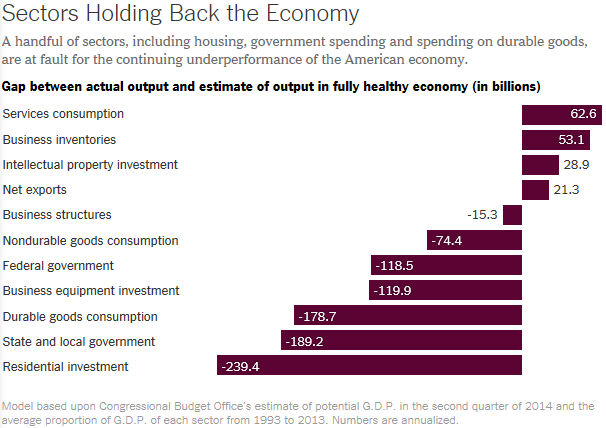
In today’s New York Times the economics writer, Neil Irwin, has an article “Why Is the Economy Still Weak?  Blame These Five Sectors.”  The five sectors are, in order of magnitude of effect: housing, state and local governments, durable goods consumption, business equipment investment, and federal government.  See the chart below.
CaptureLet’s look in turn at each of these top five barriers to faster economic growth:

  • Housing. Not at all surprising with 24 million people either unemployed or underemployed. Young people especially cannot afford to buy their first home today.
  • State and Local Governments. These governmental units have to balance their budgets. When people have more money to spend, tax revenues will increase and so will public spending.
  • Durable Goods Consumption. These same 24 million people aren’t buying much new furniture or many new cars either. It makes complete sense.
  • Business Equipment Investment.  Lower corporate tax rates will incentivize our multinational firms to bring their foreign profits back home for reinvestment.
  • Federal Government. Unfortunately nothing can be done about this category! Federal deficit spending is way too high as it is and must come down.

Conclusion:  Using broad-based tax reform to put a large amount of money in the hands of middle and lower-income wage earners, and also reforming corporate taxes, will boost spending for four of the five main barriers to faster economic growth.  Why don’t we do it?

How to Increase Growth and Decrease Inequality at the Same Time II. A Concrete Example


The United States has two fundamental economic and fiscal problems at the present time.  First of all, the economy is growing too slowly to create enough new jobs.  In fact, there are now 24 million people either unemployed or underemployed.  Secondly, federal tax revenue is not sufficient to pay the bills.  Of course, these problems are interrelated.  If the economy were growing faster, more tax revenue would be generated and deficit spending would be lower.
CaptureAt the same time, changes in society, such as globalization and technological progress, are creating higher levels of inequality.  Economic inequality is inevitable in a free society but too much of it will create resentment.  The best way to minimize such resentment is to make sure that incomes are rising for all.  In other words, first speed up growth.  If inequality can also be reduced, so much the better.
A few days ago my post “How to Increase Growth and Decrease Inequality at the Same Time!” presented such a plan.  The idea is to enact broad-based tax reform, whereby tax rates are lowered for everyone, offset by shrinking tax deductions.  The 64% of taxpayers who do not itemize deductions will receive a big tax cut.  Since they are the lower and middleclass wage earners with stagnant incomes, they will tend to spend their tax savings, thereby giving the economy a boost.  But this means that the 36% of (wealthier) taxpayers who do itemize deductions will, on average, end up paying higher taxes.  Overall, this represents a shift from the wealthy to the less wealthy and therefore lessens inequality.
Here is a concrete example to illustrate the magnitude of what can be accomplished:

  • Individual tax deductions total about $1 trillion per year.
  • Let’s suppose that these deductions are cut in half to $500 billion per year.
  • Let’s further suppose that half of this amount, or $250 billion per year, is cut from the taxes of the 64% who do not itemize deductions.
  • If these 64% spend just 2/3 of their new income (instead of saving it or paying off debt), this will total $170 billion which is 1% of GDP.
  • This would increase the rate of growth of GDP from the 2.2% average, since the end of the Great Recession, to 3.2%. This represents an enormous boost to the economy and would return average GDP growth to about its 3.3% average since 1947.

I emphasize that this is an oversimplified illustrative example to demonstrate what can be achieved with a plan of this nature.  Hopefully it will be more thoroughly analyzed by an expert economist, which I am not!

How to Increase Growth and Decrease Inequality at the Same Time!


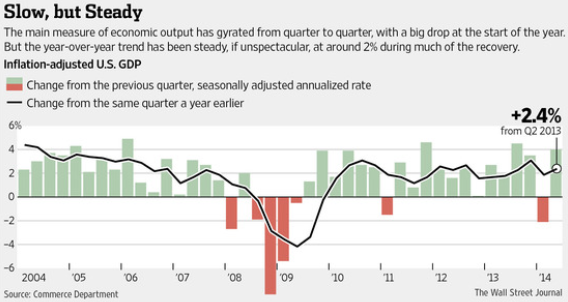
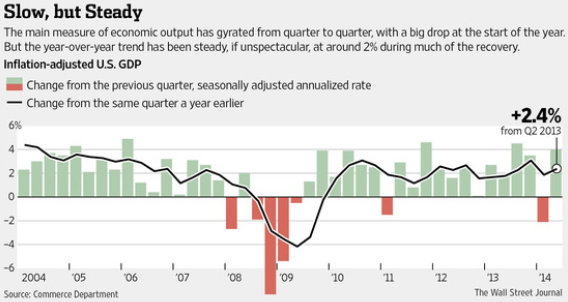
The Department of Commerce has just reported basic economic data for the second quarter of 2014.  As the chart below shows, the economy gradually lost steam from 2004 – 2008, sunk badly in 2008 and 2009, and has now grown at a slow but steady rate of about 2% during the period 2010 – 2014.
CaptureOne of my favorite journalists, the New York Times’ economics reporter Eduardo Porter, has just written again on the topic of inequality, “Income Inequality and the Ills behind It.”  He quotes the economist Tyler Cowen as saying “The right moral question is ‘are poor people rising to a higher standard of living?’  Inequality itself is the wrong thing to look at.  The real problem is slow growth.”  The economist Gregory Mankiw is quoted as saying that “Policies which address the symptom (of inequality) rather than the cause include higher taxes and a more generous safety net.  The magnitude of what we can plausibly do with these policy tools is small compared to the size of the growing income gap.”
What Mr. Cowen and Mr. Mankiw are both suggesting is that we can’t effectively attack income inequality without also increasing economic growth.  I believe that it is possible to address both problems at the same time by implementing broad-based tax reform as follows:

  • Individual income tax rates should be lowered across the board, paid for by closing loopholes and shrinking deductions, in a revenue neutral way.
  • The 64% of all taxpayers who do not itemize deductions will get a significant tax cut. Since they are largely the middle and lower-income wage earners with stagnant incomes, they will tend to spend their tax savings, thereby giving the economy a big boost.
  • At the same time the 36% of taxpayers who do itemize their deductions will, on average, see their income taxes go up. But these are, on the whole, the wealthier wage earners who can afford to pay higher taxes.
  • A plan such as this represents a shift of net after-tax income from more wealthy people to the less wealthy. It therefore reduces income inequality.

If we can cut tax rates, increase economic growth and reduce income inequality all at once, why can’t our national leaders come together and act along these lines?

Stopping Corporate Tax Dodgers

Several large U.S. companies have recently announced that they are planning to merge with foreign companies and move their corporate headquarters to a low tax country such as Ireland or Great Britain.  The Obama Administration proposes to disallow such “tax inversions” by requiring that after such a merger at least 50% of the stock of the new company would have to be foreign owned.  Otherwise the firm would still be considered American for tax purposes.  Such a technical fix is unlikely to solve a much more fundamental problem.
As the latest issue of the Economist, “How to stop the inversion perversion,” makes clear, “America’s corporate tax has two horrible flaws.  The first is the tax rate, which at 35% is the highest among the 34 mostly rich-country members of the OECD. … The second flaw is that America levies tax on a company’s income no matter where in the world it is earned.  In contrast, every other large rich country taxes only income earned within its borders (a so-called ‘territorial system’).  Here, too, America’s system is absurdly ineffective at collecting money.  Firms do not have to pay tax on foreign profits until they bring them back home.  Not surprisingly, many do not: American multinationals have some $2 trillion sitting on their foreign units’ balance sheets.”
CaptureA relatively simple solution to this glaring problem would be to lower the corporate tax rate to 25%, the OECD average, and shift to a territorial system.  Revenue losses would be offset by closing loopholes and deductions.
A better, but likely more controversial, solution would be to completely eliminate the corporate income tax and then tax dividends and capital gains at the same rate as earned income.  This would avoid the double taxation problem whereby profits are taxed first at the corporate level and then again for individuals as dividends and capital gains.
The overall goal in this entire endeavor should be to boost the economy, thereby creating more jobs, and additionally to raise the tax revenue needed to pay our bills.  Fairness is important but growth is even more important!

Bush Was a Disaster; Obama Is Merely Ineffective


As Barack Obama nears the three-quarter’s mark of his presidency, it is natural that he and George W. Bush will be compared to one another.  I consider them both to be disappointing presidents but in very different ways.
CaptureFirst, the sins of George Bush:

  • The Bush Tax Cuts of 2001-2003 lowered tax rates without being offset by closing loopholes and/or shrinking tax deductions. This made his huge budget deficits much worse than they otherwise would have been and without helping the economy.
  • The Iraq War. Regardless of whether or not the U.S. was justified in invading in 2003, the current ISIS uprising of Sunnis is likely to result in a worse outcome than existed before the U.S. invasion. This will come to mean that Iraq was a mistake.
  • Medicare Part D (2003). The Prescription Drug program now costs the federal government about $100 billion per year. It makes the unsustainable cost of Medicare that much worse.
  • The Financial Crisis of 2008. This represents an even bigger stain on his record. He appointed all of the key players such as Ben Bernanke, Tim Geithner and Henry Paulson who failed to see it coming. He also appointed Sheila Bair as head of the FDIC in 2006. She did see it coming but it was too late and she didn’t have enough clout.

Mr. Obama is very bright and articulate.  But he has made many serious mistakes including:

  • His total immediate attention in 2009 should have been on reviving the economy. Instead he and the filibuster-proof Democratic Congress pushed through the Patient Protection and Affordable Care Act. The employer mandate of Obamacare, even though postponed by the administration, has slowed down the economic recovery by making it more expensive for businesses to hire full time employees.
  • For all of his nonpartisan campaign rhetoric about “change we can believe in,” he has been one of the most divisive and partisan presidents in many years. This has created huge animosity and distrust amongst his political opponents which makes it difficult for the two sides to negotiate differences in good faith.
  • The most glaring example of this is the anemic 2.2% annual growth of the economy since the Great Recession ended in June 2009. Many economists agree that cutting both individual and corporate tax rates, offset by closing loopholes and deductions, would be hugely beneficial in boosting the economy. It would put millions of people back to work and shrink our huge deficits. Why isn’t the President talking about this and leading the charge?   But, of course, this was the Romney tax plan in 2012. What’s wrong with the election winner adopting the best parts of the program of the election loser?  Now that would be demonstrating real leadership ability!