Which Nebraska Senate Candidate Is Most Serious about the National Debt?


“The single biggest threat to our national security is our debt”
Admiral Mike Mullen, former Chairman of the Joint Chiefs of Staff

My last blog, “Why the National Debt Is Such a Threat to the U.S.” observes that our debt is very large by historical standards and will just keep getting worse under current policies now in effect.  This has many severe consequences for the well-being of our country.
What do we do about it?  We have to shrink the size of our annual deficits which are continuing to make the debt bigger and bigger.  The deficit for the 2014-2015 budget year just ended is $483 billion which is 2.8% of GDP.  Since our economy has been growing at a rate of only 2.2% for the past five years, this means that the debt is still growing faster than the economy.  We have to do better than this.
CaptureThe above chart from the Congressional Budget Office shows that the main contributors to the deficit, and therefore also the debt, over the next 20 years, will be entitlements (Social Security, Medicare and Medicaid) and interest payments on the debt.  All other programs, i.e. almost all of traditional federal spending, will decrease as a percentage of GDP.
This means that there are just two basic ways to solve our debt problem: trim entitlement spending and/or increase government revenue.  We’ll need to do both.  Furthermore, it is unrealistic to expect middle-income and lower-income people to pay higher taxes when their wages have been stagnant for many years.  New tax revenue will have to come from the wealthy including upper-income wage earners.  The best way to do this is by cutting back on the annual $1.2 trillion in loopholes and deductions built into the tax code.

CaptureOnly one Senate candidate from Nebraska is willing to both trim entitlement spending and raise additional tax revenue: Jim Jenkins, a registered independent from Calloway.  The Democratic candidate, David Domina, will not support any significant reining in of entitlement spending.  The Republican candidate, Ben Sasse, is too beholden to wealthy contributors to be willing to raise their taxes by cutting back on their tax deductions.
We badly need elected representatives in Washington who will make it their top priority to “fix the debt.”  Jim Jenkins is such a person.  I hope you will vote for him!

How Bad Is Income Inequality and How Do We Fix It?


The latest news on the American economy is mixed. The unemployment rate fell to 5.9% in September but the labor force also fell by 97,000 last month.  The labor participation is now down to 62.7%, a level last seen in 1978.  On the plus side 248,000 new jobs were created but the share of the population employed stayed at 59%, less than its 59.4% level at the end of the recession in June 2009.  In other words, job growth is definitely picking up but not fast enough.
CaptureHow about income inequality?  One simple way of describing and understanding the degree of income inequality in the U.S. is to look at median household income and how it changes over time.  The above chart from the WSJ shows how the median U.S. household income fell from an all-time high of $56,895 in 1999 to $51,939 in 2013.  However it also climbed back up to $56,436 in 2007 before dropping precipitously until 2012.
Capture1The Global Strategy Group discovered in a recent survey that registered voters overwhelmingly rate economic growth as a higher priority than economic fairness.  This means that any policy designed to speed up economic growth is likely to receive favorable support by the electorate.
In a recent post I describe a plan for broad-based tax reform specifically designed to speed up economic growth.  It would involve an across-the-board cut in tax rates totaling about $500 billion per year, but completely paid for by closing loopholes and deductions which primarily benefit the wealthy.  The 64% of taxpayers who do not itemize deductions would receive a tax cut.  And they would likely spend this extra money in their pockets because they are precisely the middle- and lower-income wage earners with falling incomes.
An income tax redistribution like this would greatly reduce inequality but in a way which is designed to give the economy a big boost!

A Glaring Example of the Need for Tax Reform


Nowadays there are many advocates for both individual and corporate tax reform. I have had several posts recently on this issue. A new report from the Tax Foundation “Is the Tax Code the Proper Tool for Making Higher Education More Affordable?” make a compelling argument that it is futile to try to do this.
CaptureFor example:

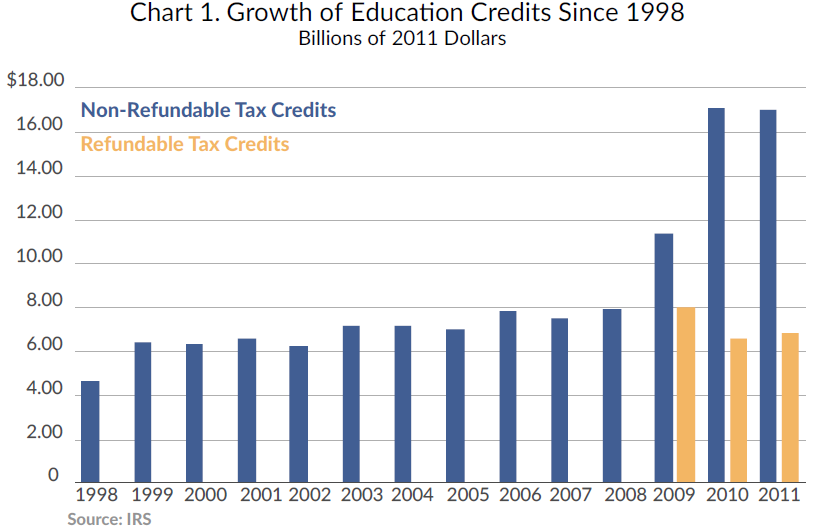
  • Education tax credits have grown from a $4.5 billion program for 4.7 million taxpayers in 1998 to a $17.4 billion program claimed by over 7 million taxpayers in 2011.
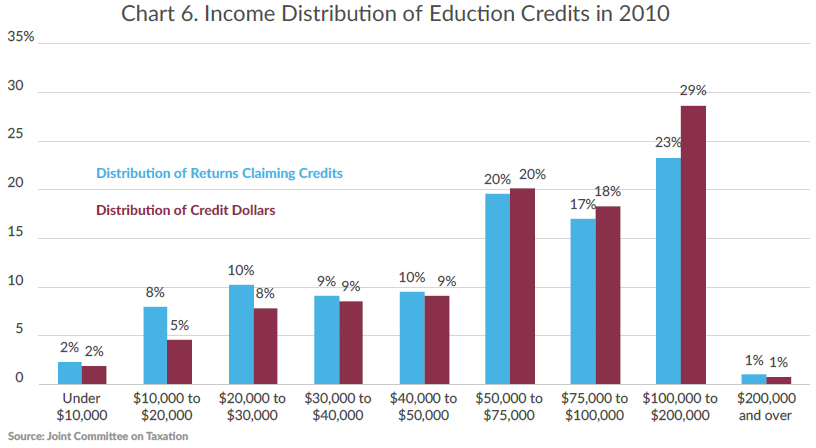
  • Education tax credits are not well targeted toward low- and middle-income families; almost 50% of the benefits accrue to taxpayers earning more than $75,000, often much more. A much more sensible way to target low income students would be to increase Pell grants.
  • The overuse of tax credits by the federal government has turned the IRS into a spending agency, with refundable tax credits projected to double to nearly $200 billion in the next five years.
  • Trading the elimination of education tax credits for lower marginal tax rates would grow the economy by $19 billion per year and create 121,000 new jobs.

Capture2

The authors go on to say: “It is likely that instead of helping, tax credits may be contributing to the rising cost of college education. Colleges are what economists call price discriminators because they can maximize the price that each student can pay.  Because of the Free Application for Federal Student Aid (FAFSA), the college has intimate knowledge of each student’s (or family’s) income and if they are eligible for tax credits, loans, or other financial aid.  This information allows the college to simply adjust its financial aid package in order to capture the maximum value of the tax credit.  Instead of being a helping hand for students, tax credits have turned into a windfall for universities.”
There are many, many reasons to reform the tax code.  The education tax credit is just one very good example!

Why I Support Jim Jenkins for the U.S. Senate from Nebraska


I have been writing this blog for almost two years because of my great concern about the direction our country is headed on fundamental fiscal and economic issues. Federal spending has been out of control for over thirty years and the situation is getting progressively worse.  Our national debt is over $17 trillion and growing at a rate of $500 billion per year.  And it will soon be growing much faster than this if we don’t make big changes.  Economic growth has been stuck at the anemic rate of 2.2% of GDP ever since the end of the Great Recession over five years ago.
Our national leaders are simply not doing the job they were elected for.  Democrats blame the Republicans and Republicans blame the Democrats but excuses are not good enough.  We need people in Washington who can figure out how to navigate within the system and actually find solutions to our very serious problems.
CaptureI believe that Jim Jenkins, a registered independent from Callaway, is the best qualified candidate to do what needs to be done.  Check out his website, Jenkins for Senate, and decide for yourself.  Here are a few of his views on important issues:

  • Fixing the Debt. Jim supports the recommendations of the Simpson-Bowles Commission which calls for dramatically cutting federal spending especially for entitlements and also raising taxes if necessary in order to drastically shrink our annual deficits.
  • Tax Reform. Jim supports lower tax rates achieved by eliminating many of the tax expenditures (credits, deductions and exclusions) embedded in the code. This is what is needed to boost economic growth.
  • Affordable Care Act. Jim believes that the ACA has many rough edges but that it is possible to fix them rather than repealing it and starting over.
  • Immigration Reform. Jim supports comprehensive immigration reform which includes securing our borders but at the same time expanding the number of guest worker visas to meet the needs of business and agriculture.
  • Veterans Administration. Jim supports setting up a plan to enable veterans to obtain medical care from health professionals within their own communities.

Compare these common sense views with the far more ideological positions of the other candidates in this race. I think that you will agree with me that Jim Jenkins is the person we want representing us in Washington!

The Big Picture on Debt Part IV The Full Model


For the past week I have been discussing different aspects of our alarming debt problem as vividly illustrated in a recent report from the Congressional Budget Office  (see chart below).  My last post discusses what I call the Buffett Model:  G > D, meaning that as long as nominal growth G (real growth plus inflation) is greater than the deficit D, then the accumulated debt will decrease as a percentage of GDP and the debt is said to be “stabilized”.  This, of course, is what has happened in the U.S. historically after all of our major wars and especially after WWII (see below).  The problem is that our current situation in 2014 appears much bleaker going forward because the debt is projected (by CBO) to just keep on growing indefinitely.
CaptureToday I look at a broader model, the so-called BRITS model:  R + I > (S – T) + B   where

  • B = borrowing costs
  • R = real growth
  • I = inflation
  • T = taxes
  • S = spending.

The BRITS model reduces to the Buffett model by letting G = R + I and D = (S – T) + B.  The value of this more general model is to show the relationship between all five of these important variables.  To meet the objective of stabilizing debt, according to this intuitive model, we should increase both R and I and decrease S – T and B.
The Federal Reserve is involved by keeping B as low as possible and making sure that I is large enough (but not too large or other problems will occur).  Congress can help by cutting spending or raising taxes but, of course, both of these actions are hard to do politically.
If real growth R is high enough then the desired inequality will hold and debt will be stabilized.  But how is this accomplished?  The Fed has been trying to increase growth through quantitative easing but it’s not working very well.  Many economists think that it would be more helpful for Congress to implement broad based tax reform, whereby tax rates are lowered and loopholes and deductions are closed in a revenue neutral manner so that overall tax revenue remains the same.  But nobody wants to lose their own deductions so this is hard to do.
CaptureAs much as faster growth will help, it is still critical for Congress to get spending under control.  The above chart from the Heritage Foundation shows that under current trends by 2030 federal spending will have increased so much that all federal tax revenue will be spent on just entitlements and interest payments alone!  Since this is unrealistic, some sort of a major new crisis is likely to occur before 2030!
Conclusion: The BRITS model helps to understand the complexity of our debt problem and some of the steps that need to be taken to alleviate it.  I will return to it in the future.

The Big Picture on Debt II. Why It Is So Alarming


My last post, “The Big Picture on Debt,” used a chart from a recent Congressional Budget Office report (pictured  below) to look at the history of U.S. debt.  It is worse now than at any other time except at the end of World War II.  But after 1945 massive military spending ended rapidly, the economy started growing briskly and debt as a percentage of GDP shrunk rapidly.
CaptureThe light purple section at the right hand side of the chart portrays CBO’s debt projection for the next 25 years.  As the report itself makes clear, CBO is using favorable economic assumptions in this projection.  Without these favorable assumptions, our future debt will be much worse than this.  And the same trends continue indefinitely into the future beyond the 25 year window.
Right now our huge debt is almost “free” money because interest rates are so low.  But this situation cannot last much longer without setting off an inflationary spiral.  As interest rates eventually resume their historical average of about 5%, interest payments on our accumulated debt will skyrocket and therefore increase the size of the annual deficits.
There are only three ways to shrink debt as a percentage of GDP: 1) cut spending, 2) achieve faster growth and 3) raise tax revenue.  Let’s look at each in turn:

  • Government spending as a percentage of GDP is not shrinking but actually growing. Primarily this is because of the massive growth of the big three entitlement programs: Social Security, Medicare and Medicaid. All other government spending is subject to Sequester limits. This is a crude and insufficient way to control discretionary spending.
  • GDP growth, averaging 2.2% annually since the end of the Great Recession five years ago, is much slower than the overall average growth of 3.3% since the end of WW II. Major tax reform at both the individual and corporate levels, with lower tax rates offset by closing loopholes and shrinking deductions, would give a big boost to economic growth. But there is resistance to cutting tax deductions.
  • Raising taxes will in principle decrease deficit spending but the trick is to do it without hurting economic growth. Both individual and corporate tax reform could accomplish this if done in the right way. See here and here for specific proposals.

Conclusion:  there are concrete ways to find solutions to get our massive accumulation of debt under control and shrinking as a percentage of GDP.  But the prospects for action are gloomy.

Five Sectors to Blame for Economic Weakness


Several of my recent blog posts have addressed various issues relating to our slow growing economy.  In particular I have proposed a simple way to speed up economic growth: namely, broad-based tax reform at both the individual and corporate levels.  The idea is to lower tax rates across the board, paid for by closing loopholes and shrinking deductions.  At the individual level this could have the effect of putting as much as $250 billion per year in the hands of the middle and lower income wage earners who will surely spend most of it, thereby giving the economy a big boost.  The U.S. corporate tax rate is not internationally competitive.
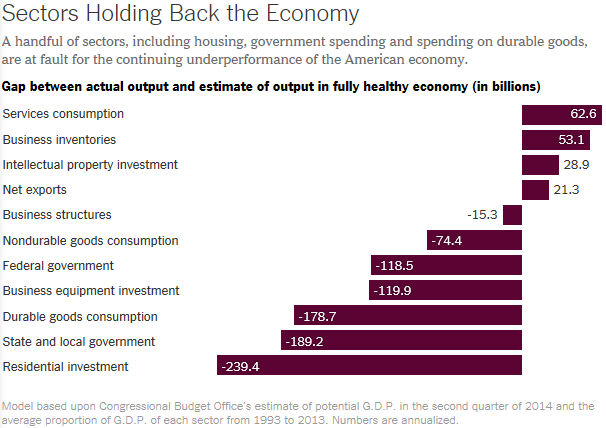
In today’s New York Times the economics writer, Neil Irwin, has an article “Why Is the Economy Still Weak?  Blame These Five Sectors.”  The five sectors are, in order of magnitude of effect: housing, state and local governments, durable goods consumption, business equipment investment, and federal government.  See the chart below.
CaptureLet’s look in turn at each of these top five barriers to faster economic growth:

  • Housing. Not at all surprising with 24 million people either unemployed or underemployed. Young people especially cannot afford to buy their first home today.
  • State and Local Governments. These governmental units have to balance their budgets. When people have more money to spend, tax revenues will increase and so will public spending.
  • Durable Goods Consumption. These same 24 million people aren’t buying much new furniture or many new cars either. It makes complete sense.
  • Business Equipment Investment.  Lower corporate tax rates will incentivize our multinational firms to bring their foreign profits back home for reinvestment.
  • Federal Government. Unfortunately nothing can be done about this category! Federal deficit spending is way too high as it is and must come down.

Conclusion:  Using broad-based tax reform to put a large amount of money in the hands of middle and lower-income wage earners, and also reforming corporate taxes, will boost spending for four of the five main barriers to faster economic growth.  Why don’t we do it?

How to Increase Growth and Decrease Inequality at the Same Time II. A Concrete Example


The United States has two fundamental economic and fiscal problems at the present time.  First of all, the economy is growing too slowly to create enough new jobs.  In fact, there are now 24 million people either unemployed or underemployed.  Secondly, federal tax revenue is not sufficient to pay the bills.  Of course, these problems are interrelated.  If the economy were growing faster, more tax revenue would be generated and deficit spending would be lower.
CaptureAt the same time, changes in society, such as globalization and technological progress, are creating higher levels of inequality.  Economic inequality is inevitable in a free society but too much of it will create resentment.  The best way to minimize such resentment is to make sure that incomes are rising for all.  In other words, first speed up growth.  If inequality can also be reduced, so much the better.
A few days ago my post “How to Increase Growth and Decrease Inequality at the Same Time!” presented such a plan.  The idea is to enact broad-based tax reform, whereby tax rates are lowered for everyone, offset by shrinking tax deductions.  The 64% of taxpayers who do not itemize deductions will receive a big tax cut.  Since they are the lower and middleclass wage earners with stagnant incomes, they will tend to spend their tax savings, thereby giving the economy a boost.  But this means that the 36% of (wealthier) taxpayers who do itemize deductions will, on average, end up paying higher taxes.  Overall, this represents a shift from the wealthy to the less wealthy and therefore lessens inequality.
Here is a concrete example to illustrate the magnitude of what can be accomplished:

  • Individual tax deductions total about $1 trillion per year.
  • Let’s suppose that these deductions are cut in half to $500 billion per year.
  • Let’s further suppose that half of this amount, or $250 billion per year, is cut from the taxes of the 64% who do not itemize deductions.
  • If these 64% spend just 2/3 of their new income (instead of saving it or paying off debt), this will total $170 billion which is 1% of GDP.
  • This would increase the rate of growth of GDP from the 2.2% average, since the end of the Great Recession, to 3.2%. This represents an enormous boost to the economy and would return average GDP growth to about its 3.3% average since 1947.

I emphasize that this is an oversimplified illustrative example to demonstrate what can be achieved with a plan of this nature.  Hopefully it will be more thoroughly analyzed by an expert economist, which I am not!

How to Increase Growth and Decrease Inequality at the Same Time!


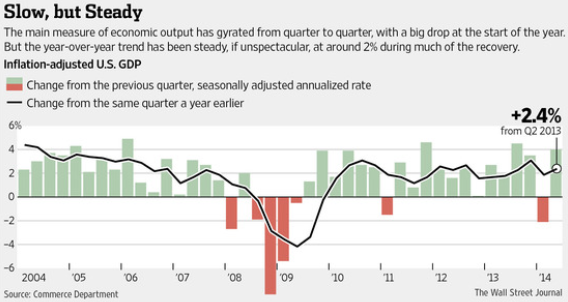
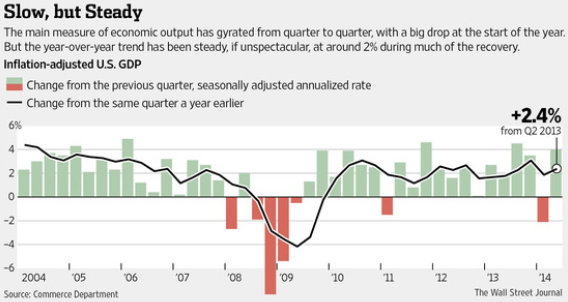
The Department of Commerce has just reported basic economic data for the second quarter of 2014.  As the chart below shows, the economy gradually lost steam from 2004 – 2008, sunk badly in 2008 and 2009, and has now grown at a slow but steady rate of about 2% during the period 2010 – 2014.
CaptureOne of my favorite journalists, the New York Times’ economics reporter Eduardo Porter, has just written again on the topic of inequality, “Income Inequality and the Ills behind It.”  He quotes the economist Tyler Cowen as saying “The right moral question is ‘are poor people rising to a higher standard of living?’  Inequality itself is the wrong thing to look at.  The real problem is slow growth.”  The economist Gregory Mankiw is quoted as saying that “Policies which address the symptom (of inequality) rather than the cause include higher taxes and a more generous safety net.  The magnitude of what we can plausibly do with these policy tools is small compared to the size of the growing income gap.”
What Mr. Cowen and Mr. Mankiw are both suggesting is that we can’t effectively attack income inequality without also increasing economic growth.  I believe that it is possible to address both problems at the same time by implementing broad-based tax reform as follows:

  • Individual income tax rates should be lowered across the board, paid for by closing loopholes and shrinking deductions, in a revenue neutral way.
  • The 64% of all taxpayers who do not itemize deductions will get a significant tax cut. Since they are largely the middle and lower-income wage earners with stagnant incomes, they will tend to spend their tax savings, thereby giving the economy a big boost.
  • At the same time the 36% of taxpayers who do itemize their deductions will, on average, see their income taxes go up. But these are, on the whole, the wealthier wage earners who can afford to pay higher taxes.
  • A plan such as this represents a shift of net after-tax income from more wealthy people to the less wealthy. It therefore reduces income inequality.

If we can cut tax rates, increase economic growth and reduce income inequality all at once, why can’t our national leaders come together and act along these lines?

Stopping Corporate Tax Dodgers

Several large U.S. companies have recently announced that they are planning to merge with foreign companies and move their corporate headquarters to a low tax country such as Ireland or Great Britain.  The Obama Administration proposes to disallow such “tax inversions” by requiring that after such a merger at least 50% of the stock of the new company would have to be foreign owned.  Otherwise the firm would still be considered American for tax purposes.  Such a technical fix is unlikely to solve a much more fundamental problem.
As the latest issue of the Economist, “How to stop the inversion perversion,” makes clear, “America’s corporate tax has two horrible flaws.  The first is the tax rate, which at 35% is the highest among the 34 mostly rich-country members of the OECD. … The second flaw is that America levies tax on a company’s income no matter where in the world it is earned.  In contrast, every other large rich country taxes only income earned within its borders (a so-called ‘territorial system’).  Here, too, America’s system is absurdly ineffective at collecting money.  Firms do not have to pay tax on foreign profits until they bring them back home.  Not surprisingly, many do not: American multinationals have some $2 trillion sitting on their foreign units’ balance sheets.”
CaptureA relatively simple solution to this glaring problem would be to lower the corporate tax rate to 25%, the OECD average, and shift to a territorial system.  Revenue losses would be offset by closing loopholes and deductions.
A better, but likely more controversial, solution would be to completely eliminate the corporate income tax and then tax dividends and capital gains at the same rate as earned income.  This would avoid the double taxation problem whereby profits are taxed first at the corporate level and then again for individuals as dividends and capital gains.
The overall goal in this entire endeavor should be to boost the economy, thereby creating more jobs, and additionally to raise the tax revenue needed to pay our bills.  Fairness is important but growth is even more important!