Where Should the New 114th Congress Focus Its Attention?


The two main themes of this website are how to boost economic growth and how to get our national debt under control.  Faster economic growth will put more people back to work by creating more jobs.  Faster growth will also bring in more tax revenue and therefore potentially reduce deficit spending.
The latest monthly unemployment rate, 5.8% for November 2014, is much higher than it should be almost six years after the end of the Great Recession in June 2009.  The best thing that Congress could do to boost economic growth is to adopt broad-based tax reform, lowering tax rates in a revenue neutral way by closing loopholes and limiting deductions.  I’m still in favor of doing this but I no longer consider it to be the top priority for the following reason.
The huge drop in the price of gasoline is already providing a big economic stimulus.  At the current price of $2 per gallon, the average American family will save about $750 per year in driving expenses.  This is even more relief than a tax cut would provide.  The economy has already picked up steam in 2014 and is predicted to grow at the rate of 3% in 2015.  This will keep the unemployment rate decreasing steadily throughout 2015 and beyond, which represents much progress.
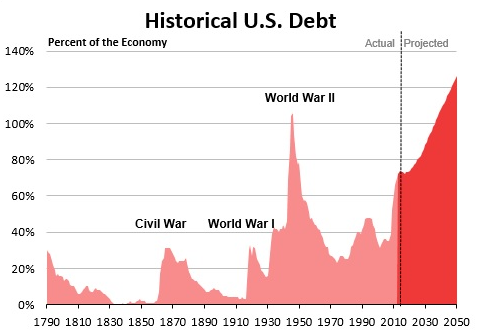
Capture1It’s now time for Congress to focus more strongly on putting the debt on a downward path.  This can only be done by shrinking our annual budget deficits well below the $483 billion deficit for the last (2014) budget year.  As the above chart from Fix the Debt shows, our current fiscal path leads inexorably to a growing debt which is completely unsustainable in the long run.  Annual deficits will have to be at least cut in half to be able to turn the debt trajectory downwards.
Getting this done will require much dedication and hard work by Congress.  Many programs will have to be eliminated.  Surviving programs will need to operate more efficiently.  The entitlement programs of Social Security, Medicare and Medicaid will have to be greatly tightened up.
Is Congress up to this task?  The future of our country depends on it!
Status Quo on the Budget Is Not Good Enough II. Look at the Big Picture!


In my last post, “Status Quo on the Budget Is Not Good Enough,” I discussed a report from the outgoing chair of the Senate Budget Committee, Patty Murray (D-WA), and explained how it epitomizes the lack of progress made on the massive debt problem which has developed since the Great Recession of 2008 -2009.
CaptureThe basic problem is that Senator Murray’s analysis simply does not recognize the seriousness of our debt problem as shown in the above chart.  Right now our public debt (on which we pay interest) is “sitting” at 74% of GDP for a year or two, before it continues its rapid increase.  This projection assumes an historically “normal” growth rate of 3% and no new recessions, neither of which assumption is assured.  It also assumes that the sequester budget cuts and new top tax rate of 39.6% stay in effect.  In other words it is a best case scenario based on current policy.
Breaking it down, the debt will continue to increase because annual deficits will continue to exceed the rate of growth of the economy.  The main driver of these increasing deficits is the cost of the health care entitlements of Medicare and Medicaid.  Medicare costs will increase rapidly because of the aging of the American people.  Medicaid costs will increase rapidly because: 1) more low-income people are being covered by the ACA and 2) since the recession there are more low-income people to be covered.  I certainly support expanded healthcare coverage but we have to figure out how to pay for it!
How do we contain the increasing costs of Medicare and Medicaid?  We do it by controlling the overall rapid growth (at twice the rate of inflation) of healthcare costs in general, i.e. for private healthcare. How do we do this?  See a couple of my recent posts either here or here.
Senator Murray, along with many other progressives, argues that we need more deficit spending in order to stimulate the economy and create new jobs.  More jobs are badly needed but more deficit spending is the wrong way to get them.  Then how?  With tax reform among other things.
Based on the outcome of the 2014 elections, I am optimistic that something along the lines of what I have just described will be tried by the next Congress.  We’ll soon find out!

Status Quo on the Budget Is Not Good Enough


I have now been writing this blog for just over two years.  I usually write three posts per week and this one is #280.  My top sources for background information are the New York Times and the Wall Street Journal.  My own local newspaper, the Omaha World Herald, carries the Washington Post economics journalist, Robert Samuelson, whom I greatly respect.
A column of his discusses a recent report from the Senate Budget Committee prepared by its outgoing chair, Patty Murray (D-WA), entitled “The updated fiscal outlook and its implications for the budget debate next year.”  To me this report clearly shows why there has been so little progress made in straightening out the budget over the past few years.
CaptureCapture1Here are some highlights of the report:

  • “Both our current fiscal situation and the outlook going forward have significantly improved, meaning we need a budget approach more focused on jobs and growth, not just on cuts.”
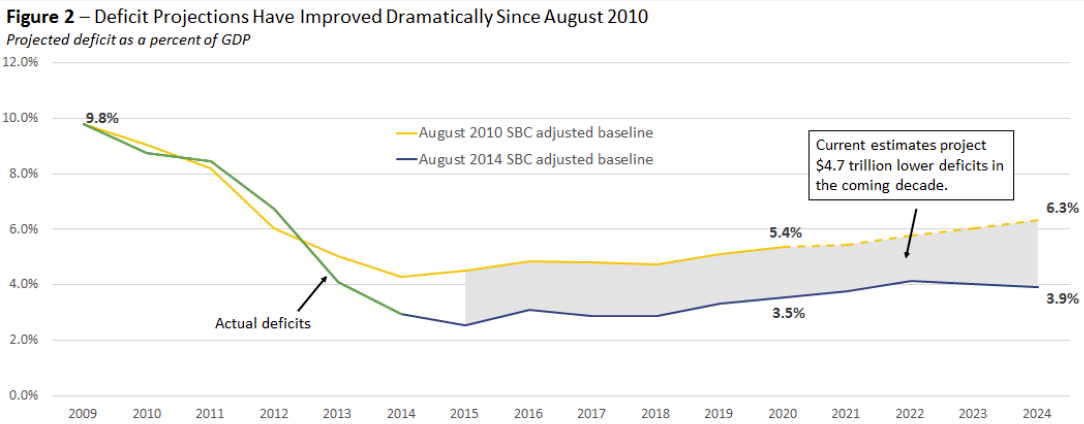
  • “Deficits have fallen dramatically over the last five years, and projected debt and deficits have also declined.”
  • “Revenue losses due to the recession and slow recovery were significant enough to counteract nearly half of the improvement in projected deficits, which highlights the need for new revenue from the wealthiest Americans and biggest corporations as part of any future deficit reduction effort.”
  • “It is clear that we need a federal budget approach more focused on jobs and growth, not on cuts for the sake of cutting. That leaves Republican leaders with a critical choice.”

In my opinion there are two basic problems with Senator Murray’s analysis:

  • Deficits have indeed fallen dramatically from their very high level in 2009, but not far enough! Deficits are projected to rise back to 3.9% in just ten years, as shown in the first chart. This means that debt will keep growing indefinitely, as shown in the second chart. This is unacceptable!
  • We do badly need to focus on jobs and growth but more deficit spending is not the way to do it. Although immigration reform and expanded trade would help, fundamental tax reform, individual and corporate, is what is really needed to grow the economy.

Hopefully a new Congress will be able to move in this direction next year!

Fix the Debt II. The National Debt and You


As I reported earlier, I am a volunteer for Fix the Debt, the outreach arm for the Washington DC think tank, Committee for a Responsible Federal Budget. I recently attended a workshop in D.C. put on by Fix the Debt and, in return, I have agreed to make presentations about our debt problem to local organizations during the coming year.  Today I gave my first such talk to a local Kiwanis Club.
CaptureThe message is that a large debt means:

  • Lower Wages and Fewer Job Opportunities. The growing debt “crowds out” productive investments in people, machinery, technology and new ventures. For example, the Congressional Budget Office estimates that the average wage in 25 years will be $7000 lower if debt is on an upward path compared to a downward path (see above chart).
  • Increased Costs of Home, Auto, Student and Credit Card Loans. Although interest rates are currently low, they will almost certainly rise as the economy recovers, and they will rise much higher if debt continues to grow.
  • Less Room for Investment in Infrastructure, Research, and the Next Generation. The CBO projects that interest costs will nearly quadruple from $220 billion in 2013 to $800 billion in 2025. By 2030, 100% of all revenue will go towards interest payments and mandatory spending.
  • A Threatened Social Security Net. Both Social Security and Medicare are on a road to insolvency. By 2033 both Medicare’s hospital insurance trust fund and the Social Security trust fund will run out of money.
  • An Increased Likelihood of a New Fiscal Crisis. If investors lose confidence in our ability to service debt, there will be tanking markets, sharply rising interest rates, mass unemployment and rapid inflation.
  • A Missed Opportunity to Grow the Economy. Debt reduction, tax reform and modest entitlement reforms have the potential to increase economic growth by 9.5% by 2035. Think of all the new jobs this would create!

Do you belong to a club or other civic organization in metro Omaha which brings in outside speakers?  If so I’d be happy to bring Fix the Debt’s message to your group.  Shoot me an email at jackheidel@yahoo.com!

The American People Are Amazingly Upbeat!


I think of myself as a political moderate, conservative on fiscal matters and somewhat liberal on social issues.  My blog posts are usually based on a recent newspaper article or think tank study presenting one side or the other of an important issue in an intelligent way.  In other words, I seldom bother to refute what I consider to be dumb ideas.  I assume that they will eventually die of their own dead weight.  My favorite approach is to respond to an attractive article with which I may have a somewhat different point of view.
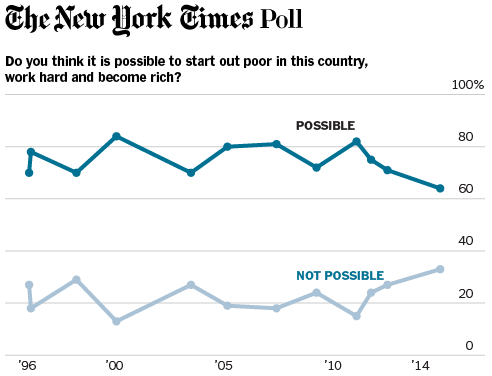
CaptureToday’s New York Times has such an article, “Many Feel American Dream is Out of Reach, Poll Shows,” pointing out that 64% of a NYT Poll respondents think that it is possible to start out poor and become rich (see above chart), which opinion has dropped from 72% in 2009.  The Poll also reports that:

  • 81% of Americans have confidence in their own local banks whereas only 41% have confidence in Wall Street bankers and brokers.
  • 52% think the economic system in the U.S. is basically fair, since all Americans have a chance to succeed, whereas 45% think it is unfair.
  • 54% of Americans think that over-regulation of the economy, which interferes with economic growth, is a bigger problem than under-regulation, which may create an unequal distribution of wealth.

For almost two-thirds of Americans to be upbeat about the American Dream, after six or seven years of recession and slow recovery is to me a very positive sign.  After a severe financial crisis, it is not at all surprising that “main street” bankers have a much higher favorability rating than “Wall Street” bankers.
Several months ago I reported on a survey taken by the progressive Global Strategy Group showing that 80% of voters consider economic growth more important than income inequality.
Both today’s NYT Poll and the previous GSG Survey are saying loud and clear that Americans put a high premium on economic growth and this is where our national leaders should be concentrating their time and energy.  The new Republican majority in Congress has an almost historic opportunity to get this right.  Let’s hope they don’t blow it!

Let’s Keep the Economic Momentum Going


There has been lots of good economic news lately:

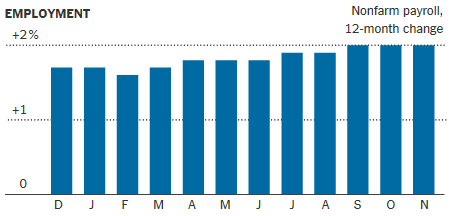
  • The economy added 321,000 jobs in November, the most in one month since January 2012.
  • The unemployment rate of 5.8% remains steady and is down from 7% in November 2013.
  • The average hourly earnings for workers is up by 2.1% from a year earlier.
  • Economic growth for the third quarter is up 3.9% from the previous quarter.
  • The deficit for the 2014-2015 fiscal year was “only” 2.8% of GDP and is predicted by the Congressional Budget Office to drop to 2.6% for the current year.
  • The price of a gallon of gasoline has dropped to $2.71 on average, its lowest level since 2010 and is still dropping.

CaptureThe New York Times predicts that the “Brighter Economy Raises Odds of Action in Congress.”  Jason Furman, Chairman of the White House Council of Economic Advisors, is quoted as saying that “At least there will be less of a philosophical debate on infrastructure, tax reforms and expanding exports.  You can have that agenda because the economy is not in free fall.” These three items would make a great agenda for the 114th Congress in the following way:

  • Infrastructure. The continuing drop in the price of gasoline offers the opportunity to replenish the inadequately funded Highway Trust Fund in a fiscally responsible manner. Congress should raise the federal gasoline tax above its current 18 cents per gallon to a level which is sufficient to fund the entire federal share of highway construction and repair.
  • Tax reform. Individual and corporate tax reform will give the economy a huge boost. The idea here is to lower tax rates in a revenue neutral way by closing loopholes and deductions.
  • Expanding Exports. What’s needed here is to give the President fast track negotiating authority so that Congress has to vote any trade agreement up or down without modification. This is the only way to get other countries to make concessions.


Of course there are many other issues which need to be seriously addressed by the new Congress.  But relatively quick action on just these three less controversial items would be a great start!

Inequality Does Not Reduce Prosperity


In the national elections this year four states: Alaska, Arkansas, Nebraska and South Dakota raised their state minimum wage rates above the national rate of $7.25 per hour and, at the same time, elected Republicans to the U.S. Senate, in three cases replacing Democratic incumbents.  Does this represent contradictory behavior by the voters?
CaptureThe American Enterprise Institute’s James Pethokoukis recently reported (see above) that the U.S. has the third highest rate of billionaire entrepreneurs behind only Hong Kong and Israel, as well as by far the most billionaires over all.  These are the high-impact innovators like Bill Gates, Steve Jobs and Mark Zuckerberg and the Google Guys.
These observations are put in context by the Manhattan Institute’s Scott Winship who recently reported that “Inequality Does Not Reduce Prosperity.” Here is a summary of his findings:

  • Across the developed world, countries with more inequality tend to have higher living standards.
  • Larger increases in inequality correspond with sharper rises in living standards for the middle class and poor alike.
  • In developed nations, greater inequality tends to accompany stronger economic growth.
  • American income inequality below the top 1 percent is of the same magnitude as that of our rich-country peers in continental Europe and the Anglosphere.
  • In the English-speaking world, income concentration at the top is higher than in most of continental Europe; in the U.S., income concentration is higher than in the rest of the Anglosphere.
  • With the exception of a few small countries with special situations, America’s middle class enjoys living standards as high as, or higher than, any other nation.
  • America’s poor have higher living standards than their counterparts across much of Europe and the Anglosphere.

Conclusion: Americans are fair-minded and would like to help the working poor do better.   But Americans also appreciate the value of innovation and entrepreneurship.  When there is a tradeoff between increasing prosperity and reducing inequality, greater prosperity comes first.

Fix the Debt


Recently I have had several posts about our national debt, for example, “Why the National Debt Is Such a Threat to the U.S.,” showing graphically that our current public debt at 74% of GDP is very high by historical standards and rising rapidly under current fiscal policies.
CaptureYesterday I attended a workshop in Washington D.C. put on by Fix the Debt.  All expenses were paid and, in return, the attendees agree to make at least three presentations to local community groups during the following year.  This means that I will soon be sending out a letter to such groups as Kiwanis and Rotary Clubs around the Omaha area where I live, offering my services as a speaker at one of their meetings.  The purpose is to build more public awareness of the threat of a huge and growing national debt to the long-term welfare of our country. Here is a summary of talking points from the workshop:

  • The deficit for the 2013-2014 fiscal year is almost $500 billion.
  • Under current fiscal policies the debt will increase to 270% of GDP by 2080.
  • Reasons for our debt problem:
  1. An aging population which means expanded Social Security spending
  2. Healthcare costs are growing for both Medicare and Medicaid
  3. Interest costs will grow rapidly as the economy recovers and interest rates rise
  • All bipartisan reform plans call for both spending cuts and revenue increases.
  • The benefits of taking action are:
  1. Increased budget flexibility
  2. Lower exposure to changes in interest rates
  3. Reduced risk of another financial crisis
  • The longer we wait:
  1. The older our population gets
  2. The higher the debt will rise
  3. The less time we have to phase in changes
  4. The slower our economy will grow
  5. The fewer tools we will have to fix it
  • How do we bring debt under control?
  1. Enact policies that grow the economy
  2. Health care cost containment
  3. Spending cuts
  4. Tax reform and tax expenditure cuts

Let me know if you’d like a speaker on this topic at your club!

Is It Feasible to Cut Tax Preferences to Pay for Lower Tax Rates?


I have been focusing lately on America’s two biggest fiscal and economic problems:

  • How to boost the economy in order to put more people back to work
  • How to either cut spending or raise revenue in order to shrink the deficit.

A few days ago in “The Great Wage Slowdown and How to Fix It,” I laid out a fairly specific proposal to make a substantial reduction in tax preferences in order to cut tax rates across the board and especially for the 64% of taxpayers who do not itemize deductions.  These are the middle- and lower-income workers with stagnant incomes who would likely spend any tax savings they received thereby giving the economy a big boost. Let’s examine whether or not this is a realistic course of action.
CaptureThe above chart from the Congressional Budget Office document, “The Distribution of Major Tax Expenditures in the Individual Income Tax System,” shows that, for example, the upper 10% of households by income receive about 40% of the total $1 trillion in individual tax expenditures per year.  Furthermore, this same top 10% of tax payers have an income of about $140,000 or more (Congressional Research Service). My basic idea is to shrink tax preferences by $250 billion per year and to lower tax rates for middle- and lower-income non-itemizers by this same amount.  If we assume that they would spend 2/3 of this new income, it would boost the economy by $170 billion per year which is 1% of GDP.
A reasonable way to achieve this savings is to expect higher income earners to contribute a greater percentage of their tax preference savings.  For example:

  • top 1% contribute $110 billion (2/3 of their total deductions).
  • top 96th % to 99th % contribute $50 billion (1/2 of their total deductions).
  • top 91st % to 95th % contribute $30 billion (1/3 of their total deductions).
  • top 81st % to 90th % contribute $30 billion (1/4 of their total deductions).
  • top 61st % to 80th % contribute $30 billion (1/5 of their total deductions).
  • this gives a total of $250 billion in tax preference savings.

This back-of-the-envelope calculation is not intended to be definitive but rather to suggest what can be done along these lines.  Those who are more well-off need to make bigger sacrifices in getting our economy back on track.

The Great Wage Slowdown and How to Fix It

With a new Congress just elected, this is a good time to reflect about what changes should be made in public policy. Our biggest economic problem is to speed up growth in order to provide more and better paying jobs.  In addition, a faster growing economy would bring in more tax revenue which would help pay our bills and reduce the deficit.
CaptureA column in today’s New York Times, “The Great Wage Slowdown, Looming over Politics,” by David Leonhardt, proposes a cut in the marginal tax rate for the middle class as a way of boosting their incomes.  As can be seen in the above chart, median household income has been flat since the year 2000, and even lower since the 2008 recession.  Mr. Leonhardt goes on to say that any tax cut for the middle class should be balanced by a tax increase for the wealthy.
It so happens that I proposed such a plan several months ago as a way of boosting the economy and reducing inequality at the same time. The idea is to enact broad-based tax reform whereby tax rates are lowered for all, offset by shrinking tax deductions.  The 64% of taxpayers who do not itemize deductions will receive a big tax cut.  But these are the very middle-class wage earners with stagnant incomes.  So they will likely spend their tax savings, thereby giving the economy a big boost.
More specifically:

  • Individual tax deductions total about $1 trillion per year.
  • Let’s suppose that these deductions are cut in half to $500 billion per year.
  • Let’s further suppose that half of this amount, or $250 billion per year, is cut from the taxes of the 64% who do not itemize deductions.
  • If these 64% spend just 2/3 of their new income (instead of saving it or paying off debt), this will total $170 billion which is 1% of GDP.
  • This would increase the rate of growth of GDP from the 2.2% average, since the end of the Great Recession, to 3.2%. This represents an enormous boost to the economy and would return average GDP growth to about its 3.3% average since 1947.

    Mr. Leonhardt suggests that presidential contenders in 2016 would greatly benefit from proposing a tax rate cut for the middle class. Here’s a specific plan they can use!