How to Shrink the Deficit: Control Entitlement Spending by Fixing Obamacare


Our country faces two major fiscal and economic problems:

  • How to boost the economy in order to put more people back to work.
  • How to either increase tax revenue or better control spending in order to shrink the deficit.

My last post, “The Great Wage Slowdown and How to Fix It” makes a specific tax reform proposal to cut tax rates for all by shrinking tax deductions for the wealthy.  This would put tax savings in the hands of millions of wage earners with stagnant incomes, who would likely spend it, thereby boosting the economy.
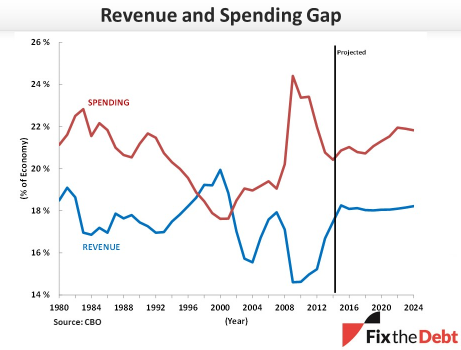
CaptureAs the above chart clearly shows, there is only one realistic way to shrink the deficit.  We have to do a better job of controlling entitlement spending (Social Security, Medicare and Medicaid.)  As a practical matter, this means we have to cut back the cost of American healthcare in general, both public and private.
The Manhattan Institute’s Avik Roy has come up with an attractive Plan for doing just this, “Transcending Obamacare.” Mr. Roy’s proposal is to:

  • Repeal the individual mandate. Insurers are encouraged to design policies of high quality tailored to individual need. By lowering the cost of insurance for younger and healthier individuals, the Plan will expand coverage without a mandate.
  • Repeal the employer mandate, thereby offering employers a wider range of options for subsidizing employees insurance.
  • Keep the exchanges to provide broad access as well as subsidies for those with low incomes.
  • Migrate the Medicaid population onto the exchanges.
  • Raise the Medicare eligibility age by 4 months per year indefinitely. Over time this will maintain future retirees on exchange-based or employer sponsored health plans.

By gradually moving the Medicaid and Medicare recipients onto the exchanges, both of these very large populations will receive equal quality coverage to everyone else, delivered in a cost effective manner.  Mr. Roy estimates that the Plan will expand coverage by 12 million above Obamacare levels by 2025 and reduce the deficit by $8 trillion over 30 years.
This is the sort of major healthcare reform which we need to get entitlement spending under control!

The Great Wage Slowdown and How to Fix It

With a new Congress just elected, this is a good time to reflect about what changes should be made in public policy. Our biggest economic problem is to speed up growth in order to provide more and better paying jobs.  In addition, a faster growing economy would bring in more tax revenue which would help pay our bills and reduce the deficit.
CaptureA column in today’s New York Times, “The Great Wage Slowdown, Looming over Politics,” by David Leonhardt, proposes a cut in the marginal tax rate for the middle class as a way of boosting their incomes.  As can be seen in the above chart, median household income has been flat since the year 2000, and even lower since the 2008 recession.  Mr. Leonhardt goes on to say that any tax cut for the middle class should be balanced by a tax increase for the wealthy.
It so happens that I proposed such a plan several months ago as a way of boosting the economy and reducing inequality at the same time. The idea is to enact broad-based tax reform whereby tax rates are lowered for all, offset by shrinking tax deductions.  The 64% of taxpayers who do not itemize deductions will receive a big tax cut.  But these are the very middle-class wage earners with stagnant incomes.  So they will likely spend their tax savings, thereby giving the economy a big boost.
More specifically:

  • Individual tax deductions total about $1 trillion per year.
  • Let’s suppose that these deductions are cut in half to $500 billion per year.
  • Let’s further suppose that half of this amount, or $250 billion per year, is cut from the taxes of the 64% who do not itemize deductions.
  • If these 64% spend just 2/3 of their new income (instead of saving it or paying off debt), this will total $170 billion which is 1% of GDP.
  • This would increase the rate of growth of GDP from the 2.2% average, since the end of the Great Recession, to 3.2%. This represents an enormous boost to the economy and would return average GDP growth to about its 3.3% average since 1947.

    Mr. Leonhardt suggests that presidential contenders in 2016 would greatly benefit from proposing a tax rate cut for the middle class. Here’s a specific plan they can use!

Which Nebraska Senate Candidate Is Most Serious about the National Debt?


“The single biggest threat to our national security is our debt”
Admiral Mike Mullen, former Chairman of the Joint Chiefs of Staff

My last blog, “Why the National Debt Is Such a Threat to the U.S.” observes that our debt is very large by historical standards and will just keep getting worse under current policies now in effect.  This has many severe consequences for the well-being of our country.
What do we do about it?  We have to shrink the size of our annual deficits which are continuing to make the debt bigger and bigger.  The deficit for the 2014-2015 budget year just ended is $483 billion which is 2.8% of GDP.  Since our economy has been growing at a rate of only 2.2% for the past five years, this means that the debt is still growing faster than the economy.  We have to do better than this.
CaptureThe above chart from the Congressional Budget Office shows that the main contributors to the deficit, and therefore also the debt, over the next 20 years, will be entitlements (Social Security, Medicare and Medicaid) and interest payments on the debt.  All other programs, i.e. almost all of traditional federal spending, will decrease as a percentage of GDP.
This means that there are just two basic ways to solve our debt problem: trim entitlement spending and/or increase government revenue.  We’ll need to do both.  Furthermore, it is unrealistic to expect middle-income and lower-income people to pay higher taxes when their wages have been stagnant for many years.  New tax revenue will have to come from the wealthy including upper-income wage earners.  The best way to do this is by cutting back on the annual $1.2 trillion in loopholes and deductions built into the tax code.
CaptureOnly one Senate candidate from Nebraska is willing to both trim entitlement spending and raise additional tax revenue: Jim Jenkins, a registered independent from Calloway.  The Democratic candidate, David Domina, will not support any significant reining in of entitlement spending.  The Republican candidate, Ben Sasse, is too beholden to wealthy contributors to be willing to raise their taxes by cutting back on their tax deductions.
We badly need elected representatives in Washington who will make it their top priority to “fix the debt.”  Jim Jenkins is such a person.  I hope you will vote for him!

Why the National Debt Is Such a Threat to the U.S.


In my last post I discussed several commonly held myths about the national debt, along the line that it is a fairly minor problem that can easily be solved sometime in the future if we decide that it is important enough to do so.
CaptureThe above chart shows that the debt is already very large by historical standards and that it is projected (by the Congressional Budget Office) to just keep getting worse if we continue on our current path of excessive borrowing to pay our bills.
The national organization, “Fix the Debt” lays out very clearly the reasons why our ever-growing debt level is so harmful:

  • It causes lower wages and fewer job opportunities. The debt will “crowd out” productive investments in people, technology and new ventures. The CBO estimates that wages will grow more slowly if debt is on an upward path compared to a downward path. This will amount to an average $7000 wage cut 25 years from now in the year 2040.
  • It leaves less room for investment in infrastructure, research and the next generation. A growing debt means higher interest payments. The CBO projects that interest payments could nearly quadruple from $220 billion in 2013 to about $800 billion in 2024. That leaves far less for investments in education, infrastructure, research, etc.
  • It increases the likelihood of a fiscal crisis. Failure to get the national debt under control could precipitate a crisis where investors are no longer willing to loan money to the government at affordable rates. This could mean large investment losses, tanking markets, mass unemployment, rapid inflation, etc.
  • It means a missed opportunity to grow the economy. Deficit reduction legislation presents an opportunity to enact pro-growth tax reform, improve programs to reward work, re-orient spending to important investments, and capture the economic benefits of putting the debt on a sustainable path.


Let’s hope and pray that our national leaders appreciate the urgent nature of the debt problem and have the political courage to do something serious about it!  

Straight Talk about the National Debt


The deficit for fiscal year 2014-2015 just ended is “only” $483 billion, about 2.7% of current GDP, and some observers are saying this means that our deficit and debt problems are now under control and we should stop fretting so much about them.
CaptureThere is a nonpartisan outfit in Washington DC, “Fix the Debt,” which focuses on this very problem and they’re saying not so fast.  In their document, “Common Myths about the Debt,” they debunk several false impressions about the national debt:

  • Myth: Deficit levels are falling and therefore debt is no longer a concern.
  • Fact: Over the next decade our debt is on track to grow about $8 trillion (see above chart). Its growth will accelerate after 2018 and will exceed the size of the entire economy by 2035.
  • Myth: Deficit reduction is just code for austerity which will ultimately hurt the economy.
    Fact: A comprehensive and gradual deficit reduction plan can replace austerity with targeted and pro-growth reforms which promote economic recovery and accelerate long-term wage growth.
  • Myth: Deficit reduction will harm low-income and vulnerable populations.
  • Fact: Every recent bipartisan deficit reduction plan has included progressive reforms that ask more from those who can afford it and protect low-income programs.
  • Myth: The debt can be solved with faster economic growth.
  • Fact: Economic growth must be part of the solution, but it can’t solve the debt problem alone. Productivity growth would have to be 50% higher over the next quarter century just to hold debt to its current record-high levels.
  • Myth: Taxing the wealthy more will solve the debt problem.
  • Fact: Our debt problems are too large, and the top 1% too few, to solve the entire problem by raising taxes on the wealthy.

Conclusion: Our debt problem is so large that it can only be solved by stern measures, such as tax reform, including reducing tax breaks, and also spending reform to slow the growth of entitlement programs. Stay tuned for further discussion of this critical problem!

Why I Support Jim Jenkins for the U.S. Senate from Nebraska


I have been writing this blog for almost two years because of my great concern about the direction our country is headed on fundamental fiscal and economic issues. Federal spending has been out of control for over thirty years and the situation is getting progressively worse.  Our national debt is over $17 trillion and growing at a rate of $500 billion per year.  And it will soon be growing much faster than this if we don’t make big changes.  Economic growth has been stuck at the anemic rate of 2.2% of GDP ever since the end of the Great Recession over five years ago.
Our national leaders are simply not doing the job they were elected for.  Democrats blame the Republicans and Republicans blame the Democrats but excuses are not good enough.  We need people in Washington who can figure out how to navigate within the system and actually find solutions to our very serious problems.
CaptureI believe that Jim Jenkins, a registered independent from Callaway, is the best qualified candidate to do what needs to be done.  Check out his website, Jenkins for Senate, and decide for yourself.  Here are a few of his views on important issues:

  • Fixing the Debt. Jim supports the recommendations of the Simpson-Bowles Commission which calls for dramatically cutting federal spending especially for entitlements and also raising taxes if necessary in order to drastically shrink our annual deficits.
  • Tax Reform. Jim supports lower tax rates achieved by eliminating many of the tax expenditures (credits, deductions and exclusions) embedded in the code. This is what is needed to boost economic growth.
  • Affordable Care Act. Jim believes that the ACA has many rough edges but that it is possible to fix them rather than repealing it and starting over.
  • Immigration Reform. Jim supports comprehensive immigration reform which includes securing our borders but at the same time expanding the number of guest worker visas to meet the needs of business and agriculture.
  • Veterans Administration. Jim supports setting up a plan to enable veterans to obtain medical care from health professionals within their own communities.

Compare these common sense views with the far more ideological positions of the other candidates in this race. I think that you will agree with me that Jim Jenkins is the person we want representing us in Washington!

The Big Picture on Debt Part III. The Oracle of Omaha Speaks


“I could end the deficit in 5 minutes.  You just pass a law that says anytime there is a deficit of more than 3% of GDP, all sitting members of Congress are ineligible for re-election.”                                                                                                                                                                       Warren Buffett, 1930 –

Mr. Buffett made this quip in a recent interview with CNBC.  Since the economy has historically grown at a rate of about 3%, Mr. Buffett is saying that we’ll be alright as long as economic growth exceeds deficit spending.  This is generally correct but, as Mr. Buffett well knows, the situation is more complicated than this.
CaptureA very good, and nontechnical, discussion of this whole subject can be found in the newly published book, “The Death of Money: the coming collapse of the international monetary system” by the financier James Rickards.  Look at Chapter 7, “Debt, Deficits and the Dollar.”
Simplifying Mr. Rickards’ approach a little bit, and keeping it in Mr. Buffett’s framework, for a stable economy we need to have
G > D
where the nominal growth G = real GDP + I (I is the rate of inflation) and the deficit D = S – T  (S is spending and T is tax revenue).  I have included interest paid on the debt as part of total spending.  As long as the left hand side is greater than the right hand side, the economy is growing faster than the deficit and the accumulated debt will shrink as a percentage of GDP. Notice that the rate of inflation affects the left hand side of the inequality while the interest rate is part of the right hand side.
Negative inflation is deflation which is clearly undesirable.  The Federal Reserve’s current target for inflation is 2%.  The challenge for the Fed is 1) to keep inflation high enough and interest rates low enough so that G > D, while at the same time, 2) to make sure that inflation does not grow so high as to destabilize the markets.
Given our underperforming economy with low real GDP growth, and huge deficits, Mr. Rickards is pessimistic that the Fed can continue successfully “in the position of a tightrope walker with no net … exuding confidence while having no idea whether its policies will work or when they might end.”
Thus the gloomy title for his book.

The Big Picture on Debt II. Why It Is So Alarming


My last post, “The Big Picture on Debt,” used a chart from a recent Congressional Budget Office report (pictured  below) to look at the history of U.S. debt.  It is worse now than at any other time except at the end of World War II.  But after 1945 massive military spending ended rapidly, the economy started growing briskly and debt as a percentage of GDP shrunk rapidly.
CaptureThe light purple section at the right hand side of the chart portrays CBO’s debt projection for the next 25 years.  As the report itself makes clear, CBO is using favorable economic assumptions in this projection.  Without these favorable assumptions, our future debt will be much worse than this.  And the same trends continue indefinitely into the future beyond the 25 year window.
Right now our huge debt is almost “free” money because interest rates are so low.  But this situation cannot last much longer without setting off an inflationary spiral.  As interest rates eventually resume their historical average of about 5%, interest payments on our accumulated debt will skyrocket and therefore increase the size of the annual deficits.
There are only three ways to shrink debt as a percentage of GDP: 1) cut spending, 2) achieve faster growth and 3) raise tax revenue.  Let’s look at each in turn:

  • Government spending as a percentage of GDP is not shrinking but actually growing. Primarily this is because of the massive growth of the big three entitlement programs: Social Security, Medicare and Medicaid. All other government spending is subject to Sequester limits. This is a crude and insufficient way to control discretionary spending.
  • GDP growth, averaging 2.2% annually since the end of the Great Recession five years ago, is much slower than the overall average growth of 3.3% since the end of WW II. Major tax reform at both the individual and corporate levels, with lower tax rates offset by closing loopholes and shrinking deductions, would give a big boost to economic growth. But there is resistance to cutting tax deductions.
  • Raising taxes will in principle decrease deficit spending but the trick is to do it without hurting economic growth. Both individual and corporate tax reform could accomplish this if done in the right way. See here and here for specific proposals.

Conclusion:  there are concrete ways to find solutions to get our massive accumulation of debt under control and shrinking as a percentage of GDP.  But the prospects for action are gloomy.

The Big Picture on Debt


Most observers agree that the Congressional Budget Office is a reliable source for detailed, objective and nonpartisan information about the federal budget.  Its frequent reports are cited by all sides in budget debates.  Today I refer to the recent CBO publication, “The 2014 Long-Term Budget Outlook in 26 Slides.”  In particular, one of its graphs entitled “Federal Debt Held by the Public” (pictured here) has a striking message.
CaptureThroughout history, the U.S. has had relatively large debt following each of its major wars, especially after World War II.  But the debt has always declined relatively quickly, as a percentage of GDP, as the economy recovered and grew briskly. But now, in 2014, we are stuck with a huge debt which is projected (by CBO) to not shrink but rather to keep getting much worse.  And furthermore, the so-called “Extended Baseline Projection” in the graph, is an optimistic projection which disregards several long-term trends such as mortality decline, possibly slower productivity growth, higher interest payments and likely growth of federal healthcare spending.
How in the world will this huge debt problem be resolved in a favorable manner?  Republicans don’t want to raise taxes and Democrats don’t want to cut spending, especially on entitlements.  The only action taken in the last few years, under threat of not lifting the federal debt limit, was to implement a Sequester on discretionary spending.  This helps but not nearly enough.
Recent budget agreements are not auspicious for future progress.  A five year farm bill was passed last spring without significant cuts to either farm subsidies or food stamps.  Highway spending was extended for a few months with a gimmick when what we really need to do is increase the federal gasoline tax.  A $17 billion (over three years) increase for veteran’s health has just been approved when what we really need is an extensive overhaul of the Veterans Administration.
There are deficit hawks in Congress, on both sides of the aisle, but their numbers are too small to be effective.  It is just very hard to vote no on spending measures when the pressure coming from special interest groups on all sides is to vote yes.
I am an eternal optimist by nature but I have a hard time visualizing a favorable outcome to our fiscal dilemma.  I am arranging my own affairs accordingly.

Bush Was a Disaster; Obama Is Merely Ineffective


As Barack Obama nears the three-quarter’s mark of his presidency, it is natural that he and George W. Bush will be compared to one another.  I consider them both to be disappointing presidents but in very different ways.
CaptureFirst, the sins of George Bush:

  • The Bush Tax Cuts of 2001-2003 lowered tax rates without being offset by closing loopholes and/or shrinking tax deductions. This made his huge budget deficits much worse than they otherwise would have been and without helping the economy.
  • The Iraq War. Regardless of whether or not the U.S. was justified in invading in 2003, the current ISIS uprising of Sunnis is likely to result in a worse outcome than existed before the U.S. invasion. This will come to mean that Iraq was a mistake.
  • Medicare Part D (2003). The Prescription Drug program now costs the federal government about $100 billion per year. It makes the unsustainable cost of Medicare that much worse.
  • The Financial Crisis of 2008. This represents an even bigger stain on his record. He appointed all of the key players such as Ben Bernanke, Tim Geithner and Henry Paulson who failed to see it coming. He also appointed Sheila Bair as head of the FDIC in 2006. She did see it coming but it was too late and she didn’t have enough clout.

Mr. Obama is very bright and articulate.  But he has made many serious mistakes including:

  • His total immediate attention in 2009 should have been on reviving the economy. Instead he and the filibuster-proof Democratic Congress pushed through the Patient Protection and Affordable Care Act. The employer mandate of Obamacare, even though postponed by the administration, has slowed down the economic recovery by making it more expensive for businesses to hire full time employees.
  • For all of his nonpartisan campaign rhetoric about “change we can believe in,” he has been one of the most divisive and partisan presidents in many years. This has created huge animosity and distrust amongst his political opponents which makes it difficult for the two sides to negotiate differences in good faith.
  • The most glaring example of this is the anemic 2.2% annual growth of the economy since the Great Recession ended in June 2009. Many economists agree that cutting both individual and corporate tax rates, offset by closing loopholes and deductions, would be hugely beneficial in boosting the economy. It would put millions of people back to work and shrink our huge deficits. Why isn’t the President talking about this and leading the charge?   But, of course, this was the Romney tax plan in 2012. What’s wrong with the election winner adopting the best parts of the program of the election loser?  Now that would be demonstrating real leadership ability!